

For nearly a century, physicists have struggled to understand how mass, gravity, and the forces of nature emerge from the fabric of space itself. Why are protons—building blocks of all matter—so stable? And why do the laws of the very large (Einstein’s relativity) and the very small (quantum mechanics) resist unification?
Haramein, N.; Alirol, O.; Guermonprez, C. Extending Einstein-Rosen’s Geometric Vision : Vacuum Fluctuations-Induced Curvature as the Source of Mass, Gravity and Nuclear Confinement. Preprints 2025, 2025091835. https://www.preprints.org/manuscript/202509.1835
In 1935, Einstein and Rosen attempted to unify relativity and quantum physics by proposing that particles might not be point-like objects at all, but structures built straight out of spacetime itself—tiny bridges now known as Einstein–Rosen wormholes. Their approach was abandoned because the predicted scales seemed impossibly small.
In this paper, we revisit and extend that attempt, showing how quantum vacuum fluctuations—tiny, energetic ripples in empty space—supply the missing ingredient. These fluctuations can curve spacetime to create mass, gravity, and even the forces that hold atomic nuclei together. By treating particles as dynamic spacetime structures, this framework bridges relativity and quantum mechanics, offering a unified explanation for phenomena like the proton’s mass and the strong nuclear force.
This work resolves a 90-year puzzle and redefines our understanding of reality itself: mass and matter are not “given” but arise from the vibrant geometry of space fulfilling Einstein and Rosen’s vision.
The paper demonstrates that electromagnetic quantum vacuum fluctuations—which have an energy density of 10113 J/m³ at the Planck scale—curve spacetime according to Einstein’s field equations. When we calculate the correlation functions of these fluctuations over a proton’s characteristic timescale (determining how many waveforms constructively and destructively interfere inside the proton’s cavity), they create a stable geometric structure that yields exactly 938.27 MeV/c2—the proton’s measured rest mass. This shows that mass emerges directly from electromagnetic quantum vacuum fluctuations at the Planck scale. While this specific calculation appears in the first section and was present in an earlier preprint publication, this paper extends the calculation significantly.
Specifically, the paper employs the Zeldovich-Boccaletti mechanism and demonstrates how electromagnetic waves from these vacuum fluctuations pass through the strong magnetic field generated by their collective circulation, producing spacetime perturbations that partially convert into gravitational waves. This conversion process, first formalized by Boccaletti et al. in 1970 and further developed by Zel’dovich in 1972, provides the mathematical framework that correctly predicts the formation of a Kerr-Newman black hole at the proton’s center.
Crucially, the paper addresses the stability of this black hole structure through Hawking radiation analysis. By calculating the Hawking temperature at the proton’s reduced Compton wavelength and applying the Stefan-Boltzmann law over the proton’s characteristic surface area and coherence time, the magnitude of emitted energy precisely equals the proton’s rest mass of 938.27 MeV. This exact balance between the Hawking radiation and the vacuum energy correlation energy within the proton cavity demonstrates that the proton’s black hole core maintains perfect thermodynamic equilibrium, explaining the proton’s observed stability over cosmological timescales.
The paper then solves Einstein’s field equations by incorporating electromagnetic quantum vacuum fluctuations as a source term in the stress-energy tensor, which naturally yields the Klein-Gordon equation, revealing a significant correspondence between gravity and quantum field theory. Solving the Klein-Gordon equation produces a Yukawa potential within the context of the field equations metric. From this metric curvature, we calculate test particle accelerations at different length scales, ultimately deriving the complete spectrum of fundamental forces from a single gravitational framework. The result is a full description of the forces across scales in significant agreement with measured values.
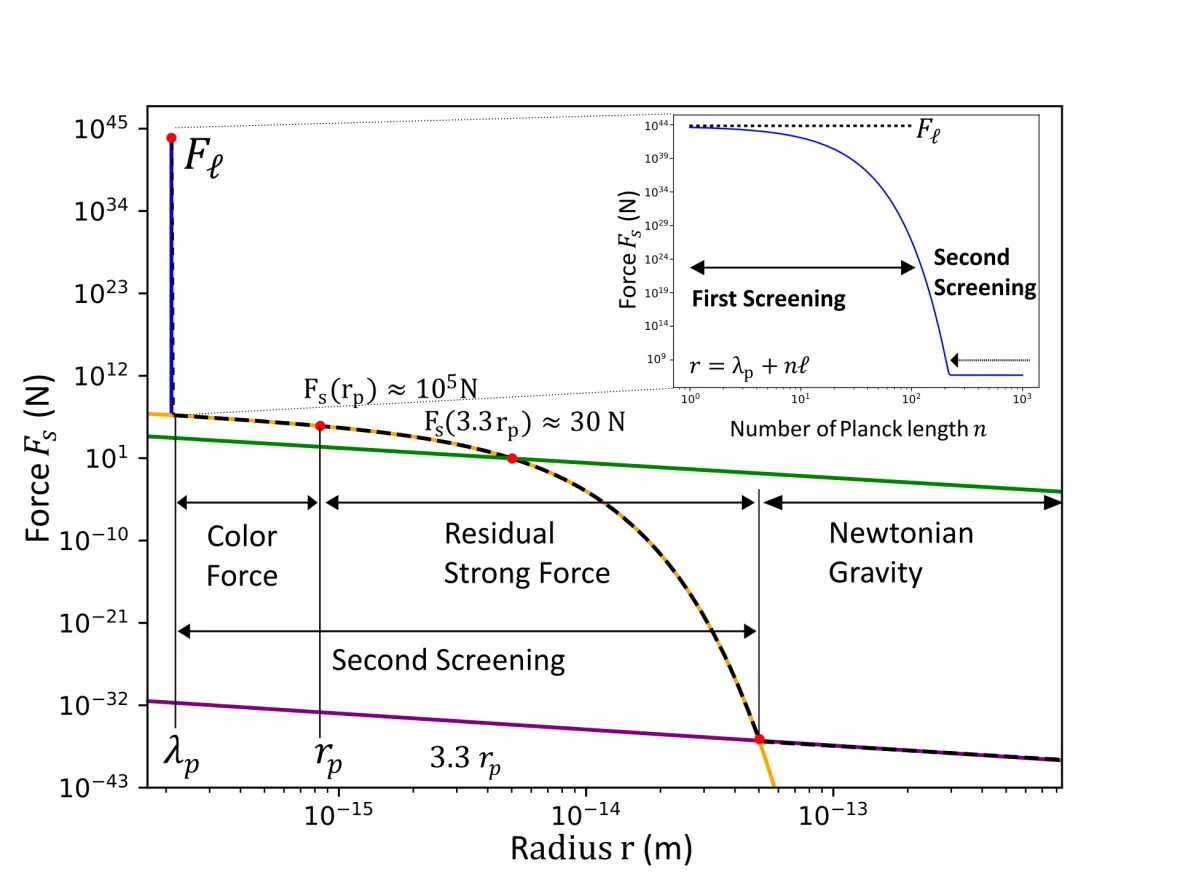
At the Planck scale, the analysis yields the Planck force (\(????_{\ell} \sim 10^{44} N\)). Through the first screening mechanism at the proton’s reduced Compton wavelength, the force reduces and recovers the color confinement force of \(1.63 × 10^5 ????\)—precisely matching recent measurements of the internal pressure force experienced by quarks within protons. This value also corresponds exactly to the string tension (\( \sigma≈ 1 GeV/fm\)) established by lattice QCD calculations for quark confinement.
Moving outward through a second screening boundary, the force transitions to the residual strong force. At the characteristic inter-nucleon separation of 3.3 proton radii, the calculated force is approximately 30 N—matching experimental measurements of nuclear binding forces in alpha clusters and explaining why protons in nuclei maintain separations of 1.9-2.4 fm.
Finally, at macroscopic distances, after multiple screening transitions reducing the vacuum energy density by a factor Equivalent to the gravitational coupling constant \(\alpha_g≈10^{39}\) , the framework recovers Newtonian gravity with its familiar 1/r² dependence.
The paper demonstrates that applying quantum electromagnetic vacuum fluctuations to the stress-energy tensor of Einstein’s field equations generates metric fluctuations that reproduce the exact mathematical forms used in nuclear physics. All force magnitudes match experimental values using only fundamental constants—no free parameters or fitting required. This unified geometric description reveals that the strong force, residual strong force, and gravity aren’t separate phenomena but different manifestations of spacetime curvature at different scales. The approach completes Einstein’s vision of particles as geometric features of spacetime itself.
This paper provides the complete mathematical details, with all results derived from fundamental constants and without free parameters. If you’d like to explore the full framework—including equations, derivations, and references—you can download the complete paper here.”
Download the paper “Extending Einstein-Rosen’s Geometric Vision : Vacuum Fluctuations-Induced Curvature as the Source of Mass, Gravity and Nuclear Confinement” here: https://www.preprints.org/manuscript/202509.1835