


A remarkable study published in February 2025 in Physical Review E [1] has demonstrated something that challenges our fundamental understanding of the boundary between classical and quantum physics. Researchers Álvaro G. López from Universidad Rey Juan Carlos and Rahil N. Valani from the University of Oxford have shown that a completely classical fluid dynamic system can exhibit quantum-like behavior with unprecedented fidelity, displaying what they term “megastable quantization” – an infinite spectrum of discrete energy states that mirrors the behavior of quantum particles.
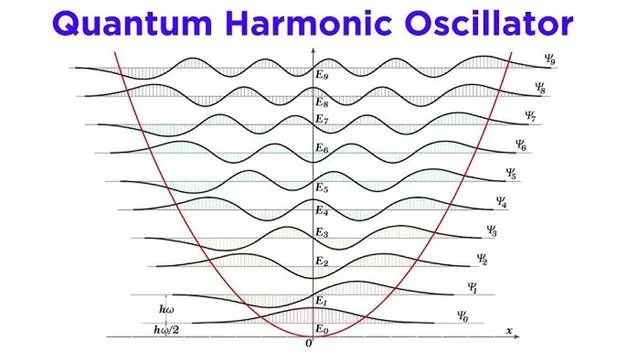
This diagram illustrates the discrete energy eigenstates of a one-dimensional quantum harmonic oscillator. The red parabolic curve represents the classical harmonic potential, while the horizontal black lines labeled E0, E1,…, E9 indicate the allowed quantized energy levels. Each wavefunction ψn(x) is shown superimposed on its corresponding energy level En, highlighting the spatial probability amplitude associated with each state. Notably, the spacing between energy levels is uniform and given by ℏω, reflecting the linear quantization rule En=ℏω(n+1/2). The lowest energy state, E0 lies at 1/2ℏω, not zero, indicating the presence of zero-point energy—a fundamental quantum property wherein the system retains nonzero energy even in its ground state due to intrinsic non-zero energy of the vacuum. This zero-point motion is absent in classical harmonic oscillators and is a hallmark of quantum mechanical systems.
This discovery represents far more than an interesting laboratory curiosity, it provides compelling experimental validation for Bohmian mechanics—one of the first interpretations of quantum mechanics—and offers striking support for physicist Nassim Haramein’s mathematically validated model that describes spacetime itself as a fluid-like medium at the Planck scale.
The Walking Droplet Revolution
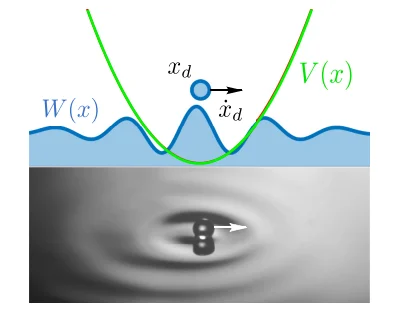
The foundation of this breakthrough lies in the fascinating world of “walking droplets” – millimeter-sized oil droplets that bounce rhythmically on a vibrating bath of the same liquid. When these droplets bounce, they create localized standing waves on the liquid surface that decay slowly over time. The droplet then interacts with these self-generated waves from its past bounces, creating a feedback loop that propels it horizontally across the surface.
What makes this system extraordinary is that it exhibits three key characteristics that mirror fundamental aspects of quantum mechanics. First, the droplet and its wave field coexist as a unified “wave-particle entity,” where neither component can exist independently – without the droplet, the waves decay completely, and without the waves, the droplet cannot sustain its walking motion. Second, the system is non-Markovian, meaning the droplet’s current behavior depends not just on its immediate state but on its entire history of wave generation, creating a form of “path memory” that sculpts its complex dynamical landscape. Third, the system is active in the sense of active matter physics, with the droplet locally extracting energy from the vibrating bath and converting it into horizontal motion.
The significance of these three characteristics extends far beyond their immediate physical manifestations. First, the demonstrable wave-particle entity fundamentally resolves the wave-particle paradox that has puzzled quantum physicists for over a century. By showing how a single system can exhibit both wave and particle properties simultaneously—rather than mysteriously switching between them—the walking droplet system explains why we sometimes observe wavelike behavior and sometimes particle-like behavior in quantum systems. The droplet is always a particle, but its behavior is continuously guided by its wave field, eliminating the need for paradoxical dual nature explanations.
Second, the “path memory” exhibited by the walking droplet system provides a direct analog for what Haramein predicted as “space memory”—the idea that spacetime itself retains information about past events and interactions. This memory effect links directly to the pilot wave concept, demonstrating how present behavior can be influenced by the accumulated history of interactions encoded in the underlying medium. In Haramein’s model, this space memory emerges from the persistent oscillations of Planck-scale entities that maintain coherent information about past states.
Third, the active matter physics aspect reveals something crucial about the nature of reality: there must be a source of energy driving these phenomena. While conventional quantum mechanics typically zeros out this source energy through mathematical renormalization, zero-point energy is always present in the system. If this background energy were truly removed, atoms as oscillators would dampen and collapse, unable to maintain their stable configurations. As detailed in Haramein et alia‘s publication “The Origin of Mass and the Nature of Gravity,” this zero-point energy is not merely a mathematical abstraction but the fundamental driver of mass, force, and the structure of matter itself.
Previous experiments with walking droplets confined in harmonic potentials – smooth, bowl-shaped energy landscapes – had already demonstrated quantum-like quantization, with droplets settling into discrete, stable orbits such as circles, ovals, and more complex patterns like lemniscates and trefoils. However, these earlier studies typically observed only a few coexisting quantized states, falling short of the infinite spectrum characteristic of quantum harmonic oscillators.
The Megastability Breakthrough
The new research by López and Valani represents a quantum leap forward in this field. By developing a sophisticated “truncated-memory stroboscopic pilot-wave model” of the walking droplet system, they discovered conditions under which the classical system exhibits “megastability” – a countably infinite set of nested, stable limit-cycle orbits that correspond to discrete energy levels.
The key innovation lies in their treatment of the droplet’s wave memory. Rather than considering the infinite memory of all past wave interactions, as in standard models, they introduced a “cut-off memory time” that limits the droplet’s interaction with its self-generated waves to a finite window of its recent past. When this memory window is set to the duration of a single droplet bounce, and when the system operates in a regime of very low energy dissipation, something remarkable emerges: the classical harmonic oscillator becomes perturbed by oscillatory nonconservative forces that give rise to an infinite spectrum of coexisting stable states.
Using sophisticated mathematical analysis techniques, the researchers were able to precisely describe this infinite spectrum of stable orbits. They discovered that each orbit has a predictable size and energy level, following patterns that are remarkably similar to what we observe in quantum systems. Just like the energy levels in atoms, these droplet orbits have discrete, evenly-spaced energy values, including a minimum “ground state” energy that the system never goes below—exactly matching the behavior of quantum harmonic oscillators.
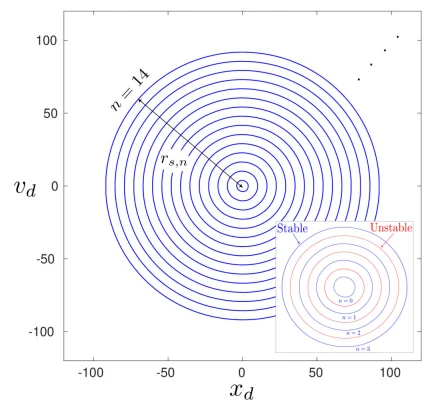
Perhaps most significantly, the researchers demonstrated that these quantized states exhibit average energy conservation, despite the presence of nonconservative forces. This apparent paradox is resolved by recognizing that the system operates as a thermodynamic engine, gaining and losing mechanical energy during different parts of each orbital cycle while maintaining overall energy balance. This behavior emerges naturally from the time-reversal asymmetry inherent in self-excited oscillator systems.
Implications for Bohmian Mechanics
The implications of this research for our understanding of quantum mechanics are profound, particularly for the interpretation known as Bohmian mechanics or pilot-wave theory. Originally developed by Louis de Broglie and later refined by David Bohm, this interpretation proposes that quantum particles have definite positions and velocities at all times, but are guided by a “pilot wave” that determines their trajectories according to the quantum wave function.
The walking droplet system provides a macroscopic, directly observable realization of precisely this concept. The droplet represents a classical particle with definite position and momentum, while the wave field it generates and interacts with serves as its pilot wave. The quantized orbits that emerge from this interaction demonstrate how wave guidance can naturally lead to discrete energy states without invoking the probabilistic interpretation of standard quantum mechanics.
What makes the López-Valani results particularly compelling is that they show how an infinite spectrum of quantized states can emerge from purely classical dynamics. Previous mathematical models that exhibited similar infinite orbit structures were dismissed as “mathematical curiosities” with no physical foundation. This research demonstrates that such behavior arises naturally from the fundamental physics of wave-particle interactions in a memory-retaining medium.
The researchers explicitly connect their work to recent developments linking self-excited oscillators to the quantum potential – a key concept in Bohmian mechanics that describes how the pilot wave influences particle motion. By defining their energy spectrum using the Lyapunov function associated with their oscillator equation, they establish a direct mathematical bridge between classical dissipative structures and quantum mechanical energy eigenstates.
Support for Planck-Scale Fluid Models
Beyond its implications for quantum mechanical interpretation, this research provides remarkable support for unified physics solutions that describe spacetime itself as a fluid-like medium at the Planck scale. As metntioned, Haramein’s quantum spacetime model describes the vacuum as a “Planck plasma fluid flow,” which finds striking validation in these results.
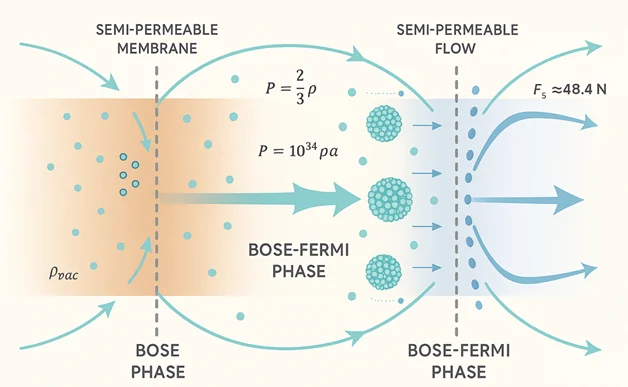
This visual depicts a quantum hydrodynamic model of the proton, in which mass and the fundamental forces arise from structured flows of energy at the Planck scale. At the core, individual Planck Spherical Units (PSUs) circulate under extreme internal pressure, forming the Bose phase — a region governed by the unified Planck force. As this high-density Planck plasma flows outward, it passes through a semi-permeable membrane into the Bose-Fermi phase, where PSUs begin to self-organize into coherent 64-unit assemblies. A secondary pressure gradient enables these larger clusters to pass through another membrane, preserving their structure while radiating outward. This model proposes that the pressure differentials within these quantum vacuum flows not only stabilize mass but also give rise to the color confinement force, residual strong force, and Newtonian gravity (Fs ~48.4N) as emergent effects of the same underlying dynamic — reframing gravity and matter formation as manifestations of deeper quantum fluid behavior in the fabric of spacetime and the quantum electromagnetic vacuum.
Haramein’s solutions in unifying physics have a foundation in a stunningly brilliant proposition: that mass and force emerge from the dynamics of a fluid-like medium composed of Planck-scale oscillators. In this framework, what we perceive as particles are actually stable excitations or “solitons” in this underlying fluid, guided by the wave dynamics of the medium itself. The walking droplet system provides a macroscopic analog of exactly this scenario – stable particle-like entities (the droplets) emerging from and being guided by the wave dynamics of an underlying fluid medium.
The megastable quantization observed by López and Valani demonstrates how discrete energy states can emerge naturally from fluid dynamics when the system exhibits appropriate memory effects and operates in low-dissipation regimes. This mirrors Haramein’s proposal that Planck-scale oscillations coalesce in a Planck Plasma Flow that underlies a unified Planck force from which confinement forces like the color force, Newtonian gravity, and hadron mass all emerge.
The mathematical structure revealed in the new research – particularly the emergence of infinite discrete states from nonlinear wave-particle interactions in a memory-retaining medium – provides a classical foundation for understanding how quantum behavior might emerge from deeper, fluid-like dynamics at the Planck scale. The fact that these phenomena arise in a completely classical system suggests that the apparent “mystery” of quantum mechanics might be resolved by recognizing the fluid-like nature of spacetime itself. As Haramein’s work demonstrates, we can derive the hadron mass and unified forces from this understanding.
Technical Achievements and Mathematical Elegance
The technical sophistication of the López-Valani research deserves particular recognition. Their truncated-memory model represents a significant advance in pilot-wave hydrodynamics, providing a mathematically tractable framework for exploring quantum analogs in classical systems. The use of averaging techniques to derive analytical expressions for the megastable spectrum demonstrates the power of modern dynamical systems theory to illuminate complex physical phenomena.
The researchers discovered a mathematical relationship that tells them exactly what conditions are needed to observe many quantized energy levels. They found that to see large numbers of these discrete states, you need two things working together: the droplet must interact strongly with its own waves, while at the same time losing as little energy as possible to friction and other losses. This gives experimenters clear targets for what they need to achieve in the laboratory to observe this remarkable phenomenon.
The mathematical elegance of their results extends to the energy-frequency relationships they derive. While the energy spectrum follows the familiar quadratic dependence on quantum number characteristic of harmonic oscillators, the orbital frequencies remain nearly constant across the entire spectrum. This represents a fundamental difference from quantum harmonic oscillators, where energy and frequency are proportional, suggesting that different confining potentials or wave forms might yield alternative quantum-like relationships.
Experimental Prospects and Challenges
While the theoretical results are compelling, translating them to experimental observation presents significant challenges. The researchers acknowledge that achieving the low-dissipation regime necessary for megastability would require reducing the drag coefficient by two to three orders of magnitude compared to typical experimental setups with silicone oil droplets—essentially an experimental requirement that in order for the analog system to better recreate the real-world condition of a frictionless mechanical ether medium it must minimize energy loss for the infinite spectrum of quantized states to emerge.
However, they suggest several promising avenues for experimental realization. The use of alternative fluids with lower viscosity could potentially access the required parameter regimes. More intriguingly, they note that Faraday instabilities have been observed in superfluids, raising the possibility of constructing walking droplet systems in superfluid environments where dissipation could be dramatically reduced.
The experimental challenges also extend to creating appropriate confining potentials. While one-dimensional harmonic potentials might be generated using ferrofluid droplets in external magnetic fields, as demonstrated in previous research, achieving the precise control necessary to observe megastable spectra would require significant technical advances.
Despite these challenges, the theoretical framework developed by López and Valani provides clear guidance for experimental efforts. Their scaling relationships and analytical predictions offer specific targets for parameter optimization, while their demonstration of megastability in multiple model variants suggests that the phenomenon is robust across different mathematical formulations.
Broader Implications for Physics
The implications of this research extend far beyond the specific domain of walking droplet experiments. By demonstrating that infinite quantized spectra can emerge from classical dynamics, the work challenges fundamental assumptions about the classical-quantum boundary and suggests new approaches to understanding the emergence of quantum behavior.
The concept of “generalized pilot-wave hydrodynamics” introduced in this research opens new avenues for exploring quantum analogs in classical systems. The mathematical framework developed by López and Valani can be extended to other self-excited oscillator systems, potentially revealing megastable structures in a wide range of physical contexts.
The researchers demonstrate this generality by showing that their mathematical framework can be applied to a wide variety of oscillating systems—essentially any system where something vibrates back and forth while being influenced by specific types of additional forces. This broad applicability suggests that the infinite quantized energy levels they discovered might be a universal feature that emerges in many different kinds of physical systems, not just walking droplets.
The connection to time-delayed systems is particularly intriguing. The researchers show that similar megastable structures emerge in systems with state-dependent time delays, inspired by classical electrodynamics of extended bodies. This suggests deep connections between memory effects, time delays, and the emergence of quantized behavior that warrant further investigation.
Philosophical and Foundational Considerations
The philosophical implications of this research are profound. By demonstrating that quantum-like behavior can emerge from purely classical dynamics, the work supports a realist interpretation of quantum mechanics where particles have definite properties independent of measurement. This stands in stark contrast to the Copenhagen interpretation, which treats quantum properties as fundamentally probabilistic and measurement-dependent.
The walking droplet system provides a concrete example of how “hidden variables” – in this case, the detailed wave field generated by the particle’s past trajectory – can determine apparently random quantum behavior. This directly supports the hidden variable approach advocated by Einstein and proponents of pilot-wave theory (a nonlocal hidden variable approach) like de Broglie, Bohm, and others.
The emergence of quantization from classical dynamics also suggests that the discrete energy levels observed in atomic systems might not be fundamental features of nature but rather emergent properties arising from deeper, continuous dynamics. This perspective aligns with efforts to develop emergent theories of quantum mechanics based on underlying classical or pre-quantum physics.
The connection to fluid models of spacetime raises even more fundamental questions about the nature of physical reality. If quantum behavior can emerge from fluid dynamics at macroscopic scales, it becomes plausible that similar mechanisms operate at the Planck scale, where spacetime itself might exhibit fluid-like properties that give rise to the quantum phenomena we observe.
Future Directions and Research Opportunities
The López-Valani research opens numerous avenues for future investigation. Experimental efforts to realize megastable quantization in walking droplet systems would provide direct validation of their theoretical predictions and potentially reveal new quantum analogs not yet explored theoretically.
The extension of their framework to two and three-dimensional systems presents significant theoretical challenges but could yield insights into more complex quantum phenomena such as angular momentum quantization and spin. The mathematical techniques they develop could also be applied to other pilot-wave systems, potentially revealing universal principles governing the emergence of quantum behavior from classical dynamics.
The connection to Planck-scale physics suggests opportunities for developing more detailed models of quantum spacetime based on fluid dynamics. The mathematical structures revealed in the walking droplet system could provide templates for understanding how discrete quantum states emerge from continuous spacetime dynamics at the most fundamental level.
The relationship between memory effects and quantization deserves particular attention. The researchers’ demonstration that truncated memory can lead to infinite quantized spectra suggests that the finite memory effects in real physical systems might play a crucial role in determining the specific quantum behaviors we observe.
Highlights
The research by López and Valani represents a watershed moment in our understanding of the relationship between classical and quantum physics. By demonstrating that a completely classical fluid dynamic system can exhibit infinite quantized energy spectra, they provide compelling evidence that quantum behavior might emerge from deeper classical dynamics rather than representing a fundamental departure from classical physics.
The implications for Bohmian mechanics are particularly significant, as the walking droplet system provides a macroscopic realization of pilot-wave dynamics that directly validates key concepts of this interpretation. The support for Planck-scale fluid models of spacetime suggests new approaches to understanding the quantum nature of reality based on the fluid-like properties of spacetime itself.
The relevance to Haramein’s unified physics work is significant. The megastable quantization observed in the walking droplet system provides a macroscopic demonstration of the very principles underlying Haramein’s model of spacetime as a fluid medium of Planck-scale oscillators. Haramein has a soon-to-be-released publication that describes the toroidal and poloidal flow of Planck quantum harmonic oscillators—spacetime voxels—and demonstrates how this dynamic flow structure exactly describes fundamental properties of the proton, including its mass, charge radius, and the forces that confine it.
Perhaps most importantly, this research demonstrates the power of interdisciplinary approaches that combine advanced mathematical techniques with physical intuition and experimental inspiration. The emergence of quantum-like behavior from classical fluid dynamics illustrates how phenomena that appear mysterious at one level of description can become comprehensible when viewed from the appropriate theoretical perspective.
As we continue to probe the foundations of quantum mechanics and seek to understand the ultimate nature of physical reality, the walking droplet system and its theoretical extensions provide invaluable tools for exploring these deep questions. The megastable quantization discovered by López and Valani may well represent the first glimpse of a new understanding of quantum mechanics based on the fluid-like dynamics of spacetime itself—a vision that finds its most complete expression in Haramein’s unified field equations.
The journey from bouncing droplets to quantum mechanics illustrates the unexpected connections that can emerge when we approach familiar phenomena from new perspectives. In revealing how classical fluid dynamics can give rise to quantum-like behavior, this research not only advances our theoretical understanding but also suggests that the deepest mysteries of quantum mechanics might find their resolution in the flowing dynamics of the physical world around us.
Reference
[1] Á. G. López and R. N. Valani, “Megastable quantization in generalized pilot-wave hydrodynamics,” Phys. Rev. E, vol. 111, no. 2, p. L022201, Feb. 2025, doi: 10.1103/PhysRevE.111.L022201.