

The Question Hiding Inside Empty Space
The vacuum of space is not empty. In the Standard Model, it is populated by many different kinds of quantum fields, and all of them have constitutive ground-state fluctuations, called quantum vacuum fluctuations. These fluctuations have measurable consequences in many instances, from the Lamb shift to the anomalous magnetic moment of the electron. Their effects are most dramatic in quantum chromodynamics (QCD): the Higgs field supplies quarks only their small intrinsic masses, but it is the energy of the QCD vacuum — its quark and gluon condensates — that generates almost all of the mass of the proton, and so most of the visible mass of the universe. This same vacuum seethes with virtual quark–antiquark pairs that flicker into and out of existence, borrowing energy from the field and repaying it before the universe can object. Far from being “virtual” and traceless, as is normally the conception, in aggregate they leave the deepest trace of all — the mass and matter we are made of. What is normally hidden is not their existence but their detail: any individual pair is buried in the churn, its specific quantum state beyond reach. But under the right conditions — a high-energy proton–proton collision, for instance — a single pair can be resolved, dressed in gluons and bound forever into the hadrons we detect, carrying its quantum imprint into the final state. In the Standard Model, the transition from free-roaming quarks to confined hadrons is the defining, and least understood, feature of the strong force.
This is the regime where perturbative QCD breaks down. The coupling grows with distance, partons (the quarks and gluons resolved in the collision) cannot be pulled apart without creating new pairs, and first-principles calculation gives way to models and phenomenology. A central question follows naturally: when a spin-correlated quark–antiquark pair is liberated from the vacuum and confined into two separate hadrons, does any of its original quantum correlation survive the violence of hadronization? Or is it scrubbed away?
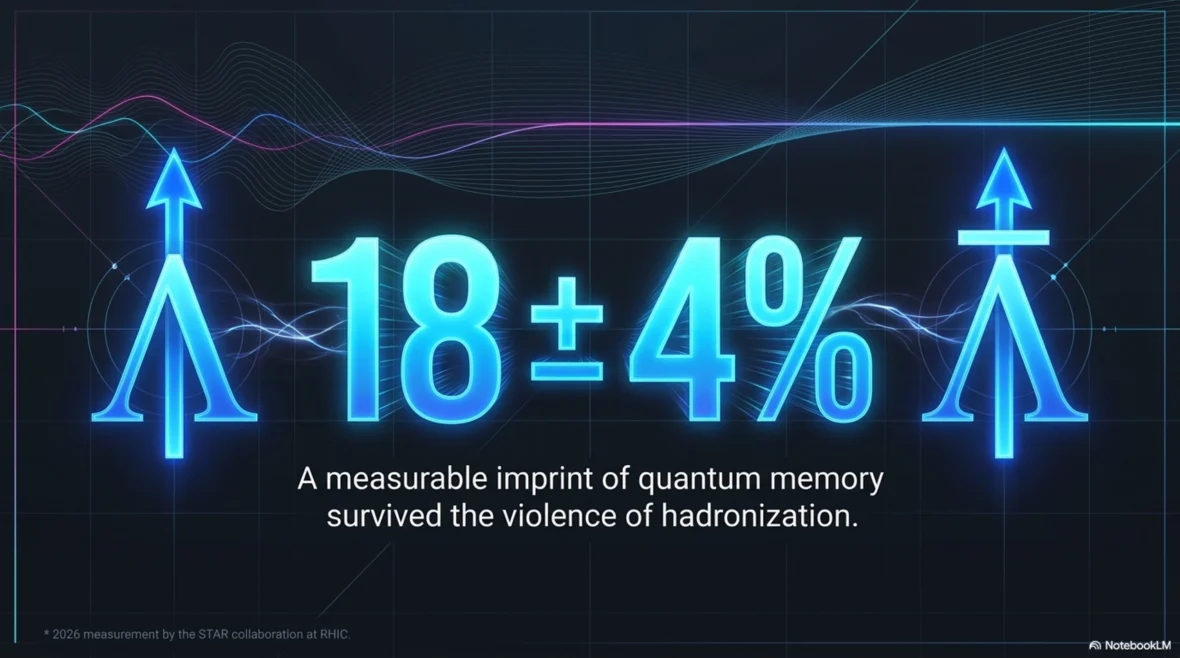
A 2026 measurement by the STAR collaboration at the Relativistic Heavy-Ion Collider (RHIC), published in Nature, answers this directly. By reconstructing the spins of ΛΛ̄ hyperon pairs, the team found a relative polarization signal of (18 ± 4)% — a measurable imprint of the spin correlation carried by the parent strange quark–antiquark pair, surviving confinement into the final-state hadrons.
That framing — confinement as an information-bearing transition of the QCD vacuum, rather than a purely phenomenological hadronization step — is precisely the lens through which ISF’s own hadron-sector program reads the result. In recent work on the proton infrared sector, Haramein and colleagues treat coherent electromagnetic vacuum fluctuations as a boundary-constrained source whose progressive decoherence across two screening horizons organizes proton mass, confinement-scale stiffness, and charge. The STAR measurement is experimental support for a central premise of that construction: vacuum-origin quantum correlations can survive the transition into observable hadronic structure over a finite coherence domain, and are then degraded by separation. We return to that connection below, after the measurement itself is laid out.
Why Hyperons, and Why Strangeness
The top quark gets all the attention in quantum-information particle physics, and for good reason: it decays before it can hadronize, so its spin is read out cleanly through its decay products. ATLAS and CMS used exactly this property to observe quantum entanglement between top and antitop spins. But the top quark sidesteps confinement entirely. To study what confinement does to quantum correlations, you need particles that actually go through it.
The Λ hyperon is the ideal instrument. In the naive quark model, the spin of the Λ (a uds baryon) is carried entirely by its strange valence quark; the up and down quarks couple to a spin-zero diquark. That means the Λ’s polarization is a faithful proxy for the spin of the strange quark inside it. Better still, the Λ is self-analyzing: it decays weakly to a proton and a pion, and the proton is emitted preferentially along the Λ spin direction. Measure the angular distribution of the decay proton, and you measure the parent quark’s spin.
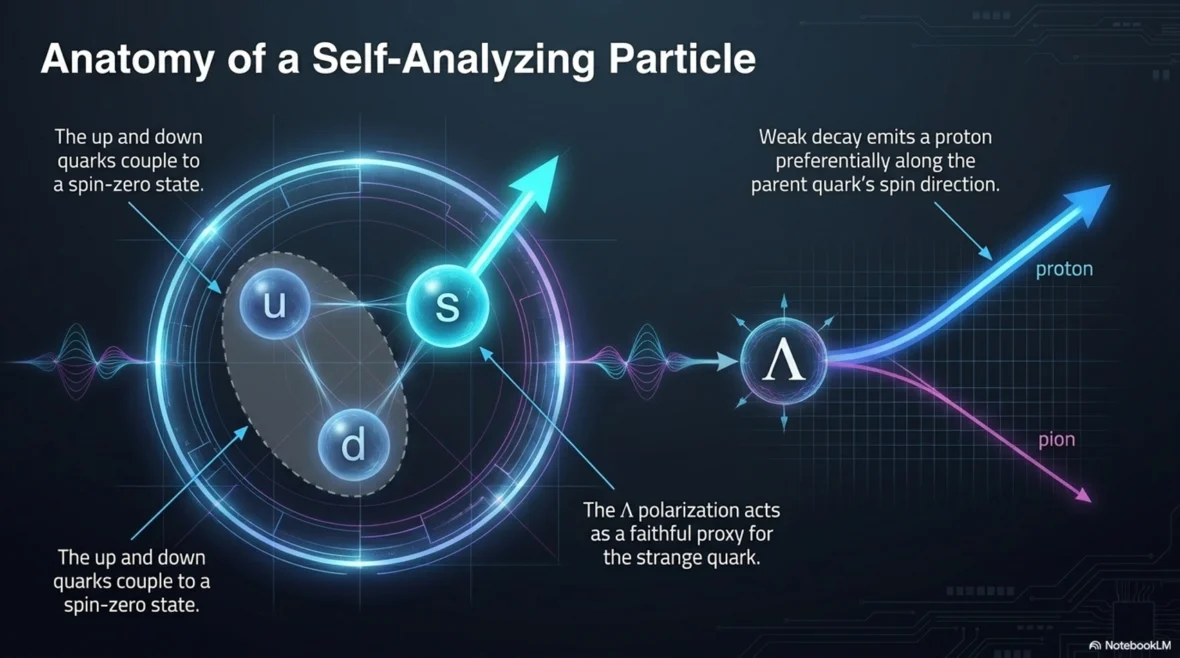
A Λ and a Λ̄ produced together can therefore reveal the joint spin state of an s–s̄ pair pulled from the vacuum. If that pair was born spin-correlated, and if the correlation survives confinement, the two hyperons should show a statistical preference to align (or anti-align) their spins relative to one another. That is precisely the signal STAR set out to extract.
What STAR Measured
Working with proton–proton collision data at √s = 200 GeV recorded in 2012, the STAR team measured spin–spin correlations for three pair types — ΛΛ̄, ΛΛ, and Λ̄Λ̄ — by analyzing the joint angular distribution of the decay protons (and antiprotons) from both members of each pair. The key observable is a relative polarization that tracks how the two hyperon spins are correlated as a function of their separation.
Two findings stand out. First, the ΛΛ̄ channel shows a clear positive correlation: a relative polarization signal of (18 ± 4)%, linking the spin state of the final-state hyperons back to a spin-correlated virtual s–s̄ pair. Second, and just as important, the correlation is not uniform. It is strongest when the two hyperons emerge close together in angle and rapidity, and it vanishes when they are widely separated.
Table 1. The angular dependence is the crux: a surviving quantum correlation should fade as the pair decoheres with separation, and it does.
| Pair / regime | What is probed | Observed behavior |
|---|---|---|
| ΛΛ̄ pairs | Spin state of a vacuum s–s̄ pair | Relative polarization (18 ± 4)% |
| Short-range (small Δy, Δφ) | Pairs likely from one hadronization vertex | Strong correlation present |
| Long-range (large Δy, Δφ) | Causally disconnected pairs | Correlation vanishes |
Confinement, Entanglement, and Decoherence in One Measurement
The disappearance of the signal at large separation is what elevates this from a curiosity to a genuine probe of quantum dynamics. If the correlation were a mundane kinematic artifact, there would be no particular reason for it to depend on angular separation in this way. Instead, the pattern is the signature of a quantum system that retains coherence over short scales and loses it as the constituents are pulled apart and interact with the surrounding color field — textbook decoherence.
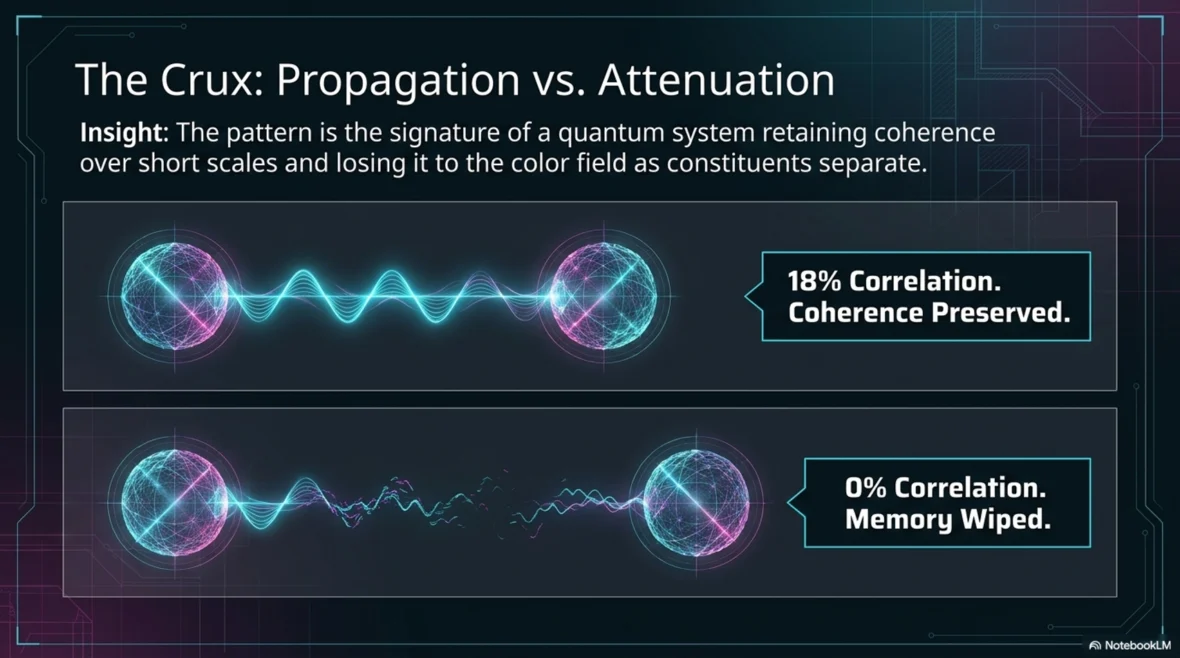
In other words, the measurement captures three of the hardest concepts in modern physics in a single dataset: confinement (the binding of quarks into hadrons), entanglement (the inherited spin correlation of the s–s̄ pair), and decoherence (the loss of that correlation through environmental interaction). A follow-up theoretical analysis has since shown that a single decoherence framework can describe both the RHIC hyperon data and complementary results from the LHC, drawing a quantitative line from the QCD vacuum through spin entanglement to hadronization.
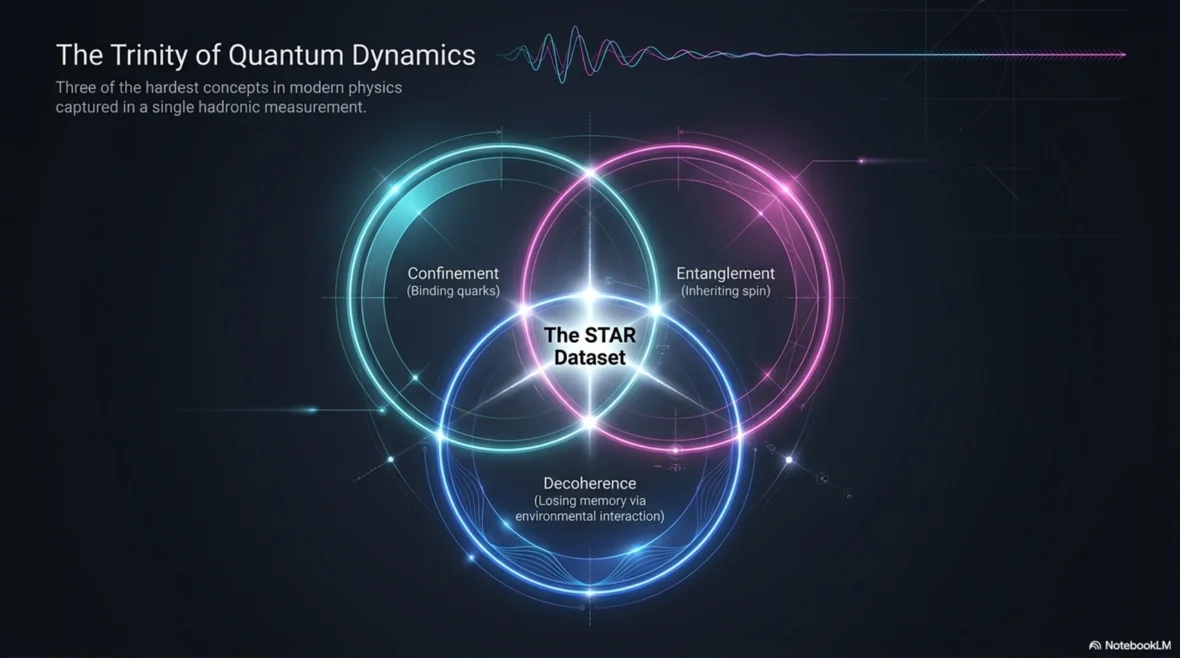
A Bridge to ISF’s Hadron-Sector Program
The STAR result lands at the center of a question ISF has been pursuing from a complementary direction. In a recent paper on the proton infrared sector [Extending Einstein-Rosen’s Geometric Vision], Haramein, Guermonprez, and Alirol develop an effective geometric model in which coherent electromagnetic vacuum fluctuations — not an imposed matter density — act as the source of proton mass, confinement-scale stiffness, and charge. Their construction is built on finite surface-capacity constraints drawn from the Bekenstein–Hawking entropy bound, which define two screening horizons: an inner one at the proton’s reduced Compton scale and an outer one at the charge radius. As coherent vacuum modes propagate from the inner horizon outward, they progressively lose phase alignment — and it is exactly this staged decoherence that the model identifies with the emergence of hadronic structure.
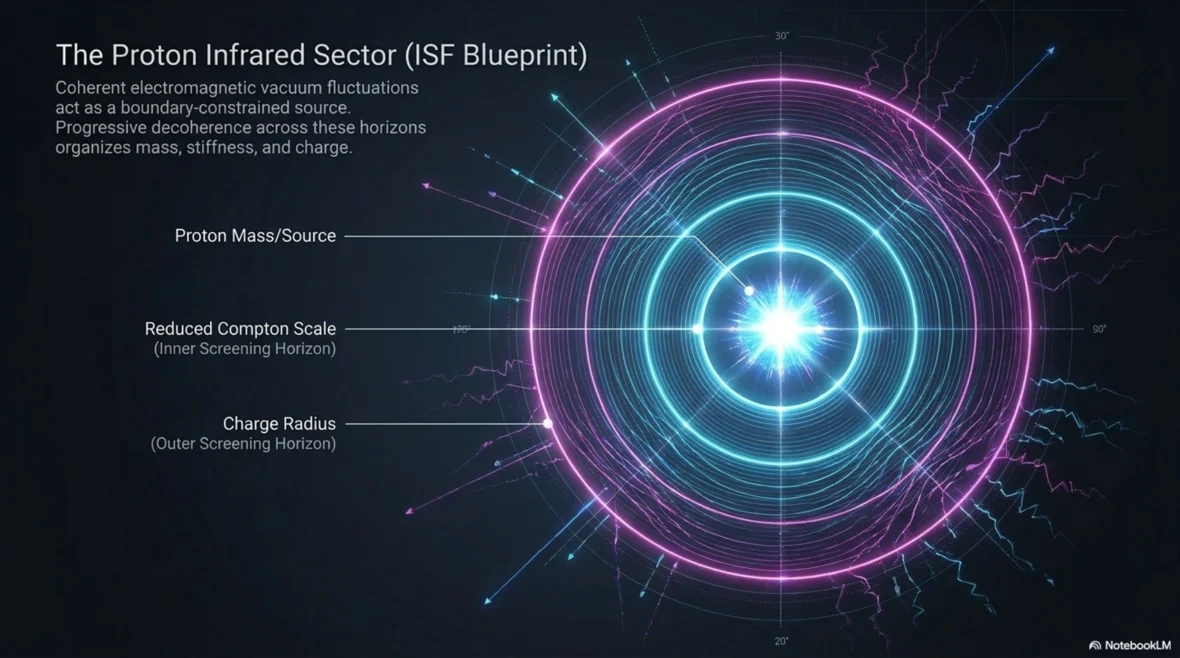
Confinement as a finite-coherence transition
The STAR measurement offers some findings that help us evaluate the ISF team’s theoretical framework with empirical data, and there is a significant outcome that supports a key property of the Haramein mechanism. Remaining clear on what the results do and do not show: e.g., the hyperon spin correlation is a QCD spin-channel observable, not the electromagnetic energy-density correlator the ISF team’s model is built on — a distinction they state plainly. The significant outcome is validation of a physical principle, and it is the principle that matters: hadronic observables can retain vacuum-origin quantum correlations over a finite coherence domain, and those correlations decohere as the constituents separate and interact. On the strength of this, their paper treats confinement not as a purely phenomenological infrared boundary condition but as an information-bearing transition of the QCD vacuum. The STAR data are presented as experimental motivation for that stance — the surviving (18 ± 4)% short-range signal as evidence that vacuum-origin correlations make it into observable hadrons, and the vanishing long-range correlation as evidence that they are subsequently degraded.
A shared signature: propagation versus attenuation
The structural parallel runs deeper than motivation. In the ISF model, the screened metric response is governed by a complex wave number whose real part carries coherent phase transport and whose imaginary part encodes irreversible attenuation — the geometric leakage of coherence into the screened vacuum environment. We can point to the STAR angular dependence as a direct phenomenological analogue of that decomposition: short-range pairs map to the coherent, phase-transporting branch, while widely separated pairs map to the attenuated branch where the correlation has leaked away. In both pictures the same story is told twice — once in spin space, once in the geometry of the screened metric: a vacuum-origin correlation that survives over a finite domain and is then erased by separation. The hadronic Y-junction and finite-width, vacuum-supported connector they propose for the confined baryon are, in their reading, exactly the kind of channel through which selected correlations are transported before coherence is lost on exit from the locked infrared regime.
It is worth being precise about the logical status here, because the STAR result does not measure aggregate decoherence of vacuum fluctuations inside the hadron predicted by the ISF research team’s model, confirm its screening horizons, or validate the geometric origin of the proton mass; no one is making that claim. What the measurement does is establish — empirically, in a clean channel — that the QCD vacuum can hand a quantum correlation to real hadrons and that the handoff is finite and geometry-dependent. That is the premise the whole ISF construction rests on. Seeing it confirmed in the laboratory does not prove the framework, but it removes a foundational objection and turns an assumption into an observation. For a program that treats the vacuum as an active, coherence-carrying participant rather than an inert backdrop, that is the single most useful thing an experiment could have provided.
Looking Ahead
The natural extensions are already on the table. Pairing hyperons with jets would let experimenters separate correlations born at a single hadronization vertex from those arising elsewhere, sharpening the link between geometry and coherence. Bell-type inequality tests using hyperon spins have been proposed and would push the question from “is there correlation” to “is it nonclassical”, opening direct investigations into vacuum memory and the non-local correlation architecture of space. And the same toolkit — self-analyzing hyperons as built-in spin meters — can be turned on heavy-ion collisions, where the vacuum is replaced by a hot, dense, rotating medium.
For now, the headline stands: a spin correlation, born in the empty vacuum and inherited by real particles, has been caught surviving confinement — and caught fading as the system decoheres. It is a rare case where the abstract machinery of quantum information finds a clean, quantitative home in the strong interaction. (18 ± 4)% of the vacuum’s memory made it out.
References
- STAR Collaboration (B. E. Aboona et al.). Measuring spin correlation between quarks during QCD confinement. Nature 650, 65–71 (2026). doi:10.1038/s41586-025-09920-0
- STAR Collaboration. Measuring spin correlation between quarks during QCD confinement. arXiv:2506.05499 (2025). arxiv.org/abs/2506.05499
- Z.-T. Liang, Q.-H. Xu, J.-L. Zhang. Probing QCD confinement with spin–spin correlation in proton–proton collisions. Nuclear Science and Techniques 37, 86 (2026). doi:10.1007/s41365-026-01907-4
- Quantum decoherence of hyperon spin correlations in QCD hadronization. arXiv:2606.17240 (2026). arxiv.org/abs/2606.17240
- ATLAS Collaboration. Observation of quantum entanglement with top quarks at the ATLAS detector. Nature 633, 542–547 (2024).
- W. Gong, G. Parida, Z. Tu, R. Venugopalan. Measurement of Bell-type inequalities and quantum entanglement from Λ-hyperon spin correlations at high energy colliders. Phys. Rev. D 106, L031501 (2022).