

What the new experiments tested
The Quantum Memory Matrix (QMM) hypothesis, developed by Florian Neukart, Eike Marx, and Valerii Vinokur at Terra Quantum AG and Leiden University, formalizes a simple, testable claim: treat spacetime as if it contains lots of tiny, local “memory cells.” When a quantum system interacts with a cell, it can imprint information there—and later you can retrieve it in a fully reversible way, without destroying information. In physics jargon: local storage + unitary (reversible) retrieval.
To probe that claim in the lab, researchers built small quantum circuits that imitate “imprint→evolve→retrieve.” They used one qubit as a field (the thing with information), one or more memory qubits, and an output qubit. A controlled rotation writes the field’s state into the memory; a controlled-SWAP reads it back. Then they ran these circuits on a real IBM quantum processor to see if the output actually matches the original field—i.e., like a stylus on a record, does the groove replay the same tune?
What they did:
In the simplest test, the team used three qubits to mimic one “memory cell.” One qubit carried the pattern to be remembered (the field), a second acted like the cell itself, and a third served as the reader. The circuit first pressed the pattern into the cell and later read it back out. Even on today’s noisy hardware, the retrieved pattern closely matched the original—roughly two-thirds to three-quarters of the time—showing that a single local unit can hold and return a quantum imprint without destroying it.
They then ran two of these write-and-read cycles at the same time using five qubits. Both “cells” worked in parallel, which shows the method isn’t limited to a lone unit; it can be arranged as a small grid, just as you’d expect if memory lived in many tiny patches rather than one central warehouse.
Finally, the researchers made life messy on purpose. They let the system evolve for a bit, injected controlled errors, and then tried to reverse those changes before reading the memory back. Despite the jostling, the correlations between what was written and what was retrieved remained strong. The imprint behaved like something reversible that you can re-access after disturbance, not a delicate snapshot that shatters under stress.
Why this points to space-memory
Taken together, the chip is a stand-in for spacetime: its qubits play the role of local “cells.” If you can write a pattern into a local unit, read it back later without losing information, do this across multiple units, and still recover it after some chaos, you’ve demonstrated the exact behavior a spacetime memory field would need. The experiments don’t prove that space is already doing this everywhere—but they show the mechanism works, which is why “space remembers” is no longer just poetry.
The bottom line the authors draw: these results of the IBM tests validate the core principle that local, reversible imprint-retrieve cycles are feasible—a grid of tiny quanta can capture and return quantum information on demand—exactly what you’d expect if spacetime (or a stand-in for it) can act as a quantum memory.
From Empty Stage to Active Medium: The Spacememory Revolution
For most of physics history, spacetime has been treated as an abstract backdrop—a coordinate grid where events happen but which doesn’t itself participate in the action. Even Einstein’s general relativity, which showed that mass curves spacetime, still treats it more like a flexible fabric than something with its own informational content. In this traditional view, spacetime is essentially empty—a geometric structure, not a substance.
Approaches like Spacememory Theory of physicist Nassim Haramein and the QMM hypothesis flips this picture on its head. Instead of spacetime being a passive, empty stage, quantum gravitational theories propose that at the tiniest scale—the Planck scale, about 10⁻35 meters—spacetime is made of discrete quanta. In QMM, these quanta are referred to as “quantum cells,” each capable of storing information like a microscopic hard drive. Think of it like the difference between a blank chalkboard (traditional view) and a screen made of pixels that can light up and hold a pattern (QMM view).
How the Memory Cells Work
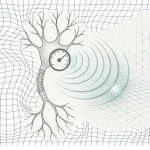
In QMM, when a quantum field—say, an electron or a photon—passes through a region of space, it doesn’t just move through emptiness. It interacts with the local quantum cell at that point, leaving an “imprint” (Figure 1). This imprint is a quantum state encoded directly into the structure of spacetime itself. The technical term is a quantum imprint operator, but the analogy to a vinyl record works remarkably well: the field is like the sound wave, spacetime is like the vinyl, and the interaction etches a groove.

Crucially, this process is reversible and unitary—meaning no information is lost. Later, another quantum system can interact with that same cell and retrieve the stored information, like playing back the record. The mathematics ensures that the total quantum state of the system (fields + spacetime cells) evolves in a way that preserves all information at every step.
Planck-Scale Quantization: Spacetime Has Pixels
The QMM framework builds on the idea that spacetime itself is quantized—broken into fundamental units at the Planck scale, similar to proposals in loop quantum gravity and rigorously demonstrated in the Unified Theory of Confinement, by International Space Federation researchers. In QMM, each cell occupies a finite region and has a finite-dimensional Hilbert space (the mathematical space where quantum states live). This discrete structure naturally provides an ultraviolet cutoff, solving certain infinities that plague quantum field theory.
Mathematically, the total Hilbert space of spacetime is the tensor product of all these individual cells—essentially, the quantum state of the entire universe includes both the matter/energy fields and the informational state of every spacetime quantum. Physical observables like length, area, and volume become quantized, with discrete spectra rather than continuous values.
Contrast with the Empty-Space Paradigm
In Newtonian mechanics, space was absolute and unchanging—a fixed container. General relativity made spacetime dynamic (it curves), but still fundamentally geometric and classical. Quantum field theory treats spacetime as a fixed background on which fields fluctuate. Even semiclassical approaches to black holes (like Hawking’s original calculation) assume spacetime geometry is classical while matter is quantum—a “split” that leads directly to the information paradox (see our articles, like An Eventful Horizon, for more on the information paradox).
QMM dissolves this split by making spacetime itself a quantum entity with informational degrees of freedom. Spacetime isn’t just where things happen—it’s what remembers what happened. This is a radical departure: spacetime becomes an active participant in quantum dynamics, not a passive arena.
Why This Matters for Black Holes
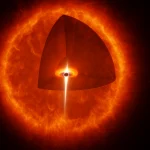
In the traditional picture, when matter falls into a black hole, its information seems to vanish behind the event horizon. Hawking radiation appears purely thermal (random), carrying no memory of what fell in—hence the paradox. QMM resolves this by proposing that as matter crosses the horizon, its quantum state imprints onto the spacetime cells near and inside the black hole (Figure 2). These imprints persist and gradually interact with outgoing Hawking radiation, allowing information to leak back out in a unitary (information-preserving) way.

The key advantage: this happens locally, through ordinary quantum interactions, without requiring exotic mechanisms like wormholes, holographic boundary projections, or violations of the equivalence principle. An observer falling into the black hole experiences nothing unusual at the horizon—general relativity’s predictions remain intact. Yet information is conserved, satisfying quantum mechanics.
Finding Supports Recent ISF Research
In our recent article, The Memory Field, we explored our research on the interaction between the biophysics of cellular biology and the informational characteristics of spacetime (note: use of the term “memory field” is not proposing a new kind of field, it is describing a property of the one unified quantum spacetime field). In the brain, we explored how potential coupling of neuronal activity to quantum information imprinted in spacetime would mean that memories aren’t analogous to “files” stored on a computer hard drive (as suggested by neurocomputational functionalism). Instead, lived experience leaves patterns in the fabric of space, and subcellular “resonators” in neurons let us re-tune to those patterns when we recall them. Synapses are more like pointers that help you find the right station; the broadcast lives in spacetime.
That picture explains awkward facts—like people with hyperthymesia who can spontaneously relive day-by-day autobiographical scenes across decades. If you treat synapses as a finite storage device, the math doesn’t add up: even a generous “cartoon neuron” estimate falls orders of magnitude short of the lifetime, movie-like recall such people report. A better fit is that synapses index; space remembers.
Inside neurons, structures like microtubules behave as tiny resonators. In this view, they can phase-lock and couple, helping the brain “retune” to prior field patterns—much like a record player’s stylus riding a groove that’s already etched.
There’s even a plausible indexing system: the enzyme CaMKII can write persistent molecular “registers” on microtubules (Figure 3) that act like address tags—useful for finding the right station without claiming the song is stored in the tag itself.

(A) Top view of a CaMKII holoenzyme poised above the microtubule (MT) outer surface. The hub (violet) organizes kinase modules (green) via flexible linkers (brown), positioning them to reach the MT lattice. (B) Side view of CaMKII docked on the MT; catalytic heads phosphorylate exposed side chains on the MT surface (yellow), establishing persistent molecular registers that can serve as synaptic indexes. (C–D) Field visualization of the catalytic footprint: red/blue lobes indicate the spatial domain over which kinase heads can act when the holoenzyme is engaged with the lattice, highlighting how clustered phosphorylation can write discrete, addressable tags along protofilaments. MT: dark gray. Scale bars as indicated. Image from:
T. J. A. Craddock, J. A. Tuszynski, and S. Hameroff, “Cytoskeletal signaling: is memory encoded in microtubule lattices by CaMKII phosphorylation?,” PLoS Comput Biol, vol. 8, no. 3, p. e1002421, 2012, doi: 10.1371/journal.pcbi.1002421.
Why that Matters for Space-memory
Think of the experiments as a tabletop, simplified version of our larger story. If tiny, local memory units can be imprinted and later replayed without losing information, then it’s reasonable to imagine the fabric of space doing something similar at a deeper level. That’s precisely what the QMM framework proposes: discrete cells of spacetime hold quantum imprints, and those imprints can later be interacted with to recover information—all while respecting normal cause-and-effect.
This has implications for a broad range of processes and properties of the natural world. A memory property of spacetime would have significant implications for morphogenesis: the cause and mechanisms of form in physical systems from crystallization to organism morphologies, the latter of which touches upon ideas like formative causation. In our recent investigation, we look at what it would mean for certain cognitive models of brain function that rely on a computational interpretation. And of course, as discussed in QMM papers, it has implications for critical issues in physics like the information loss paradox. I QMM, the “lost” information isn’t lost; it’s locally recorded and slowly retrievable, preserving quantum rules. The experiments don’t test black holes directly, of course—but they do support the mechanism (local, unitary imprint-retrieval) you’d need for such a resolution.
For our biology-focused model, this is encouraging because it lines up with a concrete, lab-demonstrated principle: you don’t have to warehouse information in one place forever; you can write it to a medium and later re-access it faithfully. That’s the essence of “the brain tunes; spacetime remembers.”
Broader Implications of QMM and its Empirical Results
In conventional physics, spacetime is treated as a passive stage for events rather than an active medium capable of dynamically storing and retrieving quantum states. The QMM experimental findings suggest a more active view: space isn’t just a container, but a medium capable of dynamically storing and allowing retrieval of quantum states.
This is subtle but profound. Instead of just asking whether information is preserved in the big picture, we can start seeing how information might be locally written, stored, and retrieved across different scales and contexts—from brains to black holes.
One of the most profound implications of the QMM framework and the ISF memory field hypothesis is that they introduce non-Markovian dynamics into fundamental physics. In standard Markovian processes, a system’s future depends only on its present state—the past is effectively erased once the present is known. However, if spacetime actively stores imprints of past interactions as persistent field patterns, then the history of a system is never truly gone; it remains encoded and retrievable.
This means quantum evolution can exhibit memory effects: a particle’s future behavior may be influenced not just by its current state but by patterns it (or entangled partners) imprinted earlier in spacetime. For quantum biology, this offers a natural mechanism for non-Markovian coherence—neurons re-accessing historical patterns without storing them locally. For black hole physics, it provides a non-Markovian resolution to the information paradox: infalling information is imprinted in spacetime memory cells and gradually retrieved through interactions with outgoing radiation, preserving unitarity across time. In essence, treating spacetime as a memory medium transforms it from a passive stage into an active participant in quantum dynamics—one that remembers.