

A striking new discovery from the Max Planck Institute for Astronomy (MPIA) strengthens the case that stars may harbor black holes at their cores. In a September 2025 press release, MPIA scientists—led by Anna de Graaff, Hans-Walter Rix, and Raphael E. Hviding in collaboration with many others—report evidence for objects they describe as “black hole stars” that could resolve long-standing puzzles in galaxy formation. This was also reported in Science with the announcement that the “early universe’s ‘little red dots’ may be black hole stars”. If you have been following our posts, like Is the Sun a Black Hole and New Evidence Points to a Compact Object at the Sun’s Core, then you know there has been a series of research studies revealing how stars with a black hole at their core are not only plausible but supported by observational evidence.
This finding dovetails provocatively with the pioneering cosmological model proposed by Nassim Haramein, which holds that all stars contain black holes at their cores. In this video from 2008, then recent observations of sunspot magnetohydrodynamics are discussed as confirming exact prediction from Haramein about stellar dynamics that will be observed as a result of the singularity at the Sun’s core:
How did Haramein come to this remarkable conclusion that not only galaxies, but also stars will have black holes at their cores? An idea so far ahead of its time that it is only now, more than twenty-five years later, that compelling observational evidence is confirming it. It came from Haramein’s novel approach to understanding spacetime and the quantum electromagnetic vacuum, also known as zero-point energy—a view that sees space, both at the quantum scale and cosmological scale, not as empty but as a rich coherent medium where energy and information flow and self-organize. This can be seen in early publications like Collective Coherent Oscillation Plasma Modes in Surrounding Media of Black Holes and Vacuum Structure – Quantum Processes with Considerations of Spacetime Torque and Coriolis Forces[1], to the recent publication Extending Einstein-Rosen’s Geometric Vision : Vacuum Fluctuations-Induced Curvature as the Source of Mass, Gravity and Nuclear Confinement [2] where it is expatiated:
Contrary to the classical approach, which views black hole formation primarily as the result of accreting infalling material to a critical limit, our findings demonstrate that black holes form as a result of natural spacetime behavior at the Planck scale resulting in a high electromagnetic energy density in a region. Specifically, black holes emerge from a state of coherence among collective quantum vacuum fluctuation oscillators that generate an electromagnetic energy density, curving spacetime, an effect classically attributed to mass. This coherence mechanism fundamentally relates to the angular momentum of an oscillator, as Max Planck originally described. The coupling of these oscillators produces collective behaviors analogous to quantum vortices in a turbulent spacetime manifold flow, which we term a Planck Plasma flow, manifesting as what we observe as black hole dynamics.
These quantum vacuum coherent behaviors at the source of black holes formation may explain recent James Webb Space Telescope observations of supermassive black holes at redshifts ????>5 in the early universe, where conventional star formation and accretion timeframes appear insufficient to produce such massive structures. Furthermore, this mechanism is in accordance with Stephen Hawking’s analysis of early universe formation, which concluded that “a sufficient concentration of electromagnetic radiation can cause gravitational collapse”, forming primordial and elementary black holes at Planck length and Compton wavelength scales.
We see then with this excerpt directly from Haramein et al.’s paper the framework explaining how black holes don’t form from collapsing stars—they emerge first from the quantum vacuum itself, then serve as gravitational seeds around which matter organizes, at the microscopic scale as baryons, and at the astronomical scale as stars and galaxies. If this is true, we would expect to find evidence of black holes embedded within stellar structures from the very earliest epochs of cosmic history, rather than only as the endpoints of stellar evolution. This is precisely what makes the recent MPIA observations so compelling.
In light of the MPIA results, we re-examine how Haramein’s framework provides indispensable insights into understanding the nature and origin of black holes, stars, and the recently observed enigmatic objects at Cosmic Dawn.
MPIA’s “Black Hole Stars” — What Their Study Reports
According to MPIA’s press release the discovery centers on an object dubbed “The Cliff”, identified among a population of very compact, red-shifted sources called “little red dots” (LRDs) in JWST data. Think of LRDs like distant ambulance sirens. Just as an ambulance speeding away from you sounds lower-pitched (its sound waves are stretched), galaxies racing away from us appear redder because their light waves are stretched toward the red end of the spectrum—a phenomenon called redshift. The LRDs are extremely compact, bright objects detected by JWST that appear unusually red, indicating they’re both incredibly distant (billions of light-years away) and moving away from us as the universe expands. Their mysterious compactness and intense brightness have puzzled astronomers, requiring a complete revision of conventional models and taking the remarkable step of placing black holes at the cores of these objects—a step that may at first seem unorthodox, but which solves almost every puzzling observational feature of these distant “little red dots”.
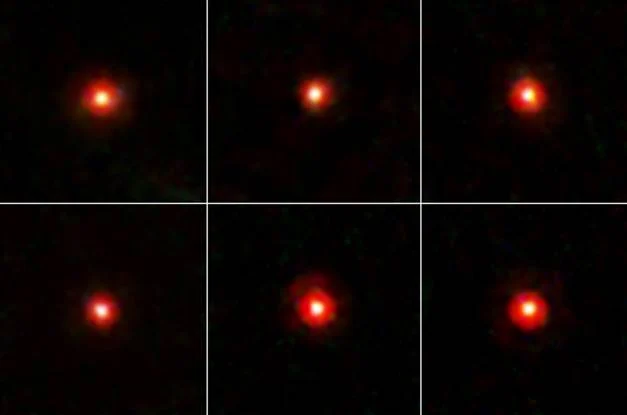
Thus, data from the JWST is posing significant challenges to conventional astrophysics models, not only with these LRDs but also the related issue of early galaxy formation and addressing the near complete lacuna in explaining how supermassive black holes (SMBH) form. The recent observations of spectral data from The Cliff underscore this situation [3].
Standard galaxy or star-burst interpretations cannot explain The Cliff’s strange light signature. Observational astronomy relies on deciphering light, and astronomers have cataloged a dizzying array of different light patterns or spectra. So, when you look at the “rainbow” of light coming from stars or galaxies (their spectrum), you expect certain patterns—like a barcode with lines in predictable places. The Cliff, however, shows an extreme and sudden drop in brightness right before the ultraviolet part of the spectrum—as if someone abruptly turned off a light switch at a very specific color. Normal stars and galaxies don’t do this. It’s like expecting to hear a song fade out gradually, but instead it cuts off sharply mid-note. That dramatic “cliff” in the light pattern (hence the nickname) doesn’t match what we see from regular stellar populations or star-forming regions, which is why astrophysicists knew they were looking at something fundamentally different.
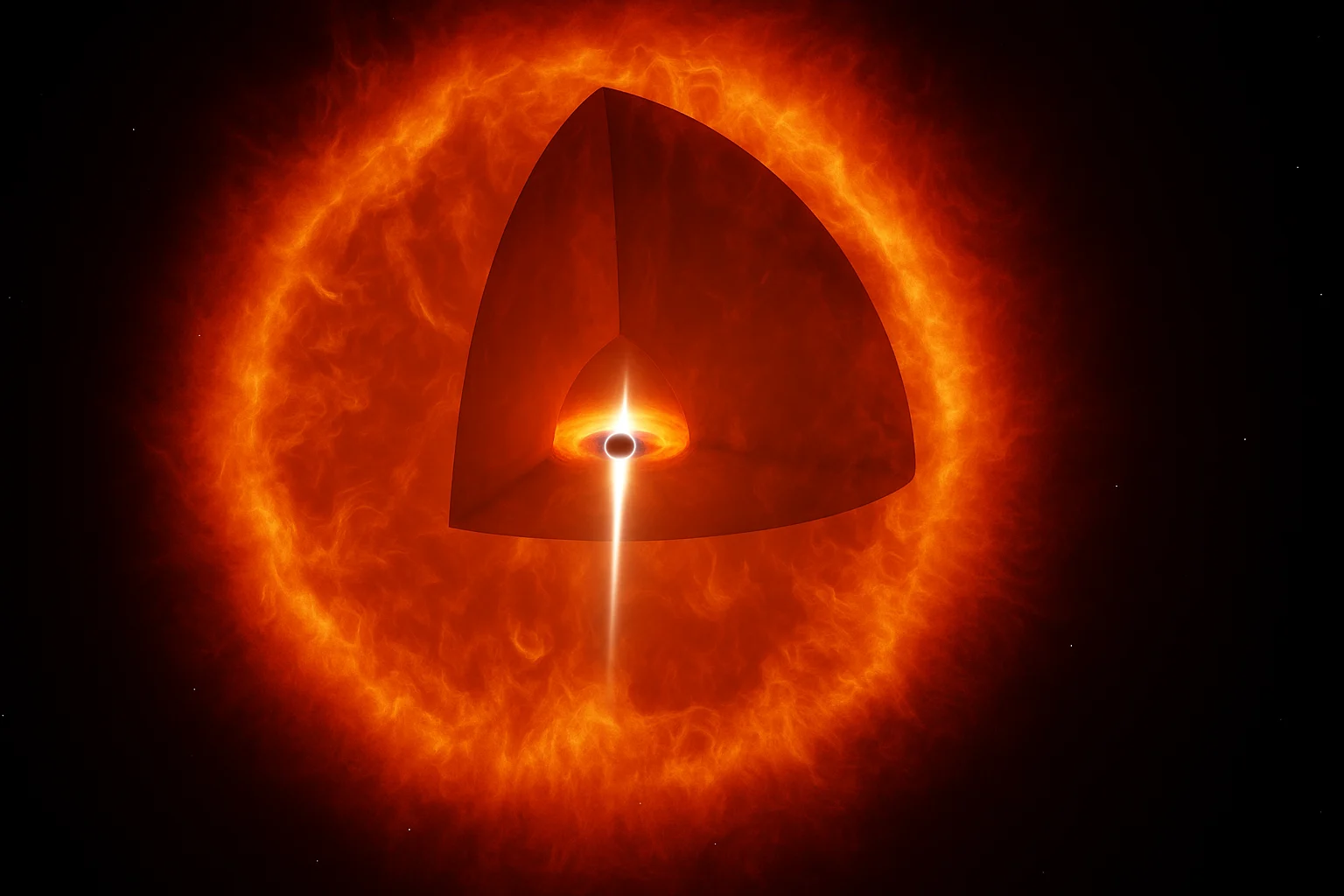
De Graaff and colleagues propose a hybrid model: a supermassive black hole with an accretion disk embedded within a turbulent, dense hydrogen gas envelope. Because the enveloping gas reddens the light (rather than intervening dust), this central engine mimics the appearance and spectral behavior of a star. Hence, the term black hole star (BH★). Here’s the stunning part: when the MPIA team placed a black hole at the core of their model—surrounded by that turbulent hydrogen envelope—the fit to The Cliff’s bizarre spectrum was dramatically better than any conventional explanation. Where galaxies, starbursts, and dusty models all failed to reproduce that sharp spectral cliff, the black-hole-core model succeeded with remarkable precision. It was as if the data had been waiting for this interpretation all along. Of course, significant uncertainties remain (how stable is that gas envelope? what fuels it? how long can it last?)—but the core insight is unmistakable: put a black hole at the center, and suddenly the puzzle pieces fall into place.
So, the MPIA researchers have presented observational and modeling evidence that some of the earliest luminous objects, like the LRDS, in the universe may in fact be black hole–core objects cloaked by gas envelopes so as to appear starlike. If confirmed, these BH★ objects would be a new class in cosmic structure—and might explain how very massive galaxies and black holes formed so early. This will also resolve the issue of SMBHs [4] because this early formation—in which primordial black holes form directly out of the medium, what could be called intrinsic black holes—is necessitated to even begin to explain the billion-plus solar mass behemoth denizens at the core of almost every galaxy, and which are indelible to the evolution and characteristics of galaxies (see our article Galactic Engines for more on how SMBH are key to galactic evolution).
Haramein’s Prediction: All Stars Contain a Black Hole Core
Nassim Haramein has long advocated a strikingly different view of cosmology and astrophysics. Central to his model are two interlinked propositions:
1) Black holes emerge directly from the quantum vacuum, via coherently organized zero-point fluctuations, rather than as end states of collapsing stars.
2) Once seeded, these vacuum-born black holes attract and organize surrounding plasma and matter, giving rise to stars, planets, and galaxies built around preexisting singular cores.
In Haramein’s pioneering model, every star (including the Sun) possesses a black-hole–like resonant core from its origin, acting as a stabilizing gravitational and electromagnetic core. He has demonstrated that this structure underlies not only gravity, but nuclear binding and the organization of matter on all scales.

From this perspective, stars do not collapse into black holes—they instead emerge around black holes that are themselves emergent from vacuum coherence.
How the MPIA Discovery Aligns with Haramein’s Model
The MPIA discovery of black hole stars in the early universe appears, at first glance, to parallel Haramein’s prediction. A few key points of resonance and tension:
| Feature | MPIA Black Hole Stars | Haramein’s Model | Comments |
| Core black hole from birth | BH★ are proposed black holes embedded at the heart of luminous envelopes | Haramein predicts that stars are organized around the quantum vacuum fluctuations-generated black holes | The MPIA model is observational and phenomenological; Haramein’s is foundational and constructive (from first principles) |
| Non-collapse origin | The BH★ objects are not the result of supernova collapse; they exist early in cosmic history | Haramein demonstrates how black holes form first, before stellar structure | The MPIA model does not explicitly derive black hole genesis from vacuum dynamics |
| Envelope as stellar mimic | The gas envelope reddens/obscures and shapes the observed spectrum, making the system appear starlike | Haramein treats the enveloping plasma as organized by the black-hole core’s gravitational dynamics | The resemblance of BH★ appearances to stars is a point of contact |
| Rapid mass growth | MPIA suggests BH★ configurations could help explain extremely fast growth of early black holes and galaxies | Haramein’s vacuum-seeding mechanism is inherently non-limited by “stellar collapse timescales” | MPIA remains cautious about the growth physics; Haramein provides a broader mechanism |
Thus, while the MPIA researchers have not yet explicitly adopted Haramein’s vacuum-origin theory, their findings offer a possible observational anchor point for it. If BH★ objects truly exist, they provide a class of objects consistent with the notion of black-hole-seeded luminous structures.
Where Observation Meets Prediction: The Path Forward
To be clear, the MPIA team’s work focuses on fitting the observed light signatures and gas behavior—they aren’t yet asking how these black holes formed in the first place. That’s where Haramein’s vacuum-origin framework offers a complementary piece of the puzzle that mainstream astrophysics has yet to fully integrate into its simulations. The MPIA discovered these supermassive black-hole cores in the early universe, but Haramein’s model suggests the same vacuum-seeding principle could apply across all scales—from the hearts of ordinary stars like our Sun, down to subatomic particles. As observational technology improves and more data pours in from JWST and future telescopes, we may witness a gradual convergence: what once seemed like fringe theory could become the foundation of a new astrophysical paradigm, just as what happened with the idea that black holes are at the core of every galaxy (another early proposal by Haramein that was also seen as speculative at the time).
The BH★ discovery is still in its early stages—more spectroscopic follow-up and modeling are needed—but each new confirmation of black holes at the cores of unexpected objects strengthens the case. The question isn’t if mainstream science will recognize vacuum-generated black holes as fundamental organizing principles, but when the weight of evidence becomes undeniable. We may be witnessing the early chapters of that transformation right now.
The MPIA results mark a significant empirical touchpoint—one that invites reinterpretation of cosmic history through the lens of black-hole–seeded organization.
A Confluence of Discovery and Prediction
The MPIA discovery of black hole stars, as reported by de Graaff, Rix, Hviding, et al., presents a tantalizing candidate for instances where black holes and stellar-like envelopes cohabit from the earliest epochs of the universe. This is precisely the kind of phenomenon that Haramein predicted—even if the mainstream astrophysical community would normally regard the notion of stars born with black holes at their cores as speculative.
In this confluence of theory and observation, we see an invitation: perhaps the early universe was not merely a swarming cloud of collapsing matter but a resonant quantum vacuum geometrizing into black-hole nuclei—seeds that later accreted matter and radiated as luminous envelopes. Such a picture aligns with classic models of primordial black-hole formation from early density fluctuations [5], as well as with scenarios involving vacuum phase transitions. At the Planck scale, the vacuum may undergo non-perturbative excitations—gravitational instantons—that momentarily concentrate curvature to black-hole densities [6, 7] (while perturbative methods describe small, incremental fluctuations of the vacuum, the non-perturbative domain reveals the vacuum’s deeper topology—where tunneling, confinement, and geometric self-organization occur [see Haramein et al., 2] and such regimes often mark the very heart of physical reality). So, we see within the physics literature a foundational legacy for understanding the nature and origin of intrinsic black holes.
Indeed, in his work on spacetime foam, Hawking [7] proposed that Planck-scale instantons represent Euclidean tunneling events of the vacuum which, at extreme curvature, form the geometric seeds of microscopic black holes. In other work he even suggested that primordial black holes might reside at the centers of stars—giving rise to the moniker “Hawking stars.” Although these two ideas were never connected by Hawking to give the full picture, we see how this early work adumbrates Haramein’s model of self-organizing structures arising from coherent quantum-vacuum fluctuations and the fluid-like properties of the spacetime Planck plasma.
If future JWST, ELT, and other observations confirm more BH★ objects, the bridge between Haramein’s vacuum-seeding cosmology and observational astrophysics will solidify.
References
1) Haramein, N., Rauscher, E. A. (2005). Collective coherent oscillation plasma modes in surrounding media of black holes and vacuum structure- quantum processes with considerations of spacetime torque and coriolis forces. Orinda: Beyond The Standard Model: Searching for Unity in Physics, 279-331.
2) N. Haramein, O. Alirol, and C. Guermonprez, “Extending Einstein-Rosen’s Geometric Vision : Vacuum Fluctuations-Induced Curvature as the Source of Mass, Gravity and Nuclear Confinement,” Sep. 23, 2025, Preprints: 2025091835. doi: 10.20944/preprints202509.1835.v1.
3) Graaff, Anna de, Hans-Walter Rix, Rohan P. Naidu, Ivo Labbé, Bingjie Wang, Joel Leja, Jorryt Matthee, et al. 2025. “A Remarkable Ruby: Absorption in Dense Gas, Rather than Evolved Stars, Drives the Extreme Balmer Break of a Little Red Dot at z = 3.5.” Astronomy & Astrophysics 701: A168. doi:10.1051/0004-6361/202554681.
4) A. Torralba et al., “The warm outer layer of a Little Red Dot as the source of [Fe II] and collisional Balmer lines with scattering wings,” Oct. 03, 2025, arXiv: arXiv:2510.00103. doi: 10.48550/arXiv.2510.00103.
5) J. Garriga, “Quantum fluctuations on domain walls, strings, and vacuum bubbles,” Phys. Rev. D, vol. 45, no. 10, pp. 3469–3486, 1992, doi: 10.1103/PhysRevD.45.3469.
6) S. W. Hawking, “Spacetime foam,” Nuclear Physics B, vol. 144, no. 2, pp. 349–362, Nov. 1978, doi: 10.1016/0550-3213(78)90375-9.