

Our recent exploration of a compact object at the Sun’s core showed how a single, well-designed analysis can reopen long-standing assumptions about “settled” astrophysics (New Evidence Points to a Compact Object at the Sun’s Core). Now another several new studies have delivered equally provocative results, this time on the largest scales we can probe: the motion of our solar system relative to the rest of the universe, inferred from the distribution of distant radio galaxies, collective rotation on the largest cosmological scales, and anomalous galaxy spin alignment.
Like the compact-solar-object research that has since corroborated Nassim Haramein’s decades-old prediction that stars are powered by a core black hole, these new surveys of the universe at the largest scales lends substantial weight to his rotating-universe cosmology—an idea that once challenged conventional models but now draws support from multiple independent lines of evidence. What began as a radio-galaxy and quasar “cosmic speed problem” is now being reinforced by anomalies in how galaxies themselves rotate and align on cosmic scales.
The Radio Dipole Anomaly
Previous analyses had already shown that the sky is slightly lopsided in radio light, a pattern called the cosmic radio dipole. Imagine throwing balls randomly around a room. You’d expect them to land roughly evenly in every direction. You might allow for a tiny bias if, say, the floor is a bit slanted (this would be analogous to the distortion that arises due to our motion through the universe, which results in a Doppler shift, see Figure 1)—but overall, no corner should hoard most of the balls. Such an even distribution, arising from the random way in which balls are thrown*, parallels the expectation of a uniform background radiation and distribution of matter, called an isotropic distribution, which is a fundamental tenet of the Cosmological Principle (that the universe is statistically isotropic and homogeneous on the largest scales).
* Technically, this is the Poisson distribution, where each area of equivalent size will have a statistically similar density of objects.
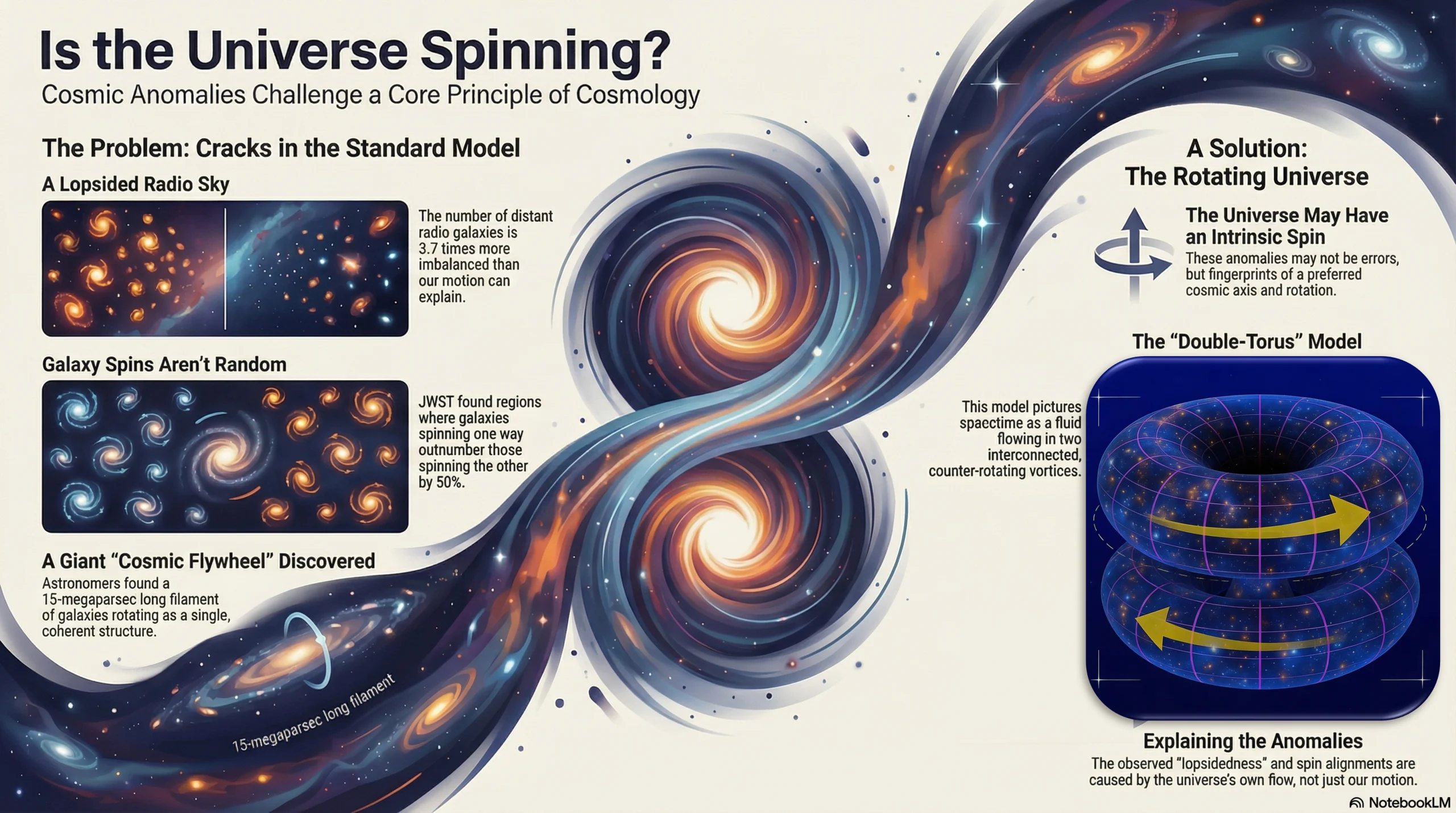
Like cataloging the balls scattered around a room, astronomers do something similar with radio galaxies: they count how many are seen in each direction across the sky. In a nearly uniform universe, with only a small effect from our motion, those counts should be almost even. Instead, they keep finding more radio galaxies in one direction and fewer in the opposite—a cosmic imbalance that looks much stronger than our motion alone can explain.

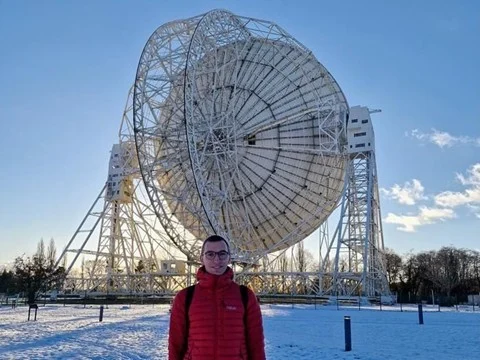
It was hoped that this imbalance would be explained away as an anomaly in the data, but in a new paper in Physical Review Letters, Lukas Böhme and collaborators present a meticulous re-analysis of the cosmic radio dipole using millions of radio sources from three major surveys: NVSS, RACS-low, and LoTSS-DR2 [1]. Böhme’s team tackled the problem of re-analysis by dividing the sky into equal-sized patches and counting how many radio galaxies showed up in each one. They also built in a way to correct for the fact that a single galaxy can look like several separate blobs in the data. Even after this careful clean-up, the dipole signal was still much stronger than expected.
Their conclusion is stark: the dipole in the number counts of radio sources on the sky is 3.67 ± 0.49 times larger than what is expected from our motion through an otherwise statistically isotropic universe—a discrepancy of about 5.4σ, far beyond what random fluctuations should produce. This poses a serious challenge to the standard application of the Cosmological Principle, which holds that on the largest scales the Universe should be statistically homogeneous and isotropic, looking roughly the same in every direction once local motions and structures are accounted for.
In plain terms, if the standard cosmological model is correct, the dipole should almost entirely be a kinematic effect: we move, the sky looks slightly brighter and more crowded in the direction of our motion, and slightly dimmer in the opposite direction. What Böhme and colleagues find instead is a dipole far too strong to be explained by that motion alone, even after carefully accounting for possible observational and statistical systematics. Independent press coverage has already framed this in a way that captures the surprise: our solar system seems to be “moving faster than expected” relative to the cosmic rest frame (Figure 2) [2].

Understanding the radio dipole anomaly
The key observable in this study is the source-count dipole: how the number of radio sources per patch of sky changes with direction. In a perfectly isotropic universe, any such dipole should be essentially zero once we correct for foreground contamination and survey masks. In practice, we know there must be at least one dipole contribution: the kinematic dipole induced by our motion with respect to the cosmic microwave background (CMB).
The CMB dipole—a temperature pattern with one side of the sky slightly hotter, the other slightly colder—has long been understood as a purely kinematic effect and gives us a velocity of about 370 km/s in a particular direction in space. Radio galaxies, distributed across billions of light-years, should respond to that same motion through relativistic aberration and Doppler boosting. That expectation sets a very precise prediction for the amplitude and direction of the radio source-count dipole.
Previous radio surveys hinted that something was off: the measured dipole seemed too large, and in some datasets, marginally misaligned with the CMB dipole. However, there was a lingering concern that the way radio sources were counted was too simplistic. Many “sources” in the catalogues are actually multi-component objects—lobes, jets, and cores of the same physical galaxy—which leads to an over-dispersion in the counts compared to a simple Poisson model. In simpler terms, this means the radio sources are clustered more unevenly than pure random chance would predict.
What separates the Böhme et al. analysis from prior work is their robust and sophisticated treatment of multi-component sources. They subdivided the sky, meticulously corrected for different survey characteristics, and then statistically de-blended the multi-part sources. The result? The dipole anomaly persists. This suggests it’s a fundamental feature of how radio sources are distributed, not just an artifact of how we count them.
This result dovetails with a broader pattern. Other works have already elevated the “cosmic dipole anomaly” to a recognized tension in ΛCDM (Lambda-CDM is the standard cosmological model describing the universe’s composition and evolution, assuming dark energy and cold dark matter drive large-scale cosmic structure and expansion): combining radio, infrared, and quasar datasets to show that the observed dipole amplitude consistently overshoots the kinematic expectation by factors of a few. The new PRL paper strengthens that picture with improved methodology and deeper surveys.
The Cosmic Speed Problem Compounds: The Quasar Dipole Anomaly
The radio dipole analysis is part of a growing series of anomalies hinting at something more complex than a perfectly isotropic cosmos. Another recent dataset highlighting this was the investigation of quasar dipoles—distant, luminous active galactic nuclei tracing cosmic structure on the largest accessible scales.
Like radio galaxies, quasars also show dipoles in their distribution that appear stronger than expected from pure kinematics. In a 2025 Scientific Reports study [3], Ashok K. Singal analyzed 1.3 million quasars from the Quaia catalogue and found a dipole in their redshift distribution implying a solar peculiar velocity of about 1,700 km/s – roughly four to five times the 370 km/s inferred from the CMB dipole, similar to the ∼4× excess velocity implied by recent radio-galaxy counts. In the radio data, the excess dipole remains closely aligned with the CMB dipole direction, as if we were moving much faster along the same axis. By contrast, Singal’s redshift dipole points close to the Galactic Centre, nearly 90 degrees away from the CMB dipole. He also notes that the same Quaia quasars exhibit a number-density dipole three to four times larger than the CMB dipole but aligned with it, deepening the puzzle: different tracers seem to agree that there is an anomalously large dipole, yet they do not all point in the same direction if interpreted purely as our motion through an otherwise isotropic universe (Figure 3).
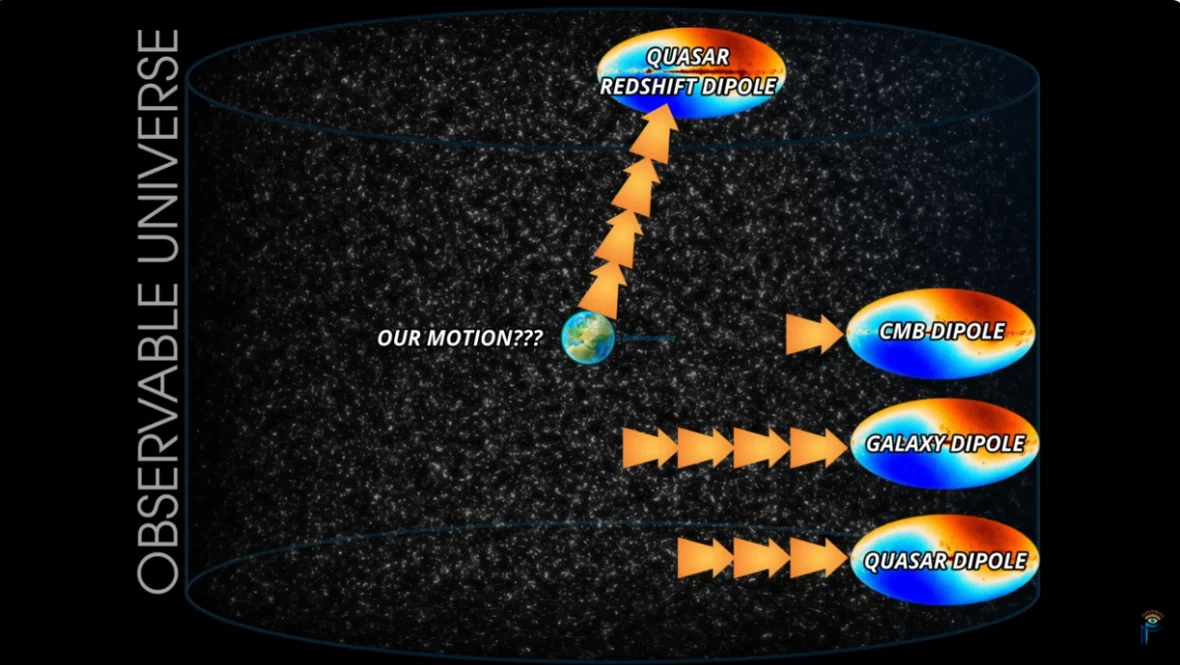
These observations aren’t just minor statistical fluctuations—they’re substantial deviations that require careful explanation. They suggest our cosmic motion is more complex than a simple, uniform universal reference frame would predict.
We know that at astronomical speeds (~1,400 km/s) light sources undergo a Doppler shift, being either red shifted or blue shifted depending on whether you traveling towards them (blue-shifted) or away from them (red-shifted). Now, imagine this kind of Doppler shift was readily visible at terrestrial speeds (~30 km/h) and you were trying to determine your car’s speed by watching how streetlights shift color as you drive. Normally, you’d expect all streetlights to report the same speed and direction. But in this cosmic scenario, different “streetlights”—the CMB, radio galaxies, and quasars—are telling wildly different stories. This suggests the observed shifts might not simply reflect our local motion, but instead reveal fundamental asymmetries woven into the very structure of the cosmos itself, what are called anisotropies.
According to these analyses, the statistical evidence for this anomaly is therefore unambiguous and calls into question the assumption of isotropy underpinning the cosmological principle and hence ΛCDM- A. Martín, C. Skordis, D. J. Bartlett, H. Desmond, P. G. Ferreira, and T. Yasin, “The Cosmological Dipole in Tilted Anisotropic Universes,” Dec. 03, 2025, arXiv: arXiv:2512.03867. doi: 10.48550/arXiv.2512.03867.
Galaxy spin-direction asymmetries: angular momentum as a cosmic compass
Dipoles in brightness and number counts are one thing; asymmetries in the directions of galactic rotation are another. If the universe truly has a preferred axis and large-scale vorticity—as would be the case for a rotating universe—we might expect this to show up not just in how many sources appear in different directions or how fast they seem to be moving, but in how galaxies themselves spin.
Over the past decade, Lior Shamir has assembled an increasingly robust case that galaxy spin directions are not randomly distributed across the sky, but show statistically significant large-scale asymmetries consistent with a cosmological-scale axis [4,5]. Analyses using SDSS, Pan-STARRS, HST, and other surveys have repeatedly found that galaxies with spin opposite to the Milky Way’s rotation as seen from Earth are more common in some parts of the sky (Figure 4), while galaxies rotating in the same sense are more common in others, forming a dipole-like pattern anchored near the Galactic poles.
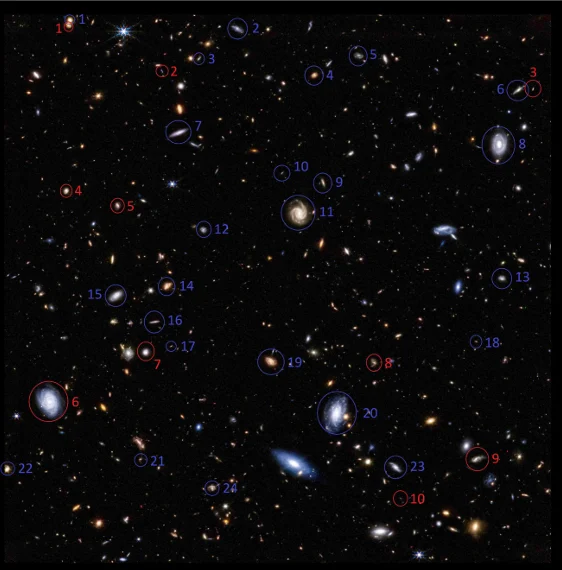
The unprecedented resolving power of the James Webb Space Telescope has now pushed these tests into the early universe. In a 2025 Monthly Notices of the Royal Astronomical Society paper, Shamir analyzed spiral galaxies in the JWST Advanced Deep Extragalactic Survey (JADES), a deep field near the Galactic pole. He found that the number of galaxies whose spiral arms indicate rotation opposite to the Milky Way is about 50% higher than those rotating in the same direction [6]. That asymmetry can be expressed as a few-percent excess in relative counts, but the contrast is so strong that it is visible even to the unaided eye when inspecting the JADES image.
Crucially, the JADES field lies in nearly the same sky region where earlier Hubble deep fields and ground-based digital sky surveys also showed a clockwise/counter-clockwise imbalance in galaxy spins. The JWST results therefore do not stand alone; they extend a pattern that:
- Appears consistently across different instruments and wavelength bands;
- Persists across a wide range of redshifts, with hints that the asymmetry may even strengthen at higher redshift; and
- Can be described in terms of a dipole in spin directions whose axis lies close to the Galactic pole (Figure 5).
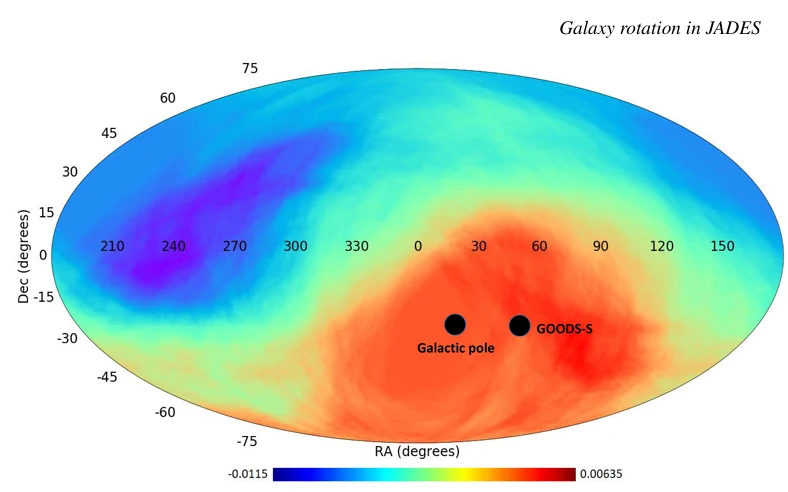
Shamir has argued that conventional explanations—such as relativistic beaming or selection effects—would require implausibly large intrinsic rotation speeds, far exceeding those of typical galaxies, and still fail to account for the coherent dipole axis. In other words, if the spin distribution were truly random in an isotropic universe, we should not see such a stable large-scale pattern emerging over survey after survey.
“An additional cosmological model that requires the assumption of a cosmological-scale axis is the theory of rotating Universe [7,8,9,10,11]. That model is also related to the theory of black hole cosmology [12,13,14,15], according which the Universe is the interior of black hole in a parent universe, and therefore is also aligned with the contention of multiverse.” – L. Shamir, from “The distribution of galaxy rotation in JWST Advanced Deep Extragalactic Survey,” Mon Not R Astron Soc, vol. 538, no. 1, pp. 76–91, Mar. 2025, doi: 10.1093/mnras/staf292.
From the perspective developed in our rotating-universe work, these galaxy spin asymmetries are exactly what one would expect if angular momentum is being seeded and organized by a global rotational field: galaxies forming in different hemispheres of the cosmic flow “inherit” a preferred spin handedness relative to a cosmic rotation axis. The fact that JWST sees the same asymmetries in very distant galaxies that Hubble and ground-based surveys see in nearer galaxies suggests that this is not a local fluke, but a long-lived imprint of the universe’s large-scale rotational structure.
A 15 Mpc rotating filament: direct evidence of cosmic-scale vorticity
While galaxy spin asymmetries tell us that angular momentum is organized on large scales, we would like to see an actual structure in which galaxies clearly share a common rotational motion—something like a giant cosmic flywheel. This is precisely what a recent discovery has delivered.
In a 2025 Monthly Notices of the Royal Astronomical Society article, Madalina Tudorache and collaborators report the discovery of a thin, elongated structure of 14 H I-selected galaxies forming a 1.7 Mpc-long filament embedded within a larger, ∼15 Mpc-scale cosmic web filament at redshift z ≈ 0.032 [17].
Several aspects of this system are striking:
- *The spin axes of the H I galaxies are significantly more strongly aligned with the filament than cosmological simulations predict, with an average |cos ψ| ≈ 0.64 ± 0.05 (compared with ≈0.5 for random orientations).
- *Even the optically selected galaxies in the broader filament show an elevated degree of alignment, |cos ψ| ≈ 0.55 ± 0.05.
- *Kinematic data show strong evidence that the galaxies are orbiting around the spine of the filament itself, indicating coherent rotation on scales of ~15 Mpc—one of the largest rotating structures discovered to date (Figure 6).
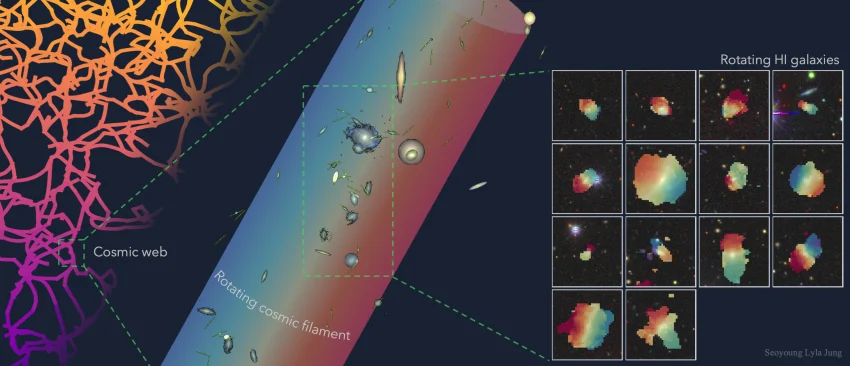
The authors interpret this as evidence that angular momentum is being transferred from the large-scale filament to the individual galaxies, and that the filament is at an early evolutionary stage where the imprint of cosmic matter flow has been preserved over cosmic time. Popular-level coverage has framed it as “one of the largest spinning structures ever seen in the universe,” a direct visual of the cosmic web in rotational motion.
In the context of a rotating universe, this discovery is highly suggestive. If spacetime itself possesses global vorticity, then cosmic filaments are natural channels where that rotation is concentrated, much like vortices in a fluid. Galaxies form and evolve within those filaments, accreting matter and angular momentum from them. A giant, coherently rotating filament therefore looks less like a lucky accident and more like a local expression of a much larger rotational pattern.
Together, the galaxy spin-direction dipoles and the rotating filament provide angular-momentum-based evidence for large-scale anisotropy that parallels the brightness- and number-count dipoles seen in radio galaxies and quasars. Where the dipoles say “something is off in how bright and numerous sources are across the sky,” the spin anomalies say “and that something is also twisting how galaxies themselves rotate.”
According to these analyses, the statistical evidence for these anomalies—radio and quasar dipoles, galaxy-spin asymmetries, and a rotating filament—is therefore unambiguous and calls into question the assumption of isotropy underpinning the cosmological principle and hence ΛCDM. A recent analysis by Martín et al. has already begun to explore how a “tilted,” anisotropic universe might accommodate the observed cosmological dipoles [18]. In effect, the combined data are forcing us to re-examine the assumption that the CMB frame is the unique, globally isotropic rest frame of the cosmos.
In our series of articles for the International Space Federation, we have argued that these cumulative anomalies are not statistical flukes but signatures of a deeper cosmological truth: the universe has a built-in orientation, multiply-connected topology, and rotation [19,20,21,22, 23]. The new radio dipole analysis provides another compelling piece of evidence for this emerging perspective.
What would such a universe look like? Haramein’s earlier work proposed a “rotating double-torus” dynamic that can naturally accommodate these observations: a universe where spacetime itself exhibits fluid dynamic properties, with energy and matter flowing in nested toroidal vortex patterns that repeat fractally from the Planck scale to cosmic scales. In this framework, spacetime behaves as a kind of plasma hydrodynamic medium, organizing itself into double-torus vorticular structures at every scale.
This framework suggests the observed dipoles and rotational asymmetries are not just the result of our local motion, but genuine manifestations of the cosmos’s intrinsic vorticular structure—a kind of cosmic “spin” woven into the fluid dynamics of spacetime itself. While it may seem difficult to conceive of how a universe, comprising all that is, could spin, the concept of a rotating universe dates back to Gödel’s pioneering 1949 solution to Einstein’s field equations [7,22]. The double-torus vortex dynamics introduce large-scale rotational flow patterns that could account for the observed anisotropies in source counts, galaxy spins, and cosmic web rotation.
Is the universe rotating yet? -Kurt Gödel, asking from his deathbed. [Wang, Hao (2002). Reflections on Kurt Gödel. A Bradford book (6. print ed.). Cambridge, Mass.: MIT Press. p. 183.]
From anomalies to topology: a multiply connected universe
In our previous article “A New Signature of a Multiply Connected Universe” [4], we examined a different but related kind of anomaly: a suppression of large-scale temperature-gradient variance in the CMB, discovered by Ralf Aurich, Thomas Buchert, and collaborators [5]. Their analysis suggested that the universe is not spatially infinite and flat, but instead finite and multiply connected, with a topology akin to a three-dimensional torus—the 3D analogue of a doughnut [5]. In such a universe, space loops back on itself: travel far enough in one direction and you eventually return to where you started.
This toroidal topology naturally introduces a characteristic maximum wavelength for primordial perturbations. Temperature fluctuations in the CMB simply cannot be larger than the size of the universe at recombination, so the longest-wavelength modes are suppressed. That suppression is exactly what Aurich and colleagues identified in the Planck data.
Independent work, including a Physical Review Letters paper by Glenn Starkman and collaborators [26], has similarly argued that certain large-scale anomalies in the CMB may be best understood if the universe has a nontrivial, doughnut-like topology rather than a simply connected, infinite geometry. Taken together, these studies make it increasingly plausible that the universe is finite and multiply connected on the largest scales.
In our multiply connected universe article, we emphasized that this finite torus geometry is not just an abstract mathematical curiosity: it affects how light, matter, and even information propagate through cosmic spacetime. It also meshes naturally with the scale-invariant unification programme developed by Haramein, in which the radius and information content of the universe fit coherently into a nested hierarchy of structures from protons to galaxies.
The rotating double-torus: adding global spin to global shape
Topology tells us how space is connected; dynamics tell us how it moves. In “The Rotating Universe,” we explored mounting evidence that the universe as a whole might possess a preferred axis and large-scale spin, despite the standard cosmological assumption of perfect isotropy [21].
Observations of aligned radio jets in active galactic nuclei across hundreds of megaparsecs [23], the so-called “axis of evil” in the CMB, and large-scale structures like the BOSS Great Wall and Laniakea all point to a universe with coherent orientation and flow. To this list we can now add:
- *Large-scale asymmetries in galaxy spin directions forming a dipole-like axis anchored near the Galactic poles;
- *JWST deep-field measurements showing a ~50% excess of galaxies rotating opposite to the Milky Way in the JADES field; and
- *A 15 Mpc rotating galaxy filament where dozens of galaxies share a common orbital motion about the filament spine.
Haramein’s unified physics framework accounts for these phenomena, which fit the model significantly when interpreted as signatures of a double-toroidal, counter-rotating geometry of spacetime itself—a cosmic “bi-torus” in which two interlinked tori channel the flow of energy and information through the universe (Figure 7).
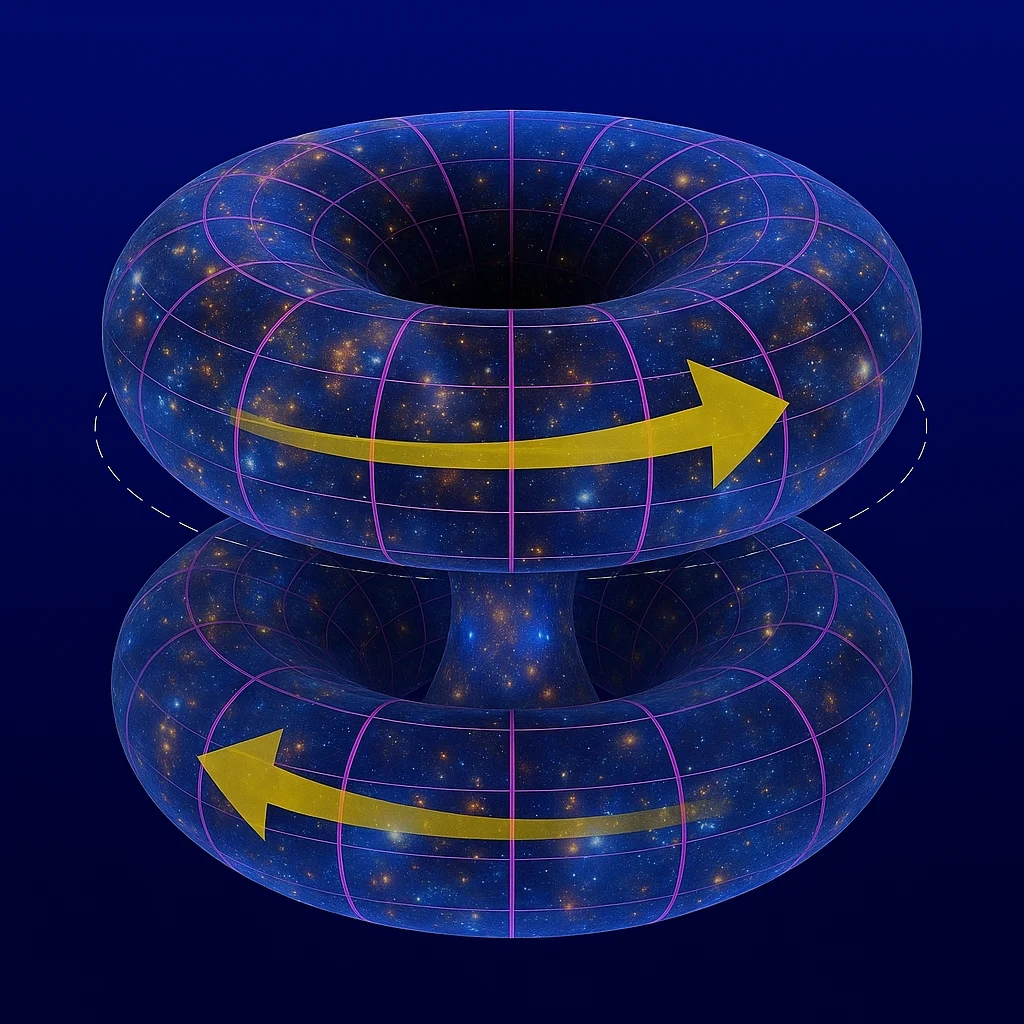
In standard cosmology, a ‘torus universe’ usually means a flat space with periodic boundary conditions – a 3-torus topology. That describes how space is connected: travel far enough in one direction and you eventually return to where you started, not because space is bent like a literal doughnut, but because opposite sides are effectively glued together.
Haramein’s double-torus model, by contrast, is not about the topology of space but about its flow: spacetime behaves like a cosmic vortex, with two interlinked, counter-rotating tori of energy circulating through a central column. This double-torus is a picture of how the universe spins and breathes, not of the abstract shape of the manifold.
These two ideas are not in conflict. In fact, they can be naturally combined: the universe can be globally flat and multiply connected like a 3-torus, while also hosting a large-scale double-toroidal vortex. The topology sets the global connectivity and finite size; the double-torus flow provides the preferred axis and circulation that may underlie observed anomalies such as the CMB ‘axis of evil,’ dark flow, and the excess radio dipole.
In this picture, spin is not an emergent property of already-formed structures; it is intrinsic to the fabric of spacetime. Torque and Coriolis terms in the Einstein field equations give rise to rotation at every scale, from subatomic particles to galaxies to the universe as a whole. Haramein and Rauscher’s work on the origin of spin shows that including these terms naturally produces structures like accretion disks, jets, and spiral arms without invoking exotic dark matter [27].
Crucially, a double-toroidal rotating universe is both anisotropic and multiply connected. It has a built-in axis—the spin axis of the double torus—and a nontrivial topology that loops back on itself. The multiply connected torus inferred from CMB analysis specifies the global connectivity; the double-toroidal rotation specifies the global flow.
Interpreting the radio dipole in a double-torus universe
How do the new radio, quasar, and galaxy-rotation results fit into this framework?
In standard cosmology, the number-count dipole is almost entirely kinematic. There is no intrinsic large-scale anisotropy; if we were at rest in the CMB frame, the radio sky would be statistically isotropic. Any significant excess in the observed dipole must then be attributed to systematics, local structures, or an unexpectedly large peculiar velocity.
In a rotating, double-toroidal universe, that premise changes. Because spacetime itself has a preferred axis and global vorticity, there is a real, dynamical asymmetry in how mass and radiation are distributed and transported on the largest scales. Wormhole-like Einstein–Rosen bridges connect regions across the double torus, entangling black holes and galaxies into a coherent network of flows (Godel’s rotating universe has the feature of intrinsic closed time-like curves, which are naturally explained by multiple connectivity of Einstein-Rosen bridge geometry). Apparent “sources” and “sinks” emerge from this flow, subtly biasing the orientation of large-scale structures.
An observer embedded in such a universe would still see a kinematic dipole from their local motion, but now superimposed on an intrinsic dipole arising from the global geometry and spin. Radio galaxies, which trace massive structures over gigaparsec scales, would preferentially cluster and beam along directions aligned with the cosmic rotation axis and the principal flow paths of the double torus.
In this context, the 3.7-fold excess in the radio source-count dipole and the ~4–5× excess quasar dipole are not merely telling us that “we are moving faster than we thought.” They are telling us that the universe itself has a built-in directional bias, and our motion is partially aligned with that bias. The close alignment of the radio dipole with the CMB dipole direction—within about 5–10 degrees—is then natural: both are responding to the same underlying global structure, not just to our local peculiar velocity.
Galaxy spin-direction asymmetries and rotating filaments add another layer: they show that angular momentum itself is organized relative to this preferred axis. Galaxies in certain hemispheres of the sky tend to rotate in a preferred sense relative to the Milky Way, and entire filaments can exhibit coherent orbital motion about their spines. In a double-torus universe, this is precisely what one expects: matter falling along the toroidal flows acquires spin aligned (or anti-aligned) with the global vorticity, much as water draining into a whirlpool tends to spin in the direction of the larger vortex (Figure 8).
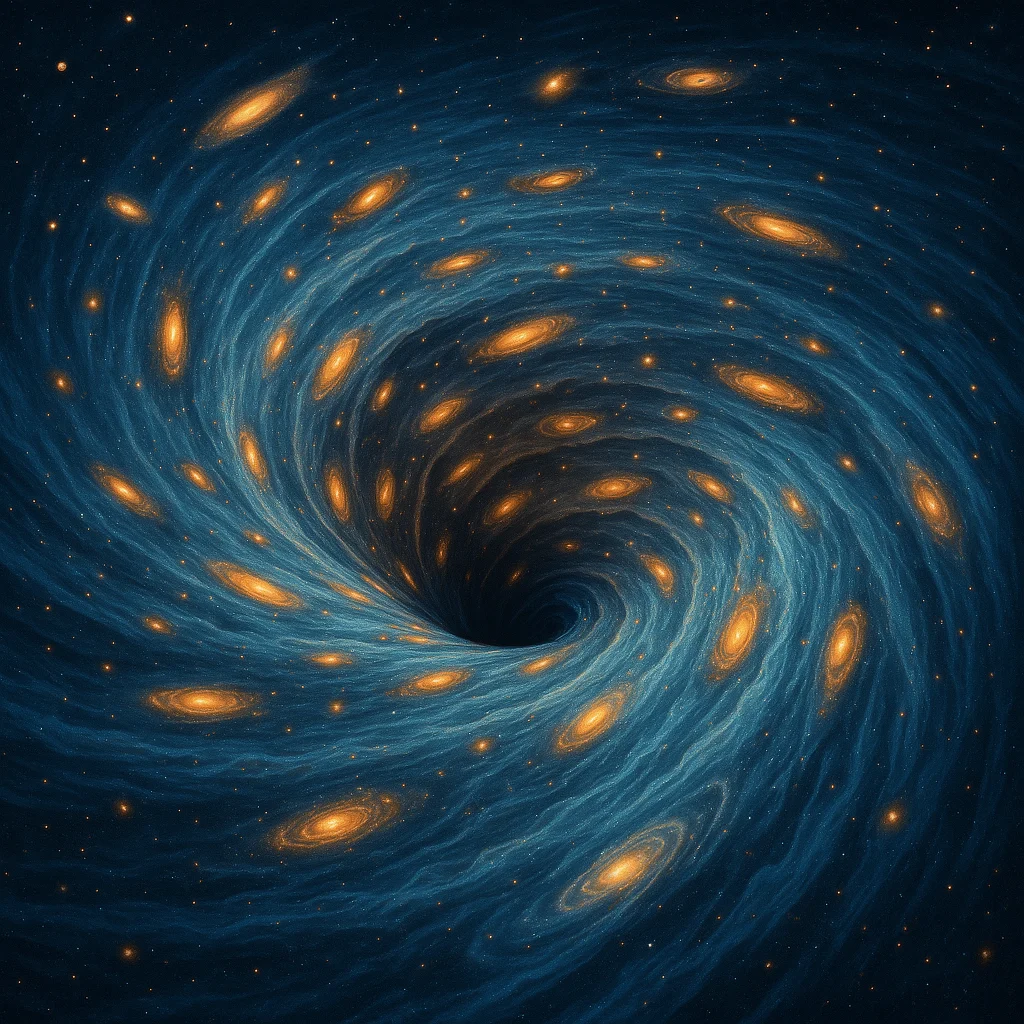
A 3-torus topology adds another subtlety. In a multiply connected space, geodesics—the “straightest” possible paths—can wrap around the torus multiple times, meaning that light from a given structure can reach us along different paths and at different apparent locations on the sky. This can generate apparent anisotropies and correlations at large angular scales even if the local statistics of structure formation are the same everywhere. In the combined 3-torus and rotating universe scenario, the large-scale distribution of radio galaxies is shaped both by topological identifications and by coherent global spin.
One can then view the radio dipole anomaly and the CMB topology anomaly as two sides of the same coin: the first is a number-count dipole in the present-day distribution of massive radio galaxies; the second is a variance deficit and mode cut-off in the primordial radiation field. Both are imprints of the same finite rotating universe. Add to this the galaxy spin-direction dipoles and the discovery of a 15 Mpc rotating filament and the emerging picture becomes compelling: our cosmos possesses an intrinsic spin, organized flow, and multiply connected topology.
Towards testable predictions
A speculative interpretation is only useful if it leads to testable predictions. The 3-torus topology and rotating universe model suggest several concrete avenues for future work:
First, the intrinsic component of the radio dipole should depend on redshift in a way that differs from a purely kinematic dipole. A detailed tomographic analysis of radio source counts in different redshift slices could disentangle local bulk flows from truly cosmological anisotropies. If the excess dipole persists and perhaps even strengthens at higher redshift, that would favour a global origin.
Second, we should observe more rotating filaments and sheets. The rotating filament of Tudorache et al. should not be unique. If cosmic vorticity is a generic feature, we should find many such structures: rotating filaments, walls, and perhaps even large-scale sheet-like flows. Mapping their distribution, spin axes, and kinematics will provide a direct test of how angular momentum is sourced by the cosmic web.
Third, a double-toroidal universe implies a pattern of higher-order multipoles—quadrupole and octupole alignments—that should be consistent between the CMB, the large-scale distribution of galaxies, and other tracers such as weak lensing and the gravitational-wave background [28].
Fourth, next-generation radio facilities like the Square Kilometre Array will dramatically expand the sample of radio galaxies and the range of frequencies and baselines over which we can measure the dipole and higher multipoles. In our rotating universe article, we pointed out that such instruments will be crucial for mapping galactic magnetic field interactions and testing the coherence of spin alignments over cosmological scales. They will also be essential for confirming whether the excess radio dipole is a persistent, stable feature of the cosmos or a mirage that fades under even deeper scrutiny.
Finally, if the universe is truly a rotating double torus, there may be subtle signatures in time-domain and polarimetric data—for example, preferred directions in polarization vectors of high-redshift radio sources and quasars, or correlations between the radio dipole and anisotropies in the cosmic acceleration inferred from supernovae. These cross-correlations would provide powerful, independent tests of the model. Cross-correlating multiple probes is key to building a statistically robust case, not simply by stacking measurements but by testing whether independent lines of evidence cohere.
It’s like the analogy of multiple blind‑folded researchers trying to describe an elephant: one reports the trunk’s texture and motion, another the wiry tail, and yet another the weight distribution at the right foot. Only by comparing notes, aligning their measurement scales, and reconciling independent uncertainties can they infer the full animal rather than three conflicting stories. Compounding anomalies are the “elephant in the room” in cosmology and demand a systematic analysis to build a unified picture. Indeed, the implications of a rotating universe are not insignificant, it not only answers a fundamental question about the nature of our universe, and hence existence, but also researchers such as Xiang He posits that it holds the answer to the Theory of Everything [29].
Conclusion: a growing case against perfect isotropy
The new “overdispersed radio source counts” study does not by itself prove that the universe is a rotating double torus. Nor do the JWST galaxy-spin asymmetries or the 15 Mpc rotating filament, taken in isolation, force us to abandon ΛCDM. Böhme and collaborators remain appropriately cautious, emphasizing the need to further test for residual systematics and to refine the modelling of multi-component radio sources. Shamir likewise acknowledges that more data and independent analyses are required to fully settle the question of galaxy spin asymmetries, and Tudorache et al. point out that a single rotating filament might, in principle, be a rare but still compatible feature in standard cosmology.
But the fact that these anomalies survive careful statistical scrutiny, and that they point in a broadly consistent direction, is significant.
When we place these results alongside:
- *The CMB topology signature of a finite, toroidal universe;
- *The large-scale spin alignments of active galactic nuclei;
- *Other anisotropies like the axis of evil, dark flow, walls and supervoids [30];
- *The early emergence of galaxies that shouldn’t exist [31]; and
- *Now the excess dipole measurements, galaxy spin-direction asymmetries, and a giant rotating filament that standard ΛCDM struggles to reconcile;
a coherent picture begins to emerge. The cosmological principle—the assumption that the universe is homogeneous and isotropic on large scales—may be incorrect.
In the unified physics perspective we have been developing, a rotating, multiply connected, double-toroidal universe is not an ad hoc patch but a natural outcome of treating spacetime as a dynamic, spinning, information-bearing medium. In such a cosmos, anisotropies are not nuisances to be averaged away; they are the fingerprints of the universe’s deep geometry. The excess radio and quasar dipoles, the asymmetric distribution of galaxy spin directions, and the discovery of a 15 Mpc rotating filament may be some of the clearest of those fingerprints so far.
References
[1] L. Böhme et al., “Overdispersed Radio Source Counts and Excess Radio Dipole Detection,” Phys. Rev. Lett., vol. 135, no. 20, p. 201001, Nov. 2025, doi: 10.1103/6z32-3zf4.
[2] “Our solar system is moving faster than expected,” EurekAlert! press release on Overdispersed Radio Source Counts and Excess Radio Dipole Detection (2025).https://www.eurekalert.org/news-releases/1105872
[3] [A. K. Singal, “Solar peculiar motion inferred from dipole anisotropy in redshift distribution of quasars appears to lie along the Galactic Centre direction,” Sci Rep, vol. 15, no. 1, p. 31805, (August, 2025), doi: 10.1038/s41598-025-13426-0.
[4] L. Shamir, “Analysis of spin directions of galaxies in the DESI Legacy Survey,” Mon Not R Astron Soc, vol. 516, no. 2, pp. 2281–2291, Oct. 2022, doi: 10.1093/mnras/stac2372.
[5] L. Shamir, “Galaxy spin direction asymmetry in JWST deep fields,” Publications of the Astronomical Society of Australia, vol. 41, p. e038, Jan. 2024, doi: 10.1017/pasa.2024.20.
[6] L. Shamir, “The distribution of galaxy rotation in JWST Advanced Deep Extragalactic Survey,” Mon Not R Astron Soc, vol. 538, no. 1, pp. 76–91, Mar. 2025, doi: 10.1093/mnras/staf292.
[7] K. Gödel, “An Example of a New Type of Cosmological Solutions of Einstein’s Field Equations of Gravitation,” Rev. Mod. Phys., vol. 21, no. 3, pp. 447–450, Jul. 1949, doi: 10.1103/RevModPhys.21.447.
[8] I. Ozsváth and E. Schücking, “Approaches to Gödel’s rotating universe,” Class. Quantum Grav., vol. 18, no. 12, p. 2243, Jun. 2001, doi: 10.1088/0264-9381/18/12/301.
[9] K. Arun and C. Sivaram, “Primordial Rotation of the Universe, Hydrodynamics, Vortices and Angular Momenta of Celestial Objects,” AACE Clinical Case Reports, vol. 7, no. 1, p. 1, 2012. ; L. M. Chechin, “Rotation of the Universe at different cosmological epochs,” Astron. Rep., vol. 60, no. 6, pp. 535–541, Jun. 2016, doi: 10.1134/S1063772916040041.
[10] L. Campanelli, “A Conjecture on the Neutrality of Matter,” Found Phys, vol. 51, no. 3, p. 56, Apr. 2021, doi: 10.1007/s10701-021-00462-9.
[11] U. V. S. Seshavatharam, and S. Lakshminarayana. 2021. “An Integrated Model of a Light Speed Rotating Universe”. International Astronomy and Astrophysics Research Journal 2 (1):282–290. https://www.journaliaarj.com/index.php/IAARJ/article/view/32 .
[12] R. K. Pathria, “The Universe as a Black Hole,” Nature, vol. 240, no. 5379, pp. 298–299, Dec. 1972, doi: 10.1038/240298a0.
[13] W. M. Stuckey, “The observable universe inside a black hole,” Am. J. Phys., vol. 62, no. 9, pp. 788–795, Sep. 1994, doi: 10.1119/1.17460.
[14] D. A. Easson and R. H. Brandenberger, “Universe generation from black hole interiors,” J. High Energy Phys., vol. 2001, no. 06, p. 024, Jul. 2001, doi: 10.1088/1126-6708/2001/06/024.
[15] Tatum et al. 2018 ; H. Chakrabarty, A. Abdujabbarov, D. Malafarina, and C. Bambi, “A toy model for a baby universe inside a black hole,” Eur. Phys. J. C, vol. 80, no. 5, p. 373, May 2020, doi: 10.1140/epjc/s10052-020-7964-0.
[17] M. N. Tudorache et al., “A 15 Mpc rotating galaxy filament at redshift z = 0.032,” Mon Not R Astron Soc, vol. 544, no. 4, pp. 4306–4316, Dec. 2025, doi: 10.1093/mnras/staf2005.
[18] W. Brown, “A New Signature of a Multiply Connected Universe,” International Space Federation (2022). https://spacefed.com/astronomy/a-new-signature-of-a-multiply-connected-universe/
[19] A. Martín, C. Skordis, D. J. Bartlett, H. Desmond, P. G. Ferreira, and T. Yasin, “The Cosmological Dipole in Tilted Anisotropic Universes,” Dec. 03, 2025, arXiv: arXiv:2512.03867. doi: 10.48550/arXiv.2512.03867.
[20] R. Aurich, T. Buchert, M. J. France, and F. Steiner, “The variance of the CMB temperature gradient: a new signature of a multiply connected Universe,” Class. Quantum Grav., vol. 38, no. 22, p. 225005, Oct. 2021, doi: 10.1088/1361-6382/ac27f0.
[21] W. Brown, “The Rotating Universe,” International Space Federation (2020). https://spacefed.com/astronomy/the-rotating-universe/
[22] W. Brown, “Mach’s Principle and Gödel’s Rotating Universe – The International Space Federation (ISF).” (2014). [Online]. Available: https://spacefed.com/physics/machs-principle-and-godels-rotating-universe/
[23] W.Brown, “Physicist Nassim Haramein’s Prediction that the Universe is Rotating Receives a Second Strong Observational Confirmation – The International Space Federation (ISF).” (March, 2020). Available: https://spacefed.com/physics/physicist-nassim-harameins-prediction-that-the-universe-is-rotating-receives-a-second-strong-observational-confirmation/.
[24] Wang, Hao (2002). Reflections on Kurt Gödel. A Bradford book (6. print ed.). Cambridge, Mass.: MIT Press. p. 183.
[25] E. Conover, “The shape of our universe may be complex — like a doughnut,” Science News Explores (2024). https://www.snexplores.org/article/complex-universe-doughnut-shape .
[26] P. M. Vaudrevange, G. D. Starkman, N. J. Cornish, and D. N. Spergel, “Constraints on the topology of the Universe: Extension to general geometries,” Phys. Rev. D, vol. 86, no. 8, p. 083526, (Oct. 2012), doi: 10.1103/PhysRevD.86.083526.
[27] Haramein, N., and Rauscher, E. A. (2005). The orgin of spin: A consideration of torque and coriolis forces in Einstein’s field equations and grand unification theory. Beyond The Standard Model: Searching for Unity in Physics, 1, 153-168. https://spacefed.com/isf-research/the-origin-of-spin-a-consideration-of-torque-and-coriolis-forces-in-einsteins-field-equations-and-grand-unification-theory/ .
[28] W.Brown, “Pulsar Network Reveals Indications of Gravitational Wave Background Permeating Spacetime – The International Space Federation (ISF).” (January, 2022). Available: https://spacefed.com/astronomy/pulsar-network-reveals-indications-of-gravitational-wave-background-permeating-spacetime/
[29] X. He, A Rotating Universe: The Revolutionary Theory of Everything: A Brief History of Timelessness. 2025.
[30] W. Brown, “Eridanus Supervoid May Explain Cosmic Microwave Background Anomalous Cold Spot – The International Space Federation (ISF).” (February, 2022). Available: https://spacefed.com/astronomy/eridanus-supervoid-may-explain-cosmic-microwave-background-anomalous-cold-spot/
[31] “‘Black Hole Stars’ Detected at Cosmic Dawn – The International Space Federation (ISF).” Accessed: (2025). Available: https://spacefed.com/astronomy/black-hole-stars-detected-at-cosmic-dawn/.