


A new quantum study sparks debate—but doesn’t rule out guided trajectories
A recent experiment has been making the rounds with bold claims: that it challenges Bohmian mechanics, the quantum interpretation that says particles follow well-defined paths guided by an invisible “pilot wave.”
So, has the famous non-local deterministic interpretation of quantum theory really been “ruled out”? The headline sounds dramatic—but the reality is more nuanced. Let’s break down what the experiment actually did, what it observed, and why its conclusion may not hold up under closer scrutiny.
The Experiment
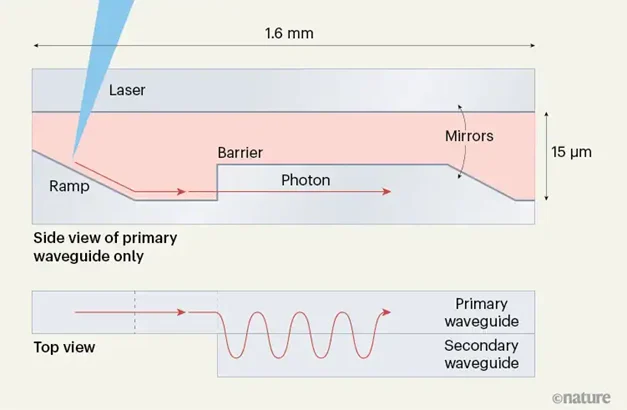
The experiment was reported in a Nature paper entitled Energy–speed relationship of quantum particles challenges Bohmian mechanics. In this experiment, researchers built a quantum system using two coupled waveguides—imagine thin optical tracks that let particles or photons flow along controlled paths. By launching particles into this setup and tracking how population shifted between the waveguides, the researchers inferred how fast the particles moved, especially within a region where the quantum wavefunction was decaying.
Here’s the key finding:
Particles with lower energy inside the barrier-like region appeared to travel faster through it. This was interpreted as a contradiction with Bohmian mechanics, which traditionally predicts slower velocities in such decaying wavefunction regions.
The Claim: Bohmian Trajectories Don’t Match the Data?
The authors argued that the measured speeds don’t match what would be predicted if particles were truly following Bohmian trajectories. They suggested that the experiment challenges the validity of the Bohmian picture.
But this interpretation misses several crucial points.
Why This Doesn’t Rule Out Bohmian Mechanics
Let’s address the core issues:
- Bohmian velocity ≠ measured speed.
The experiment doesn’t directly measure particle velocities—it infers average speeds from population transfer timing. Bohmian velocity, on the other hand, is derived from the phase of the wavefunction, not from particle arrival times. - Coupled systems require generalized Bohmian rules.
The standard Bohmian velocity formula applies to single-wavefunction systems. In this experiment, the waveguides are modeled with coupled Schrödinger equations, so the usual formula doesn’t apply. When properly adjusted, Bohmian mechanics still fits the system’s dynamics. - Scalar speed ≠ directional velocity.
What the experiment infers is a scalar “speed” (without direction), whereas Bohmian mechanics involves a vector velocity. Comparing the two directly leads to mismatched conclusions.
In fact, as Hrvoje Nikolić recently showed in a response paper, when the correct Bohmian continuity equations are applied to this system, a consistent set of velocities emerges—one that fits the observed particle densities perfectly. No contradiction remains.
What About the Strange Speeds? A Tunneling Time Twist
A particularly intriguing outcome of the experiment was that particles appeared to move faster through lower-energy regions—an apparent paradox that recalls the long-standing debate over quantum tunneling time.
Tunneling is a hallmark quantum effect where particles pass through barriers that should be impenetrable. But for decades, physicists have debated: How long does this actually take?
There’s no single answer. Different theoretical models—like dwell time, phase time, and Larmor time—offer conflicting predictions. Some even imply superluminal tunneling, where particles seem to exit the barrier before they should be able to.
In this experiment, the inferred faster speeds might suggest shorter traversal times through the barrier-like region, linking directly to this tunneling time puzzle.
Here’s where Bohmian mechanics offers clarity:
- In Bohmian terms, particles do pass through the barrier, not around it.
- Their trajectories are guided by the entire shape of the wavefunction—meaning the particle doesn’t “feel” only the local potential but is influenced by the global quantum structure.
- Even if the local energy is negative, the Bohmian velocity can remain well-defined and non-zero due to the pilot wave’s guidance.
So yes—the particles can appear to move faster through a classically forbidden region. But it’s not magic or paradox. It’s the result of nonlocal quantum guidance, not a breakdown of physical law.
Conclusion: A Misinterpretation, Not a Falsification
This experiment is a fascinating and elegant contribution to quantum research. But its claim to “challenge” Bohmian mechanics doesn’t hold up under scrutiny. The apparent contradiction arises from applying the wrong velocity formula and misinterpreting indirect measurements.
When Bohmian mechanics is applied properly—even to systems as complex as coupled waveguides—it remains fully consistent with quantum predictions.
The real lesson here?
Quantum mechanics continues to challenge our intuitions—but with the right interpretive tools, it doesn’t have to seem like magic.
Bottom line: Bohmian mechanics remains fully consistent with quantum predictions. This paper challenges an interpretation, not the theory itself.