

Mass, gravity and confinement at the nuclear scale are derived from first principles through a spacetime mechanism in which electromagnetic quantum vacuum fluctuations—historically derived from black-body radiation—induce metric perturbations that serve as a foundational source.
Haramein, N., and Guermonprez, C., Alirol, O. (2023). The Origin of Mass and the Nature of Gravity. https://zenodo.org/doi/10.5281/zenodo.8381114
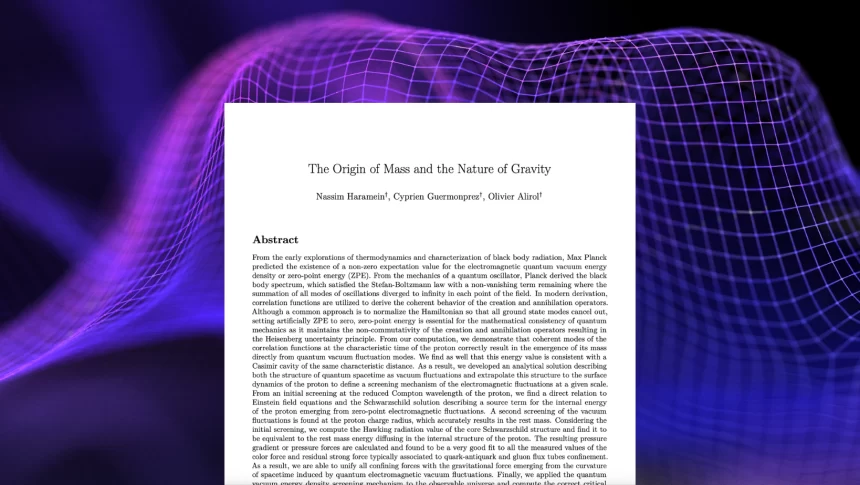
From the early explorations of thermodynamics and characterization of black body radiation, Max Planck predicted the existence of a non-zero expectation value for the electromagnetic quantum vacuum energy density or zero-point energy (ZPE). From the mechanics of a quantum oscillator, Planck derived the black body spectrum, which satisfied the Stefan-Boltzmann law with a non-vanishing term remaining where the summation of all modes of oscillations diverged to infinity in each point of the field. In modern derivation, correlation functions are utilized to derive the coherent behavior of the creation and annihilation operators. Although a common approach is to normalize the Hamiltonian so that all ground state modes cancel out, setting artificially ZPE to zero, zero-point energy is essential for the mathematical consistency of quantum mechanics as it maintains the non-commutativity of the creation and annihilation operators resulting in the Heisenberg uncertainty principle. From our computation, we demonstrate that coherent modes of the correlation functions at the characteristic time of the proton correctly result in the emergence of its mass directly from quantum vacuum fluctuation modes. We find as well that this energy value is consistent with a Casimir cavity of the same characteristic distance. As a result, we developed an analytical solution describing both the structure of quantum spacetime as vacuum fluctuations and extrapolate this structure to the surface dynamics of the proton to define a screening mechanism of the electromagnetic fluctuations at a given scale. From an initial screening at the reduced Compton wavelength of the proton, we find a direct relation to Einstein field equations and the Schwarzschild solution describing a source term for the internal energy of the proton emerging from zero-point electromagnetic fluctuations. A second screening of the vacuum fluctuations is found at the proton charge radius, which accurately results in the rest mass. Considering the initial screening, we compute the Hawking radiation value of the core Schwarzschild structure and find it to be equivalent to the rest mass energy diffusing in the internal structure of the proton. The resulting pressure gradient or pressure forces are calculated and found to be a very good fit to all the measured values of the color force and residual strong force typically associated to quark-antiquark and gluon flux tubes confinement. As a result, we are able to unify all confining forces with the gravitational force emerging from the curvature of spacetime induced by quantum electromagnetic vacuum fluctuations. Finally, we applied the quantum vacuum energy density screening mechanism to the observable universe and compute the correct critical energy density typically given for the total mass-energy of the universe.
Download the paper “The Origin of Mass and Nature of Gravity” here: https://zenodo.org/doi/10.5281/zenodo.8381114
Watch the walkthrough tutorial here
Comments and Testimonials
Thank you for sending a preprint of your paper on The Origin of Mass and the Nature of Gravity. It presents some very interesting ideas which in my opinion merit further development and exploration. The arguments leading up to Eqs. (1.6), (1.8) and Figure 5 are especially interesting. The ways in which you bring vacuum field fluctuations into the general framework of your theory are particularly interesting to me, as I have been interested in electromagnetic vacuum fluctuation effects for many years. And I appreciate the fact that you have provided detailed numerical estimates supporting your discussions. Download the full testimonial here.
Peter W. Milonni , Research Professor of Physics, University of Rochester, Laboratory Fellow (ret.), Los Alamos National Laboratory