
By using this site, you agree to the Privacy Policy.
Accept
The International Space Federation (ISF)The International Space Federation (ISF)The International Space Federation (ISF)
  • Science News
    • All Articles
    • Physics
    • Astronomy
    • Biology
    • Technology
    • Other
  • Research
    • Research Papers
    • Physicists Testimonials
  • Technology
  • About
    • About us
  • ISF News
  • Events
    • Events
  • Get Involved
    • Invest
    • Donate – Zero Point Foundation
  • Careers
  • Contact Us
Reading: Probing Quantum Magnetism with Near Absolute Zero SU(N) Atoms
Share
The International Space Federation (ISF)The International Space Federation (ISF)
Search
  • Science News
    • Physics
    • Astronomy
    • Biology
    • Technology
  • Research Papers
    • Physicists Testimonials
  • About
    • ISF News
  • Events
  • Get involved
    • Invest
  • Translations
    online pharmacy https://worldneurologyonline.com/ no prescription pharmacy
Follow US
© 2022 International Space Federation. All Rights Reserved.
The International Space Federation (ISF) / Explore / Physics / Probing Quantum Magnetism with Near Absolute Zero SU(N) Atoms
Physics

Probing Quantum Magnetism with Near Absolute Zero SU(N) Atoms

Absolute zero is the temperature at which all physical dynamics come to a halt. The laws of physics however do not allow us to attain absolute zero.

Amal Pushp
Last updated: 2024/04/02 at 2:02 PM
Amal Pushp
Share
4 Min Read
SHARE

Absolute zero is the temperature at which all physical dynamics come to a halt. The laws of physics however do not allow us to attain absolute zero. This fact unfolds from a fundamental feature of quantum mechanics according to which fluctuations are always occurring at the quantum level and the quantum particles always have enough energy to continue their dynamical motion unlike in a classical system. Such a system contains quantum mechanical energy even at absolute zero and this energy is technically called zero-point energy. However, physicists can achieve temperatures close to absolute zero in an advanced laboratory. Examples where working near absolute zero is common include quantum phenomena like Bose-Einstein condensation, superconductivity, superfluidity, etc.

Now in yet another situation, physicists from Japan and the US have succeeded in cooling atoms of Ytterbium (an element also used in making atomic clocks) close to about one-billionth of a degree of absolute zero, as reported in the press release by Rice university. To get an idea of how cold this is, one might compare it with the temperature of interstellar space which is about 2.7 Kelvin. Note that this temperature of space is determined by measuring the cosmic microwave background radiation (CMB). In the new work researchers have cooled atoms to a temperature that is 3 billion times colder than outer space, let that sink in! The research team primarily used laser to cool the atoms to ultra-cold levels and subsequently built a quantum magnet based on a spin-like property.

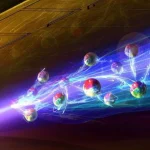
A chain of single-atom magnets (red spheres with black arrows indicating north-south orientation) that repel one another. Image and Text Source: Harvard University

In condensed matter theory, physicists generally use an ansatz or an approximation known as the Hubbard model to describe the behavior of solids, high-temperature superconductors, quantum magnets, etc.  In the new work which got published in nature physics [1], physicists used Hubbard models with a special symmetric property arising from a mathematical framework called group theory. The property is known as SU(N), where SU stands for special unitary group and N signifies the possible spin states of particles considered within the model. The complexity of magnetic behavior inside the system under study is also directly proportional to the number N.

The atoms of Ytterbium have six spin states so that the symmetry becomes SU(6). Moreover, the Hubbard model that was simulated in this work is interestingly the first simulation to reveal magnetic relationships in an SU(6) model, calculations of which are impossible to make even on a powerful modern-day supercomputer. As the corresponding author of the study, Kaden Hazzard says, “That’s the real reason to do this experiment. Because we’re dying to know the physics of this SU(N) Hubbard model”.

The novel work paves the way for further developments and new tools are anticipated which will be able to measure atomic correlations and discover subtler and more exotic phases of matter as well as inflate the boundaries of research within condensed matter in general and quantum magnetism specifically.

References

[1] Shintaro Taie et al., Observation of antiferromagnetic correlations in an ultracold SU(N) Hubbard model, Nature Physics (2022). DOI: 10.1038/s41567-022-01725-6
Sign Up For Daily Newsletter

Be keep up! Get the latest breaking news delivered straight to your inbox.
loader

loader

loader

By signing up, you acknowledge the data practices in our Privacy Policy. You may unsubscribe at any time.
En vous inscrivant, vous reconnaissez les pratiques en matière de données dans notre politique de confidentialité. Vous pouvez vous désinscrire à n'importe quel moment.
Al registrarse, reconoce las prácticas de datos en nuestra política de privacidad. Puedes darte de baja en cualquier momento.
Share This Article
Facebook Twitter Copy Link Print
Previous Article First Observation of an Exotic Light-Matter Coupled State
Next Article The Generalized Holographic Model, Part II: Quantum Gravity and the Holographic Mass Solution

Stay Connected

981k Like
18.7k Follow
7.7k Follow
7.3k Subscribe

Categories

  • Astronomy106
  • Biology69
  • ISF News25
  • ISF Research14
  • Other22
  • Physics168
  • Technology36

You Might also Like

Physics

Gravitational Waves Leave Their Mark on Atomic Light: A New Window into Vacuum Field Physics

22. April 2026.
BiologyPhysics

Do Cells Use a Quantum Compass to Heal Wounds?

2. December 2025.
Physics

Space-Memory Experiments: Quantum Memory Matrix Results Explained

3. October 2025.
Physics

From Bit to Quanta: New Theory Links Entanglement to Particle Creation

17. September 2025.
The International Space Federation (ISF)The International Space Federation (ISF)

Harnessing quantum vacuum energy for sustainable solutions – a unified approach to science, technology and education.

Quick links

  • About
  • Research Papers
  • Events
  • Invest

Explore

  • ISF Research
  • Physics
  • Technology
  • Astronomy
  • Biology
  • ISF News

Sign Up for Our Newsletter

Subscribe to our newsletter to get our newest articles instantly!

loader

Follow US
© 2023 International Space Federation. All Rights Reserved. INTERNATIONAL SPACE FEDERATION is a trademark of ISFS SA. The mark is registered in the United States under Registration No. 7772313. The ®️ symbol is used exclusively in the U.S.
  • Press
  • Careers
  • Privacy policy
  • Carrieres
  • Presse
  • Prensa
Join Us!

Subscribe to our newsletter and never miss our latest news.

loader

Welcome Back!

Sign in to your account

Lost your password?