

Experimental evidence of quantum behavior in neural microtubules could support Penrose and Hameroff’s hypothesis that consciousness originates in the microtubules of the neurons, as described by their theory called Orchestrated objective reduction (Orch -OR).
In former RSF articles [1,2,3], biophysicist William Brown had addressed the Orchestrated objective reduction theory (Orch OR), originally proposed by physicist Roger Penrose and anaesthesiologist Stuart Hameroff, in the 1990.
As William Brown brilliantly explains [1]:
“One of the key features of Hameroff’s and Penrose’ theory is called Orchestrated Objective Reduction (Orch-OR), in which it is theorized that the state vector (the wavefunction that describes a particle) of delocalized free electrons within tubulin undergoes an observer-independent reduction (an objective versus subjective collapse of the wavefunction). As the electron exhibits more and more nonlocal attributes, what is referred to as a superposition, the underlying spacetime geometry bifurcates, and the degree of separation between the spacetime “bubbles” – measured in Planck lengths – reaches a critical distance, at which time the spacetime geometry becomes unstable and collapses.”
And he adds: “This mechanism is referred to as the Diósi-Penrose criterion of gravity-induced quantum collapse. Each such bifurcation and collapse represents an indeterminable quantum computation, and the coordination of a multitude of such events through quantum entanglement (the orchestrated part of OR) allows for massively parallel quantum computations within the brain. As Hameroff and Penrose suggest, this is what produces conscious awareness. Since, reduction of the state vector is due entirely to this stochastic mechanism, and is therefore in-determinate, it bestows a characteristic of unpredictability to consciousness.”
Tubulin refers to a family of globular proteins, and they polymerize into microtubules, a major component of the cytoskeleton in eukaryotic cells (animal and plant cells). Microtubules play an essential role in cellular processes, such as mitosis (cellular division).
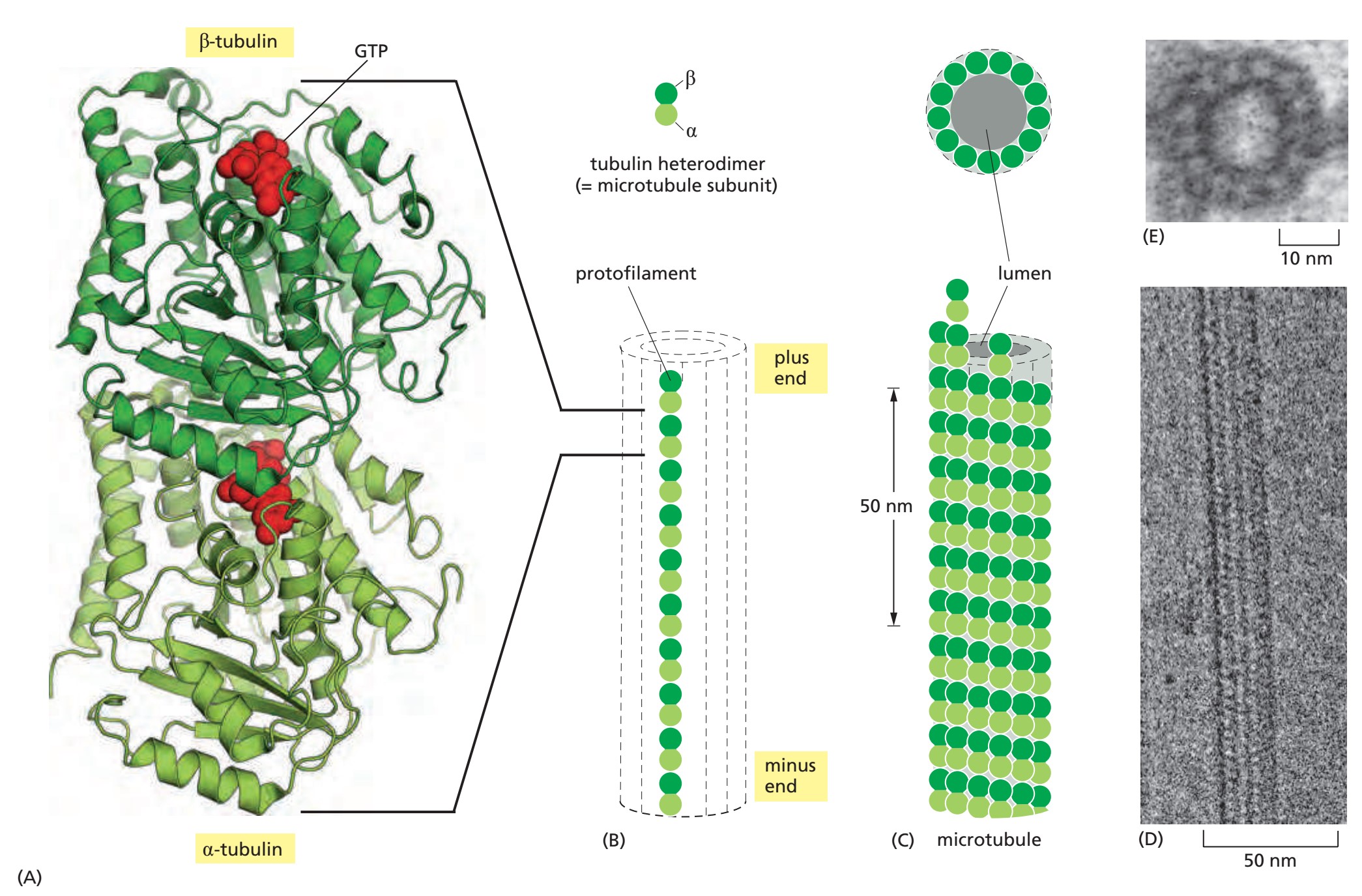
Figure: (A) Tubulin heterodimers α/β. GTP molecules are shown in red. (B) Schematics of one subunit and one protofilament.(C) Stiff hollow microtubule consists of 13 protofilaments. (D) A short segment view of microtubule under electron microscope. (E) A view of ring structure constituted by 13 protofilaments under electron microscope.
(Source: Alberts, et al. Molecular Biology of the Cell 6th, 2014).
The idea that quantum effects in the microtubules inside neurons are mainly responsible for consciousness, has been strongly debated, for one main reason: quantum regime is extremely sensible to noise and temperature, so any quantum coherence inside microtubules would be swiped away by the warmth noisy conditions in the brain, at time scales much before it could have any effect on the neurons. The belief that quantum regime is extremely fragile, is deeply backed-up by quantum theory and experimental observations.
Nevertheless, compelling evidence has surfaced, that quantum effects may be observed in such noisy and warm biological environments, thanks to research from Jack Tuszynski at the University of Alberta in Canada and his colleagues. They have observed that light shone on microtubules was very slowly re-emitted over several minutes. Following Tuszynsk experiments, it takes hundreds of milliseconds for tubulin units to emit half of the light, and it takes more than a second for full microtubules. Interestingly, human brain takes comparable timescales to process information.
“Orchestrated objective reduction (Orch OR) theory postulates that brain microtubules are the place where gravitational instabilities in the structure of space-time break the delicate quantum superposition between particles, and this gives rise to consciousness” Thomas Lewton, New Scientist magazine.
Since light emission -known as luminescence- is a quantum phenomenon, this experimental finding showing that quantum effects can be observed in microtubules, in times scales and conditions which belong to the classical, macroscopical regime, is very unexpected. The time scale observed here earns the name “long-lived quantum state”.
Hameroff, from University of Arizona, was involved in the study that included probing whether anesthetics, which switch consciousness on and off, can have any impact on the microtubules observed long-lived quantum states. If it did, this would provide compelling evidence that quantum effects in microtubules do play a role in consciousness. And it seems to have been confirmed by the results of these experiments showing that anesthetics drugs reduced the time that these microtubules can sustain the observed quantum behavior. The time it takes for microtubules to re-emit trapped light got shorten by about a fifth with the use of anesthetics.
This result is extremely relevant, as it hints on the quantum origin of consciousness.
Highlights:
Surprising and unexpected experimental evidence of quantum behavior in biology, has been happening as well in inorganic samples such as macroscopic diamond, where the quantum effect known as entanglement, has shown up … even at room temperature!
Tuszynsk’s results can be explained within the framework proposed by Nassim Haramein et al., explained in the published paper “The Unified spacememory network: from cosmogenesis to consciousness”. In this work authors describe how there is an integral function of information feedback dynamics of spacetime through a Planckian wormhole network entanglement, that engenders mass-energy and is the missing piece to understand the evolution and development of self-organizing physical and biological organisms.
References:
[1] Confirmation of Quantum Resonance in Brain Microtubules https://resonance8.oldrsf.com/confirmation-quantum-resonance-brain-microtubules/
More at: Quantum experiments add weight to a fringe theory of consciousness