


Crawl-walk-run. This is the motto of Harold “Sonny” White— former director at NASA’s Eagleworks division for advanced propulsion physics research— to put into perspective the proper technological progression required for developing a warp drive. True to this grounded perspective on how a remarkable civilization-changing technology can become a reality, Dr. White has published empirical simulation data of a nanometer scale warp bubble— a spacetime geometry that enables novel propulsion via gravitational control— that albeit too small for practical applications of propulsion, is experimental indication that the energy density requirements for a warp drive are technologically feasible.

This is an important demonstration, as a common objection to warp drive technology—and even the use of wormholes—is the seeming requirement for negative energy densities, which many physicists erroneously view as unphysical. Negative energy densities are known to exist and have been demonstrated in the lab, specifically with the Casimir cavity: a set-up that involves two closely spaced non-conducting parallel plates that result in restriction of the allowable modes of vacuum fluctuations in the cavity. This cancellation of some oscillatory modes of the vacuum in the cavity between the parallel plates results in a negative energy density, generating an attractive force between the two plates. An analogous phenomenon can be observed in a hydrodynamic analog set-up:
Showing that the vacuum structure is like a fluid dynamic system, an important property that is germane to Pilot Wave Mechanics in quantum theory, and an important starting point for understanding the theoretical basis of organized matter and other properties of our universe.
In application, understanding the substantive nature of the quantum vacuum and its dynamic properties is key to developing gravitational control technology. In NASA’s testing of the Impossible Drive, reported by our team here, Dr. White invoked the substantive nature of the vacuum structure to explain the apparent thrust of the engine and how it does not violate conservation of momentum or energy (subsequent testing performed by 3 independent laboratories did not find any apparent thrust produced by the EmDrive design).
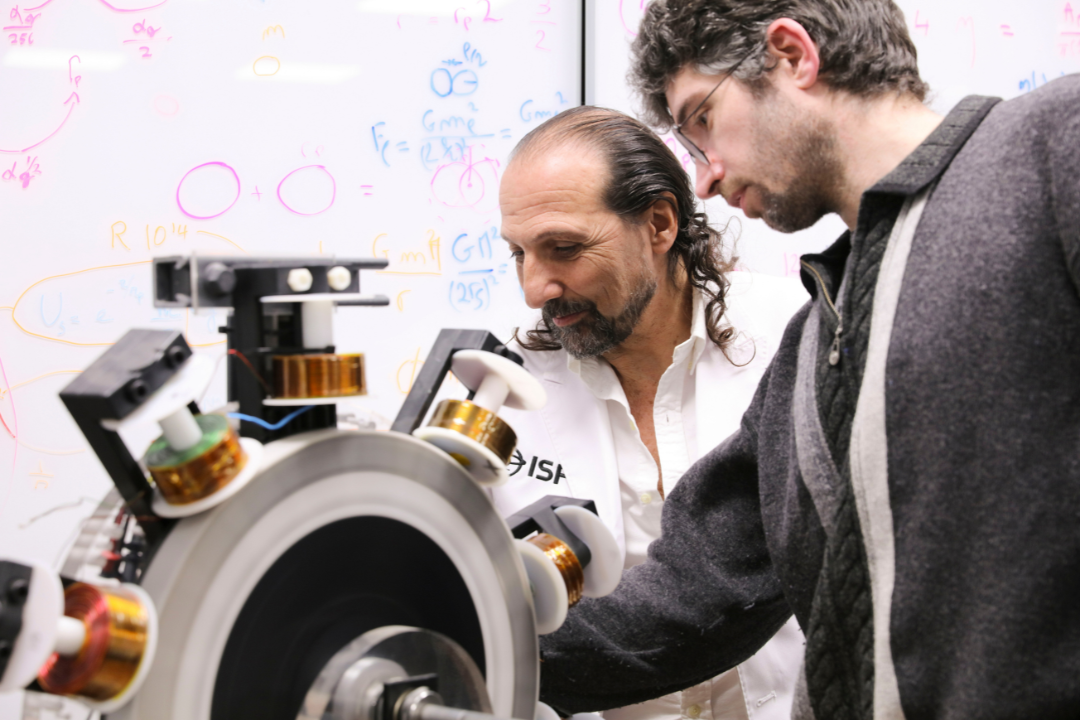
White and his research team elaborated on this idea with a publication on what is referred to as the dynamic vacuum model, where the team was able to derive electron orbitals as acoustic resonant modes of the vacuum and molecules as acoustic resonances in a multi-atom system. A model that is highly synergistic with Physicist Nassim Haramein’s generalized holographic approach, where he is able to show that the proton and electron charge and mass result from the electromagnetic modes and granular Planck scale structure of spacetime, and the confinement for both the proton and the electron repulsive electrostatic field are accounted for by a quantum gravitational force exerted by the holographic information structure of the vacuum.
For more on Dr. White’s empirical research into warp field mechanics and plans for future studies see the article by The Debrief: Darpa Funded Researchers Accidentally Discover the World’s First Warp Bubble .
Highlights:
With the publication by Mexican Mathematician Miguel Alcubierre in 1994 of his Warp drive concept, the idea of warp drives moved from pure science fiction to theoretical possibility, as for the first time it was shown, at least theoretically and mathematically, that warp drives were not in violation of the known laws of general relativity. While the solution presented in Alcubierre’s initial most work is practically impossible—requiring unphysically large amounts of (negative) energy—it was an important first step in the development of warp field mechanics: adhering to the practical technological iterative process of crawl-walk-run.
The classical-relativistic Alcubierre drive solution has evolved greatly since that initial publication, with Dr. White’s reworking of the original metric to dramatically reduce the exotic materials and energy requirements of the original concept—producing the “Alcubierre/White Warp Drive”—to more recent theoretical breakthroughs that outline the solutions of real physical warp drives that do not require unrealistic amounts of negative energy, exotic materials, closed time-like loops, or quantum instabilities that lead to massive levels of radiation (something very hazardous to would be human occupants of any such warp drive capable craft).
There is a common misconception that seems to be prevalent when discussing warp drives—the idea that somehow superluminal travel, which the Alcubierre/White Warp Drive allows, is necessitated for interstellar travel. This misconception is so prevalent that it is often reiterated even by scientists who should know better. The prevalence of this misconception seems to be due to a lack of understanding or awareness of what is known as Lorentz contraction in general relativity, whereby lengths contract, and time dilates or slows down. If relativistic speeds are achieved, which are velocities approaching the speed of light, the distances between objects, say stars and planetary systems, contracts or decreases due to Lorentz contraction, and similarly the time aboard a craft traveling at relativistic velocities slows down. This means that for interstellar travelers aboard a ship traveling at a significant fraction of the speed of light, the light-year distances between stars can be traversed in reasonable timeframes. In fact, no matter the distance between two stars, the time required to travel between two stellar systems can be made arbitrarily short (as quick as one would like) by moving at velocities closer and closer to the speed of light.
Because of this, superluminal travel is not necessitated for human-feasible interstellar travel. This avoids the need for extremely advanced physics that can generate large negative energy densities, and obviates the problems associated with backwards time travel—as all superluminal travel results in going “back” in time, or closed time-like loops. Superluminal travel is more of a consideration in the feasibility of time travel and not interstellar travel, specifically travel “back” in time since relativistic speeds de facto result in time travel into the future (because time slows down for non-inertial observers). So, always keep in mind that the laws of physics as they stand today allow for interstellar travel in human-relevant timeframes.
Warp field technology is key not because of the potential for superluminal travel, but because it is a form of gravitational control propulsion technology— which absolutely is required for interstellar travel. We will not become a space-faring civilization utilizing Newtonian mechanics of thrust generation and chemical propulsion. Technological capabilities to control or modulate the gravitational field is key.