


The debate over absolute versus relative frames of reference has been a cornerstone of modern physics, evolving dramatically from Newton’s classical mechanics to Einstein’s revolutionary theories of relativity. This article explores the historical development of our understanding of space, time, and motion, beginning with Newton’s concept of absolute space and his famous bucket experiment. Through an examination of Mach’s principle—which suggests that all motion must be understood relative to the entire cosmos—we trace how this fundamental question has shaped our modern understanding of the universe.
The discussion progresses from these historical foundations to contemporary physics, examining how Einstein’s general relativity and Gödel’s rotating universe model have further complicated our conception of space-time relationships. The article concludes with recent experimental evidence from Gravity Probe B and observations of black holes, which demonstrate the dynamic nature of space-time through phenomena like frame-dragging. This journey through physics history reveals how our understanding of motion and space-time has evolved from simple absolute frameworks to an intricate web of relativistic relationships that continue to challenge our intuitive notions of reality.
Newton’s Cosmic Theatre: an absolute frame of reference
The question of the nature of absolute and relative frames of space, time, and motion forms the basis of Newton’s work in The Mathematical Principles of Natural Philosophy, as the opening discussion of the book. Newton delved deeply into the complexities of motion and how it relates to the universe around us. He described a fundamentally absolute frame of space and time in which an object’s motion was absolute, or independent of its orientation relative to other objects. This concept was revolutionary at the time and laid the groundwork for classical mechanics, fundamentally shaping our understanding of physics.
Newton’s ideas challenged the prevailing thoughts of his era, introducing a new way to perceive the natural world. He argued that true motion could be distinguished from relative motion by considering the forces acting on an object. Through his laws of motion and universal gravitation, Newton provided a framework that explained not just earthly phenomena but also celestial mechanics, influencing generations of scientists and thinkers. His work continues to be a cornerstone in the study of physics, inspiring ongoing exploration into the nature of the universe.
Newton illustrated the relationship between absolute and relative motion with an example of a bucket filled with water and suspended by a rope from the ceiling. If the rope were to be turned until it was sufficiently twisted, and then released, the rapid spinning motion of the bucket would impart to the water a centrifugal force that would cause it to pull away from the center of the axis of rotation, imparting a concave curve to the surface. Newton asserted that this motion of the water would be completely independent of any other bodies apart from the bucket, the rope, and the water – it was a closed system.

J. van Engelshoven, “Study on Inertia as a Gravity Induced Property of Mass, in an Infinite Hubble Expanding Universe,” Advances in Mathematical Physics, vol. 2013, no. 1, p. 801574, 2013, doi: 10.1155/2013/801574.
Ernst Mach, a 19th century physicist and philosopher, pointed out that it was not a closed system, as the Earth’s gravitational force on the water and the bucket were certainly important factors, and hence the motion of the water could never be considered independently of the other objects around it.
Mach’s Principle and the Bucket Argument
Mach asserted that the water’s motion could only be defined relative to all other objects in the Universe. This concept has since become known as the bucket argument and Mach’s principle. Mach’s principle, first stated by George Berkeley nearly 200 years before Mach, is the assertion that the inertial reaction forces experienced by massive objects, when they are accelerated by external forces, are generated by the action of chiefly the most distant matter in the cosmos. This idea suggests a profound interconnectedness between all matter in the universe, highlighting how even the farthest stars and galaxies play a role in the behavior of objects right here on Earth.
Since the only known force with universal coupling to mass is gravity, it is natural to assume that, if the principle is correct, the gravitational interaction is the source of inertial reaction forces. This is indeed the case in general relativity theory for the class of cosmological models thought to encompass our reality. In Einstein’s framework, the influence of distant cosmic matter on local physical laws is elegantly described through his field equations, showing the universe as a dynamic, interconnected web. The metric tensor gµυ, which describes the geometry of spacetime, incorporates Mach’s principle by considering the distribution of mass-energy throughout the cosmos. This relationship is expressed in Einstein’s field equations:
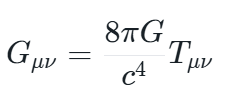
where Tµυ represents the stress-energy tensor containing all matter and energy in the universe. The metric tensor must solve these equations while accounting for both local and distant mass-energy distributions, ensuring that the geometric structure of spacetime at any point is influenced by the totality of cosmic matter. This mathematical framework captures Mach’s insight that inertial effects arise from the gravitational interaction with the entire universe, as the curvature of spacetime at any location depends on the global distribution of matter and energy throughout space.
If we apply Mach’s principle to the effect of matter on space and time, it becomes evident that matter curves spacetime. This is much like the water in the bucket, which curves due to the force of spin, a fact elucidating the equivalence of gravitational forces with acceleration. Consequently, space and time are not independent of the matter occupying them. This revelation has profound implications, suggesting that the very fabric of the universe is shaped by the presence and distribution of matter, leading to a deeper understanding of our cosmos.
However, this elegant connection between matter and spacetime raised new questions about the nature of reference frames that would challenge even Einstein’s framework. While Mach’s principle suggested all motion must be purely relative, a revolutionary solution to Einstein’s field equations would soon suggest otherwise. In 1949, mathematician Kurt Gödel discovered a solution that would reignite the debate about absolute versus relative motion, and in doing so, expose an unexpected gap between Mach’s principle and general relativity.
Gödel’s Rotating Universe: A New Perspective
Even when considering a rotating Universe and the potential for a preferred frame of reference that would result in, recent empirical evidence shows that Newton’s conception of an absolute space is still not a possibility because space can twist under torque leading to significant distortions. This is evident in measurements from experiments such as Gravity Probe B, which have demonstrated the validity of a theory known as the Lense-Thirring effect, also referred to as frame-dragging or gravitomagnetism.
Gravity Probe B demonstrated that as the Earth rotates, it ‘twists’ or drags the local vicinity of spacetime along with it. This intricate phenomenon means that the motions of objects in the vicinity of Earth are influenced by the Earth’s spin, subtly altering their trajectories. This revelation has profound implications for our understanding of how celestial bodies interact with the fabric of spacetime.
An astounding example of this can be observed in the vicinity of a black hole. Black holes must have an incredible rate of spin, which produces what is known as an ergosphere around the black hole. Within the ergosphere, the Lense-Thirring effect causes such a high degree of torque that spacetime is dragged in the direction of the spin of the black hole at a velocity greater than the local speed of light relative to the rest of the Universe. This means that for an object within the ergosphere to appear at rest to an external observer, it would have to travel in the opposite direction of the frame-dragging at a velocity greater than the speed of light.
The implications of these phenomena stretch beyond our current technological capabilities but offer a tantalizing glimpse into the complexities of our Universe. It challenges our perceptions of motion, time, and space, prompting us to rethink the fundamental principles that govern the cosmos. As we continue to explore these cosmic mysteries, the potential for new discoveries remains boundless, reshaping our understanding of reality itself.
These fascinating insights into the nature of spacetime and motion highlight the complexities of the cosmos and the profound implications of Einstein’s theory of general relativity, as well as Gödel’s innovative contributions, which continue to inspire physicists to explore the mysteries of the Universe. As we delve deeper into these phenomena, we uncover the intricate dance of matter and spacetime, forever reshaping our perception of reality.