

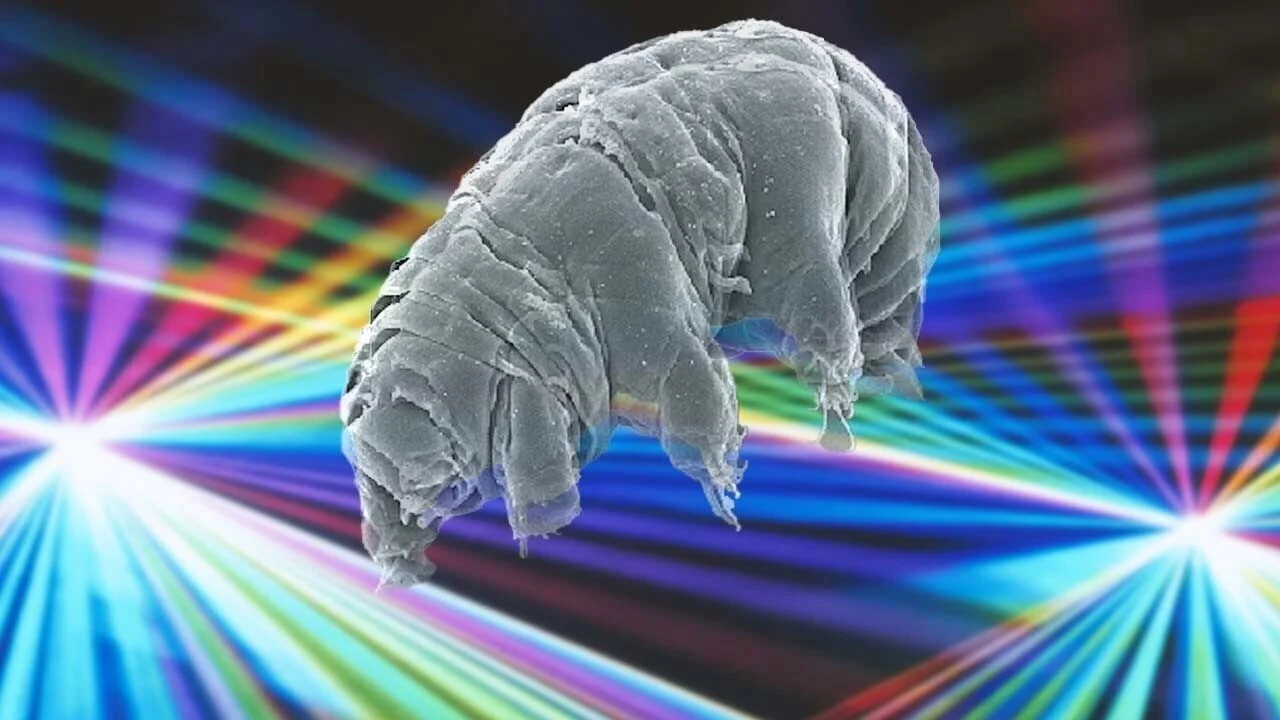
Tardigrade revived after most inhospitable conditions yet documented for the meiofauna organism, setting a record for the conditions under which a complex form of life can survive.
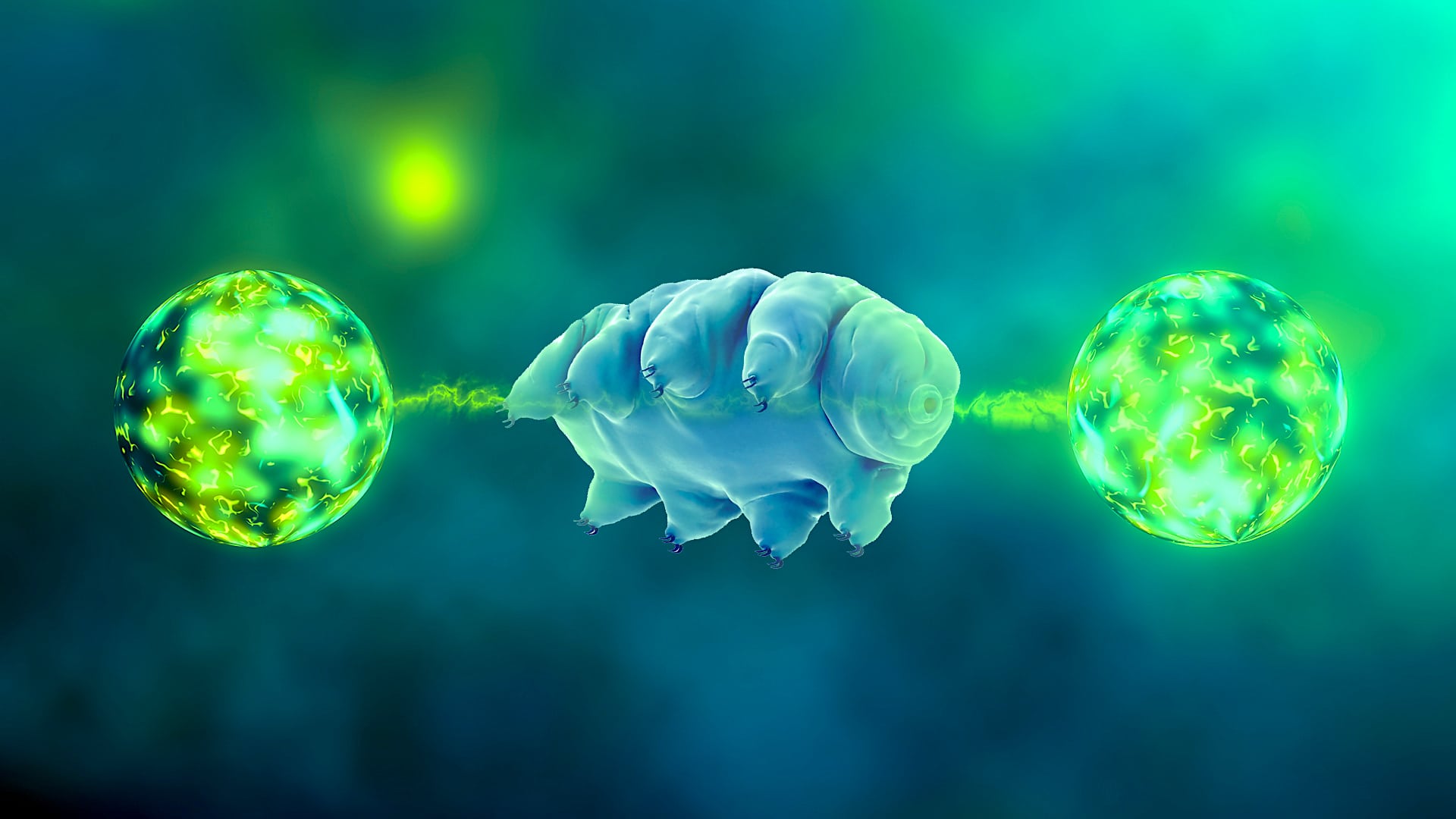
A new study has claimed to have taken a tardigrade— a microscopic multicellular organism known to tolerate extreme physiochemical conditions via a latent state of life known as cryptobiosis—and prepared it in a type of superconducting Josephson junction known as a transmission line shunted plasma oscillation qubit, or transmon for short, causing the tardigrade (in the suspended cryptobiosis state) to purportedly become entangled in the qubit system.

Figure from: K. S. Lee et al., “Entanglement between superconducting qubits and a tardigrade,” arXiv:2112.07978 [physics, physics:quant-ph], Dec. 2021, Accessed: Jan. 03, 2022. [Online]. Available: https://arxiv.org/abs/2112.07978
When the suspended tardigrade was placed in the qubit system, the researchers documented a shift down in the maximum frequency of the nearest qubit, which they interpret as an indication that the multicellular organism has become quantum correlated with the state of that qubit and a second tardigrade-free qubit. Other quantum physicists, however, do not find the results so convincing. Ben Brubaker—a science writer and physicist from Yale—summarized the lackluster findings as “the qubit is an electrical circuit and putting the Tardigrade next to it affects it through the laws of electromagnetism we’ve known about for more than 150 years… putting a speck of dust next to the qubit would have a similar effect.”
So, while the degree of entanglement and it’s actual usefulness—for instance to do any kind of operation with the quantum state of the tardigrade-qubit system—is still a matter of debate, at least until the work has undergone peer review, the fact that the researchers were able to revive a tardigrade after subjecting it to the most inhospitable conditions yet documented for a multicellular organism is an extremely interesting finding and has implications for using such meiofauna organisms in quantum experiments—perhaps in the future showing unambiguously that multi-atom systems as large as multicellular organisms can enter the highly correlated and coherent wave-matter states normally only observed in single particles.
Moreover, the results have interesting implications for the capability of life, and namely complex organisms, to survive harsh environments—for instance on generally inhospitable planets or inter-stellar transits (such as in panspermia).
Since the tardigrade is in a state of suspended animation—where there are no chemical reactions and therefore no metabolism occurring—such quantum experiments do not shed much light on the role and extent of non-trivial phenomenal quantum states in the biological system, as was observed in the experiment where living functioning photosynthetic bacteria were entangled in a nanophotonic structure. The experiments of the former type are more germane to probing the extent and nature of quantum states in large, even macroscopic systems—such as in the report in Science magazine of Direct observation of deterministic macroscopic entanglement, where entanglement of mechanical drumheads weighing 70 picograms each was achieved (the mass equivalent of about 41 trillion nucleons).
This class of experiments may enable new ways to probe the quantum behaviors and properties of biomolecules, as well as address fundamental questions in physics, like how large and complex can matter be and still clearly display the wave-like properties inherent to all matter? For example, the quantum physicist Markus Arndt and his team created interference patterns (indicative of superposition or wave-matter behavior) with a functional biomolecule— specifically, a natural peptide called gramicidin A1— even though these are fragile molecules to submit to the arduous conditions of molecular-beam interference experiments. The experiment was reported in the Nature paper Matter-wave interference of a native polypeptide. Arndt says his goal is to increase the mass of the particles by a factor of 10 every year or two. That would soon take them well into the size and mass range of biological objects such as viruses.
A particular criticism of the quantum experiment with the tardigrade is that the way in which the organism was entangled with the qubit is trivial—no meaningful entanglement was produced since the internal states of the microorganism (the internal degrees of freedom) where not entangled in any meaningful way with a secondary system. The merits of this criticism not-withstanding, it is interesting to note that there are researchers who have proposed experiments to entangle the internal states of a microorganism, such as the electron spin of a glycine radical, with a secondary system. Tongcang Li of Purdue University (who’s work has been discussed in our subsequent article on utilization of quantum vacuum fluctuations for unidirectional energy transfer) has proposed a methodology, along with Zhang-Qi Yin, to quantum entangle the internal states of a cryopreserved bacterium using an electromechanical oscillator, in which it may even be possible to teleport the internal states of the microorganism into another bacterium. The researchers note that since the internal states of an organism contain information, the proposed experiment may also provide a means for teleporting information or memories between two remote organisms.
Highlights:
When considering such experiments, it is important to remember that everything is always entangled—something I refer to as the entanglement nexus (and discuss the implications in information processes of the universe)—, and what is really being discussed are behaviors under maximal entanglement, whereby two subsystems are shielded from environmental interactions— e.g., via cooling to near absolute zero temperatures, placing in a vacuum, or trapping in a laser— to such an extent that their correlated interaction becomes dominant over the constructive inputs of the larger system of the environment.
It is maximal entanglement and other highly coherent states that have important usefulness in quantum teleportation, quantum computation, superconducting circuits, magnetic levitation, and other phenomenal quantum behaviors—primarily due to the high parallelism that can be achieved with two systems simultaneously processing the same information. However, as experiments proceed with macroscopic quantum entanglement and quantum biology, it may become evident the capabilities of large-scale quantum coherence and perhaps even the importance of maximizing our own “coherent state”, in which certain phenomenal properties of the entanglement nexus will be accessible.
For more on what it means for a macroscopic object to be quantum entangled see physics professor Douglas Natelson’s discussion of the latest tadigrade-qubit experiment:
No, a tardigrade was not meaningfully entangled with a qubit