
By using this site, you agree to the Privacy Policy.
Accept
The International Space Federation (ISF)The International Space Federation (ISF)The International Space Federation (ISF)
  • Science News
    • All Articles
    • Physics
    • Astronomy
    • Biology
    • Technology
    • Other
  • Research
    • Research Papers
    • Physicists Testimonials
  • Technology
  • About
    • About us
  • ISF News
  • Events
    • Events
  • Get Involved
    • Invest
    • Donate – Zero Point Foundation
  • Careers
  • Contact Us
Reading: Missing Molecule Finally Discovered
Share
The International Space Federation (ISF)The International Space Federation (ISF)
Search
  • Science News
    • Physics
    • Astronomy
    • Biology
    • Technology
  • Research Papers
    • Physicists Testimonials
  • About
    • ISF News
  • Events
  • Get involved
    • Invest
  • Translations
    online pharmacy https://worldneurologyonline.com/ no prescription pharmacy
Follow US
© 2022 International Space Federation. All Rights Reserved.
The International Space Federation (ISF) / Explore / Biology / Missing Molecule Finally Discovered
Biology

Missing Molecule Finally Discovered

The evolution from the first molecule to the complex chemistry that exists in our universe today is now one step closer to being understood.

RSF Research
Last updated: 2024/04/15 at 11:24 AM
RSF Research
Share
3 Min Read
SHARE

The evolution from the first molecule to the complex chemistry that exists in our universe today is now one step closer to being understood.

When we think of complex chemistry, we usually think of all the matter that exists on our planet which in our atmosphere is a massive 10 trillion trillion molecules per cubic meter. As we move away from our planet this drops exponentially. However, surprising as it may be, space space – like the interstellar and intergalactic regions – are host to a myriad of molecules. Albeit not at quite the same high densities.

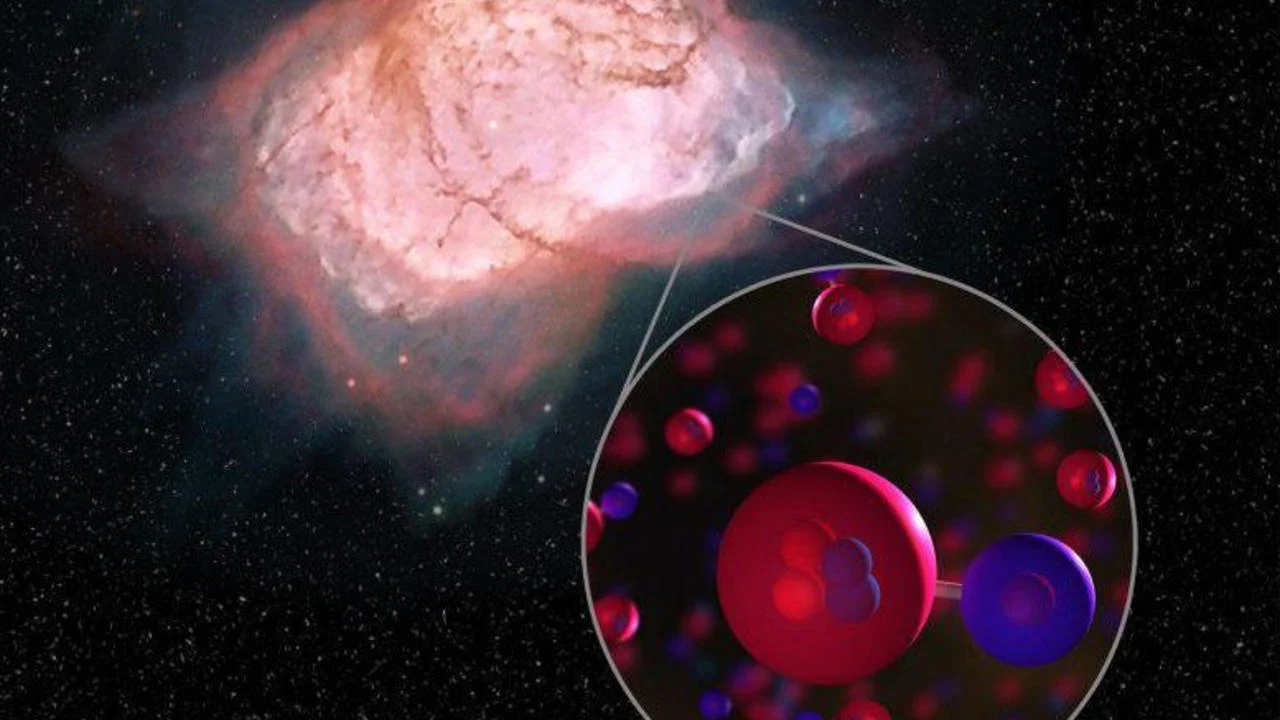
How these molecules formed and became the complex chemistry that we see today remains to be fully understood. It is currently agreed that the early universe consisted of only a few kinds of atoms and it wasn’t until the age of 100,000 years that hydrogen and helium combined to form the first molecule – helium hydride. However, although theorized to exist it has never been detected. That was until a team of scientists from NASA’s SOFIA Science Center (Stratospheric Observatory for Infrared Astronomy) observed its signature – in our own galaxy.

Previously, scientists were able to successfully combine helium and ionic hydrogen to create helium hydride in the laboratory. They then speculated that astrophysical plasmas such as those found in planetary nebulae – an expanding shell of dust that has been ejected from its host star as it runs out of fuel – provided the prefect environment for helium hydride to form. The young, dense planetary nebula, NGC 7027, located around 3,000 light-years from Earth in the constellation Cygnus, seemed like the perfect candidate. However, the instruments of the time were not sufficient to distinguish its signal and the observations were thus inconclusive.

Finally, in 2016, utilizing the world’s largest airborne observatory SOFIA, scientists were able observe NGC 7027 above the interfering layers of Earth’s atmosphere and clearly distinguish the elusive signature of helium hydride.

Highlights:

In the unified perspective everything is interconnected, and evolution is a natural consequence resulting from the information feedback dynamics of spacetime – or space memory. Read more here. This view sees a world where forms take familiar shapes and patterns are repeated across scales. Observations confirming the first molecule that led to molecular hydrogen and the complex chemistry we observe today will therefore add insight into the feedback dynamics that give rise to these fundamental patterns.

Learn more in our free Unified Science Course

Sign Up For Daily Newsletter

Be keep up! Get the latest breaking news delivered straight to your inbox.
loader

loader

loader

By signing up, you acknowledge the data practices in our Privacy Policy. You may unsubscribe at any time.
En vous inscrivant, vous reconnaissez les pratiques en matière de données dans notre politique de confidentialité. Vous pouvez vous désinscrire à n'importe quel moment.
Al registrarse, reconoce las prácticas de datos en nuestra política de privacidad. Puedes darte de baja en cualquier momento.
Share This Article
Facebook Twitter Copy Link Print
Previous Article Fifth State of Matter confirmed!
Next Article A Tiny Galaxy With A Big Heart!

Stay Connected

981k Like
18.7k Follow
7.7k Follow
7.3k Subscribe

Categories

  • Astronomy106
  • Biology69
  • ISF News25
  • ISF Research14
  • Other22
  • Physics168
  • Technology36

You Might also Like

Biology

Quantum Spin Controls Microtubule Assembly, Study Finds

20. May 2026.
Biology

Cognition Without Brains: How Memory Emerges in Polymers, Cells, and Spacetime.

23. March 2026.
Biology

Where Biology Meets Resonance: Light, Vibration, and Living Order

19. February 2026.
BiologyPhysics

Do Cells Use a Quantum Compass to Heal Wounds?

2. December 2025.
The International Space Federation (ISF)The International Space Federation (ISF)

Harnessing quantum vacuum energy for sustainable solutions – a unified approach to science, technology and education.

Quick links

  • About
  • Research Papers
  • Events
  • Invest

Explore

  • ISF Research
  • Physics
  • Technology
  • Astronomy
  • Biology
  • ISF News

Sign Up for Our Newsletter

Subscribe to our newsletter to get our newest articles instantly!

loader

Follow US
© 2023 International Space Federation. All Rights Reserved. INTERNATIONAL SPACE FEDERATION is a trademark of ISFS SA. The mark is registered in the United States under Registration No. 7772313. The ®️ symbol is used exclusively in the U.S.
  • Press
  • Careers
  • Privacy policy
  • Carrieres
  • Presse
  • Prensa
Join Us!

Subscribe to our newsletter and never miss our latest news.

loader

Welcome Back!

Sign in to your account

Lost your password?