

Essential Synopsis
The concept of criticality in living systems has attracted growing interest in recent decades (Are Biological Systems Poised at Criticality [1]) due to the potential of the critical physical state to elucidate the behavior of complex biological systems, from the cellular membrane (Critical Casimir forces in cellular membranes [2]) to the brain, and because of the scale-invariance of the state—a fractal property—which may reveal universal scaling laws operational in information processing systems.
In furtherance of this burgeoning field of high-activity investigation, a recent study by Helen S. Ansell and István A. Kovács has revealed universal scaling laws in the cellular anatomy of the brain, supporting research that has shown that the brain is poised at a critical state between two phases [3]. By analyzing cellular-level volumetric brain reconstructions, the researchers have quantified the complexity of brain anatomy and established the notion of structural criticality. This framework provides guidance in selecting informative structural properties of brain anatomy and offers a key step towards generative computational brain models.
The study also clarifies the extent to which one animal may be a suitable anatomic model for another, based on the consistency of critical exponents across different organisms. The finding of certain aspects of scaling universality, fractal organization and criticality from one organism to the next suggests that many aspects of information processing in the human brain are not greatly divergent from other species; supporting recent proposals like the New York Declaration on Animal Consciousness that states that “empirical evidence indicates at least a realistic possibility of conscious experience in all vertebrates (including reptiles, amphibians, and fishes) and many invertebrates (including, at minimum, cephalopod mollusks, decapod crustaceans, and insects)”. As well, the latest findings offer insights into more general aspects of fundamental organization and information flows in the universe, as fractal structure and critical phase transitions gives rise to some key features of physical systems even at the quantum level.
Fractals, Holographic Memory, and Criticality
In a previous ISF article on quantum optical dynamics of neuronal microtubule-actin networks in regulating electrical signaling of the brain, the review began by stating that “the brain is a fractal massively parallel processor generating complex spatiotemporal electromagnetic field patterns that correlate with cognition and perception”, and that “a key property of a fractal system is scale-free complexity, which means that the degree of complexity of the system is invariant under scaling— for example, using a power-law quantification, it can be shown that the degree of complexity within the human brain is approximately invariant from the tissue, to the cellular, to the molecular levels.” Indeed, Self-similarity has been widely reported in both the structure and function of the brain at a range of scales as reviewed by Grosu et al. [4]:
- At the macroscale, self-similarity is observed in the gyrification of the cerebral cortex [5] and in the human connectome at various scales [6].
- The asymptotic connectivity strength of the synaptic network is self-similar across multiple organisms [7].
- At the microscale, self-similarity is present in the dendritic branching of individual neurons, as detected through measuring correlations in the structures [8], and box-counting techniques [9].
- As well as scale-invariance of neural activity, which implies that spontaneous neural activity operates close to a phase transition (a critical point, because the critical behavior of a physical system is governed by fluctuations that are statistically self-similar) [10].
The authors of the latest study have stated that “the relationship between these self-similar spatial features and scale-invariant functional properties is not yet well understood. A deeper understanding of brain structure will facilitate further exploration of this relationship”.
The significance of these studies are not just in better understanding the fractal organization of the brain and how that is integral to the kind of information processing that takes place within the labyrinthine aborization patterns of dendritic networks– the self-similarity not only across scale but also from species to species— but that it points to a deeper-level significance of how information is structured in the universe more generally. The studies bring together two key features of universal organization which are scale-invariance or fractality and criticality, the latter being the significance of critical boundaries (domains poised at criticality between two phases, like a coherent phase and a decoherence phase).
Fractal organization is observed in a wide variety of physical phenomena from the cosmic web [11] (The Universe Organizes in a Galactic Neuromorphic Network) to deep within hadrons at the nucleonic scale (Fractal Behavior Found in High Energy Collisions and Bose Einstein Condensate Formation).
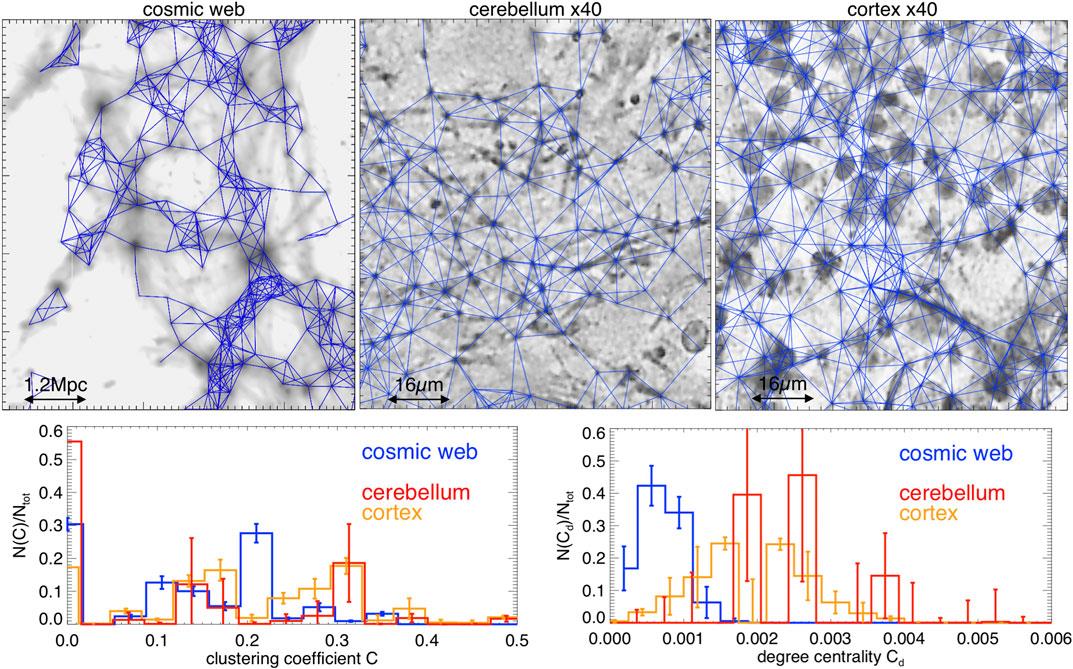
There is a link between the scale-free self-similarity of fractal organization and criticality, so the fact that fractality is evident at the subatomic scale for the dynamics underlying nuclear confinement force [12] is not surprising since other studies have shown that the nuclear confinement force arise from two screening horizons within the nucleon that are poised at a critical point between a highly coherent phase and a decoherent phase of a Planck Plasma Flow in which fundamental units of gravitationally-bound electromagnetic objects—called Planck spherical objects or PSUs—undergo a phase transition from near-crystalline zero entropy ordering to a decoherent phase characterized by self-aggregates of 64 unit clusters, called kernel-64 information packets [13]. It is therefore interesting that the same organization of fractality and criticality observed in the brain is seen in other fundamental information structures / dynamics of the universe, even at fundamental quantum levels, like within the proton with the kernel-64 voxel and its associated flux through the nucleon semi-permeable membrane structures.
This observation aligns with the holographic principle, which posits that the information-entropy of a volume of space can be thought of as encoded on the surface area boundary to the region. Just as the brain’s fractal and critical nature supports information flux across scale and resiliency of information processing, the holographic principle suggests that the universe itself may operate on similar principles, where information and dynamics at one scale reflect and influence those at another. This interconnectedness hints at a deeper, universal architecture of information processing that transcends different scales and systems. As such, a third key feature that is salient to highlight in relationship to the latest studies is the idea of holographic information or how information is stored in holograms (holographic memory). Holographic information is unique because it is not stored in individual pixels but rather in the interference patterns of waveforms (stored in the hologram’s subunits). In this way, any information stored in a hologram is distributed through the entire system, such that each subunit contains the entire information. Considering the holographic information to be that of an image, if some of the pixels were removed from a hologram the entire image would still be projected, whereas with other non-holographic media, if the pixels are removed that portion of the image is lost. In his 1991 book Brain and Perception neuropsychologist Karl Pribram posited the holonomic model of brain processing in an extension of his work with physicist David Bohm, in which he explained a model whereby the brain processes information in a manner similar to a hologram. According to Pribram, memories are not stored in specific locations but are distributed throughout the brain in a pattern of interference, much like a holographic image. This theory suggests that each part of the brain contains the information necessary to reconstruct the whole, allowing for robust and flexible memory storage and retrieval.
Pribram’s holographic model aligns with the concept of structural criticality, as it implies a highly interconnected and dynamic network capable of complex information processing. The brain’s fractal architecture, characterized by self-similarity and scaling laws, supports this model by providing a structural basis for the distributed and resilient nature of memory and cognition. As well, the fractal architecture is a key feature of Pibram’s holonomic brain model as he posited that in addition to the circuitry accomplished by the large fiber tracts in the brain, processing also occurs in webs of fine fiber branches (for instance, dendrites) that form webs, as well as in the dynamic electrical fields that surround these dendritic “trees”. In addition, the processing occurring around these dendritic trees can influence that occurring in those trees of nearby neurons whose dendrites are entangled but not in direct contact (known as ephaptic signaling). In this way, processing in the brain can occur in a non-localized manner. This type of processing is properly described by Dennis Gabor, the inventor of holography, as quanta of information he called a “holon”, an energy-based concept of information.
The interplay between fractal structures (evident in the apparent criticality of the brain) and holographic memory mechanisms may underlie the brain’s ability to integrate and process vast amounts of information efficiently and couple it in a nonlocal manner so that the information is stored as a field, like a holographic memory field, perhaps even extending into the memory field of space itself, i.e., the spacememory network [14].
What was Found
The study by Ansell and Kovács has uncovered evidence of universal scaling laws in the cellular anatomy of the brain. By quantifying the complexity of brain structure using cellular-level volumetric reconstructions, the researchers have shown that the brain’s anatomy satisfies these scaling laws, indicating that it is poised at a critical state between two phases. This finding establishes the concept of structural criticality in the cellular architecture of the brain.
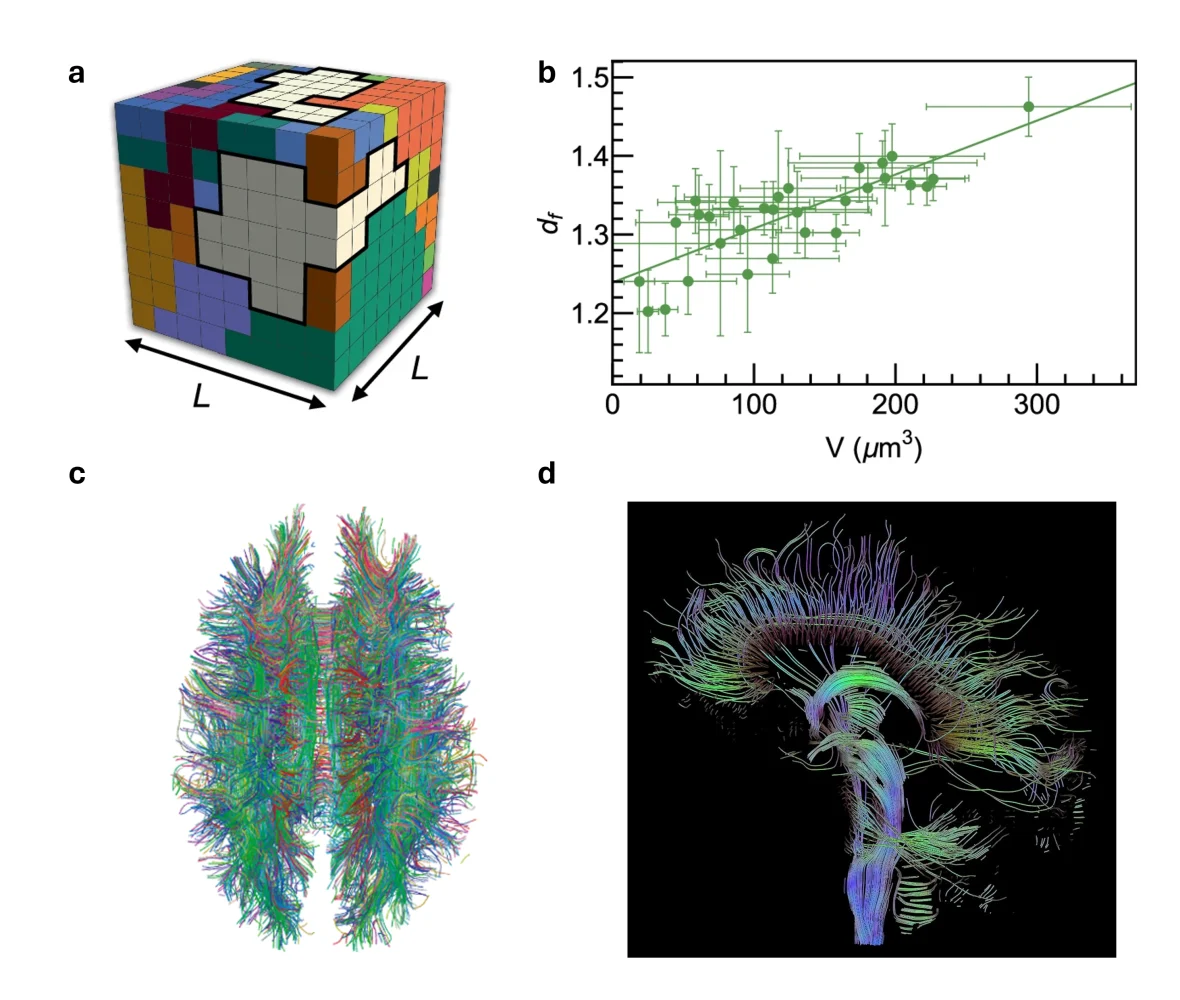
The researchers obtained estimates for critical exponents in the brains of humans, mice, and fruit flies. Remarkably, these exponents were found to be consistent across the different organisms, within the limitations of the available data. The consistency of these universal quantities suggests that they are robust to many of the microscopic details that vary between individual brains.
The discovery of these universal scaling laws provides a framework for selecting the most informative structural properties of brain anatomy. By focusing on these critical features, researchers can develop more accurate and efficient computational models of the brain. Additionally, the consistency of critical exponents across species offers insight into the extent to which one animal’s brain may serve as a suitable anatomic model for another.
How was this Study Performed?
The study by Ansell and Kovács employed a combination of computational analysis and theoretical modeling to investigate the cellular anatomy of the brain. The researchers utilized cellular-level volumetric brain reconstructions, which provide detailed information about the spatial arrangement and connectivity of brain cells. The volumetric brain reconstructions were made possible by a study the generated a petavoxel fragment of human cerebral cortex reconstructed at nanoscale resolution (Figure 2 [15]).
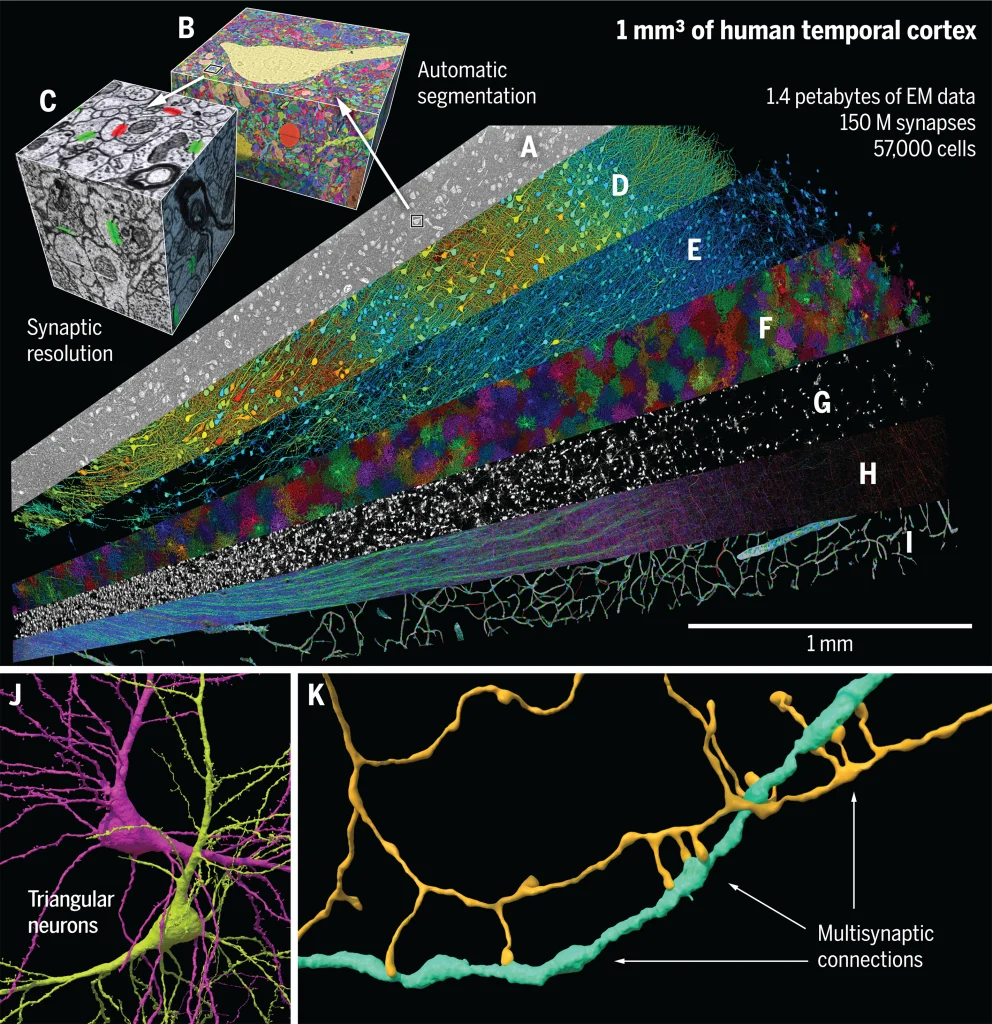
To quantify the complexity of brain anatomy, the authors applied various mathematical and statistical techniques to these reconstructions. They analyzed the scaling properties of different structural features, such as the distribution of cell sizes, the connectivity between cells, and the spatial organization of cellular networks.
By comparing the observed scaling properties with those predicted by theoretical models of critical systems, the researchers were able to establish the presence of universal scaling laws in brain anatomy. They also estimated the values of critical exponents for the human, mouse, and fruit fly brains, which allowed them to assess the consistency of these universal quantities across different organisms.
The Significance of Fractal Architecture in the Brain
The discovery of universal scaling laws and structural criticality in the cellular anatomy of the brain has significant implications for our understanding of brain function and evolution. A fractal architecture, characterized by self-similarity across different scales, is a hallmark of systems that are optimized for information processing and adaptability. That such fractal architecture is observed across scale, almost as if the universe itself was a giant fractal, indicates that information processing, perhaps even in a natural autodidactic iterative evolutionary process [the autodidactic universe], suggest that information processing and holographic storage (for instance, in the holographic principle of physics) is a key mechanism and dynamic underlying the properties of the universe.
In the context of the brain, a fractal structure may facilitate efficient communication and integration of information across different regions and scales. The self-similar nature of the brain’s cellular networks could allow for the emergence of complex, coordinated activity patterns that underlie cognitive processes such as perception, memory, and decision-making.
Moreover, the presence of structural criticality suggests that the brain is poised at a transition point between two distinct phases or states. This critical state is thought to confer several advantages, including enhanced sensitivity to external stimuli, increased flexibility in adapting to changing environments, and the ability to generate a wide range of dynamic activity patterns.
The consistency of critical exponents across different animal species indicates that these universal properties of brain anatomy have been conserved throughout evolution. This finding supports the idea that the fractal architecture and critical state of the brain are essential for its function and have been selected for over the course of evolutionary history, and since this appears to be a near-ubiquitous feature of universal organization, its critical functionality in the biological system may have been present at the very emergence of life, like for instance a plasma membrane poised at criticality [criticality underlying long-range critical Casimir forces in the plasma membrane] as systems of organized matter in the universe naturally self-order around criticality and fractal patterning.
Key Findings and Implications
- Universal scaling laws have been discovered in the cellular anatomy of the brain, indicating that brain structure is governed by fundamental principles that transcend species-specific differences.
- The brain’s cellular architecture exhibits structural criticality, suggesting that it is poised at a transition point between two distinct phases or states.
- Critical exponents, which characterize the universal scaling properties of brain anatomy, are consistent across humans, mice, and fruit flies, within the limitations of available data.
- The consistency of these universal quantities implies that they are robust to many of the microscopic details that vary between individual brains.
- The fractal architecture and critical state of the brain may facilitate efficient information processing, adaptability, and the emergence of complex cognitive functions.
- The conservation of these universal properties across different animal species suggests that they have been selected for throughout evolution due to their functional importance.
- The discovery of universal scaling laws provides a framework for selecting the most informative structural properties of brain anatomy, aiding in the development of more accurate and efficient computational models of the brain.
- The consistency of critical exponents across species offers insight into the extent to which one animal’s brain may serve as a suitable anatomic model for another, potentially guiding future research in comparative neuroscience.
Potential Insights to Glean from the Study
The findings of Ansell and Kovács have far-reaching implications for our understanding of brain function, evolution, and the development of computational models. The discovery of universal scaling laws and structural criticality in the cellular anatomy of the brain suggests that these properties are fundamental to the brain’s ability to process information and adapt to changing environments.
The fractal architecture of the brain, characterized by self-similarity across different scales, may be a key factor in its ability to efficiently integrate and process information from multiple sources. This hierarchical organization could allow for the emergence of complex cognitive functions, such as perception, memory, and decision-making, from the coordinated activity of cellular networks at different scales.
The presence of structural criticality in the brain implies that it is poised at a transition point between two distinct phases or states. This critical state is thought to confer several advantages, including enhanced sensitivity to external stimuli, increased flexibility in adapting to changing environments, and the ability to generate a wide range of dynamic activity patterns. Several studies have shown that critical neural systems maximize information transmission, storage, and processing [16, 17]. The brain’s critical state may be essential for its ability to learn from experience, form memories, and generate novel behaviors in response to new challenges.
The consistency of critical exponents across different animal species suggests that these universal properties of brain anatomy have been conserved throughout evolution. This finding supports the idea that the fractal architecture and critical state of the brain are essential for its function and have been selected for over the course of evolutionary history. The conservation of these properties across species also raises the possibility that insights gained from studying the brains of simpler organisms, such as fruit flies or mice, may be applicable to understanding the human brain.
The discovery of universal scaling laws in brain anatomy provides a framework for selecting the most informative structural properties to focus on when developing computational models of the brain. By incorporating these critical features, researchers can create more accurate and efficient models that capture the essential aspects of brain function. The consistency of critical exponents across species also suggests that computational models based on the brains of simpler organisms may be useful for understanding the human brain, to the extent that these universal properties are shared.
In conclusion, the study by Ansell and Kovács has revealed a previously hidden order in the seemingly complex cellular anatomy of the brain. The discovery of universal scaling laws and structural criticality suggests that the brain’s architecture is governed by fundamental principles that conform to natural universal properties of information processing and adaptability, not just in the human brain but in other species and even more generally in physical systems across scale. These findings provide a new framework for understanding brain function and more generally the nature of scale-free cognitive processes in the universe.
References
[1] T. Mora and W. Bialek, “Are Biological Systems Poised at Criticality?,” J Stat Phys, vol. 144, no. 2, pp. 268–302, Jul. 2011, doi: 10.1007/s10955-011-0229-4.
[2] B. B. Machta, S. L. Veatch, and J. P. Sethna, “Critical Casimir forces in cellular membranes,” Phys. Rev. Lett., vol. 109, no. 13, p. 138101, Sep. 2012, doi: 10.1103/PhysRevLett.109.138101.
[3] H. S. Ansell and I. A. Kovács, “Unveiling universal aspects of the cellular anatomy of the brain,” Commun Phys, vol. 7, no. 1, p. 184, Jun. 2024, doi: 10.1038/s42005-024-01665-y.
[4] Grosu, G. F. et al. The fractal brain: scale-invariance in structure and dynamics. Cerebral Cortex 33, 4574–4605 (2022)
[5] Mota, B. & Herculano-Houzel, S. Cortical folding scales universally with surface area and thickness, not number of neurons. Science 349, 74–77 (2015)
[6] Zheng, M., Allard, A., Hagmann, P., Alemán-Gómez, Y. & Serrano, M. A. Geometric renormalization unravels self-similarity of the multiscale human connectome. Proc. Natl. Acad. Sci. USA 117, 20244–20253 (2020)
[7] Lynn, C. W., Holmes, C. M. & Palmer, S. E. Heavy-tailed neuronal connectivity arises from Hebbian self-organization. Nat. Phys. 20, 484–491 (2024)
[8] Alves, S. G., Martins, M. L., Fernandes, P. A. & Pittella, J. E. Fractal patterns for dendrites and axon terminals. Physica A 232, 51–60 (1996).
[9] Smith, J. H. et al. How neurons exploit fractal geometry to optimize their network connectivity. Sci. Rep. 11, 2332 (2021).
[10] A. Ponce-Alvarez, M. L. Kringelbach, and G. Deco, “Critical scaling of whole-brain resting-state dynamics,” Commun Biol, vol. 6, no. 1, pp. 1–11, Jun. 2023, doi: 10.1038/s42003-023-05001-y.
[11] F. Vazza and A. Feletti, “The Quantitative Comparison Between the Neuronal Network and the Cosmic Web,” Front. Phys., vol. 8, Nov. 2020, doi: 10.3389/fphy.2020.525731.
[12] A. Deppman, E. Megías, and D. P. Menezes, “Fractals, nonextensive statistics, and QCD,” Phys. Rev. D, vol. 101, no. 3, p. 034019, Feb. 2020, doi: 10.1103/PhysRevD.101.034019.
[13] N. Haramein, C. Guermonprez, and O. Alirol, “The Origin of Mass and the Nature of Gravity,” Sep. 2023, doi: 10.5281/zenodo.8381115.
[14] N. Haramein, W. D. Brown, and A. Val Baker, “The Unified Spacememory Network: from Cosmogenesis to Consciousness,” Neuroquantology, vol. 14, no. 4, Jun. 2016, doi: 10.14704/nq.2016.14.4.961.
[15] A. Shapson-Coe et al., “A petavoxel fragment of human cerebral cortex reconstructed at nanoscale resolution,” Science, vol. 384, no. 6696, p. eadk4858, May 2024, doi: 10.1126/science.adk4858.
[16] Friedman, N. et al. Universal critical dynamics in high resolution neuronal avalanche data. Phys. Rev. Lett. 108, 208102 (2012).
[17] Shew, W. L., Yang, H., Petermann, T., Roy, R. & Plenz, D. Neuronal avalanches imply maximum dynamic range in cortical networks at criticality. J. Neurosci. 29, 15595–15600 (2009).