

Understanding Nucleic Acids: RNA vs. DNA
The origin of prebiotic RNA (ribonucleic acid) is one of the deepest mysteries in biology.
RNA and DNA (deoxyribonucleic acid) are nucleic acids; macromolecules called biopolymers, and they are essential in life, since they play a critical role in biological processes such as coding, decoding, regulation and expression of genes. RNA is assembled as a chain of nucleotides (monomers composed of 5-carbon sugars, phosphates groups and a nitrogenous base), just like DNA, but unlike DNA that has a paired double strand, RNA is found in nature as a single strand folded onto itself. If the sugar involved is ribose, the biopolymer is RNA; if the sugar is the ribose derivative deoxyribose, the resulting biopolymer is DNA.

The Importance of RNA in the Evolution of Life
Cellular organisms use messenger RNA (mRNA) to bring genetic information that directs synthesis of specific proteins, among other functions.
The general idea in the development of life on the earth, is that evolution based on RNA replication precede the appearance of protein synthesis. This would mean that RNA is the precursor of DNA.
One of the hardest questions to answer is: how and why do these nucleotides that form the bases of RNA and DNA come together, or in other words, create biopolymers? And the response may be just around the corner.
 Huasca Basaltic Formations, in Hildago State, México.These prisms are the result of volcanic activity called effusive volcanism, which occurred 2.6 million years ago (Pliocene-Pleistocene epoch). By: Inés Urdaneta.
Recent experiments show that RNA can spontaneously form when component molecules known as ribonucleoside triphosphates are incubated and filter through basaltic glass, as those likely present 4.3–4.4 billion years ago on the Earth surface, where they were formed by impacts and volcanism.
The obtained polyribonucleic acid averages 100–300 nucleotides in length, and it was stable for months, with a synthesis rate of 2 × 10⁻³ pmoles of triphosphate polymerized each hour per gram of glass, at 25°C temperature and pH 7.5.
Basalt is an igneous rock that contains more than 45 and less than 52% of SiO2 and less than five percent of total alkalies (K2O + Na2O)3, as defined in the TAS diagram shown above, where the different types of basaltic formations are depicted in terms of their relative compositions.

These basalt structures coming from hot environments, such as volcanic activity, have rendered geological formations that seem out of this world, such as the Giant’s Causeway, in Ireland, consisting of more than 40,000 hexagonal basalt columns which were formed when magma spurted through cracks in the Earth’s surface 60 million years ago.
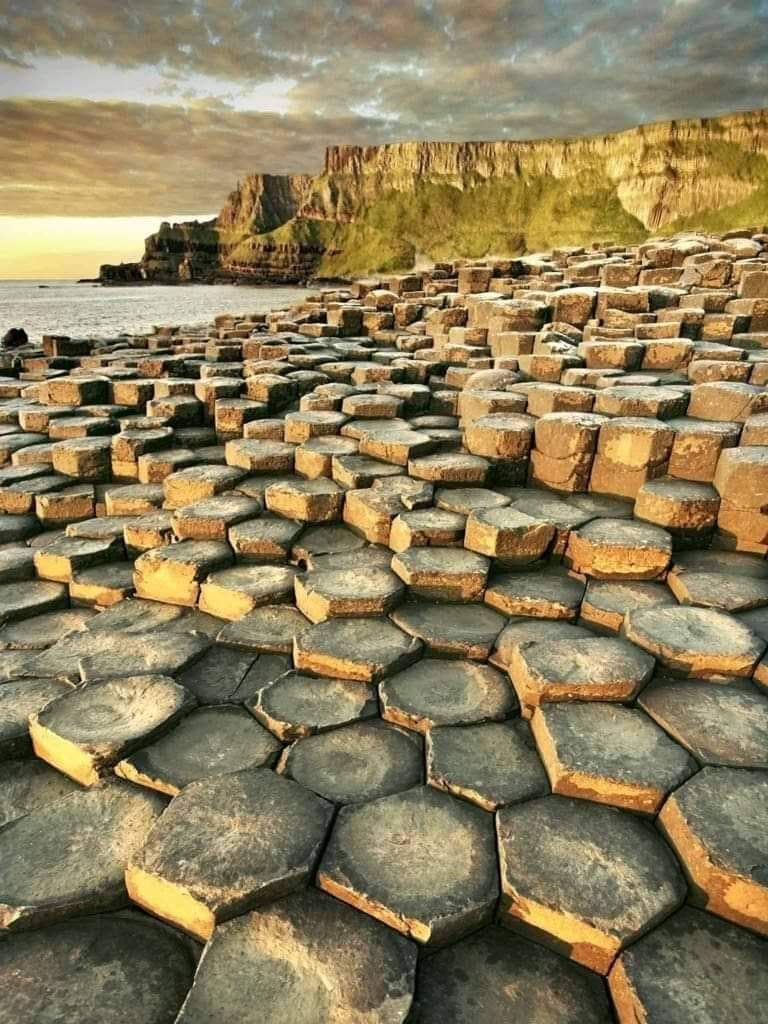
Another incredible basaltic formation can be found in Armenia; the Garni Gorge, situated 23 km east of Yerevan, is shown below.

The Garni Gorge is situated 23 km east of Yerevan, Armenia. This portion of the Garni Gorge is known as “Symphony of the Stones”. The origin of columnar jointing is still uncertain. Image credit : © @globetolter[IG]
Most areas within Earth’s ocean basins are underlain by basalt; lava flows and flood basalts underlie more of Earth’s surface than any other rock type. And not only on Earth, but basalt is also an abundant rock on the Moon’s surface underlain, areas knowns as “lunar maria”. The ages of lunar maria can be estimated by observing the density of impact craters on their surface. Younger basalt flows will have fewer craters.
Basalt is found even on Mars! Its volcano, Olympus Mons, was formed from basaltic lava flows. Olympus Mons is the highest mountain on Mars and is the largest known volcano in our solar system. See the image below for reference on the scales.

The Basalt structures of Huasca de Ocampo, in Hidalgo State, Mexico, where found by Alexander von Humboldt, in 1803, who did the following drawing:

Highlights:
These results suggest that if triphosphates were available in the environments, then polyribonucleotides would be too. The origin of life on Earth is progressively revealing its mysteries. We find intriguing that spontaneous RNA formation would happen in basaltic structures, since most of them have hexagonal geometry. Nassim Haramein’s Unified Field Model proves that this geometry is fundamental to the structure of spacetime.
When seen in 2D, the packing of the Planck Spherical Units (PSU) that discretize space, results in this honeycomb shape which in ancient civilizations is known as the flower of life. The fact that this hexagonal geometry could be associated with the origin of life on Earth, may be more than just a coincidence.
 Inés Urdaneta at the Huasca Basaltic Formations, in Hildago State, México.