


In 2019, researchers from the Massachusetts Institute of Technology made headlines when they created the “blackest black” material made from carbon nanotubes—ten times blacker than any material that had been manufactured at that time—a material so black that it had the ability to absorb 99.995% of incident light. Such research in light absorption is not a trivial pursuit or mere aesthetics, there are many technologies that can benefit from maximizing light absorption—for instance, in photovoltaics because of the need to absorb and convert as much light as possible into electricity, or on the interior surface of a light sensor because of the need to minimize unwanted stray light. The physics of light absorption can get quite complex when you get into the details, as what we non-technically consider as “black” is usually not a perfect absorber. Indeed, there are many ways to create something that can absorb some light, but the endeavor gets increasingly more difficult the closer one attempts to achieve 100% absorption.
That takes some serious physics.
Now, physicists in Austria and Israel report in the journal Science that they have engineered a light trap that utilizes the quantum properties of electromagnetic waves— in which waveforms undergo constructive or destructive interference when combined in just the right manner—to generate an anti-laser that has near-perfect light absorption [1]. Because the light trap functions essentially as a time-reversed laser, where instead of multiple passes of single-wavelength light for maximum stimulated emission of photons the multiple passes are engineered for maximum absorption, the device is a veritable anti-laser.
By harnessing the quantum properties of light to achieve near-perfect absorption, the anti-laser is referred to as a “coherent perfect absorber”. The ingenious setup, based around a set of mirrors and lenses, traps incoming light inside a cavity and forces it to circulate so that it hits the absorbing medium repeatedly, until completely absorbed. This has the potential to improve various light harvesting, energy delivery, light control and imaging techniques.

The light trap: The set-up comprises a partially transparent mirror, a thin, weak absorber, two converging lenses and a totally reflecting mirror. Due to precisely calculated interference effects, the incident light beam interferes with the beam reflected back between the mirrors, so that the reflected beam is ultimately completely extinguished [image and image description from Tu Wien].
The device actually picks up on a trick that nature already utilizes— at night when you shine a flashlight at a cat or owl you will see their eyes reflecting back the light. This is because their eyes have a reflective layer of tissue behind the retina, called the tapetum lucidum, which gives any un-absorbed light an additional pass through the thin retina and therefore a greater chance of being absorbed. This is one reason why nocturnal animals have such good night vision. And it is a good solution to the problem of getting light to absorb onto a thin surface material, do multiple passes of the incident light— just the kind of trick we could adapt for technological applications like light harvesting and image capture techniques.
To improve such a system further you could add another reflective surface in front of the retina. Light would then bounce back and forth between the two mirrors, passing through the light absorbing surface multiple times. But it isn’t quite that simple.
For such a device to work, the front mirror cannot be perfectly reflective. It needs to be partially transparent so that light can enter the system in the first place. But then as the light bounces between the two mirrors some of it will be lost through the partially transparent mirror. When researchers tried to replicate such set-ups, they found that they only work for specific patterns of light. While certain modes of light become trapped, repeatedly hitting the absorbing surface, other light, for instance entering the device at a different incidence angle or having a different wavelength, escapes.
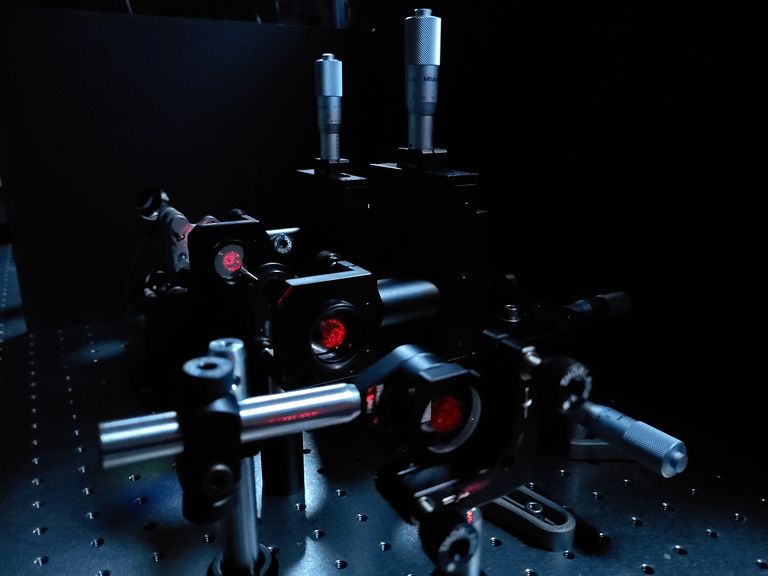 Image of the experimental setup in the lab at the Hebrew University of Jerusalem [image and image description from Tu Wien].
The research teams from TU Wien and from The Hebrew University of Jerusalem have found a surprising trick that allows a beam of light to be completely absorbed even in the thinnest of layers: the teams have demonstrated that an exceedingly efficient light trap can be created if two lenses are placed in between the two mirrors, enabling multiple passes of the incident light and enabling it to be specifically structured for coherent combining and ultimate absorption. The team essentially built a light trap around a thin absorption layer using mirrors and lenses, in which the light beam is steered in a circle and then superimposed on itself – exactly in such a way that the beam of light blocks itself and can no longer leave the system. Thus, the light has no choice but to be absorbed by the thin layer – there is no other way out.
While the system has to be tuned exactly to the wavelength that is desired to be absorbed, the absorption-amplification method nevertheless is a robust effect that promises a wide range of applications— not only for the aforementioned light-harvesting technologies, but as well it could be enabled to perfectly capture light signals that are distorted during transmission through the Earth’s atmosphere, or used for optimally feeding light waves from weak light sources (such as distant stars) into a detector.
All-in-all it is another toolkit in the emerging technology of shaping light for a wide variety of applications.
Structured light refers to the tailoring or shaping of light in all its degrees of freedom—whether in time and frequency, to create ultrafast tailored time pulses; or, more commonly, in controlling light’s spatial degrees of freedom such as polarization, amplitude and phase.
With the latest example of the anti-laser, light is being shaped and structured for coherent perfect absorption.
References
[1] Y. Slobodkin, G. Weinberg, H. Hörner, K. Pichler, S. Rotter, and O. Katz, “Massively degenerate coherent perfect absorber for arbitrary wavefronts,” Science, vol. 377, no. 6609, pp. 995–998, Aug. 2022, doi: 10.1126/science.abq8103.