
By using this site, you agree to the Privacy Policy.
Accept
The International Space Federation (ISF)The International Space Federation (ISF)The International Space Federation (ISF)
  • Science News
    • All Articles
    • Physics
    • Astronomy
    • Biology
    • Technology
    • Other
  • Research
    • Research Papers
    • Physicists Testimonials
  • Technology
  • About
    • About us
  • ISF News
  • Events
    • Events
  • Get Involved
    • Invest
    • Donate – Zero Point Foundation
  • Careers
  • Contact Us
Reading: Blue And Green Colors On Nature Are More Intense … Why?
Share
The International Space Federation (ISF)The International Space Federation (ISF)
Search
  • Science News
    • Physics
    • Astronomy
    • Biology
    • Technology
  • Research Papers
    • Physicists Testimonials
  • About
    • ISF News
  • Events
  • Get involved
    • Invest
  • Translations
    online pharmacy https://worldneurologyonline.com/ no prescription pharmacy
Follow US
© 2022 International Space Federation. All Rights Reserved.
The International Space Federation (ISF) / Explore / Physics / Blue And Green Colors On Nature Are More Intense … Why?
Physics

Blue And Green Colors On Nature Are More Intense … Why?

Colors in nature come mainly from three sources: pigments, structural colors, and bioluminescence. Have you noticed that some colors are more intense than others in nature? Such is the case of blue and green colors, compared to reds and the rest. The main reason is that blue and green can be structural colors, while the remaining colors seem to not be part of the team.

Dr. Inés Urdaneta
Last updated: 2024/08/28 at 6:56 PM
Dr. Inés Urdaneta
Share
4 Min Read
SHARE


Colors in nature come mainly from three sources: pigments, structural colors, and bioluminescence.

Have you noticed that some colors are more intense than others in nature?
Such is the case of blue and green colors, compared to reds and the rest. The main reason is that blue and green can be structural colors, while the remaining colors seem to not be part of the team.

What is Structural Coloring?

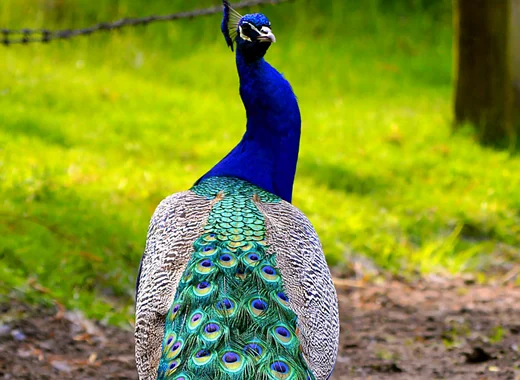
Structural coloring is the result of microscopically fine structured surfaces that interfere with visible light, sometimes in combination with pigments. For example, peacock tail feathers are brown pigmented, but because of their microscopic structure, they also reflect blue, turquoise and green light. And they are often iridescent. Thus, structural coloring is a classic optical effect of interference and diffraction, rather than a quantum property of photon absorption and emission, which is responsible for color in pigments (as plants, which efficiently absorb red light and the green is reflected) and bioluminescence.

British scientists Robert Hooke and Isaac Newton were the first to observe structural coloration, while its principle – wave interference – was explained by Thomas Young a century later, in 1803. Young described iridescence as the result of interference between reflections from two or more thin film surfaces, combined with refraction when light enters and leaves the film. The geometry determines the angles at which the light reflected from both surfaces interferes constructively and is amplified, and the angles at which the light interferes destructively and is cancelled out. Therefore, different colors appear at different angles.

Well known examples include the colors produced by the bright iridescent scales of butterfly wings and the chins of bird feathers, such as the tail of a peacock.

Challenges in Recreating Structural Colors Artificially

Recent computer models carried out by researchers from the Chemistry Department at Cambridge University explain why blues and greens are nature’s brightest colors.

The appearance of the matte or iridescent color will depend on how the internal structures are arranged on the nano scale. Ordered or crystalline structures result in iridescent colors, which change when viewed from different angles. Most examples of structural color in nature are iridescent.

Unordered structures result in matte colors, independent of viewing angles. Since the color of structures does not fade, these matte colors would be very useful for applications such as paints or coatings where metallic effects are not desired. So far, examples of natural matte structural color only exist in shades of blue or green.


“When we try to artificially recreate structural matte color for reds or oranges, we end up with a poor-quality result, both in terms of saturation and color purity”. Lukas Schertel, co-author of the research  


“In addition to its intensity and resistance to fading, a matte paint that uses structural color would also be much more environmentally friendly, since no toxic dyes and pigments would be needed,” said the first author, Gianni Jacucci.


By modeling the optical response and color appearance of nanostructures as found in the natural world, the researchers found that saturated and matte structural colors cannot be recreated in the red region of the visible spectrum, which could explain the absence of these tones in natural systems. The same difficulty was found for yellow and orange tones.

The researchers suggest that these apparent limitations of structural colors can be overcome by using other types of nanostructures, such as network structures or multi-layer hierarchical structures. Further investigations and understanding of these systems are required to achieve it.

More at:
https://en.wikipedia.org/wiki/Structural_coloration
https://phys.org/news/2020-09-blues-greens-brightest-colous-nature.html

Sign Up For Daily Newsletter

Be keep up! Get the latest breaking news delivered straight to your inbox.
loader

loader

loader

By signing up, you acknowledge the data practices in our Privacy Policy. You may unsubscribe at any time.
En vous inscrivant, vous reconnaissez les pratiques en matière de données dans notre politique de confidentialité. Vous pouvez vous désinscrire à n'importe quel moment.
Al registrarse, reconoce las prácticas de datos en nuestra política de privacidad. Puedes darte de baja en cualquier momento.
Share This Article
Facebook Twitter Copy Link Print
By Dr. Inés Urdaneta
Dr. Inés Urdaneta is a multi-published research physicist in the domain of light-matter interaction at the atomic, molecular, and nano/solid-state scales. In her more than 20 years of research she participated in national and international research projects throughout France, USA, México and Venezuela, on an extensive variety of topics. At present, as part of our research staff at the International Space Federation, Inés focuses on developing physical-chemical models in the frame of the generalized holographic model (GHM) and unification theory developed by Nassim Haramein, together with quantum information processes and their connection to black holes and to proto-consciousness.
Previous Article Beyond Science Fiction! Extracting Energy from Black Holes
Next Article Is the Physical World a Neural Network?

Stay Connected

981k Like
18.7k Follow
7.7k Follow
7.3k Subscribe

Categories

  • Astronomy106
  • Biology69
  • ISF News25
  • ISF Research14
  • Other22
  • Physics168
  • Technology36

You Might also Like

Physics

Gravitational Waves Leave Their Mark on Atomic Light: A New Window into Vacuum Field Physics

22. April 2026.
BiologyPhysics

Do Cells Use a Quantum Compass to Heal Wounds?

2. December 2025.
Physics

Space-Memory Experiments: Quantum Memory Matrix Results Explained

3. October 2025.
Physics

From Bit to Quanta: New Theory Links Entanglement to Particle Creation

17. September 2025.
The International Space Federation (ISF)The International Space Federation (ISF)

Harnessing quantum vacuum energy for sustainable solutions – a unified approach to science, technology and education.

Quick links

  • About
  • Research Papers
  • Events
  • Invest

Explore

  • ISF Research
  • Physics
  • Technology
  • Astronomy
  • Biology
  • ISF News

Sign Up for Our Newsletter

Subscribe to our newsletter to get our newest articles instantly!

loader

Follow US
© 2023 International Space Federation. All Rights Reserved. INTERNATIONAL SPACE FEDERATION is a trademark of ISFS SA. The mark is registered in the United States under Registration No. 7772313. The ®️ symbol is used exclusively in the U.S.
  • Press
  • Careers
  • Privacy policy
  • Carrieres
  • Presse
  • Prensa
Join Us!

Subscribe to our newsletter and never miss our latest news.

loader

Welcome Back!

Sign in to your account

Lost your password?