


Brownian motion is the random motion of particles suspended in a fluid (a liquid or a gas) resulting from their collision with the quick atoms or molecules in the fluid. This phenomenon is named after the botanist Robert Brown, who first observed it in 1827 while studying pollen grains in water. The motion is irregular, unpredictable, and consists of sudden, darting movements. Albert Einstein’s theoretical explanation of Brownian motion in 1905 provided strong evidence for the existence of atoms and molecules, helping to confirm the atomic theory of matter.
Understanding Brownian motion is important in fields such as biology (e.g., movement of particles within cells), chemistry (e.g., colloidal systems), and physics (e.g., study of particle dynamics). It plays a crucial role in many natural and technological processes, including diffusion in cells, the mixing of fluids, and even some financial models.
While Brownian motion describes the random translational movement of particles, Brownian torque focuses on their random rotational movement. Translational Brownian motion is well-known and extensively studied, particularly in colloid and macromolecule behavior. Meanwhile, Brownian rotation remains a less explored frontier. This ‘hidden’ aspect of Brownian motion presents significant challenges, as measuring Brownian torques is far more complex than measuring Brownian forces. Consequently, research on rotational Brownian motion of micro-objects is relatively scarce.
Rotational Brownian motion has intriguing effects, such as smoothing the transition between synchronous and asynchronous modes of microparticle rotation. To validate experimental observations of microparticle rotation under Brownian torque, researchers often employ numerical Brownian dynamics simulations, providing a crucial link between theory and practice in this emerging field of study.
In a recent study published in Scientific Reports [1], researchers from Moscow State University used optical tweezers and rotating magnetic fields to study the motion of microscopic magnetic beads. Their goal? To detect and measure the elusive effects of Brownian torque motion. An optical tweezer is an instrument that uses a highly focused laser beam to manipulate microscopic objects. It works on the principle of radiation pressure, where light can exert small forces on small particles.
The key features of optical tweezers are:
- – Function: They can trap and move small particles, typically ranging from nanometers to micrometers in size.
- – Applications: Widely used in biology, physics, and chemistry for studying single molecules, cells, and colloidal particles.
- – Mechanism: The laser beam creates a strong electric field gradient that attracts particles to the focal point of the beam.
- – Precision: Optical tweezers can manipulate objects with extremely high precision, often on the scale of nanometers.
- – Non-invasive: They allow for manipulation of biological samples without direct physical contact, reducing the risk of damage.
Optical tweezers have revolutionized many areas of scientific research, enabling scientists to study the mechanical properties of DNA, measure forces within living cells, and assemble nanostructures with unprecedented control.
The team used focused laser beams to trap individual 3-micrometer magnetic beads in water. They then applied rotating magnetic fields to make the beads spin. The rotating magnetic fields interact with the magnetic moments of the beads, causing them to rotate. By precisely controlling the strength and rotation speed of the magnetic field, they could observe how the beads’ motion changed under different conditions.
As explained in [1], there are two modes of microparticle rotation controlled by the interplay between magnetic and viscous torques. In magnetic fields rotating at low frequencies, the microparticles rotate synchronously with a rotating magnetic field. Once the frequency of the magnetic field rotation exceeds some critical value ωcrit, the microparticle motion becomes asynchronous (see Fig. 1).
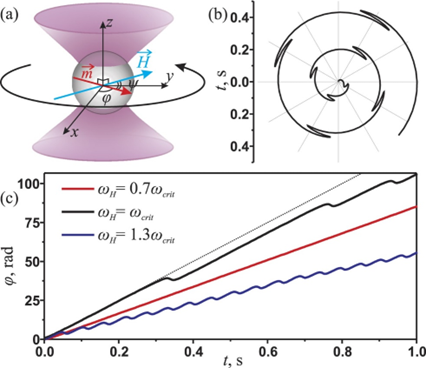
What they found was fascinating. At low rotation speeds, the beads spun in sync with the magnetic field. But as the rotation speed increased up to the critical value, something strange happened – the beads’ motion became erratic, occasionally spinning backwards against the field. This bizarre behavior stems from the interplay between two forces: the driving force of the magnetic field, and the random kicks from Brownian motion. It’s a bit like trying to steer a tiny boat in choppy waters: imagine trying to row a boat in a direction dictated by a compass (magnetic field), while waves (Brownian motion) randomly push you around. At low speeds, you can course correct easily. At high speeds, the waves’ influence becomes more significant, occasionally pushing you backward despite your efforts.
Since the value of the critical frequency depends on the viscosity of the liquid, the strength of the magnetic field and the shape of the microparticles, the response of the critical rotational frequency to changes in the liquid properties allows a microparticle to be a tiny physiochemical microsensor of the local properties of a liquid with a volume of a few picoliters.
The fascinating behavior observed as rotation speed increases is a manifestation of stochastic resonance, a phenomenon where adding noise to a nonlinear system can enhance the detection of weak signals:
1. Low Rotation Speeds: At these speeds, the magnetic torque dominates over Brownian forces. The bead’s rotation is deterministic, following the external field closely.
2. High Rotation Speeds: As speed increases, the system enters a regime where magnetic and Brownian forces are comparable. This leads to stochastic dynamics.
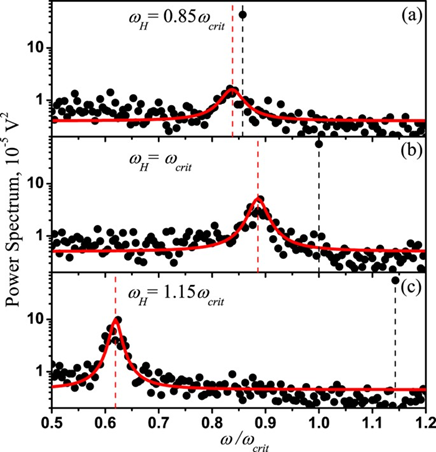
The stochastic properties of the microparticle rotation near the critical point can be determined from the frequency dependence of the power spectra of the quadrant photodiode (QPD) signals shown below in Fig. 2. Asynchronous motion appears as a peak in the power spectrum of the QPD signal, which becomes higher and narrower with increasing frequency of the magnetic field rotation. When ωH < ωcrit, the particle rotation is not strictly uniform and the peak position shifts toward higher frequencies as ωH increases (see Fig. 2(a)). For ωH > ωcrit, the peak shifts to the left (see Fig. 2(c)).
By carefully analyzing this transition between smooth and erratic rotation, the researchers were able to measure the strength of the Brownian forces acting on the particles. This is no easy feat – these forces are incredibly tiny, equivalent to about a millionth of a billionth of a Newton. The researchers’ ability to measure the strength of Brownian forces acting on the particles is a significant achievement in experimental physics. The forces measured are indeed incredibly small, in the order of femtonewtons (10-15 N). To put this in perspective, it’s roughly equivalent to the weight of a single virus particle. Measuring such minute forces requires exquisitely sensitive equipment and sophisticated data analysis techniques.
The advanced experimental setup for studying Brownian motion provides high temporal resolution, as the technique allows for real-time observation of Brownian effects, and 3D measurements; unlike some existing methods, this approach can probe Brownian motion in all three spatial dimensions.
The study also demonstrated some clever applications. By measuring how the particles’ rotation changed in different conditions, the team showed they could detect minute changes in temperature and viscosity of the surrounding fluid. Small changes in temperature affect the intensity of Brownian motion. By monitoring the particles’ rotation, researchers can detect temperature fluctuations with high precision, potentially on the order of millikelvins or better. The rotational behavior of the particles is also sensitive to the fluid’s viscosity. This could enable real-time monitoring of viscosity changes in microfluidic systems or biological samples. This all could lead to new types of ultra-sensitive microsensors, that could be applied in fields such as 1) biomedical diagnostics (these microsensors could detect subtle changes in bodily fluids, potentially indicating disease states or drug responses), 2) Environmental Monitoring (ultra-sensitive detection of pollutants or contaminants in water or air samples) and 3) materials Science (studying the properties of complex fluids, polymers, and nanomaterials)
“We’re essentially watching the thermal energy of individual molecules kick these nanoparticles around,” explains Dr. Petrova. “It’s like trying to track a cork bobbing in the ocean during a storm, but at a scale a billion times smaller.”
The authors of this study remark that their theoretical models don’t perfectly match the experimental results, hinting at even more complex physics at play. The theoretical challenges of this work include the need to refine the models, as the discrepancy between theoretical predictions and experimental results highlights the need for more sophisticated models of stochastic systems far from equilibrium. This includes as well multiscale modeling, as bridging the gap between quantum mechanical effects and classical Brownian motion remains a significant challenge in theoretical physics. Additionally, advanced simulation techniques may be needed to fully capture the complex dynamics observed in these experiments.
This research represents a significant step forward in our ability to probe and understand the microscopic world. By bridging the gap between theoretical models of Brownian motion and experimental observations, it opens up new avenues for both fundamental research and practical applications across a wide range of scientific disciplines.
Unified Science In Perspective:
Understanding Brownian motion is crucial for many areas of science and technology. It plays a role in everything from the diffusion of molecules in cells to the behavior of nanotech devices. This research provides a new tool for probing these effects at the microscale. The study of Brownian motion is important in a variety of fields, such as:
a) Cellular Biology: Brownian motion drives the diffusion of molecules within cells, influencing processes like enzyme kinetics and signal transduction.
b) Colloidal Science: It affects the stability and behavior of suspensions, emulsions, and other complex fluids.
c) Nanotechnology: As devices shrink to nanoscale, Brownian effects become increasingly significant, impacting their performance and reliability.
This research not only provides insights into the fundamental physics of noise-driven systems but also has potential applications in developing micro- and nano-scale devices that can operate reliably in noisy environments, such as within living cells or in microfluidic systems.
Regarding fundamental physics, this work deepens our understanding about:
a) Non-equilibrium Thermodynamics: This work provides insights into systems far from equilibrium, a frontier area in statistical physics.
b) Fluctuation Theorems: The results could help test and refine theoretical models describing energy dissipation in microscopic systems.
c) Determinism vs. Stochasticity: This work highlights the delicate balance between predictable, deterministic behavior and random fluctuations in nature.
d) Emergence: It provides a concrete example of how complex, seemingly unpredictable behavior can emerge from simple underlying rules.
e) Scale and Physical Laws: The research underscores how different physical principles dominate at different scales, feature that is deeply related to the research that we perform at ISF for the unification of scales [2].
References:
[1] Romodina, M., Lyubin, E. & Fedyanin, A. Detection of Brownian Torque in a Magnetically-Driven Rotating Microsystem. Sci Rep 6, 21212 (2016). https://doi.org/10.1038/srep21212
[2] Nassim Haramein, & Olivier Alirol. (2020). Scale invariant unification of forces, fields and particles in a Quantum Vacuum plasma. https://doi.org/10.5281/zenodo.4050623