

Entanglement Harvesting Protocol
In this exploration of novel energy technologies we look into one of the most fascinating frontiers in quantum physics – the ability to extract and harness the intrinsic quantum correlations woven into the very fabric of empty space. Far from being a lifeless void, the quantum vacuum teems with entangled states that can be “harvested” for practical applications, from quantum computing to energy extraction. This groundbreaking protocol demonstrates how two quantum systems, even when separated by space-like distances, can tap into these hidden quantum correlations and become entangled themselves – without any direct interaction. As we’ll see, recent breakthroughs in derivative coupling and quantum energy teleportation are pushing this technology from theoretical possibility to experimental reality, opening up remarkable new possibilities for quantum technologies. The implications are profound, suggesting that the quantum vacuum itself may serve as an unlimited resource for future quantum devices and communications systems.
It has long been recognized that the vacuum states described by quantum field theory are highly entangled across spacelike regions [1]. What’s more, these strongly correlated (entangled) loci of quantum spacetime can be utilized or “harvested” for experimental purposes as well as for potential technological applications like vacuum energy extraction and storage. This technique of utilizing the intrinsic nonlocal correlations of the quantum vacuum is called entanglement harvesting, something that we have discussed in previous ISF articles like quantum energy teleportation protocol (which has an associated live webinar presentation).
The theoretical foundations of entanglement harvesting were laid in the 1980s when physicists Summers and Werner first proved that the vacuum state of a quantum field contains entanglement between spacelike-separated regions [2,3].
However, it wasn’t until the early 2000s that physicists began exploring how to practically extract this entanglement. Valentini first suggested in 1991 that particle detectors could become entangled through their interaction with the vacuum [4]. followed by Reznik’s groundbreaking work in 2003 that formally established the entanglement harvesting protocol [5].
The protocol involves two quantum systems that couple locally to a quantum field; these quantum systems are generally described as an Unruh-Dewitt detector, such as a two-level atom, which can be in one of two states depending on its coupling with a quantum field, like the electromagnetic field (figure 1, see also my article Unruh-Hawking Radiation Observed in Accelerating Electrons). Through their interaction with the field vacuum, these initially uncorrelated detectors can become entangled—even when they are spacelike separated and cannot directly communicate. This remarkable phenomenon demonstrates that the quantum vacuum itself contains extractable quantum correlations. In my study on The Entanglement Nexus of Awareness [6], I explored some of the implications of what it means that quantum systems can become entangled even without direct local interaction but instead via the intrinsic correlations of the quantum vacuum (a veritable entanglement nexus for atoms and molecules).

Early theoretical work focused on understanding the fundamental aspects of entanglement harvesting. Ver Steeg and Menicucci showed that the protocol is sensitive to spacetime curvature and can distinguish between different background geometries [8]. The protocol has also proven useful for applications in quantum metrology.
Quantum metrology is the science of using quantum phenomena to improve the precision and accuracy of measurements beyond the limits of classical techniques. It leverages uniquely quantum mechanical properties such as entanglement, superposition, and squeezed states to achieve greater sensitivity in measuring physical quantities like time, distance, magnetic fields, or gravitational waves. For example, squeezed states are a technique where uncertainty in one property (e.g., phase) is reduced at the expense of increased uncertainty in a complementary property (e.g., amplitude), improving measurement sensitivity in the desired dimension. Most salient to the discussion here, an entanglement harvesting protocol can be utilized because multiple sensors or detectors can be quantum entangled via the intrinsic nonlocal correlations of the quantum vacuum and the entanglement can then be leveraged to enable measurements that are more precise than those achievable with independent systems.
A significant development came with the concept of “entanglement farming” – the idea that vacuum entanglement could be repeatedly harvested and distilled into Bell pairs for use as a quantum resource. This opened up practical possibilities for quantum information processing applications.
Recent work has continued to expand our understanding of entanglement harvesting. A 2024 paper by Teixidó-Bonfill and Martín-Martínez demonstrated that particle detectors coupled to a field through its derivative (rather than its amplitude) can genuinely harvest entanglement even when in causal contact [9].
The term derivative coupling refers to a specific interaction between a quantum system, such as a particle detector, and a quantum field, where the system couples to the spatial or temporal derivatives of the field rather than to the field’s value itself. This means that the detector’s interaction depends on the rate of change of the field at a point, capturing how the field varies over space or time.
In quantum field theory, coupling mechanisms describe how systems interact with fields. A derivative coupling involves the detector interacting with the gradient (spatial derivative) or time derivative of the field. This contrasts with minimal coupling, where the interaction is directly with the field’s value at a point.
So, Teixidó-Bonfill and Martín-Martínez demonstrated that derivative coupling allows for the harvesting of genuine entanglement between detectors even when they are within each other’s light cones, meaning they can causally influence each other. This finding is significant because it shows that entanglement can be extracted from the field in scenarios where direct causal communication is possible, challenging previous assumptions that entanglement harvesting is limited to spacelike separated regions.
The research highlights the role of derivative coupling in enabling entanglement harvesting in situations involving causal contact, providing new insights into the interplay between quantum fields and entanglement.
This is particularly relevant for experimental implementations, as derivative coupling naturally appears in various physical systems including superconducting circuits coupled to transmission lines. So, entanglement farming is seeing significant advancements in understanding and applicability, with the latest development in derivative coupling enabling genuine entanglement harvesting during causal contact (in which the quantum systems, like qubits, do not have to maintain spatial isolation).
As quantum technologies advance, entanglement harvesting may provide a novel resource for quantum information processing. The ability to extract and utilize vacuum entanglement could enable new capabilities in quantum communication, computation, and sensing. The recent developments in derivative coupling bring us closer to practical implementations while deepening our understanding of the quantum nature of the vacuum.
Implementation of Entanglement Farming for Practical Extraction of Energy from the Quantum Vacuum
In previous articles we have explored how the quantum vacuum, far from being empty space, contains rich structure and inherent energy even in its ground state, which can be reviewed in our articles such as Spacetime Engineering & Harnessing Zero-point Energy of the Quantum Vacuum, and Experiment Generates Electron-Positron Plasma from the Vacuum (both articles can be accessed via the provided hyperlinks).
This vacuum energy manifests in various experimentally verified phenomena such as the Casimir effect [Controlling the Quantum Vacuum for Energy Transfer and Functional Casimir Devices], vacuum polarization [Experiment Generates Electron-Positron Plasma from the Vacuum], and many optical phenomena [e.g., spontaneous emission]. Of particular relevance to recent experimental breakthroughs is the intrinsic spatial entanglement of quantum vacuum fluctuations, which creates a network of correlations that can be accessed and utilized through carefully designed protocols.
The quantum energy teleportation (QET) protocol, first proposed by Masahiro Hotta in 2008, provided a theoretical framework for extracting energy from what we now understand to be a “quasi-vacuum” state [10]. While this state shares many properties with a true vacuum, it is more accurately described as a strongly local passive (SLP) state, from which energy cannot be extracted through local operations alone, because of the indelible involvement of nonlocal correlations. The entangled ground state is a strongly local (SL) passive state, and such SL passivity is associated in many-body systems with the presence of ground state entanglement in a way suggestive of collective quantum phenomena such as quantum phase transitions, superconductivity, and the quantum Hall effect. So, it is very interesting from a technological perspective since macroscopic / collective quantum states have significant potential applications, and the role of SL passivity in quantum energy teleportation.
Initialization of the Enhanced QET Protocol
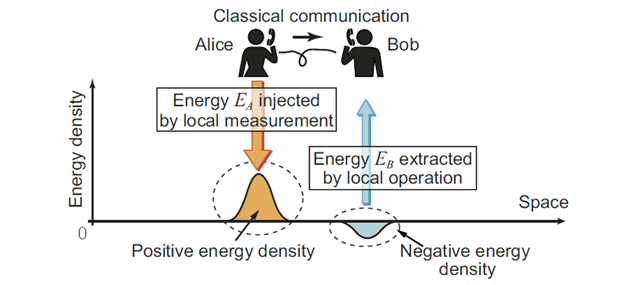
The protocols of QET consist of local operations and classical communication. By measuring the local fluctuation induced by a zero-point oscillation in the ground state of a many-body quantum system and by announcing the measurement result to distant points, energy can be effectively teleported without breaking any physical laws including causality and local energy conservation… Quantum fields in vacuum states carry an infinite amount of quantum entanglement. -Hotta [11].
The original QET protocol demonstrated the possibility of extracting energy from vacuum correlations, but suffered from a significant limitation: the extracted energy was lost to classical measurement devices, making it unavailable for practical applications. The enhanced protocol, recently demonstrated experimentally [12], overcomes this limitation through the introduction of a third qubit that serves as a quantum energy storage device. This breakthrough represents a significant advancement in quantum thermodynamics and energy harvesting techniques.
The addition of the third qubit fundamentally changes the dynamics of the system by providing a quantum mechanical storage solution that preserves the coherent nature of the extracted energy. This preservation is crucial because it maintains the quantum properties of the extracted energy, allowing for its subsequent use in quantum operations or transfer to other quantum systems. The experimental validation of this enhanced protocol opens new possibilities for quantum energy distribution networks and could potentially revolutionize our approach to energy harvesting at the quantum scale.
Although the enhanced quantum energy teleportation protocol probably only has practical applications in quantum computing and quantum communication systems for the foreseeable future— where energy management at the microscopic level is crucial for maintaining quantum coherence and performing complex operations—it has a deeper significance as it is a proof-of-principle that the quantum vacuum energy density can be utilized, it is not thermodynamically dead as is erroneously presumed. In this case, energy is being teleported via the nonlocal correlations of the vacuum state and stored in a quantum subsystem.
Experimental Verification of Enhanced QET
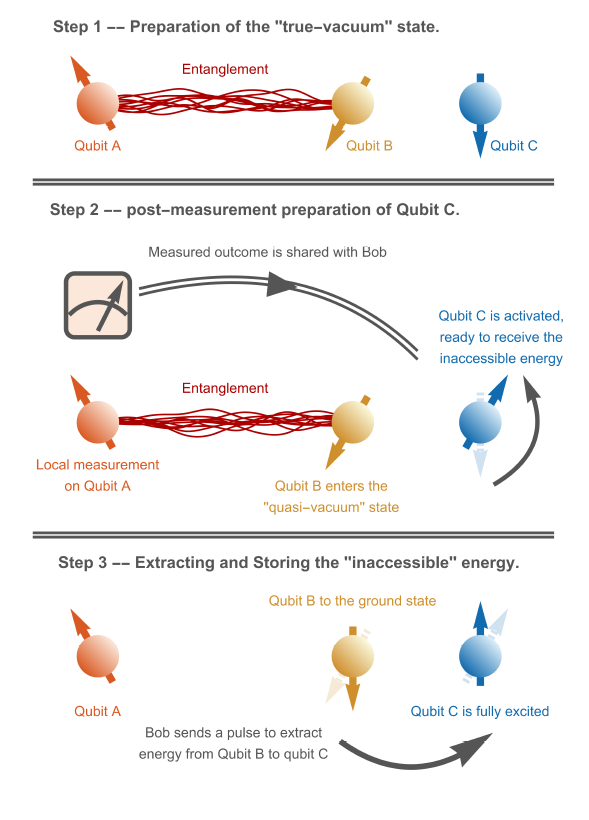
The experimental validation of the enhanced QET protocol was performed using IBM’s superconducting quantum computer “ibm_brisbane.” The protocol consists of three distinct steps:
- Preparation of the initial three-qubit ground state
- Post-measurement preparation of the storage qubit
- Energy extraction and transfer from the measurement qubit to the storage qubit
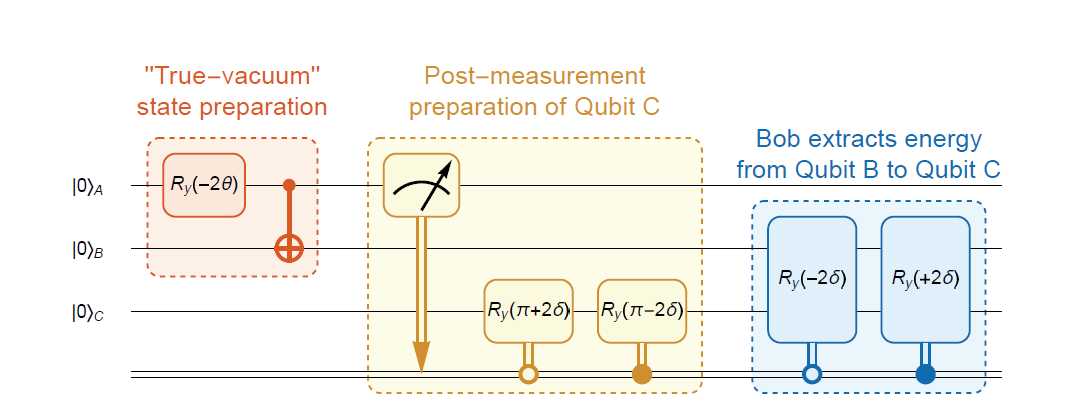
While this was only a gedankenexperiment performed on a quantum computer, the researchers were able to demonstrate an optimal extraction and storage of energy within the simulation. Their experimental results showing remarkable agreement with theoretical predictions across all three stages of the protocol. This verification represents a significant proof-of-concept demonstration towards controlled energy extraction and storage from quantum vacuum correlations. The next step obviously being to implement the protocol in a real physical three-qubit system for real-world validation.
Implications and Future Applications
The successful implementation of the enhanced QET protocol opens numerous possibilities for quantum technologies. The ability to store extracted vacuum energy within quantum systems could enable:
- Quantum batteries utilizing vacuum energy (batteries draw energy from zero-point energy)
- Enhanced quantum communication protocols
- Enhanced quantum computations, with fine control of the multi-qubit state
- Experimental probes of quantum thermodynamics

Many-body quantum vacuum fluctuation engines
A final breakthrough we will look at is remarkable research that has revealed an exciting way to harness quantum vacuum energy through many-body quantum vacuum fluctuation engines. This approach builds on Quantum Energy Teleportation (QET) and entanglement harvesting protocols. These engines work by capturing the energy difference between an interacting quantum system’s entangled ground state and its local separable states.
Similar to the QET, the fundamental operating principle involves performing local energy measurements on an interacting many-body system, which can produce excited states from which work can be extracted via local feedback operations. These measurements reveal the quantum vacuum fluctuations present in the global ground state when viewed in the local basis, providing the energy required to run the engine. The measurement process effectively “collapses” the quantum state—the entanglement network undergoes brief decoherence— temporarily breaking the delicate quantum correlations that characterize the ground state.
This measurement-induced excitation process is particularly fascinating because it harnesses purely quantum mechanical effects – specifically, the inherent uncertainty and non-local correlations present in quantum systems. The energy extracted comes from the quantum vacuum fluctuations themselves, rather than from any external energy input. This represents a fundamentally different paradigm from classical heat engines.

As shown in Figure 6, the reset phase is simple— the interacting many-body system merely needs to be coupled to a cold bath and allowed to relax back to its entangled ground state. During this relaxation process, the quantum correlations are gradually reestablished as the system dissipates energy to the environment and returns to its lowest-energy configuration. This completes the cycle and prepares the system for the next round of measurement and energy extraction.
This concept has been demonstrated theoretically for two distinct types of many-body systems: chains of coupled qubits and coupled harmonic oscillator networks, which faithfully represent fermionic and bosonic excitations respectively. In both cases, analytical results show that for a large number of coupled subsystems, the average work output scales linearly or faster and dominates over fluctuations, while the efficiency approaches a constant value.
The efficiency is controlled by what researchers term the “local entanglement gap” – the energy difference between the many-body ground state and the lowest-energy eigenstate of the local Hamiltonian. Notably, in the case of qubit chains, work and efficiency exhibit sharp increases at quantum critical points. For one-dimensional oscillator chains, the efficiency remarkably approaches unity as the number of coupled oscillators increases, even while maintaining finite work output.
A key advantage of this approach is that the entanglement resource comes “for free” through natural relaxation to the ground state, rather than requiring complex quantum gate operations to generate. However, the main experimental challenge lies in implementing sufficiently fast and strong local measurements that can overcome the coupling between neighboring quantum systems.
This work represents a significant theoretical advance in quantum thermodynamics and points toward new possibilities for extracting useful work from quantum vacuum fluctuations as quantum technologies continue to develop. The combination of high theoretical efficiencies and conceptually simple reset mechanisms makes many-body quantum vacuum fluctuation engines an intriguing direction for future experimental implementation. Intriguingly, the enhanced quantum energy teleportation protocol can be directly applied to this technique so that the work extracted from quantum vacuum fluctuations via decoherence of the entanglement of a qubit system can be stored, perhaps creating a quantum battery that continuously recharges by drawing energy from the quantum vacuum (Energy-conversion device using a quantum engine with the work medium of two-atom entanglement [14]).

Highlights
The successful demonstration of energy storage from quantum vacuum correlations represents a significant milestone in our understanding and utilization of vacuum energy. While previous experiments showed the possibility of extracting such energy, the ability to store it within quantum systems opens entirely new possibilities for practical applications. This achievement also provides further evidence for the substantive nature of the quantum vacuum and its potential utility in future technologies.
The enhanced QET protocol demonstrates that the quantum vacuum is not merely a theoretical construct but a real, accessible resource for quantum technologies. As we continue to develop more sophisticated methods for manipulating quantum systems, the practical applications of vacuum energy extraction and storage may become increasingly important for future quantum technologies.
The enhanced QET protocol will probably only have niche applications in the foreseeable future, like in quantum computing, quantum communication, and possibly nanotechnology (powering nanodevices) since from the perspective of harnessing the quantum vacuum energy density it is “extracting” the same amount of energy that was injected into the vacuum and is involving very small amounts. However, the utilization of quantum entanglement is an excellent empirical demonstration that EPR correlations are real and involve the quantum vacuum, showing how vacuum fluctuations are intrinsically entangled—perhaps fundamentally via micro-wormhole (Einstein-Rosen bridges or ER) connections in spacetime— which makes the link to ER = ERP not so far-fetched.
Moreover, the many-body quantum vacuum fluctuation engine directly draws energy from the energetic fluctuations of the vacuum energy density. These protocols offer direct proof-of-concept that the quantum vacuum energy density can be utilized. These particular methodologies are unlikely to enable large-scale harnessing of quantum vacuum energy, however they enable direct technological testing of transferring and storing energy with quantum entanglement, and this may provide invaluable insight for techniques that will draw tremendous energy from the quantum vacuum, like with plasma spin-coherence magnetohydrodynamic systems (Figure 5).

References
[1] S. J. Summers and R. Werner, The vacuum violates Bell’s inequalities, Phys. Lett. A 110, 257 (1985).
[2] S. J. Summers and R. Werner, Bell’s inequalities and quantum field theory. II. Bell’s inequalities are maximally violated in the vacuum, J. Math. Phys. (N.Y.) 28, 2448 (1987).
[3] S. J. Summers and R. Werner, Bell’s inequalities and quantum field theory. I. General setting, J. Math. Phys. (N.Y.) 28, 2440 (1987).
[4] A. Valentini, “Non-local correlations in quantum electrodynamics,” Physics Letters A, vol. 153, no. 6, pp. 321–325, Mar. 1991, doi: 10.1016/0375-9601(91)90952-5.
[5] B. Reznik, “Entanglement from the Vacuum,” Foundations of Physics, vol. 33, no. 1, pp. 167–176, Jan. 2003, doi: 10.1023/A:1022875910744.
[6] William Brown. Unified Physics and the Entanglement Nexus of Awareness. Journal of Neuroquantology; Vol 17, No 7 (2019).
[7] G. Gregori, G. Marocco, S. Sarkar, R. Bingham, and C. Wang, “Measuring Unruh radiation from accelerated electrons,” Eur. Phys. J. C, vol. 84, no. 5, Art. no. 5, May 2024, doi: 10.1140/epjc/s10052-024-12849-9.
[8] G. V. Steeg and N. C. Menicucci, “Entangling power of an expanding universe,” Phys. Rev. D, vol. 79, no. 4, p. 044027, Feb. 2009, doi: 10.1103/PhysRevD.79.044027.
[9] A. Teixidó-Bonfill and E. Martín-Martínez, “Derivative coupling enables genuine entanglement harvesting in causal communication,” Jun. 20, 2024, arXiv: arXiv:2406.14637. doi: 10.48550/arXiv.2406.14637.]
[10] M. Hotta, “A protocol for quantum energy distribution,” Physics Letters A, vol. 372, no. 35, pp. 5671–5676, Aug. 2008, doi: 10.1016/j.physleta.2008.07.007].
[11] M. Hotta, “Controlled Hawking Process by Quantum Energy Teleportation,” Phys. Rev. D, vol. 81, no. 4, p. 044025, Feb. 2010, doi: 10.1103/PhysRevD.81.044025.
[12] S. Xie, M. Sajjan, and S. Kais, “Extracting and Storing Energy From a Quasi-Vacuum on a Quantum Computer,” Sep. 06, 2024, arXiv: arXiv:2409.03973. doi: 10.48550/arXiv.2409.03973.
[13] É. Jussiau, L. Bresque, A. Auffèves, K. W. Murch, and A. N. Jordan, “Many-body quantum vacuum fluctuation engines,” Phys. Rev. Research, vol. 5, no. 3, p. 033122, Aug. 2023, doi: 10.1103/PhysRevResearch.5.033122.
[14] J.-W. Zhang et al., “Energy-Conversion Device Using a Quantum Engine with the Work Medium of Two-Atom Entanglement,” Phys. Rev. Lett., vol. 132, no. 18, p. 180401, Apr. 2024, doi: 10.1103/PhysRevLett.132.180401.