

Entanglement, coined by Einstein as “spooky action at a distance”, has achieved a new record for long distance communication, as a team from Ludwig-Maximilians-University Munich (LMU) and Saarland University have reported in Nature [1].
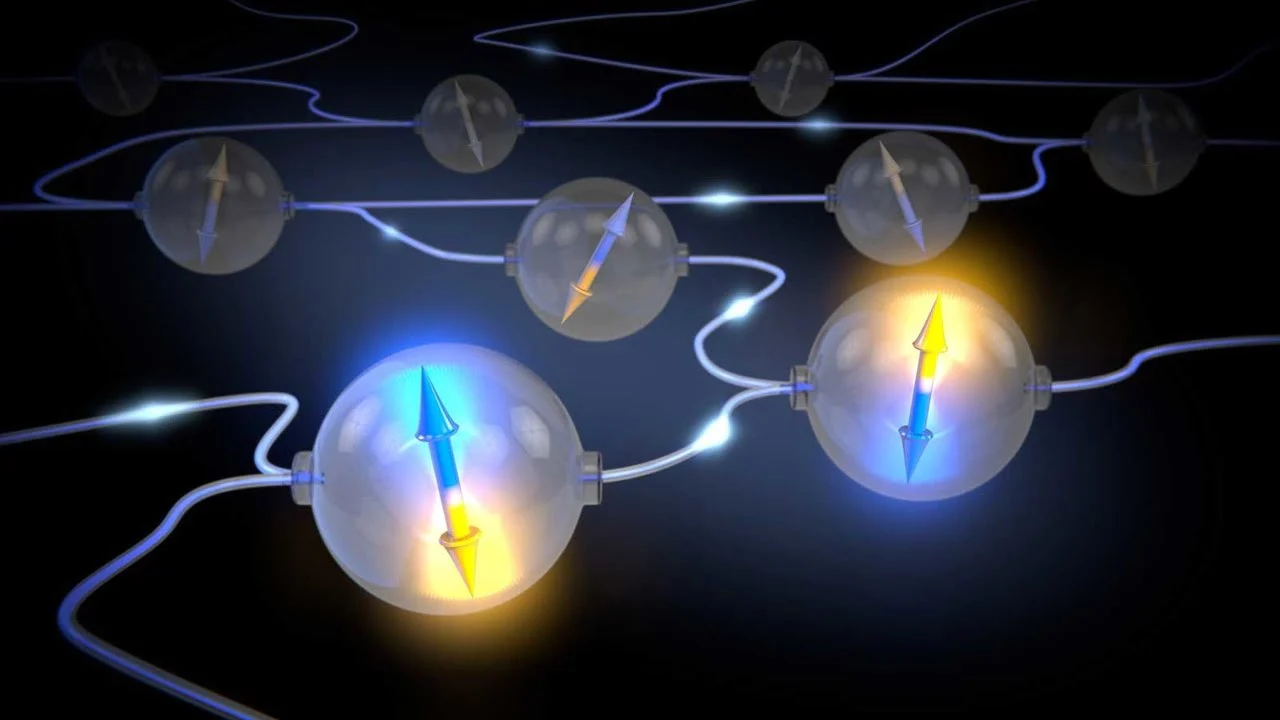
Entanglement is the property by which two quantum objects, such as atoms, are connected in such a way that their quantum state can’t be described independently from the other. Hence, when a change happens in one of the objects, the other object modifies its state as to preserve the relationship between them, no matter the distance between them.
This feature seems to defy Einstein’s special relativity, in which nothing, not even information could travel faster that the speed of light. It is as if the correlation between entangled particles was preserved “instantaneously” by some miraculous mechanism implying an intrinsic nonlocality of space-time. Our RSF article entitled Does Space-time Emerge From Entanglement? addresses this last [2].
The authors establishing the latest new record of entangled states conservation along long distances, demonstrated entanglement between two independently trapped single rubidium atoms generated over fiber optic fibers with a length up to 33 km by producing atom–photon entanglement in two nodes located in buildings which are 400 m apart. To overcome high-attenuation losses in the fibers, they converted the photons to telecom wavelength using polarization-preserving quantum frequency conversion.
 Figure 1: In each node, located in buildings 400 m apart, a single 87Rb atom is loaded in an optical dipole trap. Both atoms are synchronously excited to the state to generate atom–photon entanglement in the subsequent spontaneous decay. The single photons emitted at a wavelength of 780 nm are collected using high-numerical aperture objectives and coupled into single-mode fibers leading to the QFC devices. There, they are converted to telecom wavelength (λ = 1,517 nm) by difference frequency generation. Such a configuration fully maintains the polarization quantum state of the photon. The converted photons are guided to a middle station by fiber cables with lengths up to 16.5 km, where the entanglement is swapped to the atoms by a BSM. After successfully generating atom–atom entanglement, the atoms are analyzed independently by a readout pulse of which the polarization, set by a half-wave plate (HWP) and quarter-wave plate (QWP), defines the measurement setting. PC are the polarization controllers. Figure and text taken from original paper.
The results are reported through the distribution of entanglement between two remote quantum nodes (87Rb atoms trapped and manipulated independently at locations 400 m apart) generated over fiber cables with a length of up to 33 km. The experiment begins with entangling the spin state of an atom with the polarization state of a photon in each node. Each atom was excited with a laser pulse, which causes it to emit a photon that’s quantum entangled with the atom.
Then, the photons emitted by the atoms at 780 nm are converted to telecom wavelengths and sent down the fiber optic cables which are 16.5 km long, to meet at a receiving station in the middle, place where a Bell-state measurement (BSM) is performed to swap the entanglement to the atoms. Since the photons undergo a joint measurement, they are being entangled with each other, and since they’re each already entangled with their own atom, the two atoms become entangled with each other as well.
“The key is that the mediating photons were converted into a longer wavelength so that they travel further through the fibers – their natural wavelength of 780 nanometers (nm) means they’d normally be lost after a few kilometers, so before their journey started the team ran them through a device to convert them to a wavelength of 1,517 nm. This is close to the 1,550-nm wavelength commonly used for telecoms in fiber optics, which reduces losses.” Michael Irving.
Networks running on this novel technology are faster and more secure. It will just be a matter of time before entangled networks become available and common in our everyday life.
This new record aligns well with the recent experiment in which for the first time, quantum-encoded photons and classical signals were simultaneously delivered across a metropolitan-scale distance (50 km) with an unprecedented accuracy of synchronization that allows to precisely identify and manipulate entangled photon pairs involved in quantum networks over large distances and in real-world conditions [3].
This all will procure solid grounds for quantum information processing (quantum computing) as well, offering an exponential increase in computational capacities, which now a days seem out of this world.
Highlights:
When first measured experimentally, entanglement was supposed to happen in extremely rare scenarios involving only very few quantum objects and extreme laboratory conditions. Now-a-days it has been detected in macroscopic samples and at room temperature.
This has huge implications regarding nature of reality. If entanglement happens much more frequently than previously thought, this could mean that nonlocality is the rule, instead of an exceptional event. Many phenomena that remain unaccounted for in leading physical theories, would probably have an explanation in terms of entanglement. In fact, given that leading theories conclude that 95% of our universe is accounted for as dark mass and dark energy -which have not been detected yet- one could wonder if entanglement could replace them.
Such an entangled network could provide a quasi-instantaneous feedback-feedforward mechanism connecting all scales in the universe, acting as a huge neural network [4]. This has further implications regarding an evolution driven to higher order of complexity, and in consciousness and self-awareness as well.
RSF biophysicist William Brown addressed these last in his very interesting papers entitled The Space-memory Network: From Cosmogenesis to Consciousness [5] and Unified Physics and The Nexus of Awareness [6].
References:
[1] van Leent, T., Bock, M., Fertig, F. et al. Entangling single atoms over 33 km telecom fibre. Nature 607, 69–73 (2022). https://doi.org/10.1038/s41586-022-04764-4.
[2] Urdaneta, I. Does Space-time Emerge From Entanglement? The Resonance Science Foundation.June 06, 2020.
[3] Urdaneta, I. Scaling of Quantum Computing to Macroscopic regime is Closer! The Resonance Science Foundation. July 01, 2022.
[4] William Brown, The Universe Organizes in a Galactic Neuromorphic Network, The Resonance Science Foundation. May 04, 2021.
[5] Haramein, N., Brown W., & Val Baker, A. K. F. (2016). The Unified Spacememory Network: from cosmogenesis to consciousness, Journal of Neuroquantology.
[6] William Brown. Unified Physics and the Entanglement Nexus of Awareness 2019. Journal of Neuroquantology; Vol 17, No 7 (2019)