
By using this site, you agree to the Privacy Policy.
Accept
The International Space Federation (ISF)The International Space Federation (ISF)The International Space Federation (ISF)
  • Science News
    • All Articles
    • Physics
    • Astronomy
    • Biology
    • Technology
    • Other
  • Research
    • Research Papers
    • Physicists Testimonials
  • Technology
  • About
    • About us
  • ISF News
  • Events
    • Events
  • Get Involved
    • Invest
    • Donate – Zero Point Foundation
  • Careers
  • Contact Us
Reading: Neutron Helical Waves
Share
The International Space Federation (ISF)The International Space Federation (ISF)
Search
  • Science News
    • Physics
    • Astronomy
    • Biology
    • Technology
  • Research Papers
    • Physicists Testimonials
  • About
    • ISF News
  • Events
  • Get involved
    • Invest
  • Translations
    online pharmacy https://worldneurologyonline.com/ no prescription pharmacy
    • Français
    • Español
Follow US
© 2022 International Space Federation. All Rights Reserved.
The International Space Federation (ISF) / Explore / Physics / Neutron Helical Waves
Physics

Neutron Helical Waves

Neutrons form a major component of baryonic matter. Except for hydrogen, neutrons are present in the central region (nucleus) of the atoms of all elements. Although they are electrically neutral, they are very crucial for the determination of atomic structure and its composition.

Amal Pushp
Last updated: 2025/03/07 at 2:59 PM
Amal Pushp
Share
6 Min Read
SHARE

Neutrons form a major component of baryonic matter. Except for hydrogen, neutrons are present in the central region (nucleus) of the atoms of all elements. Although they are electrically neutral, they are very crucial for the determination of atomic structure and its composition. One of the key reasons why they are influential is due to the fact that they can penetrate materials that optical radiations like X-rays usually cannot. 

The de Broglie hypothesis of quantum theory tells us that elementary particles can possess dual characteristics, wave and particle, depending on the situation. Just like the electrons, the wave characteristics of neutrons can also be employed to study materials and one of the major advantages in this regard is that the wavelength can be turned extremely small which in turn results in a high-resolution image of the sample under study. This characteristic is commonly employed in neutron diffraction techniques.  

The laws of quantum mechanics also tell us that elementary particles like electrons, protons, etc possess two kinds of momenta, these are due to the orbital motion and spin motion. The former is called the orbital angular momentum (OAM) and the latter is referred to as the spin angular momentum (SAM). Their sum is collectively known as the spin-orbit coupling. Neutrons also have an intrinsic OAM and this has been employed recently in the creation of a novel quantum device which was then used to uncover an aspect of the neutron’s OAM which was not known previously.  

The research group based at the Institute for Quantum Computing (IQC), Waterloo in an unprecedented experimental scenario has observed that when neutrons traverse from the newly created device, they display a donut or torus-like structure [1]. This observation suggests that neutrons can possess quantized OAM and propagate in a helical manner. 

Neutrons express the property of spin polarization. This in combination with the observation of quantized OAM for neutrons have very interesting applications. Some of the areas where this would be handy are in the investigation of quantum materials, quantum computing and in working out important problems in fundamental theoretical physics.   
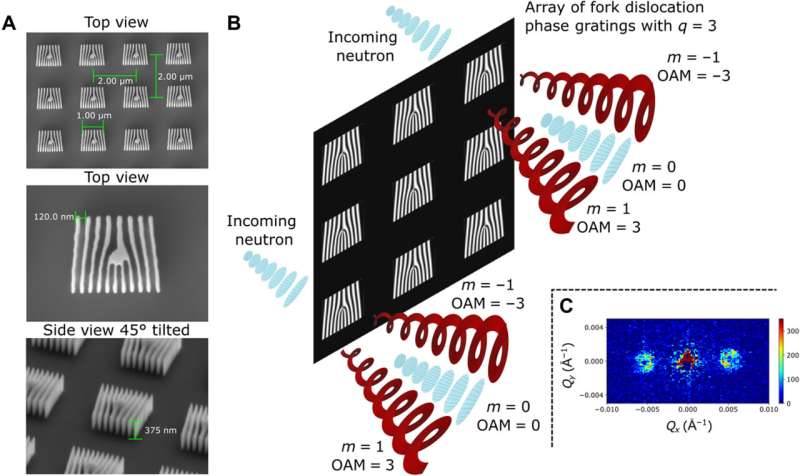
Holographic approach to generating neutron helical wavefronts that carry well-defined OAM. (A) SEM images characterizing the array of fork dislocation phase gratings used to generate the neutron helical wavefronts. The arrays covered an area of 0.5 cm by 0.5 cm and consisted of 6,250,000 individual 1 μm–by–1 μm fork dislocation phase gratings that had a period of 120 nm, had a height of 500 nm, and were separated by 1 μm on each side. Three arrays with topological charges of q = 0 (standard grating profile), q = 3 (shown here), and q = 7 were used in the experiment. (B) Each phase grating generates a diffraction spectrum consisting of diffraction orders (m) that carry a well-defined OAM value of ℓ = mħq. (C) Intensity in the far field is the sum over the signal from all of the individual fork dislocation phase gratings. Shown is an example of the collected small-angle neutron scattering (SANS) data. Credit: Science Advances (2022) 

Highlights:

Physicist Nassim Haramein has been propounding for decades that all the particles in the universe are characterized by spin motion and the origin of this spin is inherent in the field governing the dynamics of the respective particles. In his previous publications, he has shown that by incorporating torque and Coriolis forces into the Einstein field equations, a new solution is achieved which tells us that spacetime is itself curling at all scales and which in turn is the source of all spin dynamics in the universe [2]. There are several consequences of this realization, one of them being the existence of rotational property for all black holes.  

Now many other physicists around the world are realizing the importance of spin, like the discovery of neutron helical waves described in this article, it is explicit that predictions of Nassim’s theories are proving to be true. Furthermore, given that now there are numerous evidences in favour of Nassim’s work, it is expected that once the new paper is out, all these ideas would be woven coherently into an overarching framework. 

References: 

[1] Dusan Sarenac et al, Experimental realization of neutron helical waves, Science Advances (2022). DOI: 10.1126/sciadv.add2002 

[2] Haramein, N., and Rauscher, E. A. (2005). The origin of spin: A consideration of torque and Coriolis forces in Einstein’s field equations and grand unification theory. Beyond The Standard Model: Searching for Unity in Physics, 1, 153-168. 

Sign Up For Daily Newsletter

Be keep up! Get the latest breaking news delivered straight to your inbox.
loader

loader

loader

By signing up, you acknowledge the data practices in our Privacy Policy. You may unsubscribe at any time.
En vous inscrivant, vous reconnaissez les pratiques en matière de données dans notre politique de confidentialité. Vous pouvez vous désinscrire à n'importe quel moment.
Al registrarse, reconoce las prácticas de datos en nuestra política de privacidad. Puedes darte de baja en cualquier momento.
Share This Article
Facebook Twitter Copy Link Print
Previous Article Topological Complexity of Liquid Water Described in New Colloidal Model
Next Article Are Some of the Black Holes Detected, Wormholes Instead?

Stay Connected

981k Like
18.7k Follow
7.7k Follow
7.3k Subscribe

Categories

  • Astronomy106
  • Biology69
  • ISF News25
  • ISF Research14
  • Other22
  • Physics168
  • Technology36

You Might also Like

Physics

Gravitational Waves Leave Their Mark on Atomic Light: A New Window into Vacuum Field Physics

22. April 2026.
BiologyPhysics

Do Cells Use a Quantum Compass to Heal Wounds?

2. December 2025.
Physics

Space-Memory Experiments: Quantum Memory Matrix Results Explained

3. October 2025.
Physics

From Bit to Quanta: New Theory Links Entanglement to Particle Creation

17. September 2025.
The International Space Federation (ISF)The International Space Federation (ISF)

Harnessing quantum vacuum energy for sustainable solutions – a unified approach to science, technology and education.

Quick links

  • About
  • Research Papers
  • Events
  • Invest

Explore

  • ISF Research
  • Physics
  • Technology
  • Astronomy
  • Biology
  • ISF News

Sign Up for Our Newsletter

Subscribe to our newsletter to get our newest articles instantly!

loader

  • Français
  • Español
Follow US
© 2023 International Space Federation. All Rights Reserved. INTERNATIONAL SPACE FEDERATION is a trademark of ISFS SA. The mark is registered in the United States under Registration No. 7772313. The ®️ symbol is used exclusively in the U.S.
  • Press
  • Careers
  • Privacy policy
  • Carrieres
  • Presse
  • Prensa
Join Us!

Subscribe to our newsletter and never miss our latest news.

loader

Welcome Back!

Sign in to your account

Lost your password?