
By using this site, you agree to the Privacy Policy.
Accept
The International Space Federation (ISF)The International Space Federation (ISF)The International Space Federation (ISF)
  • Science News
    • All Articles
    • Physics
    • Astronomy
    • Biology
    • Technology
    • Other
  • Research
    • Research Papers
    • Physicists Testimonials
  • Technology
  • About
    • About us
  • ISF News
  • Events
    • Events
  • Get Involved
    • Invest
    • Donate – Zero Point Foundation
  • Careers
  • Contact Us
Reading: New Measurement of the Roundness of the Electron
Share
The International Space Federation (ISF)The International Space Federation (ISF)
Search
  • Science News
    • Physics
    • Astronomy
    • Biology
    • Technology
  • Research Papers
    • Physicists Testimonials
  • About
    • ISF News
  • Events
  • Get involved
    • Invest
  • Translations
    online pharmacy https://worldneurologyonline.com/ no prescription pharmacy
Follow US
© 2022 International Space Federation. All Rights Reserved.
The International Space Federation (ISF) / Explore / Physics / New Measurement of the Roundness of the Electron
Physics

New Measurement of the Roundness of the Electron

Point particle, electron cloud, if the electron is actually a physical object with a finite size, then how big is it. Surprisingly, there is yet no clear answer to this simple question.

RSF Research
Last updated: 2025/03/07 at 3:08 PM
RSF Research
Share
4 Min Read
SHARE

Point particle, electron cloud, if the electron is actually a physical object with a finite size, then how big is it. Surprisingly, there is yet no clear answer to this simple question. However, some theories turn out to be pretty interesting such as the Bohr radius (10-10m), the classical electron radius (10-15m), the Compton Wavelength (10-12m), the Planck length (point particle 10-35m), or finally the empiricist’s view with the measurement of the electron electric dipole moment (EDM).

Some theories suggest that some subatomic particles outside the electron could create a slight separation between a positive and a charge, giving the electron a pear shape. However, a new measurement from the ACME team at Yale suggests that any extra particles that exist may be permanently beyond the LHC’s reach.

We’re gonna need a bigger tunnel.

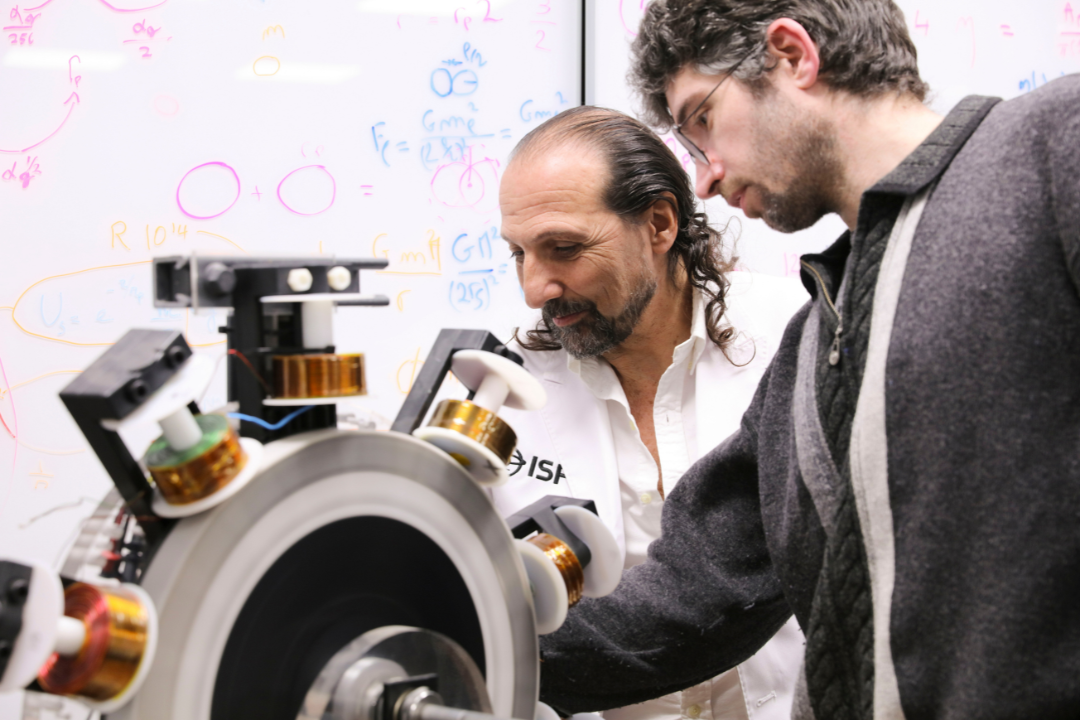
Yale University physicist David DeMille, a member of the Advanced Cold Molecule Electron Electric Dipole Moment, or ACME team

The standard model of particle physics proposes a description of all particle physics measurements made so far in the laboratory. However, it is unable to answer many questions that arise from cosmological observations:

  • Why do neutrinos have mass?
  • What is dark matter?
  • Why is there so much matter in the universe?
  • Why does the expansion of the universe seem to accelerate?
  • Where does the gravity come from?

Theories that contain particles and interactions beyond the standard model, such as models that incorporate supersymmetry, may explain these phenomena. Such particles appear in the vacuum and interact with common particles to modify their properties.

For example, the existence of very massive particles whose interactions violate time-reversal symmetry, which could explain the cosmological matter–antimatter asymmetry, can give rise to an electric dipole moment along the spin axis of the electron. And yet, no electric dipole moments of fundamental particles have been observed. However, dipole moments only slightly smaller than the current experimental bounds have been predicted to arise from more massive.

In their last paper the ACME collaboration team presented an improved experimental limit on the electric dipole moment of the electron. They measured the electron spin precession subjected to a huge electric field. The results showed an electron electric dipole moment of 1.1×10⁻²⁹ e.cm or a hypothetical radius of 6.9 x 10⁻¹³m, a tiny and pretty round shape!

If we had discovered that the shape wasn’t round, that would be the biggest headline in physics for the past several decades. But our finding is still just as scientifically significant because it strengthens the Standard Model of particle physics and excludes alternative models. However, the Standard Model as it stands cannot possibly be right because it cannot predict why the universe exists. That’s a pretty big loophole.

Gerald Gabrielse leading the research at Northwestern University

Read more at: https://www.sciencenews.org/article/electron-shape-round-standard-model-physics

The holographic mass solution proposes a solid alternative to the standard model explaining at the Planck scale the origin of the mass of the proton and also predicts accurately the mass of the electron.

Learn more in our free Unified Science Course

Sign Up For Daily Newsletter

Be keep up! Get the latest breaking news delivered straight to your inbox.
loader

loader

loader

By signing up, you acknowledge the data practices in our Privacy Policy. You may unsubscribe at any time.
En vous inscrivant, vous reconnaissez les pratiques en matière de données dans notre politique de confidentialité. Vous pouvez vous désinscrire à n'importe quel moment.
Al registrarse, reconoce las prácticas de datos en nuestra política de privacidad. Puedes darte de baja en cualquier momento.
Share This Article
Facebook Twitter Copy Link Print
Previous Article A Physics Nobel Prize for a New Way of Manipulating Light
Next Article Transformational Medicine and Resonating Frequencies in Cancer

Stay Connected

981k Like
18.7k Follow
7.7k Follow
7.3k Subscribe

Categories

  • Astronomy106
  • Biology69
  • ISF News25
  • ISF Research14
  • Other22
  • Physics168
  • Technology36

You Might also Like

Physics

Gravitational Waves Leave Their Mark on Atomic Light: A New Window into Vacuum Field Physics

22. April 2026.
BiologyPhysics

Do Cells Use a Quantum Compass to Heal Wounds?

2. December 2025.
Physics

Space-Memory Experiments: Quantum Memory Matrix Results Explained

3. October 2025.
Physics

From Bit to Quanta: New Theory Links Entanglement to Particle Creation

17. September 2025.
The International Space Federation (ISF)The International Space Federation (ISF)

Harnessing quantum vacuum energy for sustainable solutions – a unified approach to science, technology and education.

Quick links

  • About
  • Research Papers
  • Events
  • Invest

Explore

  • ISF Research
  • Physics
  • Technology
  • Astronomy
  • Biology
  • ISF News

Sign Up for Our Newsletter

Subscribe to our newsletter to get our newest articles instantly!

loader

Follow US
© 2023 International Space Federation. All Rights Reserved. INTERNATIONAL SPACE FEDERATION is a trademark of ISFS SA. The mark is registered in the United States under Registration No. 7772313. The ®️ symbol is used exclusively in the U.S.
  • Press
  • Careers
  • Privacy policy
  • Carrieres
  • Presse
  • Prensa
Join Us!

Subscribe to our newsletter and never miss our latest news.

loader

Welcome Back!

Sign in to your account

Lost your password?