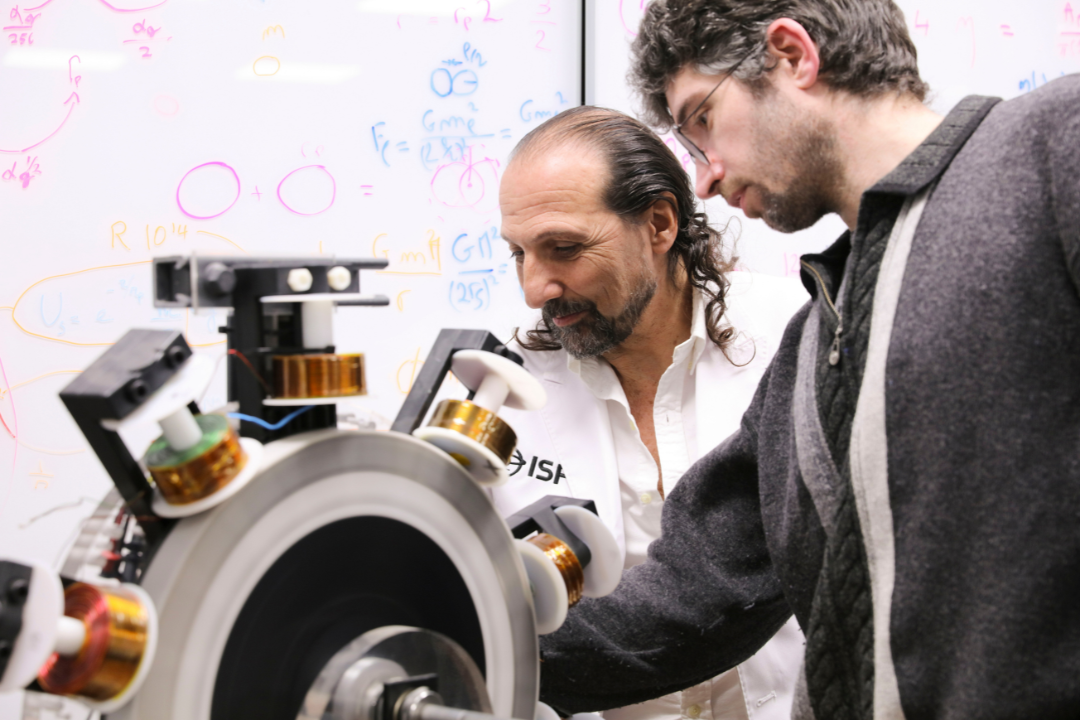



A team of researchers from University of Vienna, Ulm University and the University of Duisburg-Essen has made a groundbreaking observation of non-Hermitian dynamics and non-reciprocal interactions between optically levitated nanoparticles. This exciting development, published in Nature Physics [1], opens up new possibilities for studying quantum phenomena and could lead to advancements in sensing technologies and quantum information processing.
What are Hermitian and non-Hermitian systems?
In quantum mechanics, Hermitian systems are the “standard” or “well-behaved” systems. They conserve energy, meaning the total energy of the system remains constant over time. Observable quantities in Hermitian systems (such as position, momentum, or energy) always have real values, which correspond to measurements we can make in the physical world. Hermitian systems are described by mathematical operators that have specific properties, ensuring the system’s stability and predictability.
Non-Hermitian systems, in contrast, behave in ways that deviate from these “normal” quantum rules. They can exchange energy with their environment, which means the system’s energy can increase or decrease over time. Observable quantities in non-Hermitian systems can have complex values (involving both real and imaginary parts), which makes their physical interpretation more challenging. These systems are described by mathematical operators that lack the specific properties of Hermitian operators.
There are Intriguing phenomena in non-Hermitian systems, such as:
- Exceptional points (EPs): EPs are special configurations where two or more eigenstates (quantum states) of the system coalesce. At these points, the system becomes highly sensitive to perturbations, which can be useful for sensing applications. EPs can lead to counterintuitive effects, such as loss-induced transparency or unidirectional invisibility.
- PT symmetry breaking: PT stands for Parity-Time symmetry, a special property where the system remains unchanged under a combination of spatial reflection and time reversal. This property no longer holds when there is a symmetry breaking.
The Experiment
To better understand this groundbreaking research, let’s break down the experiment into its main stages:
The setup: The scientists used two tiny particles made of silica (a type of glass). Each particle was incredibly small, about 210 nanometers in diameter. To give you an idea of how small that is, these particles are about 500 times thinner than a human hair!
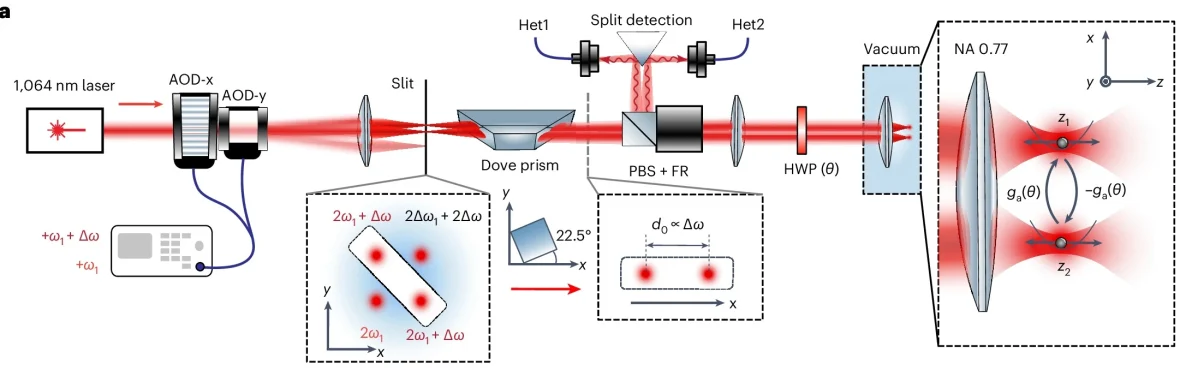
Trapping the particles: The researchers used a clever technique called “optical tweezers” to hold these tiny particles in place. Optical tweezers use focused laser beams to trap and manipulate small objects by means of the light’s frequency and intensity. Imagine using a pair of tweezers made of light instead of metal!
Controlling the interaction: By carefully adjusting the frequency and intensity of the laser light interacting with these particles, the scientists were able to make something unusual happen. They created a situation where the particles influenced each other in an uneven way.
Non-reciprocal coupling: Here’s where it gets interesting. Normally, when two objects interact, they affect each other equally. This is what Newton’s third law of motion tells us – for every action, there’s an equal and opposite reaction. But in this experiment, the researchers managed to break this rule, they were able to induce non-reciprocal coupling between them. This means that the influence of particle A on particle B was different from the influence of B on A – a seeming violation of Newton’s third law, in which if object A exerts a force on object B, object B also exerts an equal and opposite force on object A.
Why this is important: This unusual interaction, called “non-reciprocal coupling,” is rarely seen in the everyday world. By creating and controlling this effect, scientists can study unique quantum phenomena that are usually hard to observe. This could lead to new discoveries in quantum physics and potentially help develop more sensitive measurement tools or advanced quantum technologies.
Key Findings
This work demonstrates that optically levitated nanoparticles provide an excellent platform for studying non-Hermitian physics. Among the interesting results of these experiments, this study reported the following outcomes:
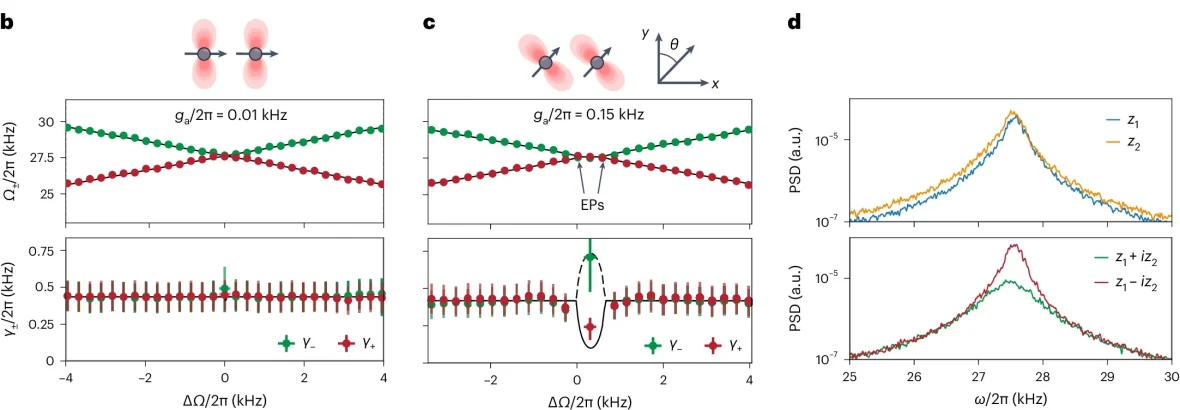
- PT symmetry breaking: The team observed a transition between PT-symmetric and PT-broken phases as they varied the coupling strength between the particles. This phenomenon is a hallmark of non-Hermitian systems. In the broken phase the interaction leads to correlated particle motion, which was confirmed by measuring a constant phase delay between the oscillators. As the coupling strength changes, the system can transition to a PT-broken phase, where energy eigenvalues become complex. In symmetric phase, the system’s energy eigenvalues are real, despite being non-Hermitian. This transition from symmetric to broken can lead to counterintuitive effects, such as unidirectional energy transfer (hence the term “non-reciprocal coupling”), or enhanced sensitivity to perturbations.
- Exceptional points (EPs): The researchers identified two EPs, which are special points in the parameter space where eigenvalues and eigenvectors coalesced, as depicted in the image below,. These points are unique to non-Hermitian systems and have intriguing properties, such as 1) coalescence: at an EP, two or more eigenvalues and their corresponding eigenvectors become identical. 2) Enhanced sensitivity: near EPs, the system becomes extremely sensitive to small perturbations, potentially useful for sensing applications. 3) Topological features: EPs can exhibit interesting topological properties, such as chiral behavior. 4) Two EPs: The presence of multiple EPs in this system suggests a rich and complex parameter landscape.
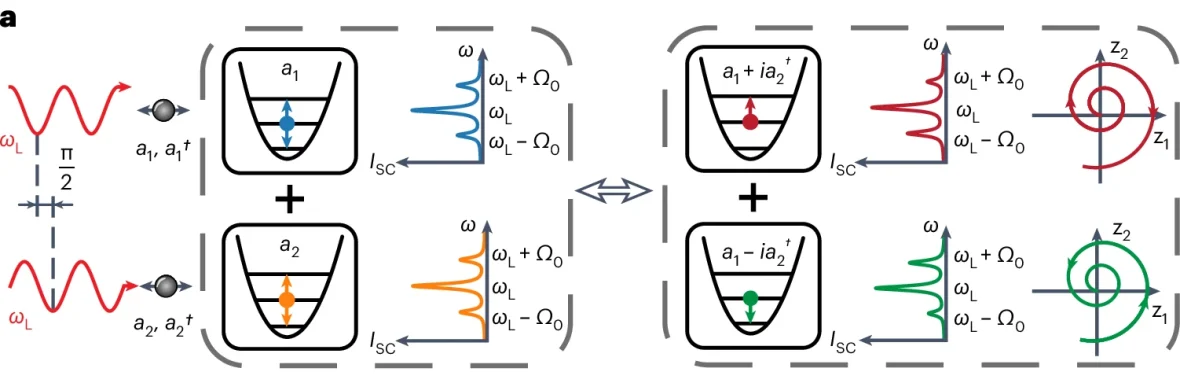
- Mechanical lasing: in the strongly coupled regime, the particles’ motion settled into a stable oscillatory pattern known as a limit cycle. To be more specific, for a sufficiently high coupling rate, due to the correlated motion the system exhibited a “mechanical lasing” effect as the system passes through a Hopf bifurcation where the joint phase space distribution exhibits a limit cycle. A limit cycle is a closed trajectory in phase space that other nearby trajectories spiral towards or away from. Limit cycles are characteristic of non-linear systems and can emerge from the interplay of energy gain and loss in non-Hermitian systems. The presence of limit cycles suggests that the system can maintain stable, periodic motion even in the presence of energy exchange with the environment. This behavior indicates a self-sustaining oscillation that resists small perturbations.
When the system exhibits a Hopf bifurcation into the mechanical lasing phase, the interaction-induced amplification dominates over the intrinsic damping such that the motion becomes nonlinear, where one vibrational mode was amplified while the other was suppressed. Therefore, one vibrational mode of the nanoparticles grows in amplitude over time, while simultaneously, another vibrational mode decreases in amplitude (see image and caption below). This effect is analog to optical lasing effect in how lasers work with light, but here it occurs with mechanical vibrations. Mechanical lasing could lead to the development of novel mechanical oscillators or sensors. This behavior could be exploited for creating robust mechanical oscillators or studying synchronization phenomena in coupled systems.
The findings of this work collectively demonstrate the rich physics accessible in this optically levitated nanoparticle system. By observing PT symmetry breaking, exceptional points, mechanical lasing, and limit cycle behavior, the researchers have shown that this platform can be used to study a wide range of non-Hermitian phenomena. This opens up new possibilities for exploring fundamental quantum mechanics and developing novel technologies in areas such as sensing, signal processing, and quantum information.
Implications and Applications
Studying non-Hermitian systems allows physicists to explore quantum mechanics in regimes that were previously difficult to access. The unique properties of these systems, such as their enhanced sensitivity near exceptional points, could lead to the development of ultra-sensitive sensors or detectors.
Non-Hermitian physics might also find applications in quantum information processing, where the unusual behavior of these systems could be harnessed for novel computational techniques. By observing non-Hermitian dynamics in optically levitated nanoparticles, the researchers have created a new platform for exploring these fascinating quantum phenomena. This breakthrough could pave the way for a deeper understanding of quantum mechanics and the development of new technologies that exploit the unique properties of non-Hermitian systems.
The high degree of control and precision offered by this system could enable:
- Investigations of topological phases in non-Hermitian systems.
- Development of ultra-sensitive force sensors.
- Exploration of quantum effects in coupled mechanical oscillators.
- New approaches to controlling and manipulating nanoparticles.
As research in this field progresses, we may see applications in areas such as quantum computing, precision measurement, and the development of novel optical devices.
References
[1] Manuel Reisenbauer et al, Non-Hermitian dynamics and non-reciprocity of optically coupled nanoparticles, Nature Physics (2024). DOI: 10.1038/s41567-024-02589-8