

Something extraordinary is happening in the world of energy research — and almost nobody is talking about it.
For decades, the phrase “cold fusion” was practically a punchline. Ever since the controversial 1989 announcement — when electrochemists Martin Fleischmann and Stanley Pons claimed to have achieved nuclear fusion at room temperature using a simple palladium-and-heavy-water electrochemical cell — mainstream science largely closed the door on the idea that nuclear reactions could happen at low temperatures inside ordinary materials. Careers were ruined. Funding dried up. The very concept became radioactive — not literally, but professionally.
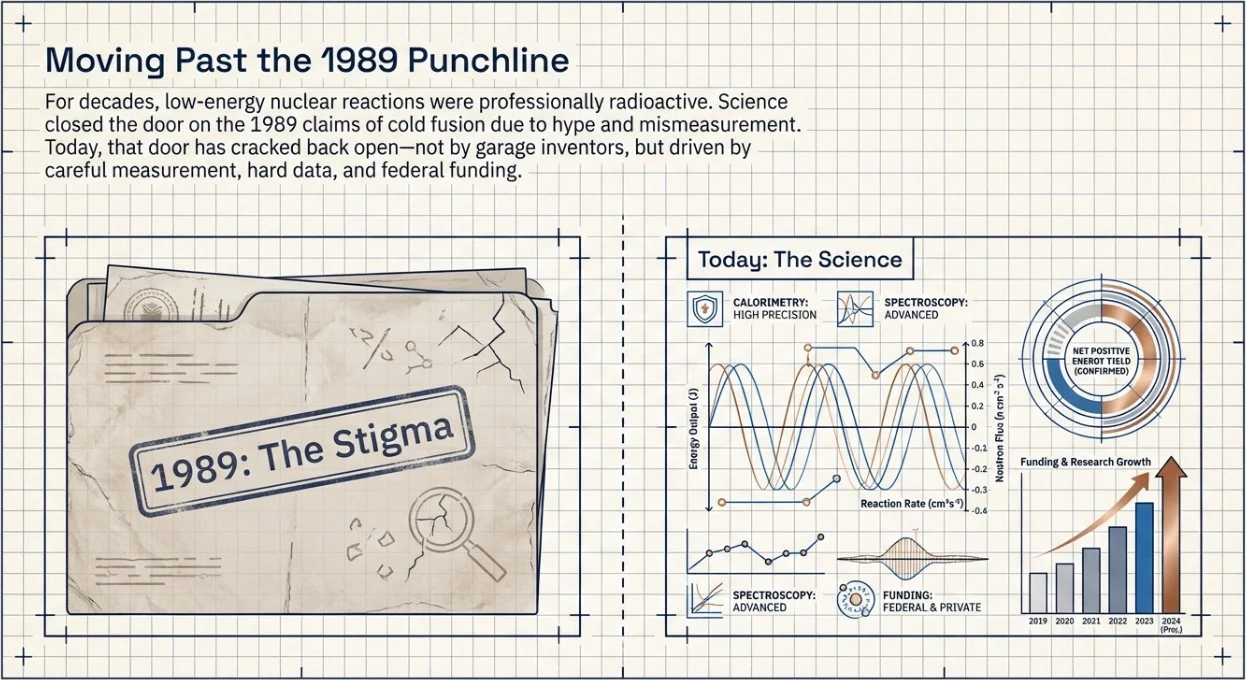
And yet, quietly, over the past few years, that door has cracked back open. Not because of hype or miracle gadgets, but because of something far more compelling: hard data, careful measurement, and serious money from the kinds of agencies that don’t gamble on fairy tales.
The U.S. Government Just Bet Millions on “Impossible” Energy
In 2022, ARPA-E — the U.S. Department of Energy’s advanced research agency, famous for funding moonshot technologies — did something remarkable. It opened a formal research program specifically targeting Low-Energy Nuclear Reactions, or LENR [1]. This wasn’t a fringe conference or an underground experiment in someone’s garage. This was a federal agency saying, in essence: we think this question deserves a proper answer, and we’re going to pay for the instruments to find it.
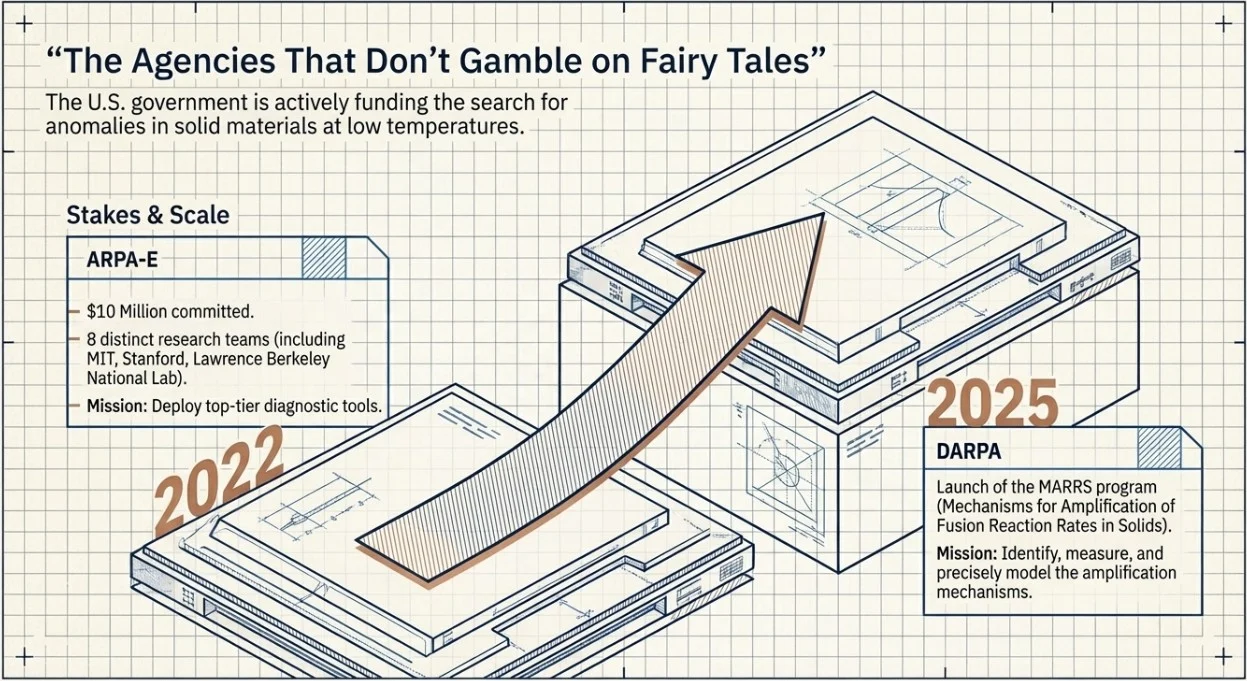
By early 2023, eight research teams — including scientists at MIT, Stanford, and Lawrence Berkeley National Laboratory — had been selected and funded to the tune of roughly $10 million. Their mission wasn’t to build a reactor. It was something more fundamental: to use the best diagnostic tools available to find clear, unmistakable evidence of nuclear activity happening inside solid materials at low temperatures.
Then, at the end of 2025, the stakes went even higher. DARPA — the legendary defense research agency behind the internet, GPS, and stealth aircraft — launched its own program called MARRS (Mechanisms for Amplification of Fusion Reaction Rates in Solids). DARPA’s framing was refreshingly honest. Their own program materials openly acknowledged the field’s troubled history of “hype and mismeasurement.” But they also pointed to something new: since 2023, multiple independent research groups had reported that fusion reaction rates inside solid materials were dramatically higher than older models predicted.
The MARRS program isn’t claiming that cold fusion works. It’s asking a sharper question: can we identify the mechanisms that amplify these reactions, measure them precisely, and model them predictively? It’s the scientific equivalent of saying, “We see smoke. Let’s figure out exactly where the fire is.”
What the Scientists Are Actually Finding
So what’s changed on the lab bench? Several things — and while none of them amount to a working power plant, together they paint a picture that is hard to ignore.
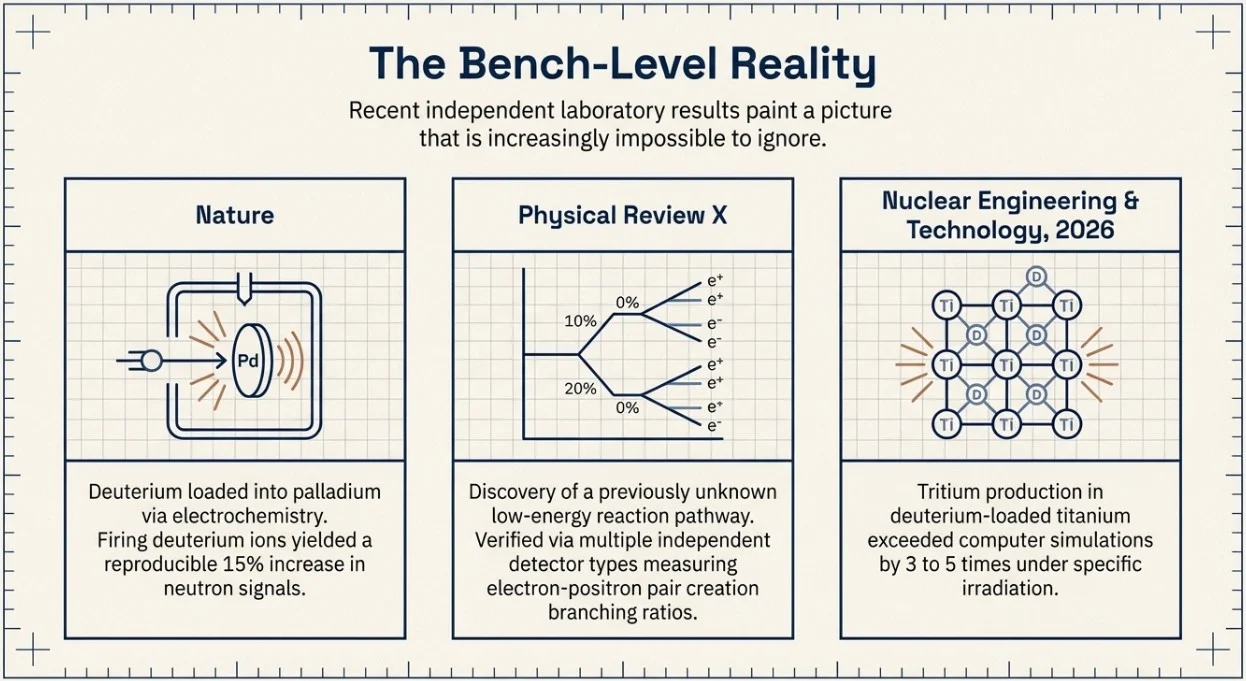
A paper published in Nature — one of the most prestigious scientific journals in the world — demonstrated something elegant and important. Researchers loaded deuterium (a heavier form of hydrogen) into palladium metal using electrochemistry, then fired a beam of deuterium ions at it. The result? A consistent and reproducible 15% increase in the neutron signal — a telltale signature of fusion [2]. The total energy produced was vanishingly small, but that wasn’t the point. The point was that by changing the material’s condition — how much deuterium was packed inside — they could reliably turn a “knob” and watch the fusion signal respond. That’s real science, and it’s a crucial building block.
Meanwhile, a team publishing in Physical Review X — another top-tier journal — reported detailed measurements of what appears to be a previously unknown reaction pathway at very low energies, complete with signatures of electron-positron pair creation [3]. They measured branching ratios (essentially, the probabilities of different outcomes) with stated uncertainties across multiple independent detector types. This kind of rigorous, multi-instrument approach is exactly what separates genuine findings from wishful thinking.
And in early 2026, a study in Nuclear Engineering and Technology found that tritium production in a deuterium-loaded titanium material exceeded computer simulations by three to five times under certain irradiation conditions — suggesting that something is happening inside these materials that our current models don’t fully capture [4].
Three Knobs That Could Change Everything
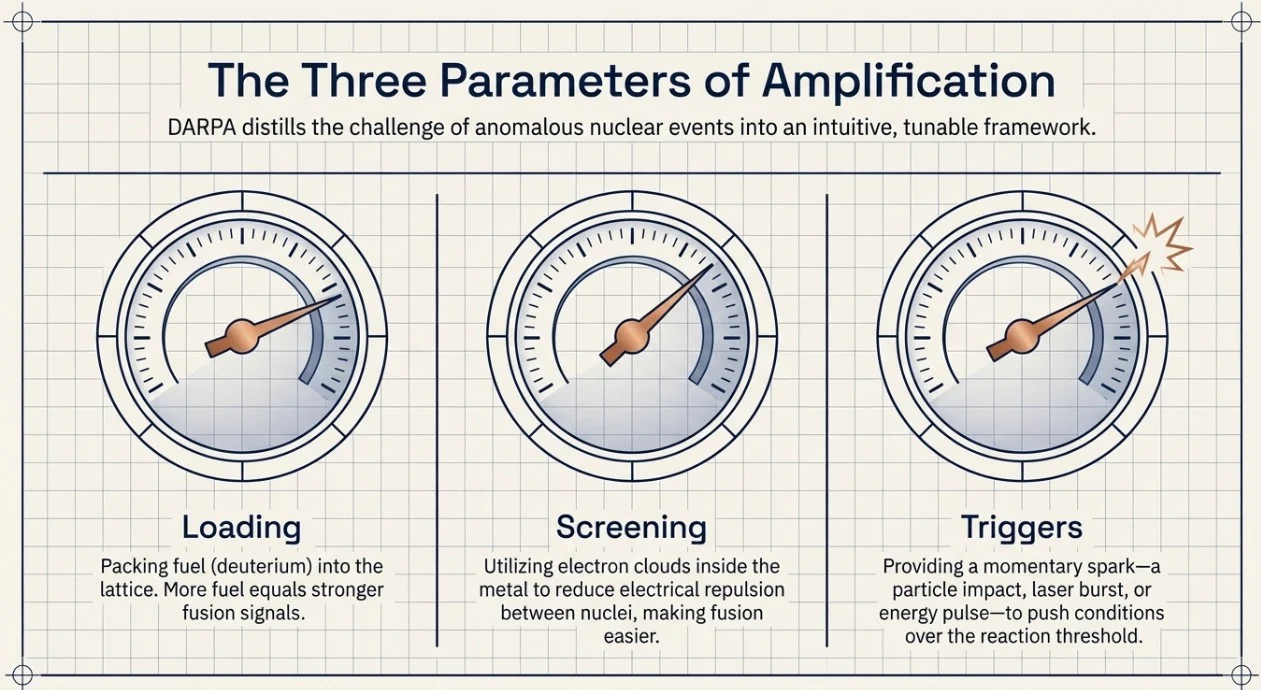
DARPA’s MARRS program has distilled the challenge into an intuitive framework built around three “amplification knobs” that researchers can potentially tune:
Loading — How much fuel (deuterium) can you pack into the material? The Nature study showed this matters. More fuel in the lattice correlates with more fusion activity.
Screening — Inside a metal lattice, the electrons surrounding the atomic nuclei effectively reduce the electrical repulsion between them, making it easier for nuclei to get close enough to fuse. Multiple studies have now shown that this “electron screening” effect can be far stronger than theoretical models predicted — sometimes by an order of magnitude — and that it varies dramatically depending on the exact condition of the material.
Triggers — Can you provide a “spark” — a pulse of energy, a particle impact, a laser burst — that momentarily pushes conditions over the threshold for a reaction? Early evidence from irradiation experiments and collision cascade studies suggests that the environment and the type of energy input matter enormously.
The honest truth is that even if all three knobs are turned to their maximum, we are still orders of magnitude away from producing useful amounts of heat. DARPA’s own slides make this clear: producing just one watt of power from deuterium-deuterium fusion requires approximately one trillion reactions per second. Their program goal of reaching one million reactions per second per gram of material is ambitious, but it’s still a million-fold short of a single watt. This is a long road — but it’s a road that now has a map.
Beyond Nuclear Reactions: The Quantum Vacuum Frontier
While LENR researchers are working to coax nuclear reactions out of metal lattices at modest temperatures, there’s an even more fundamental question sitting at the very foundation of physics: what about the energy of space itself?
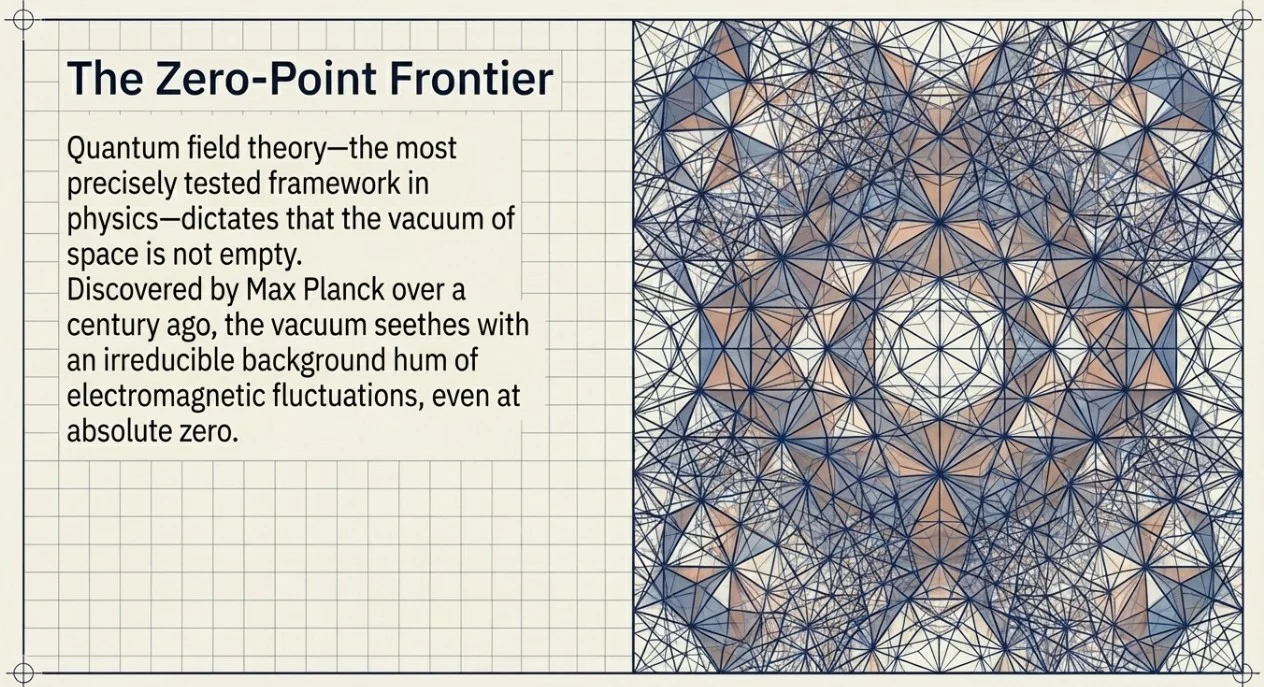
In our previous articles (what is zero-point energy?), we have explained how modern quantum field theory demonstrates unambiguously that the vacuum of space is not empty. It seethes with electromagnetic fluctuations, a kind of irreducible background hum of energy that exists even at absolute zero. The physicist Max Planck recognized this over a century ago when he discovered what he called zero-point energy: the energy that remains in an oscillating system even when you cool it down as far as physically possible.
The amount of energy contained in this quantum vacuum is staggering. Depending on how you calculate it, the energy density of vacuum fluctuations within even a tiny subatomic volume of space dwarfs the energy content of all the matter in the observable universe. This is not a fringe claim — it’s a direct consequence of well-established quantum mechanics. The challenge has always been: how do you access it?
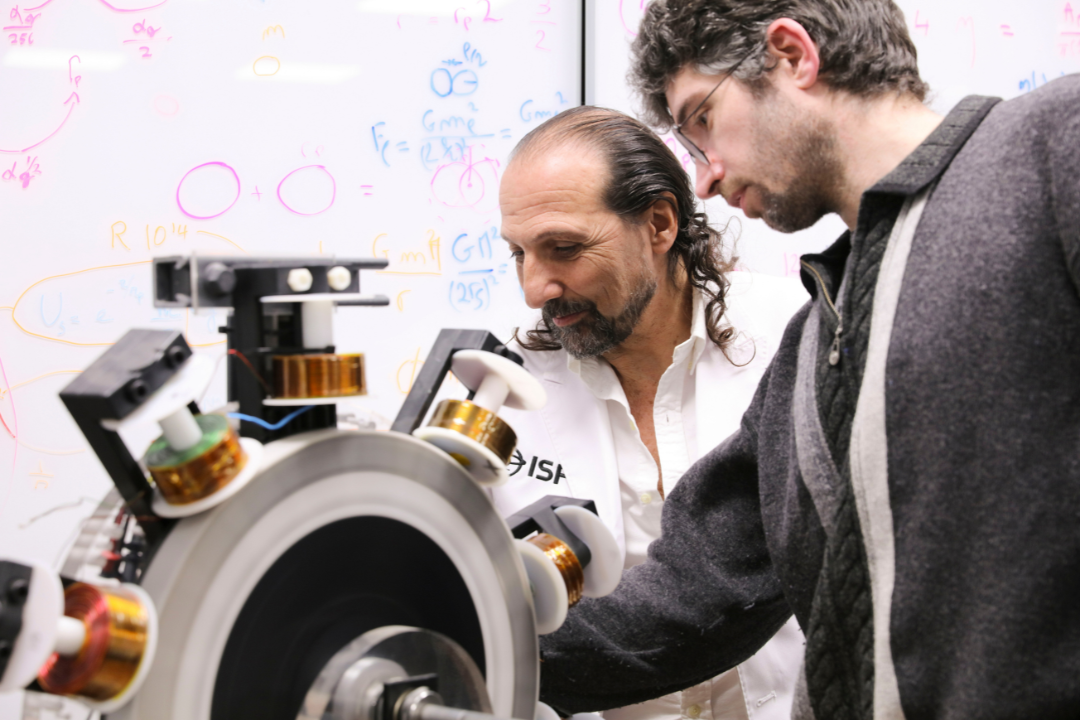
This is precisely the question we have been pursuing here at the International Space Federation (ISF). For over three decades, Nassim Haramein— Founder and Director of Research at the ISF— has been developing a theoretical framework — sometimes called the generalized holographic approach — that treats protons not as inert building blocks, but as resonant structures that actively couple with quantum vacuum fluctuations. In his model, the mass of the proton itself emerges from the interaction between the particle’s internal geometry and the surrounding vacuum energy field — a process that is best described as “holographic screening.”
In their paper The Origin of Mass and the Nature of Gravity, Haramein and co-authors Dr. Olivier Alirol and Dr. Cyprien Guermonprez present a mathematical framework in which the strong nuclear force and gravity are unified through what they call “Planck plasma flow” — a mechanism rooted in the correlation functions of quantum electromagnetic vacuum energy density. Their approach addresses one of the most notorious puzzles in all of physics: the so-called “vacuum catastrophe,” a staggering 122-order-of-magnitude discrepancy between the vacuum energy density predicted by quantum field theory and what we observe at cosmological scales [5].
Then, in their subsequent paper Extending Einstein-Rosen’s Geometric Vision : Vacuum Fluctuations-Induced Curvature as the Source of Mass, Gravity and Nuclear Confinement, they solve Einstein’s field equations by incorporating electromagnetic quantum vacuum fluctuations as a source term in the stress-energy tensor, which naturally yields the Klein-Gordon equation, revealing a significant correspondence between gravity and quantum field theory [6]. Solving the Klein-Gordon equation produces a Yukawa potential within the context of the field equations metric. From this metric curvature, they calculated test particle accelerations at different length scales, ultimately deriving the complete spectrum of fundamental forces from a single gravitational framework. The result of the paper represents a full description of the forces across scales in significant agreement with measured values.
What makes the ISF’s work particularly exciting is that it doesn’t stop at theory. We are actively developing technologies aimed at coupling with the quantum vacuum to produce tangible, measurable effects in physical and biological systems. If the vacuum is indeed the fundamental source from which mass, gravity, and all the forces of nature emerge, then learning to interact with it coherently could represent the ultimate clean energy breakthrough — not by burning fuel or splitting atoms, but by tapping into the very fabric of spacetime itself. Since we have demonstrated quantitatively that mass-energy emerges from electromagnetic quantum vacuum fluctuations, then it is immediately evident how to control EM interactions to shape boundary conditions and dielectric gradients to extract net energy from the quantum vacuum structure.
Two Paths Toward the Same Horizon
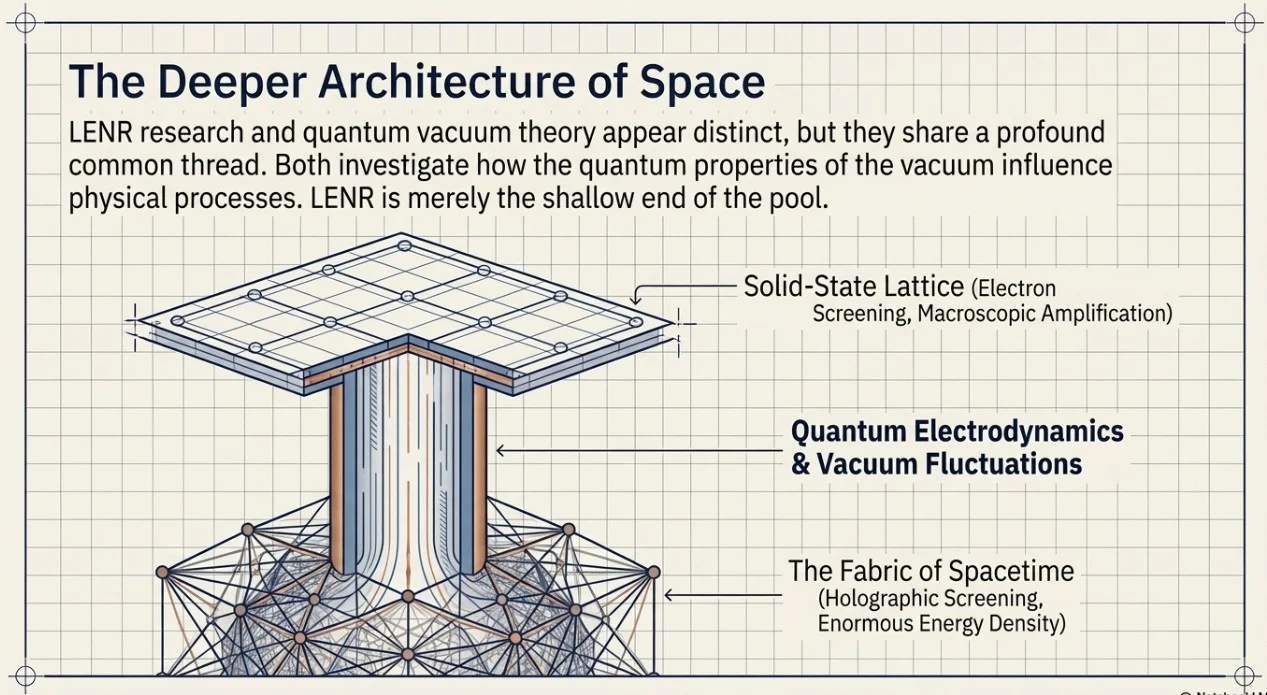
At first glance, LENR research and quantum vacuum energy might seem like completely different pursuits. One is focused on nudging nuclear reactions inside metals; the other is aimed at the deepest structure of space itself. But look more carefully and you’ll see a profound common thread: both fields are investigating how the quantum properties of the vacuum influence physical processes at scales we can measure and potentially engineer.
The electron screening effects that LENR researchers are documenting — where the behavior of electrons in a lattice dramatically changes the probability of nuclear events — are, at their root, consequences of quantum electrodynamics, the same framework that describes vacuum fluctuations. DARPA’s MARRS program is essentially asking how quantum-level phenomena inside solid materials can be amplified to produce macroscopic results. Haramein and the ISF are asking the same question at an even more fundamental level: how can the quantum vacuum’s enormous energy density be coherently coupled to produce real-world effects?
These aren’t competing visions. They’re complementary layers of the same grand puzzle — and the fact that mainstream institutions are now investing serious resources into the “easier” end of this spectrum (LENR) may be opening the door for the deeper question (vacuum energy) to be taken seriously as well.
A Future Worth Imagining
We live in a world that desperately needs a clean energy revolution. Solar, wind, and batteries are making tremendous progress, but the sheer scale of global energy demand — and the urgency of the climate crisis — means we should be exploring every promising avenue, including ones that mainstream science has historically been reluctant to touch.
The LENR breakthroughs of 2022–2026 haven’t given us a cold fusion reactor. But they’ve done something arguably more important: they’ve shown that anomalous nuclear phenomena in solid-state systems are real, measurable, and responsive to experimental control. That’s the foundation on which real engineering eventually gets built.
And beyond LENR, the work of Nassim Haramein and the International Space Federation points toward an even more profound possibility: that the energy source we’ve been searching for has been right here all along, woven into the quantum fabric of space itself, waiting for us to learn the language of the vacuum.
The question isn’t whether the energy is there. Quantum mechanics tells us it is. The question is whether we have the courage, the creativity, and the scientific rigor to figure out how to access it. The early signs suggest we might be closer than anyone thought.
References
[1] K. Czerski, “Deuteron-deuteron nuclear reactions at extremely low energies,” Phys. Rev. C, vol. 106, no. 1, p. L011601, Jul. 2022, doi: 10.1103/PhysRevC.106.L011601.
[2] K.-Y. Chen et al., “Electrochemical loading enhances deuterium fusion rates in a metal target,” Nature, vol. 644, no. 8077, pp. 640–645, Aug. 2025, doi: 10.1038/s41586-025-09042-7.
[3] R. Dubey et al., “Experimental Signatures of a New Channel of the Deuteron-Deuteron Reaction at Very Low Energy,” Phys. Rev. X, vol. 15, no. 4, p. 041004, Oct. 2025, doi: 10.1103/chlp-b215.
[4] A. K. Gillespie et al., “Enhanced tritium production in irradiated TiD2 from collisional fusion in the solid-state,” Nuclear Engineering and Technology, vol. 58, no. 3, p. 104031, Mar. 2026, doi: 10.1016/j.net.2025.104031.
[5] N. Haramein, C. Guermonprez, and O. Alirol, “The Origin of Mass and the Nature of Gravity,” Sep. 2023, doi: 10.5281/zenodo.8381115.
[6] N. Haramein, O. Alirol, and C. Guermonprez, “Extending Einstein-Rosen’s Geometric Vision : Vacuum Fluctuations-Induced Curvature as the Source of Mass, Gravity and Nuclear Confinement,” Sep. 23, 2025, Preprints: 2025091835. doi: 10.20944/preprints202509.1835.v1.