

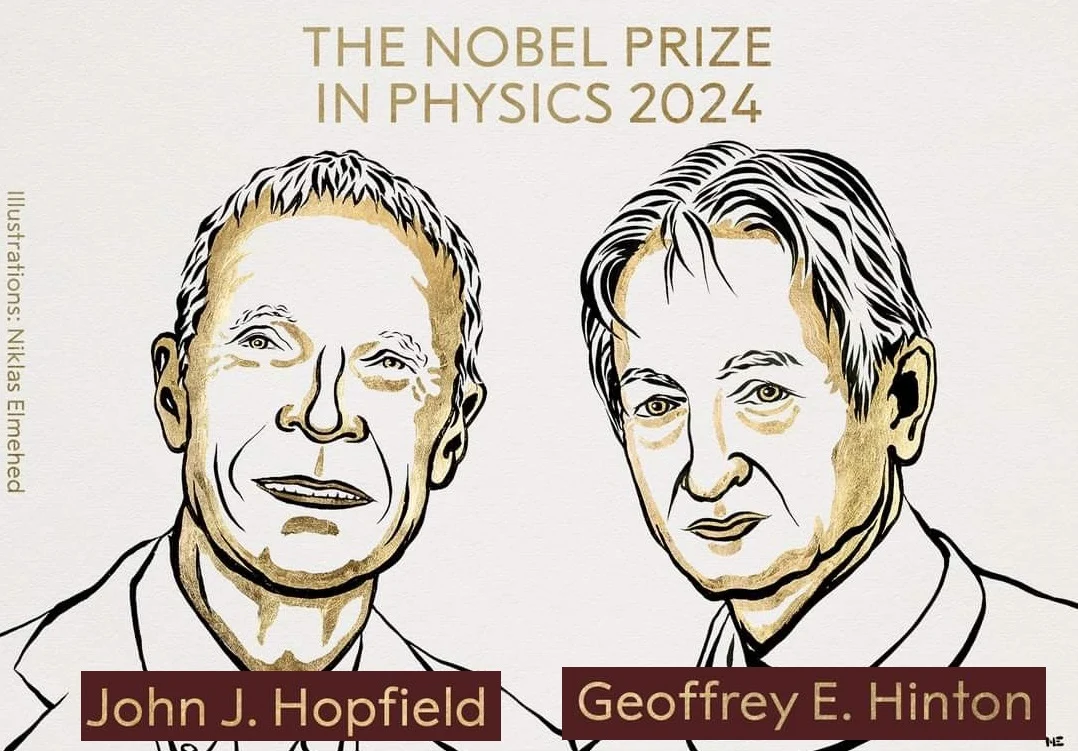
The 2024 Nobel Prize in Physics, awarded to John J. Hopfield and Geoffrey E. Hinton “for foundational discoveries and inventions that enable machine learning with artificial neural networks”, marks a significant milestone in the field of artificial intelligence (AI) and its intersection with physics. Hopfield and Hinton’s work, rooted in concepts from statistical physics and materials science, laid the groundwork for modern neural networks and deep learning algorithms. Their contributions demonstrate how interdisciplinary approaches can lead to revolutionary breakthroughs in technology and our understanding of information processing.
This award comes at a time when AI and machine learning are at the forefront of scientific and public discourse. Hopfield’s work on associative memory networks and Hinton’s Boltzmann machine draw fascinating parallels to how information might be processed in biological systems, including the human brain. Hopfield’s seminal 1982 paper in the Proceedings of the National Academy of Sciences explicitly drew comparisons between his neural network model and biological neural systems [1]. Similarly, the introduction of the Boltzmann machine by Ackley, Hinton, and Sejnowski in 1985 discussed its relation to neural computation [2].
These parallels have been further explored and validated in subsequent research. For instance, Rolls and Treves [3] provided an extensive overview of how artificial neural networks relate to brain function, including discussions of Hopfield networks and Boltzmann machines. More recently, Hassabis et al. [4] reviewed how neuroscience has inspired AI developments, including associative memory networks.
The recognition of AI research with a Nobel Prize in Physics also highlights the growing convergence of different scientific disciplines. As noted in our previous discussions about the potential for neural networks to replace traditional scientific models, this award suggests that the tools of AI may become increasingly central to how we conduct scientific research and understand the world around us.
Interestingly, the advancements in neural network research have led some theorists to propose more radical ideas about the nature of reality itself. The concept that the universe could be a vast neural network, akin to a cosmic-scale version of the artificial neural networks developed by Hopfield and Hinton, has gained traction in some scientific circles.
The connection between artificial and biological neural networks raises intriguing questions about the nature of intelligence and consciousness. As we develop increasingly sophisticated AI systems, the line between artificial and human intelligence may become increasingly blurred, as evidenced by the LaMDA controversy some years ago.
Developments, such as the controversy surrounding Google’s LaMDA chatbot and its alleged sentience, underscore the rapid advancements in AI capabilities and the ethical questions they raise. The Nobel committee’s decision to honor foundational work in neural networks reflects the growing importance of AI in scientific research and its potential to reshape our understanding of reality and consciousness.
However, the decision to award the Physics Nobel Prize to work that is primarily rooted in computer science has sparked a debate within the scientific community. Some argue that this choice reflects a concerning trend: the potential stagnation of traditional physics research. This perspective suggests that the lack of groundbreaking discoveries in fundamental physics in recent years has led the Nobel committee to look beyond the conventional boundaries of the discipline.
Critics point out that while Hopfield and Hinton’s work is undoubtedly revolutionary, it may not represent the kind of fundamental breakthroughs in our understanding of the physical universe that the Physics Nobel has traditionally celebrated. The last major paradigm shift in physics—the development of the Standard Model of particle physics—was largely completed in the 1970s. Since then, despite significant experimental achievements like the detection of gravitational waves and the Higgs boson, there have been few transformative theories that have fundamentally altered our view of the physical world.
This apparent slowdown in groundbreaking physics discoveries could be attributed to several factors:
- 1) The increasing complexity and cost of experiments needed to probe the frontiers of physics, such as particle accelerators and space-based observatories.
- 2) The challenge of reconciling quantum mechanics with general relativity, a problem that has stumped physicists for decades.
- 3) The possibility that we are approaching the limits of our current experimental and theoretical frameworks, necessitating entirely new approaches to make further progress.
- 4) The bureaucratization of scientific research and academia, as we described in the former ISF article Science under Siege.
The recognition of AI research with the Physics Nobel could be seen as an acknowledgment of these challenges and a shift towards honoring work that, while not traditional physics, has the potential to revolutionize how we approach scientific problems across disciplines.
The interdisciplinary nature of Hopfield and Hinton’s work might justify its inclusion in the physics category, as it represents a novel application of physical principles to information processing and computation.
Moreover, the award could be interpreted as a recognition of the growing importance of computational methods in physics research. Advanced AI and machine learning techniques are increasingly being applied to complex problems in physics, from simulating quantum systems to analyzing astronomical data. In this light, the Nobel committee’s decision might be seen as forward-looking, acknowledging the crucial role that AI and computational methods will play in future physics research.
Unified Science In Perspective
The topic awarded raises important questions about the future direction of physics as a discipline. Will the field continue to pursue fundamental questions about the nature of reality, or will it increasingly merge with computer science and other fields? Is this shift a natural evolution of physics, or does it signal a need to reinvigorate traditional areas of physics research?
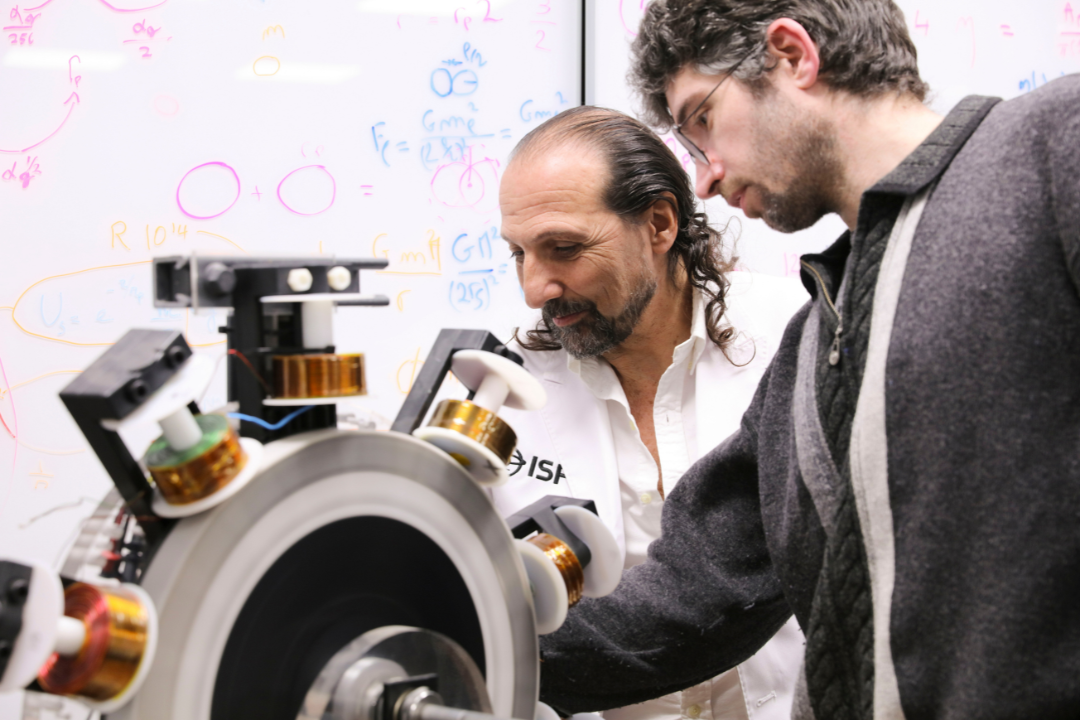
This is why it is critical to truly understand the nature of the neural networks used as tools to understand the nature of reality. As we explained in this article where we compare two neural networks : 1) the generalized holographic model (GHM) and 2) the artificial neural networks, the GHM is not just a black box of connected nodes with their respective weights simulating a network. It goes beyond as we can follow the physical mechanics of the information flow all the way through. The latest work from Nassim Haramein, Cyprien Guermonprez and Olivier Alirol, entitled The Origin of Mass and The Nature of Gravity [5] addresses the foundations on which the GHM stands on, showing that the physical properties such as mass, fields and forces emerge from the information flow of the Planck plasma composing the quantum vacuum, where the physicality of the entire information flow, from Planck scale up to the universal scale, is preserved.
These theories intersect with the simulation hypothesis, which posits that our entire universe could be a sophisticated computer simulation, suggesting a potentially programmable universe, where the fundamental laws of physics might be analogous to the algorithms and weights in a neural network.
However, the generalized holographic principle, a concept coming from theoretical physics, introduces a compelling counterpoint to this view. This principle hints at a fundamental interconnectedness of the universe that transcends simple programming or simulation, even if such connectivity behaved as a cosmological neural network.
The holographic principle suggests that the information contained in a volume of space can be described by information encoded on its boundary. This implies a level of complexity and interconnectedness in the fabric of reality that may not be fully replicable by even the most advanced simulations or neural networks. It points to an underlying structure of existence that is perhaps too intricate and fundamentally interconnected to be reduced to mere programming or simulation, even if one could insert stochastic processes into the artificial neural network.
In conclusion, the 2024 Nobel Prize in Physics recognizes groundbreaking work that has enabled the AI revolution we are experiencing today. As we continue to push the boundaries of what’s possible with artificial neural networks, we must remain mindful of both the tremendous potential and the ethical challenges these technologies present. The work of Hopfield and Hinton not only reminds us that fundamental research in physics and other sciences can lead to transformative technologies with far-reaching implications for society, but also It challenges us to reconsider our understanding of consciousness, reality, and the very nature of information itself.
References:
[1] Hopfield, J. J. (1982). Neural networks and physical systems with emergent collective computational abilities. Proceedings of the National Academy of Sciences, 79(8), 2554-2558.
[2] Ackley, D. H., Hinton, G. E., & Sejnowski, T. J. (1985). A learning algorithm for Boltzmann machines. Cognitive science, 9(1), 147-169.
[3] Rolls, E. T., & Treves, A. (1998). Neural networks and brain function. Oxford University Press.
[4] Hassabis, D., Kumaran, D., Summerfield, C., & Botvinick, M. (2017). Neuroscience-inspired artificial intelligence. Neuron, 95(2), 245-258.
[5] Nassim Haramein, Cyprien Guermonprez, & Olivier Alirol. (2023). The Origin of Mass and the Nature of Gravity. DOI: 10.5281/zenodo.8381114.