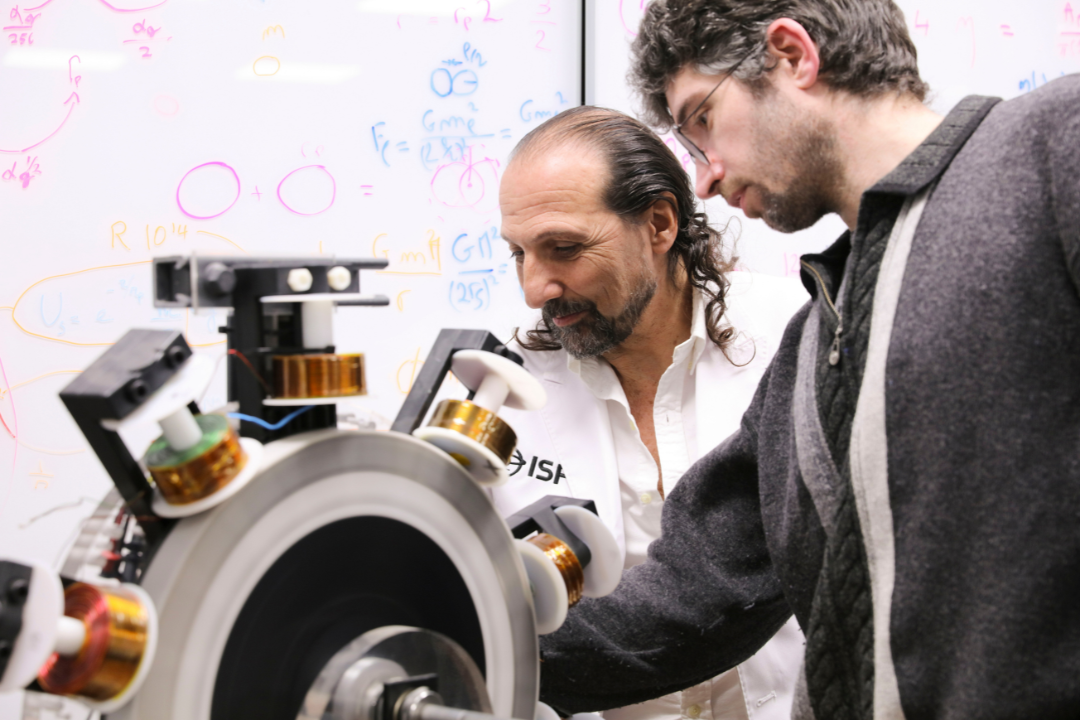



A couple of months ago, I presented a talk at the Benemerita Universidad Autonoma de Puebla’s Physics Institute (IFUAP), the topic being the Generalized Holographic Theory developed by Nassim Haramein. The invitation was serendipity; Haramein’s Holographic model prediction of the proton muonic radius – within experimental precision – had just been confirmed by the latest electronic hydrogen measurements from Bezginov et al. 2019. These measurements also confirmed that the standard model was off by 4%, far beyond the experimental certitude.
I was not sure which frame would fit best as an introduction to the subject for the presentation. Should I start with black hole thermodynamics, or the holographic principle? Despite the pertinence of both these topics, neither quite captured the dimension of the concern I had. The unified model demonstrates scaling from the Planck – and even smaller – up to the universal size, a fact which by itself is of ultimate importance! But why should this matter to me, and to you? Where does it lead? Therefore, instead of starting with these topics, I decided to begin with the topic of artificial intelligence and how it relates to the unified model developed by Nassim Haramein. Could it be a coincidence that the unified model is running parallel to artificial intelligence, while the two haven’t yet “met”?
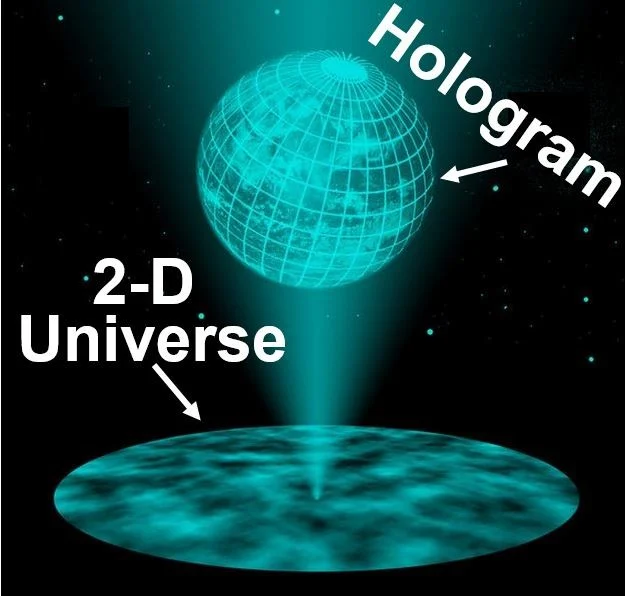
The word holographic could imply reality to be a holographic projection, as explained here and represented in Figure 1 below. The holographic principle states that the entropy of any mass is proportional to its surface area and not its volume; volume itself could be illusory and the universe a hologram which is isomorphic to the information imprinted on the surface of its boundary. Since entropy and information are equivalent, the holographic principle based only on the surface information suggests that the universe could be projected from a two-dimensional information structure on the cosmological horizon, just like volume expresses in a 3D film originated from a flat 2D screen.
Taking this concern further, it may also lead to the conclusion that we live in a simulation, which is something Elon Musk and other technological and scientific authorities say is highly probable.
It is important to note that such conclusions are not derivable from Haramein’s holographic approach because his model doesn’t reduce to information at the surface. Instead, reality is explained as the dynamic between the information confined in the volume of a bounded system and the information that it can effectively exchange with its surroundings and, therefore, expresses as mass. Mass in this context is the unfolded portion of the whole information contained within such a bounded system, which is intricated or interconnected to the information contained inside and outside its boundaries. We could say that mass is the balanced state of an information transfer inertia resulting from a bounded volume and the impossibility of expressing all the information enfolded within.
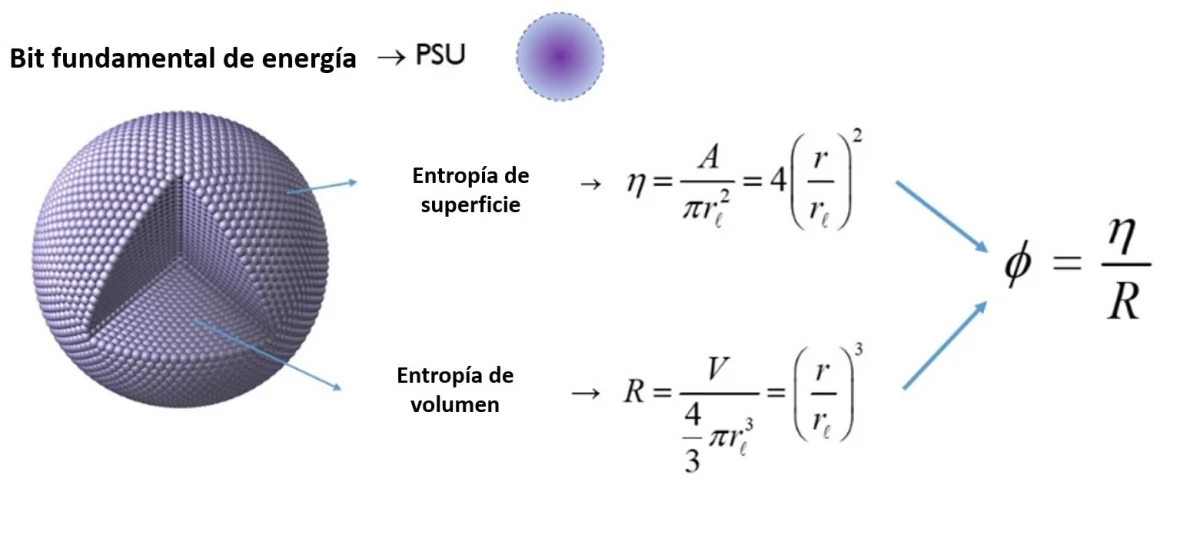
Figure 2 depicts the idea of volume information voxelated with bits or Planck Spherical Units (representing an energy density unit of the zero point field happening at the Planck scale), and the surface-to-volume ratio derived from it.
The holographic nature in Haramein’s model arises because the volume-to-surface ratio (R/η in Figure 2), when brought to mass units using the Planck mass, gives the exact numerical value of the Schwarzschild solution of a black hole. We call it the holographic mass of the object. Surprisingly, when the volume information content R within this ratio is applied to the proton and multiplied by the Planck mass, it amounts to the mass of the universe (taken as the sum of all other protons in the universe). This implies that the information of all other protons in the universe is inside each proton! Hence, the term holographic applies: the information of the whole Universe is contained in each holographic unit, the proton.
This could also explain the otherwise unexplained stability of the proton.
Why do we obtain a much smaller mass of the proton in experiments? This is because we measure the rest mass of the proton, which is that part of the information-energy resulting from the surface-to-volume entropy η/R (by the term “information” we mean the fundamental bits of energy, i.e., the Planck Spherical Units). This extremely profound and simple principle shows that mass and reality are not programmable (more details here).
A second concern to be addressed is that quantum computing and artificial intelligence (mainly artificial neural networks) are reaching capabilities through deep machine learning such that they could soon replace our theoretical models. The main reason for this is the fact that neural network technologies for information processing can naturally achieve something standard theories have a rough time with: expressing emergent properties. Emergent properties are those new properties that appear in a collective of individuals which are not necessarily present in any integrant of the collective. Such is the case addressed by many complex systems. Even consciousness could be an example of an emergent property.
A third concern regarding AI and artificial neural networks is that they are exceptionally good at correlating variables, but at a very high price … we gain information on the what at the expense of the how and why. It becomes a black box because it reveals and weighs correlations between variables, but the process explaining how and why those variables are correlated is highly nonlinear and gets imprinted in the neural network. It becomes the network itself. Software and hardware mix; they are no longer separate entities. They too get correlated and become a complex system. The other way around also holds true: the science of complex systems is increasingly being approached through machine learning and neural networks. And given the difficulty and almost ‘impossible to solve’ complexity of our current physical models – for instance, the standard model of particles – it wouldn’t come as a surprise that we started doing AI in order to fill in the gaps and repair the inconsistencies in our theories. In our quest for more precise results, we would lose richness in the theoretical modeling.
What triggered my concern in this topic? Most of my physicist colleagues have turned to Data Science. We – myself included at some period of my career – have survived a voracious system where postdocs are in precarious labor conditions, and we have survived thanks to Data Science. Given the limited and decreasing positions available worldwide, subjected to a competition where connections are often prioritized, Data Science has become the best alternative for researchers. Data processing and the information obtained from it are the new gold mine. Most companies will have their own data processing department: it’s inevitable. The labor market has increased exponentially for scientists willing to make the turn into Data. But what about the opposite direction – the data or information coming from traditional science and research?
Companies are turning into the science of data, with little interest in the data coming from scientific models.
This gap increases the handicap when renowned universities offer new specific careers for the field of Data Science and Information Processing, to which more and more students are turning. The message couldn’t be clearer: if fundamental science doesn’t recover its meaning – its reason to be – it could perish and be replaced by the meaningless, but very lucrative, Data Science field.
Considering all these philosophical issues, I decided to name my talk: Holographic Theory and/or Data Science. And it was a good choice! The audience was sensible to the approach given to the whole topic; the topic within the topic. Surprisingly, or maybe not, many of the colleagues attending the conference already had similar concerns regarding data science… we share the feeling we are about to become dinosaurs unless we become eager programmers in machine learning and data processing.
It’s undeniable that data processing and analytics provide crucial information. Big Data – the field dealing with memory storage of huge amounts of data – such as the one recorded by scientific projects like the Event Horizon Telescope and CERN experiments require these tools in order to store and process their data. Neural networks and machine learning are extremely powerful in any field one can think of, going from designing of new medicaments up to the design of an entire city and its different features (buildings, transportation, amenities, schedules, etc). Particularly, these tools have become indispensable in complex system fields – such as in social or biological sciences – given the lack of models and the need to reveal the unknown relations between variables.
Machine learning and artificial neural networks are precious allies for providing and expanding information, but they shouldn’t replace the standard ways of reasoning and discerning reality. Maybe machine learning could develop a mind of its own, but that doesn’t mean it has replaced our own mind. They are complementary ways of processing data and creating information.
It may seem very subtle, but this has far reaching consequences. If it wasn’t for the Generalized Holographic Theory, our future wouldn’t look so bright… a probable scenario would be stagnation in dark mass and dark energy obscurity combined with AI simulations kidnapping reality. Fortunately, this powerful learning tool can be extremely useful in the context of the holographic model, to help us connect to the reality.
The reductionist conclusion that we live in a projection from 2D to 3D is radically different from the conclusion of the unified view embedded in Nassim Haramein’s holographic model, which beautifully condenses in the phrase, “Everything is connected.”
Unified Science in Perspective
Every paradigm shift is followed by enormous changes in the way we live. The topics discussed in this article present a wide range of potential applications. However, a deeper question arises…. why should I care about the nature of reality? This question must be answered by each of us.
If you are driven by the meaningful concepts shaping our amazing universe, birthing the infinite diversity of phenomena around us and in ourselves, then the Generalized Holographic Theory is here for you!
More at
- https://steemit.com/science/@etherealcreation/do-we-live-in-matrix-holographic-universe-theory
- https://medium.com/data-science/data-science-jobs-with-their-salaries-171acd3bf9be
- https://www.the-scientist.com/magazine-issue/artificial-intelligence-versus-neural-networks-65802