

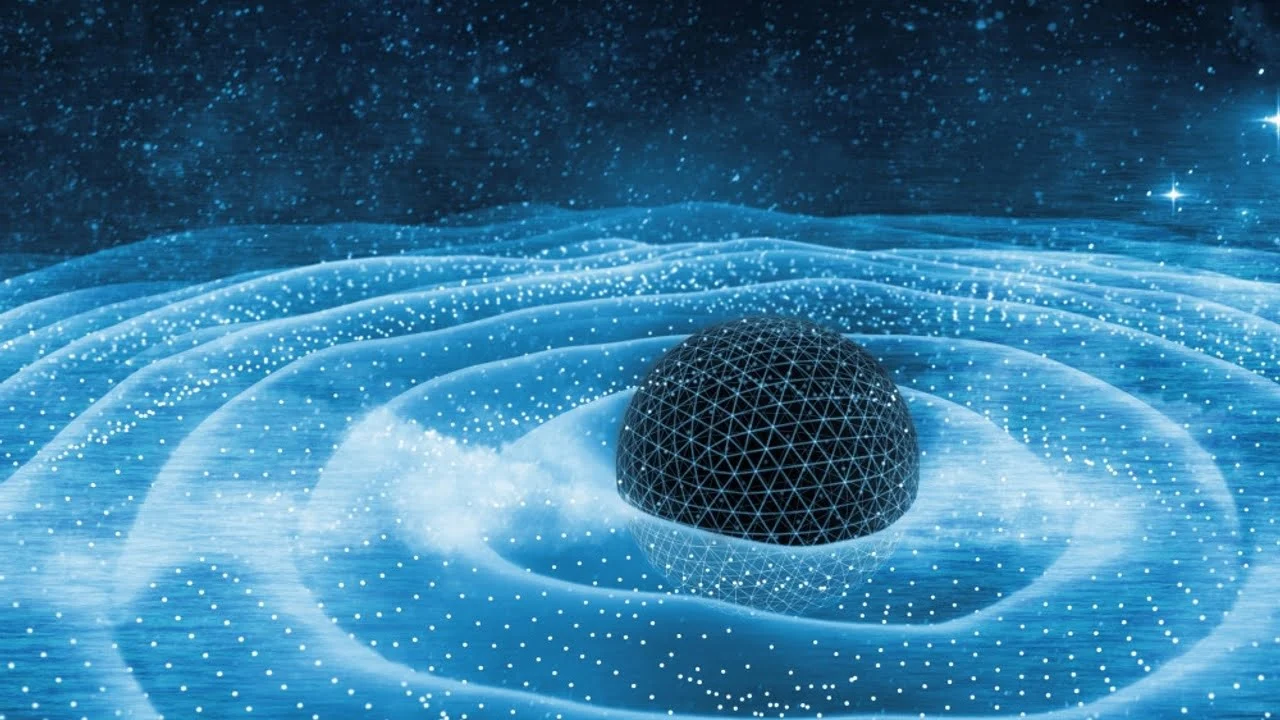
The holographic principle is one of the first introductions of the idea that information may be present holographically within certain structures in the universe — namely, black holes. At this point, one may start to notice how the scientific narrative has been progressively and very subtly switching from terms like energy, forces, particles, and fields, to this word: information.
When we think of information, we think of computers, programming and bits of information expressed in values of 0 or 1 in a binary system. This all is a subset of a larger field called information theory, whose goal is to explain all features of reality as emerging from information exchange and its properties.
This article explores further the topic, giving a brief overview of the history and development of the holographic principle behind the fundamental concept of the generalized holographic model developed by Nassim Haramein [1-3], which gives a quantized solution to mass and gravity.
Entropy and Thermodynamics of a Black hole
The holographic principle has its origins in the work of David Bohm [4] [5], who suggested that every region contains a total ‘structure’ enfolded within it. Bohm equated this idea with the structure of the Universe, which he referred to as a hologram, based on its analogy to optical holography.
This “structure” enfolded within each region or volume can also be described in terms of its information content, which connects it to entropy, since from the perspective of information theory, entropy is a measure of the information content in a system.
When these ideas are applied to black holes, we find the following problem: current understanding states that the content of a black hole cannot be accessed directly because everything that reaches a black hole gets “trapped” inside. Therefore, in this view, an external observer is limited by the apparent impossibility of accessing the dynamics and content inside a black hole. This has prevented physicists from addressing the black hole’s interior and it is unclear what happens to the information that falls into it. The assumption was made that the information falling into a black hole is lost, but that would violate the laws of quantum physics stating that entropy or information cannot be destroyed. This establishes what is known as the information paradox that Stephen Hawking, among others, have tried to solve since then.
To address the issues raised above, Bekenstein proposed that the entropy or information in a given region of space is limited by the area of its boundary, and this seemed to solve the problem because this boundary can be accessed by an external observer. Therefore, all the information contained in the volume could be accessed from the surface as it would be holographically imprinted on it. Bekenstein [6-8] proposed that the entropy S or information contained in a given volume of space, such as a black hole, would be proportional to its surface horizon area A expressed in square units of Planck area l2 as

Then, after additional calculations considering black hole thermodynamics and entropy (see Appendix A at the end of this article for a more detailed explanation), the Bekenstein-Hawking entropy of a black hole expressed in units of Planck area was defined as

where the Planck area is the square of area l2 taken as one unit of entropy and A is the surface area of the black hole.
Bekenstein [9] further argued for the existence of a universal upper bound for the entropy of an arbitrary system with a maximal radius r,

where E is the energy content,  is the reduced Planck constant (
 ) and c is the speed of light in vacuum. By assuming E = mc2 he found that this maximal bound is equivalent to the Bekenstein-Hawking entropy for a black hole.
This idea of a maximal entropy defined by the Bekenstein bound together with energy conservation arguments eventually led to a holographic principle as described by ‘t Hooft [10-12] and later further developed by Susskind [13]. By studying the quantum mechanical features of black holes and the third law of thermodynamics relating entropy to the total number of degrees of freedom (the number of independent ways in which a dynamic system can move without violating any constraint imposed on it), ‘t Hooft showed that the entropy directly counts the number of binary degrees of freedom (known formally as Boolean degrees of freedom, taking values of 0 or 1) and concluded that the relevant degrees of freedom of a black hole must not exceed 1/4 of the total surface area and thus the maximal entropy for a black hole is A/4.
That is, “a region with surface boundary of area A is fully described by no more than A/4 degrees of freedom, or about 1 bit of information per Planck area.” See the image below for more clarity.

However, as noted by Bousso [12], the volume information content will exceed the surface area one for all systems larger than the Planck scale. Thus, the result obtained when only the surface is considered is at odds with the much larger number of degrees of freedom estimated when the volume is considered. The question thus arises whether the Bekenstein-Hawking entropy counts all Boolean states inside a black hole or only the ones distinguishable to the external observer.
Nassim Haramein’s Generalized Holographic Approach
How could we account for the information inside a volume that in principle, one can not access? Well, we may not be able of entering a black hole, but if we know the surface area and hence the radius of the system, we certainly could estimate the degress of freedom inside, by defining a volume unit.
In these works [1] [2] [3], Haramein defined a spherical volume unit or voxel for space which he called the Planck Spherical Unit (PSU), which is the fundamental unit of energy. The PSU represents a quantum of electromagnetic oscillation and also represents a bit of information. A bit is a unit of information, which can be the position or direction of a particle, in this case, of a PSU.
Nassim Haramein’s generalized holographic approach gives a quantized solution to mass and gravity in terms of Planck Spherical Units (PSU). His idea is summarized in the Figure below, where rl is half the Planck length l and r is the radius of any sphere larger than the PSU.

Image courtesy of Dr Amira Val Baker.
Haramein’s approach describes the system under consideration (such as a PSU, a proton, an electron, or the Universe) as a spherical object, and this first order approximation has proven to be a very good assumption. Tiling the surface and filling the volume of such a spherical system with these PSUs results in the figure above, which also shows the expressions for the surface and volume densities with respect to the PSUs.
The number of PSUs that can tile the surface of the spherical object under consideration is expressed by the Greek letter eta (η) representing a surface density which gives the information content of the surface in terms of PSUs. To calculate η we must divide the surface area of the object, A ( = 4π r2), by the equatorial area π rl2 of a PSU with radius rl which is half the Planck length l, rl = l / 2. Since in the frame of information theory, entropy is a measure of the information content in a system, η is also associated with the surface entropy.
In addition, we can find the volume density or information content (i.e., entropy) inside the volume of the spherical system by dividing its volume (represented by the letter V) by the volume of a PSU. This calculates the number of PSU that can fill the volume V, an amount that we represent with the letter R. The volume of a spherical object with radius r is V = (4 /3)πr3 and the same formula calculates the volume of a PSU using its radius rl.
With these very simple densities that we have named surface entropy η and volume entropy R, Haramein defines the fundamental holographic ratio ɸ = η / R shown in the figure above, which is a non-dimensional ratio that expresses the surface-to-volume entropy and represents the information potential transfer or rate of information exchange between the volume and the surface of the spherical system. This holographic ratio ɸ is the primary concept of the generalized holographic theory. The generalized holographic solutions presented the published papers prove that it is this ratio that explains the emergence of features such as mass and gravity.
It is clear then that the degrees of freedom inside the spherical system can and needs to be accounted for, in order to obtain the correct values for the mass of the system. As we will show in the following article, the volume information content – number of PSUs in the volume – for a proton is larger than the area information content – PSUs in the surface – by a factor of 1020.
Highlights:
In summary, we see that the holographic principle limits itself to the surface or boundary of a black hole, neglecting the volume information content even though not all of it can be encoded at the surface. Haramein’s approach also considers the information in the volume.
The nature of holography, the holographic principle and the maximal entropy of a black hole is thus further explored by Haramein, who proposes a generalized holographic approach in terms of both the surface and volume entropy of a spherical system [1] [2]. In this way, the information paradox is addressed. We will give a brief outline of this approach applied to protons and Cygnus X-1 Black hole, in the next article entitled The Generalized Holographic model Part II: Quantum Gravity and the Holographic mass.
If the reader wants to delve deeper into the physics and equations of the holographic principle and entropy of a black hole explained in this article, see the Appendix below.
Appendix
Since a black hole would also obey the laws of thermodynamics, its total entropy or information (that of its surface plus that of its volume) obeys a generalized second law of thermodynamics in which the black hole surface entropy plus the entropy in its interior never decreases.

This relationship between black hole physics and thermodynamics also exists between the first law of black hole mechanics and the first law of thermodynamics.
The first law of black hole mechanics:

gives the mass M in terms of the surface gravity κ, the surface area A, the angular velocity Ω, the angular momentum J, an electrostatic potential Φ and the electric charge Q, and it is inversely proportional to the gravitational constant G. Note that for a Schwarzschild black hole, the angular momentum J and electric charge Q are set to zero. This is to say that this particular black hole is not rotating and has no charge, which is just an idealized situation that allows us to solve some equations analytically (in reality, all black holes spin, although detecting this behavior is challenging).
Whereas the first law of thermodynamics determines the energy of a system in terms of its temperature T, entropy S, pressure P and its volume V using the equation below, and where dE, dS and dV express the infinitesimal change of each:

When there is no charge, the last term in Eq. (3) becomes zero, and we can clearly see the analogy between Eq. (3) and Eq. (4), as explained in the figure below.

The quantities A and κ of the black hole have a close analogy with entropy and temperature respectively, thus by equating the first terms on the right-hand side of each equation (Eq. (3) and Eq. (4)), Bardeen, Carter, and Hawking [9] were able to show that,

Then, Hawking predicted in 1974 the spontaneous emission of black hole thermal radiation (arising from the conversion of quantum vacuum fluctuations into particle-antiparticle pairs) with a temperature given by [10] [11]:

where kB is the Boltzmann constant and τk is the characteristic lifetime of the light pulse emitted by the infalling matter and is seen as the time it takes light to travel a distance 2rS, where rS is the Schwarzschild radius (the radius Schwarzschild obtained as the solution to Einstein’s field equations for a non-rotating and uncharged black hole described as a spherical body. The Schwarzschild radius is considered the limit or boundary of the Black hole; inside this radius nothing could escape).
We can substitute the above definition for Hawking temperature Eq. (6) and include a factor c2 / kB so that the entropy can be given in dimensionless units as,

where, l2 replaces (G h)/c3 as given in the definition of the Planck length.

References
[1] N. Haramein, Phys. Rev. Res. Int. 3, 270 (2013).
[2] N. Haramein, e-print https://doi.org/10.31219/osf.io/4uhwp (2013).
[3] N. Haramein and A. K. F. Val Baker, Journal of High Energy Physics Gravitation and Cosmology 5, 412 (2019).
[4] D. Bohm, B. J. Hiley and A. E. G. Stuart, Int J Theor Phys 3, 171 (1970).
[5] D. Bohm, Wholeness and the Implicate Order (Routledge, London, 1980).
[6] J. D. Bekenstein, Nuovo Cim. Lett. 4, 737 (1972).
[7] J. D. Bekenstein, Phys. Rev. D 7, 2333 (1973).
[8] J. D. Bekenstein, Phys. Rev. D 9, 3292 (1974).
[9] J. D. Bekenstein, Phys. Rev. D 23, 287 (1981).
[10] G. ‘t Hooft, e-print arXiv:gr-qc/9310026 (1993).
[11] G. ‘t Hooft, in Basics and Highlights in Fundamental Physics (Proceedings of the International School of Subnuclear Physics, Erice, Sicily, Italy, 2000)
[12] R. Bousso, Rev. Mod. Phys. 74, 825 (2002).
[13] L. Susskind, J. Math. Phys. 36, 6377 (1995).