

By Amal Pushp, Affiliate Physicist at the Resonance Science Foundation
Among all the various particles that exist in nature, neutrinos are one of the most peculiar of all. Neutrinos are elementary particles that are essentially produced during radioactive decay and are named so because they do not carry any charge and hence are electrically neutral. It would be quite surprising to the reader that neutrinos are ever-present and are fluctuating around us all the time. They also penetrate the earth with little to no interaction.
Neutrinos essentially travel at the speed of light and are not deflected in presence of magnetic fields. All these properties make the detection of neutrinos a cumbersome process. In view of the fact that neutrino interactions are usually quite low, scientists have built a neutrino observatory at the South pole, called the IceCube Neutrino Observatory which consists of pure and stable ice having a thickness of a cubic kilometer, which substantially acts as the detector. Experiments that probe the detection of neutrinos generally identify the same with light emission when the particles collide with water or ice.
One of the uncertainties surrounding neutrinos is whether they carry mass. A phenomenon called neutrino oscillation does show that they possess some mass. These puzzling particles originally come in three flavors (electron, muon, and tau) and their oscillation involves the transition of one flavor into another (look at the figure below). Observation of this phenomenon supposedly also resolves the solar neutrino problem according to which the measured rate of neutrinos emission from the sun is only one-third of the expected flux [1, 2]. The leaders of the research collaboration were also awarded the Nobel prize in physics in 2015 for this discovery.

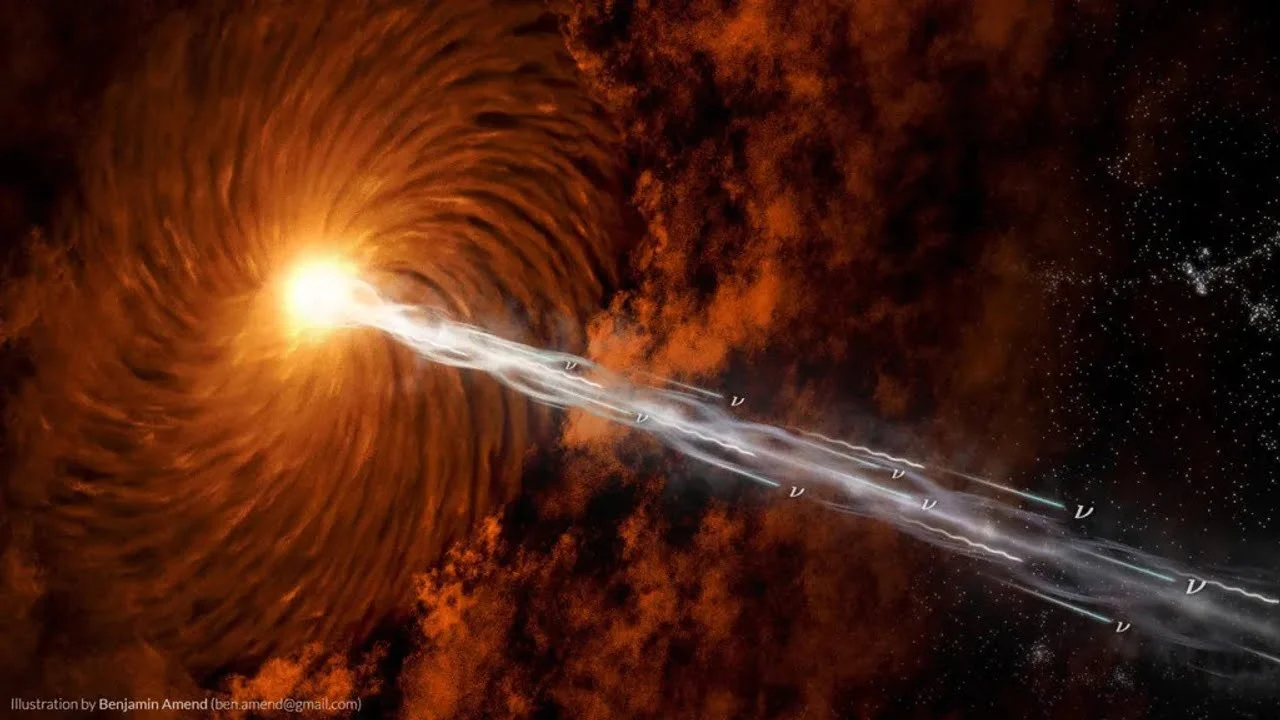
Moreover, scientists have proposed several astrophysical objects as sources of neutrinos, however only two have been identified so far and studied significantly, they are our Sun and Supernova 1987A. Now for the first time, astrophysicists from Morocco have reported an observation of high-energy neutrinos from a Blazar which apparently is a quasar with a relativistic jet [3]. The associated energy is about 300 TeV and the Blazar is close to about 4 billion light-years away from the earth.
As described above, neutrinos oscillate and it apparently indicates that they carry some mass. However, this fact is not contained within the standard model of particle physics as the latter consists of only massless neutrinos. Nevertheless, the researchers have their hopes high after this new work as it would help probe deeper into the nature of neutrinos and expect revealing new physics beyond the standard model of particle physics.
RSF in Perspective:
One of the things that this new detection helps with is that it allows us to probe the physics beyond the standard model. Several frameworks have already come up in this regard that has tried to picture such a scenario like the MSSM, NMSSM, etc. The work would also require us to revise our understanding of the forces of nature in a novel way.
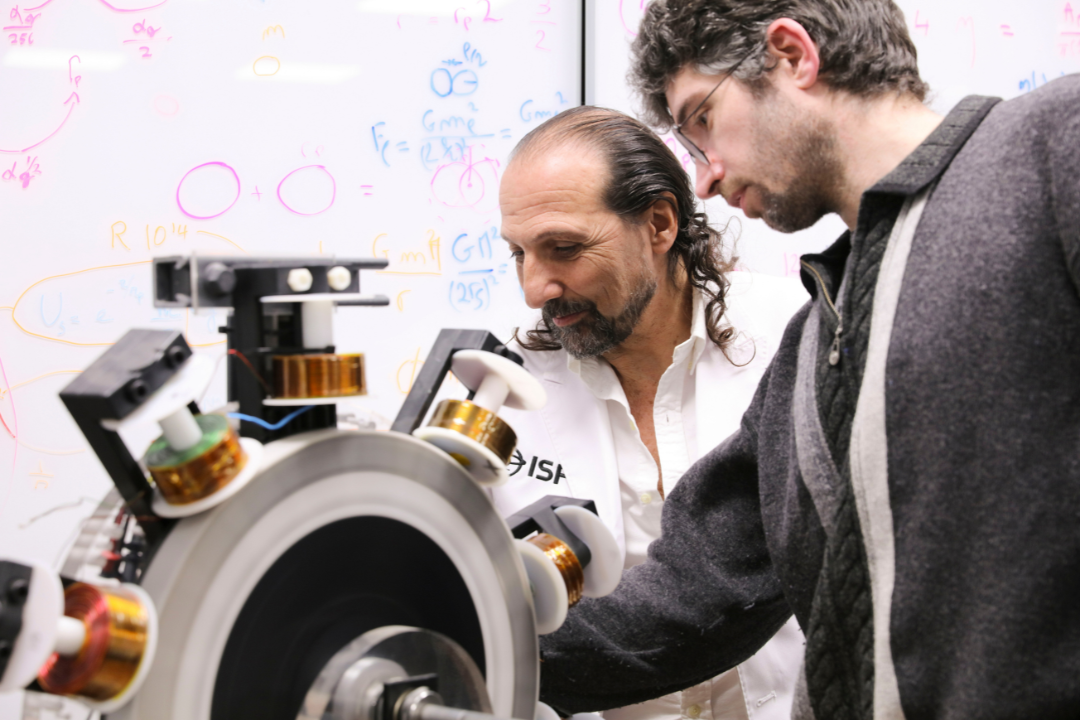
Interestingly, Nassim Haramein’s model helps with both aspects. His model is a first principles approach that would lead to the unification of forces and would be elucidated in the upcoming paper: “Scale Invariant Unification of Forces, Fields & Particles in a Quantum Vacuum Plasma“.
In addition to this, Haramein’s model is more testable with regard to the experimental standards since theories like MSSM and NMSSM are based on the idea of supersymmetry which has failed to deliver any significant empirical result even after decades of research whereas Haramein’s work opens up new possibilities which can be verified with current scientific technologies and also make way for new physics and relevant technologies.
References
[1] Fukuda, Y.; et al. (Super-Kamiokande Collaboration). “Evidence for oscillation of atmospheric neutrinos”. Physical Review Letters. 81 (8): 1562–1567 (1998). doi:10.1103/PhysRevLett.81.1562
[2] Q. R. Ahmad et al. (SNO Collaboration). Phys. Rev. Lett. 87, 071301 (2001). doi:10.1103/PhysRevLett.87.071301
[3] Adil Belhaj et al, “Probing new physics scale from TXS 0506+056 blazar neutrinos”, The European Physical Journal Plus (2022). DOI: 10.1140/epjp/s13360-022-02792-7