

A pair of quantum entities spatially separated in the network of spacetime displays a mysterious correlation when measured. This quantum correlation is commonly referred to as entanglement. In the current age, phenomena involving entanglement and its diverse applications are inevitable, however, it would be quite surprising to the reader at first that this quantum phenomenon was dismissed as an impossible spooky scenario by none other than Albert Einstein who is believed to be one of the founding fathers of quantum physics itself.
Entanglement, also popularly known as non-locality within scientific circles, has become a well-established topic over the decades. However, there is another quantum aspect that is equally interesting but probably most of us haven’t heard of it. This lesser-known phenomenon of quantum mechanics is termed contextuality. To put it simply, contextuality says that properties of particles, such as their position or polarisation, exist only within the context of measurement.
Contextuality originally stems from a well-known no-go theorem of quantum mechanics called the Bell-Kochen-Specker theorem or more generally just the Kochen-Specker theorem, named after the scientists who helped formulate it [1, 2]. The theorem basically says that the theory describing a quantum system must be contextual and that the values of the observables involved, such as an electron’s speed and spin, change depending on the choices we make during the measurement process. Anton Zeilinger, a well-regarded quantum physicist based at the Institute for Quantum Optics and Quantum Information (IQOQI) of the Austrian Academy of Sciences, said in an interview– “We know that it is wrong to assume that the features of a system, which we observe in a measurement exist prior to the measurement…So in a sense what we perceive as reality now depends on our earlier decision on what to measure”.
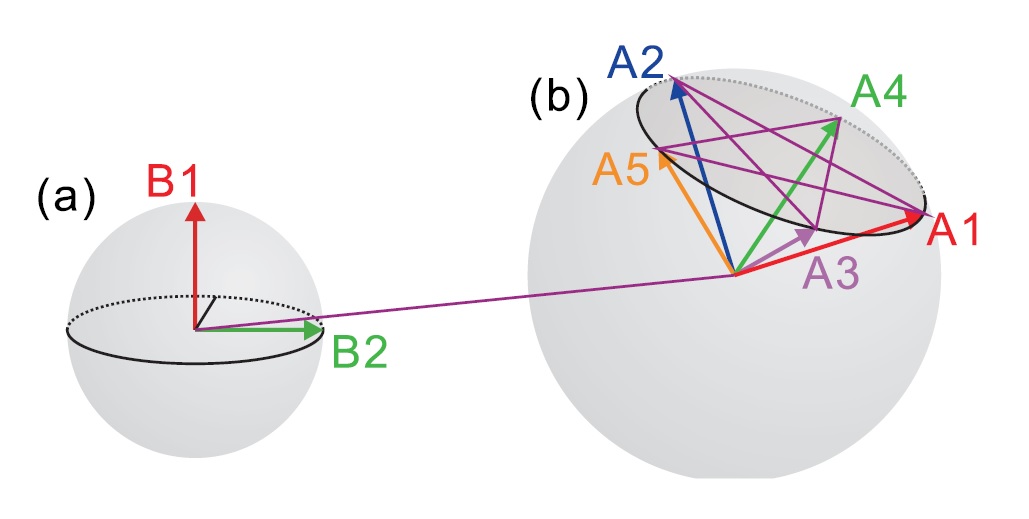
Representation of measurements that demonstrate the contextuality-nonlocality trade-off. Credit: Zhan, et al. ©2016 American Physical Society
The entire scenario is actually much more complex and puzzling than it seems. Not only the measurement depends on our choices but also on who is performing the experiment and taking the measurements of the physical observables of a quantum system as well as its subsystems, as has been reported in a recent article.
There are certain researchers, however, who do not agree with the world being contextual and have imposed loopholes in the Kochen-Specker theorem. But recently physicists have claimed to have resolved all the loopholes by performing a loophole-free test of the Bell-Kochen-Specker experiment [3]. Also, there have been instances when physicists have proposed alternatives to contextuality for example Rob Spekkens from the Perimeter Institute suggested ways to replace contextuality with other theories and Matt Leifer of Chapman University thinks that contextuality could be avoided through retro causality- a phenomenon by which future events affect past events thereby creating a feedback loop between causality and future states. In spite of the proposals of alternatives to contextuality on multiple occasions, physicists are quite skeptical of whether they would actually succeed in eradicating the multifaceted nature of this phenomenon.
Research into contextuality is gaining wide interest among scientists lately with more focus on using it as a tool to explore the foundations of quantum mechanics and its applications to scalable quantum computing as a viable resource [4]. In fact, researchers consider contextuality to be more universal than the property of non-local correlations that particles exhibit, see a recent report by Quanta Magazine. The previous statement which at first seems quite bizarre is actually quite obvious since a single particle cannot show non-local properties whereas contextuality is still applicable for the same. Thus, it would be interesting to see how contextuality unfolds itself in the diverse fields of physics as well as other sciences that we have at our disposal today.
Highlights:
The foundations of quantum mechanics deal with questions like- What is a wave function? Is the wave function ontic (state of reality) or epistemic (state of knowledge)? What happens when the wave function collapses? etc. Several interpretations have been proposed and several are being proposed as we speak, in order to answer these questions, however, there is a lack of consensus among physicists even after decades of work.
The topic of quantum contextuality which has been discussed in this article is related to another puzzling quantum obstacle called the measurement problem, which apparently deals with the wave function collapse process. The experiments show that a fundamental change occurs when an observer tries to measure the quantum system under consideration and many researchers have related this with the problem of consciousness. However, many others have their own biases when it comes to consciousness and its relationship with the collapse of the quantum state vector. Look at a recent paper that I published which gives a critical account of such a work [5].
Nassim Haramein and RSF Scientist William Brown have also published a great deal on a unified approach to understanding space, memory, and consciousness which displays coherence among all the topics and also has an important role to play in resolving the problems related to quantum measurement discussed in this article [6, 7]. A lot more is yet to come so stay tuned!
References
[1] S. Kochen; E. P. Specker (1967). “The problem of hidden variables in quantum mechanics”. Journal of Mathematics and Mechanics. 17 (1): 59–87.
[2] J. S. Bell, “On the Problem of Hidden Variables in Quantum Mechanics”, Rev. Mod. Phys. 38, 447 (1966).
[3] A. Cabello et al. “Significant loophole-free test of Kochen-Specker contextuality using two species of atomic ions”, Science Advances 8 (2022).
[4] A. Cabello et al. “Quantum Contextuality”, arXiv e-prints (2021).
[5] A. Pushp, “The Dead Alive Physicist Gedankenexperiment Debunked”, Quant. Phys. Lett. 11 (1): 1-7 (2022).
[6] W. Brown, “Unified Physics and the Entanglement Nexus of Awareness”, NeuroQuantology 17 (7): 40-52 (2019).
[7] N. Haramein, W. D. Brown, A. Val Baker. “The Unified Spacememory Network: from Cosmogenesis to Consciousness”, NeuroQuantology 14 (4) (2016).