

The information processes underlying physical systems— from organized matter to biological organisms— involves a self-organizing dynamic emerging from specific properties of the substantive medium of space. We have identified these properties as: intercommunicability, memory / hysteresis, iterative feedback-feedforward mechanisms, retrocausal influences, and nonlocal interactions, the gestalt of which we refer to as spacememory [1].
In our publication The Unified Spacememory Network, we identify and describe properties of space that endow it with memory, a property that is required for complexification of physical systems (evolution and development of the universe)— which is integrally related to the emergent property of time— and info-entropy dynamics that engender morphogenesis, intelligence, and sentient systems like human beings. This property of space is due in part to state-dependence and response of the medium to information inputs, that in a local causal structure appear as “past” events. Such dependence of the state of a system on its history is called hysteresis, and is exhibited by certain nonlinear systems, found in electronics, and is an essential feature of the novel class of circuit known as a memristor.
Because of the continuous memory capabilities of such systems—as opposed to the digital memory of conventional electronics—these memory materials and systems offer exciting possibilities in novel information processing modalities like neuromorphic information processing, as continuous memory operations are more akin to what the brain does than traditional digital computations. And investigating such novel functional materials and systems potentially elucidates key insights into fundamental physics—like the spacememory network—and biophysics involved in intelligence and consciousness.
In the Journal Nature Electronics a research team from the Institute of Electrical and Micro Engineering in Switzerland (in collaboration with the Max Planck Institute for the Structure and Dynamics of Matter) have purported to discover continuous memory properties in a molecule called vanadium dioxide (VO2), that if borne through, may one day replace conventional metal-oxide-semiconductors of today’s integrated circuits and offer totally novel data storage and processing, opening new avenues within neuromorphic computation and multi-level memory [2].
Remarkably, the team demonstrated that the memory molecule retains state memory of the entire history of pervious external stimuli, something that has not been previously observed in any other material to-date. The identification and demonstration of a material with these properties is highly interesting to our research as such structural memory capabilities with continuous recall is something that we postulated as a property of the material state of spacememory.
So, since this has clear relevance to fundamental physics as well as technological applications, it is important to understand how this glass-like material, an insulator at cold temperatures, is amenable to electronically accessible continuous memory. What has been discovered is that Vanadium Dioxide experiences a distinct phase transition just above average room temperature, in which the atomic lattice rearranges from a monoclinic to a tetragonal structure. In the monoclinic phase the material is an insulator, yet with just a small input of energy across the critical threshold temperature, which is just above average room temperature, it becomes a conductor. Remarkably, at the transition temperature to the tetragonal paracrystalline structure the electrical conductance increases by a factor of 10,000.

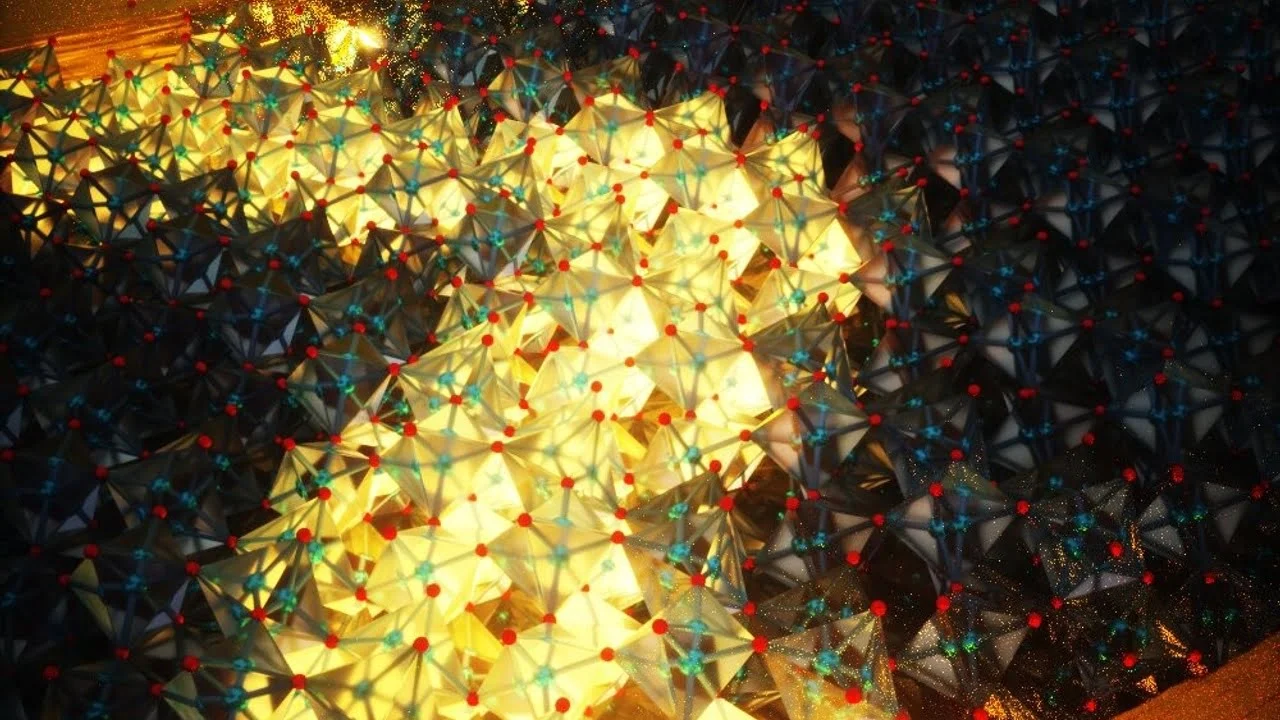
Changes in the crystal structure and electronic properties of vanadium dioxide occur during its insulator-to-metal phase transition (V blue; O red). Above 67°C (right), large-amplitude, nonlinear lattice vibrations (phonons) lead to a tetragonal crystal structure with mobile electrons (yellow) indicating that the vanadium dioxide is a metal. At lower temperatures (left), the electrons are localized in the atomic bonds in the distorted monoclinic crystal structure indicating that the vanadium dioxide is an insulator. Credit: Oak Ridge National Laboratory
A previous study had shown that the thermodynamic force driving the insulator-to-metal transition is dominated by the lattice vibrations (phonons) rather than electronic contributions, such that low-energy phonons change the electron orbital configuration (i.e., the atomic bonds) between atoms, and the configurational rearrangement causes delocalization of some electrons in the lattice, allowing them to travel freely like in the Fermi liquid of metals [3]. This unique mechanism of insulator-to-metal transition involving structural—rather than electronic—states and how it enables long-lived memory of the material is an investigative area rich with new discoveries waiting in materials science and the physics of information processing systems.
In addition to the novel insights that investigation of this material will gleam to fundamental physics: engineering the material for functional applications may offer significant advancements in the miniaturization and reduction of energy consumption of electronic components, as for example, memristors can enable extremely high-density memory platforms that far exceed the capacity of transistor-based memories. In these strongly-correlated memory materials several nonlinear interactions involving spin, charge, lattice, dipole, and orbital configurations are simultaneously active, so that memory arises as an intrinsic property of their structural characteristics and not based on manipulation of electronic states.
In a subsequent article discussing Spacememory Dynamics we will look at these properties in the memristor-like subcellular structures called microtubules, which may play an integral role in information and memory processing in cells of the body, particularly the neuronal networks of the brain. Indeed, because the newly discovered continuous memory properties of Vanadium Dioxide are much more similar to the memory functions of subcellular and neuronal networks of the brain —as opposed to binary on/off computational processing of transistor-based memories, i.e. the brain is not a computer—this novel class of material with memory innate to its structure may have applications in unique neuromorphic information processing systems.
We find this latest discovery to be highly relevant to our Unified Spacememory Network model as it is an empirical physical demonstration that certain states, systems, and materials possess an integral memory function that is an intrinsic property of their structure and naturally arises due to their remarkable features like strong correlation (long range or nonlocal inter-relationships), intercommunicability, and phase transitions between coherent and mixed states. In addition to the theoretical relevance, the utilization of such novel memory materials may well enable functional devices that can outperform conventional metal-oxide-semiconductor electronics in terms of speed, energy, consumption and miniaturization, as our information processing technologies move beyond binary digital-based computation to the more natural system of continuous parallel information processing exhibited by the fundamental-most organizations of nature, like the spacememory network.
References
[1] N. Haramein, W. D. Brown, and A. Val Baker, “The Unified Spacememory Network: from Cosmogenesis to Consciousness,” Neuroquantology, vol. 14, no. 4, Jun. 2016, doi: 10.14704/nq.2016.14.4.961
[2] M. Samizadeh Nikoo et al., “Electrical control of glass-like dynamics in vanadium dioxide for data storage and processing,” Nat Electron, pp. 1–8, Aug. 2022, doi: 10.1038/s41928-022-00812-z
[3] J.D. Budai, J. Hong, M.E. Manley, E.D. Specht, C.W. Li, J.Z. Tischler, D.L. Abernathy, A.H. Said, B.M. Leu, L.A. Boatner, R.J. McQueeney, and O. Delaire, “Metallization of vanadium dioxide driven by large phonon entropy.” Nature 515, 535-539 (2014). DOI: 10.1038/nature13865