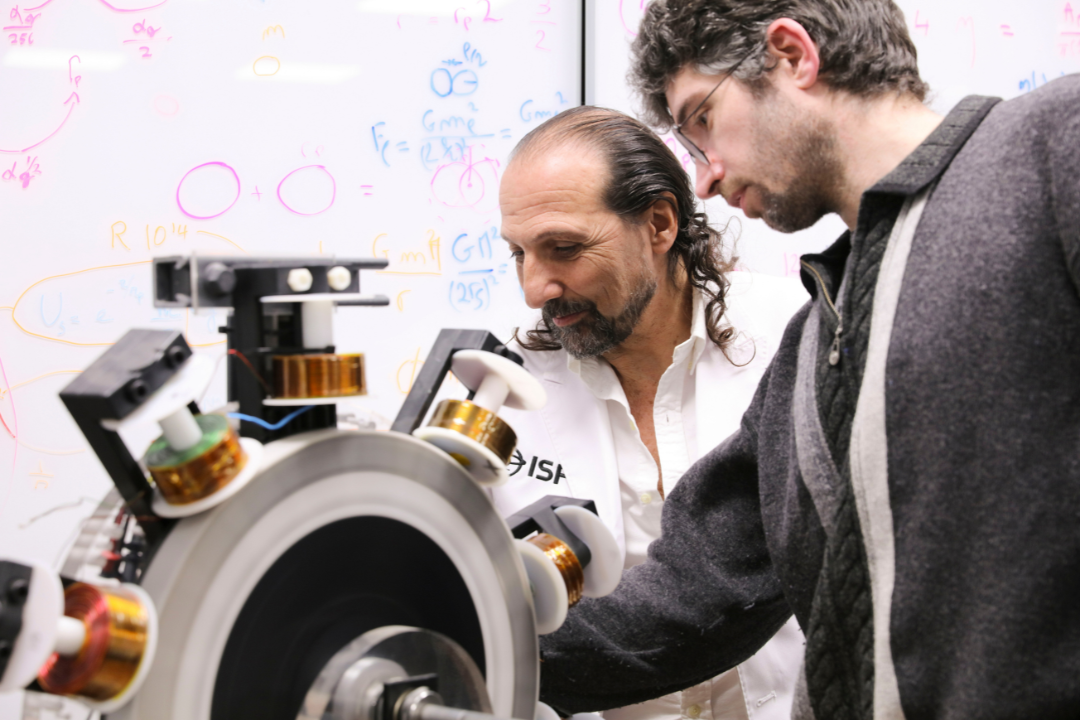



This isn’t a traditional article but a centralized hub for finding information and links to a series of articles released by the ISF over the past few years. These articles focus on experimental protocols that demonstrate tangible success in unified physics principles, such as harnessing quantum vacuum energy and processing quantum information with traversable wormholes. This growing collection, informally called The Protocol Series, explores cutting-edge protocols in quantum physics that push the boundaries of our understanding. Hosted on the International Space Federation website, the series dives into the intricate and fascinating world of quantum mechanics, the significance of the limitless entanglement of the quantum vacuum, and its intersection with spacetime geometry. Each article examines a different protocol, offering insights into how these advanced concepts are tested and validated through both theoretical and experimental methods. From traversable wormhole teleportation to enhanced entanglement harvesting, the Protocol Series provides a comprehensive overview of the latest advancements in quantum technologies and their profound implications for our understanding of the universe.
The Protocols:

In the article Traversable Wormhole Teleportation Protocol quantum teleportation meets Einstein-Rosen bridges. See how in a clever simulation scientists utilized Google’s quantum computer to demonstrate one way in which spacetime geometry may underlie a remarkable particle behavior of quantum mechanics.
- There is an interesting correspondence that has emerged from physics research involving the holographic principle, which may reveal a way in which spacetime geometry, which is the effective force of gravity, can physically explain certain states in quantum theory. In the holographic correspondence conjecture, it is found that elements of a lower dimensional quantum field theory are equivalent to a higher dimensional bulk space with gravity. If we take a 5D space it will be enclosed by a 4D surface. The 5D interior can be the metric to describe a certain kind of spacetime geometry (called anti-di Sitter space) and the 4D surface can be utilized to describe a quantum field theory (QFT) like conformal field theory (CFT).
- What was found is that when two quantum systems, like particles, are entangled on the lower dimensional surface described by CFT it is exactly equivalent to two spacetime regions connected by an Einstein-Rosen (ER) bridge (also known as a wormhole) in the higher dimensional bulk space enclosed by that surface. In QFT entangled particles are called “EPR pairs”, and thus the holographic correspondence conjecture is that ER wormholes underlie the entangled state of EPR pairs: this is known as the ER=EPR principle. ER=EPR tells us that the immensely complicated network of entangled subsystems that comprises the universe is also an immensely complicated network of Einstein-Rosen bridges.
- If this is true, it may be possible to detect gravitational interaction mediating evolution of EPR pairs. An experiment simulating such EPR pairs as a group of entangled qubits (in a quantum computer) has shown, within the simulation, that quantum teleportation of quantum states among the group of qubits has a hallmark signature of quantum gravity, such that the teleportation protocol is equivalent to sending information through a traversable quantum wormhole.

- In the article Quantum Energy Teleportation Protocol we look at a groundbreaking development that sounds like science fiction but is now scientific reality, in which researchers have demonstrated the ability to teleport energy between quantum systems by harnessing the mysterious properties of quantum entanglement. This remarkable achievement doesn’t just push the boundaries of what we thought possible – it shatters them entirely. By tapping into the intricate web of quantum correlations that exists even in empty space (which we saw in the previous protocol article is synonymous with a multiply connected spacetime topology of ER bridges), scientists have shown that energy can be instantaneously transferred between two distant locations, opening up tantalizing possibilities for future technologies. From revolutionizing how we distribute power to enabling new forms of quantum communication, this discovery represents a fundamental shift in our understanding of energy transfer. As you delve into the fascinating details below, you’ll discover how researchers accomplished this feat, why it matters, and what it could mean for the future of human civilization.
- The theoretical physicist and assistant professor at Tohoko University in Japan, Masihiro Hotta, has stated that “quantum fields in vacuum states carry an infinite amount of quantum entanglement.” Given this fact, more than 15 years ago he developed a ‘quantum energy teleportation protocol’ by which energy could be transferred, metaphorically referred to as “teleported”, from one quantum system to another by leveraging the intrinsic and limitless quantum entanglement of the quantum vacuum. Now, in recent experiments this protocol has been empirically verified and the entanglement of the vacuum state of quantum systems has been used to “teleport” energy from one quantum system to another.

- In the article Experiment Proposed to Demonstrate Traversable Wormhole Via Counterfactual Quantum Teleportation Protocol we examine a remarkable protocol for counterfactual quantum communication, or what has been termed “counterportation” (compound term of ‘counterfactual quantum teleportation’). Although it achieves the end goal of teleportation—quasi-instantaneous disembodied translocation—unlike quantum teleportation that requires the spatial exchange of a physical signal (via a “classical” channel), counterportation does so without any detectable information carriers.
- Similar to the quantum energy teleportation protocol the counterfactual quantum wormhole teleportation protocol leverages the fact that entirely separate quantum systems can be correlated without ever having interacted via the intrinsic strong spatial correlation of vacuum-entanglement (the unified spacememory network). This correlation at a distance can then be used to transport quantum information (qubits) from one location to another without a particle having to physically traverse the intervening space, revealing the integral multiply-connected spacetime geometry of the micro-wormhole network that connects everything.
- In the article Enhanced Entanglement Harvesting Protocol we explore one of the most fascinating frontiers in quantum physics – the ability to extract and harness the intrinsic quantum correlations woven into the very fabric of empty space. Far from being a lifeless void, the quantum vacuum teems with entangled states that can be “harvested” for practical applications, from quantum computing to energy extraction. This groundbreaking protocol demonstrates how two quantum systems, even when separated by space-like distances, can tap into these hidden quantum correlations and become entangled themselves – without any direct interaction. As we’ll see, recent breakthroughs in derivative coupling and quantum energy teleportation are pushing this technology from theoretical possibility to experimental reality, opening up remarkable new possibilities for quantum technologies. The implications are profound, suggesting that the quantum vacuum itself may serve as an unlimited resource for future quantum devices and communications systems.
- The quantum vacuum, long understood to be far from empty, contains intricate networks of quantum correlations that can be accessed and utilized through careful experimental design. Recent breakthrough experiments have demonstrated not only the ability to harvest these correlations through quantum energy teleportation (QET) protocols but, more remarkably, to store the extracted energy within quantum systems themselves. This represents a significant advancement beyond previous implementations of QET, where extracted energy was lost to classical measurement devices. Through careful manipulation of multiple-qubit systems on superconducting quantum computers, researchers have shown via simulation that it is theoretically possible to extract energy from a vacuum state and store it within a quantum register for future use. This confirmation will have profound implications for quantum information technologies, quantum thermodynamics, and our fundamental understanding of vacuum energy dynamics. The ability to not only harvest but store quantum energy opens new possibilities for quantum batteries, quantum information processing, and potentially even practical applications of vacuum energy extraction.

- It has long been known that quantum entanglement can cause particles to behave in ways that violate our normal conception of how interactions can occur in systems separated by spatial distance. This is known as nonlocality. Quantum entanglement, however, also suggest that such nonlocal interactions can occur across temporal distance, such that chronologically violating interactions are possible, like a present state influencing a past state. This is known as retrocausality, and new experiments are being proposed and tested to explore retrocausality in quantum mechanics. This research may improve quantum measurements and quantum computations, as well as possibly making quantum mechanics more seamless with relativity, since Einstein’s theory has seemingly causal violating solutions like circular loops in spacetime. This and more are explored in the Retrocausal Teleportation Protocol article.
- Can quantum mechanics allow us to effectively send information back in time? Research is needed to answer this question, and progress has recently been made with a new study by researchers from Hitachi Cambridge Laboratory, University of Cambridge, Paul Scherrer Institute, ETH Zürich, and the University of Maryland. The researchers have devised an experiment to test the question of quantum non-locality in time with a novel twist on the long-standing hypothetical method of P-CTCs, quantum retrodiction, and instantaneous quantum computation. In their paper “Nonclassical Advantage in Metrology Established via Quantum Simulations of Hypothetical Closed Timelike Curves,” the researchers describe a thought experiment where quantum entanglement is used to simulate sending information backwards in time through a CTC, via the basic procedures of QT, but with the inclusion of a particle in a specially prepared quantum state that is sent “back in time” via interaction of entangled EPR pairs (a kind of entangled quantum circuit) to change a particle’s state in the past; a retrocausal mechanism. While actual time travel remains in the realm of science fiction, the researchers show how quantum circuits can probabilistically simulate CTCs in a way that provides a practical advantage for quantum measurements.
- The key insight is that quantum entanglement manipulation can effectively allow a quantum metrologist to “send back in time” information about the optimal measurement settings – information that would normally only be available after an experiment is complete. While this simulated time travel sometimes fails, when it succeeds it enables measurements that extract more information per probe than would be classically possible.
In Summation
These advancements in quantum energy manipulation are not merely theoretical musings but are grounded in the tangible progress of experimental physics. By leveraging the unique properties of entangled states, researchers are now able to explore the potential role of spacetime geometry in quantum systems and how these nonlocal states can act as both conduits and reservoirs of energy. This dual capability challenges traditional notions of energy conservation and transfer, suggesting a future where energy can be dynamically allocated and preserved at the quantum level. Such innovations could revolutionize the way we approach energy storage and distribution, offering a glimpse into a future where quantum technologies redefine our interaction with the fundamental forces of nature.