

By using this site, you agree to the Privacy Policy.
Accept
The International Space Federation (ISF)The International Space Federation (ISF)The International Space Federation (ISF)
  • Science News
    • All Articles
    • Physics
    • Astronomy
    • Biology
    • Technology
    • Other
  • Research
    • Research Papers
    • Physicists Testimonials
  • Technology
  • About
    • About us
  • ISF News
  • Events
    • Events
  • Get Involved
    • Invest
    • Donate – Zero Point Foundation
  • Careers
  • Contact Us
Reading: Researchers Discover a Theoretical Correspondence Between Topology and Quantum Entanglement
Share
The International Space Federation (ISF)The International Space Federation (ISF)
Search
  • Science News
    • Physics
    • Astronomy
    • Biology
    • Technology
  • Research Papers
    • Physicists Testimonials
  • About
    • ISF News
  • Events
  • Get involved
    • Invest
  • Translations
    online pharmacy https://worldneurologyonline.com/ no prescription pharmacy
Follow US
© 2022 International Space Federation. All Rights Reserved.
The International Space Federation (ISF) / Explore / Physics / Researchers Discover a Theoretical Correspondence Between Topology and Quantum Entanglement
Physics

Researchers Discover a Theoretical Correspondence Between Topology and Quantum Entanglement

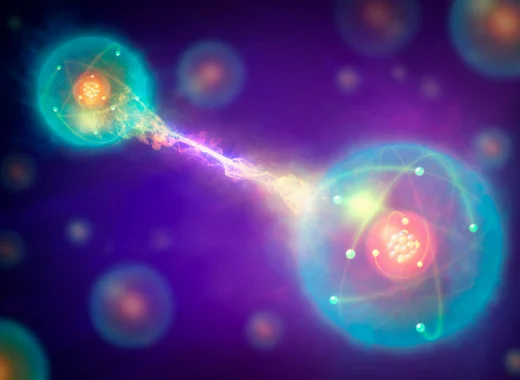
Topology is a branch of mathematics concerning the properties of geometric objects and their shapes. These properties are essentially invariant under continuous deformations such as stretching, twisting, etc. Entanglement on the other hand is purely a physical phenomenon wherein two particles can influence each other instantaneously irrespective of the spatial distance between them.

Amal Pushp
Last updated: 2024/04/22 at 4:05 PM
Amal Pushp
Share
3 Min Read
SHARE

Topology is a branch of mathematics concerning the properties of geometric objects and their shapes. These properties are essentially invariant under continuous deformations such as stretching, twisting, etc. Entanglement on the other hand is purely a physical phenomenon wherein two particles can influence each other instantaneously irrespective of the spatial distance between them.

In new research published in the journal Physical Review X, Charles Kane, who is the Christopher H. Browne Distinguished Professor of Physics in U. Penn’s School of Arts & Sciences established a conceptual duality between topology and entanglement along with his collaborators [1].

Consider a sphere and a donut. The difference between the two lies in the fact that a donut, which has a toroidal topology, is specified by a single hole whereas there are no holes in a sphere. In this sense, a coffee mug and donut are topologically similar since both of them are characterized by a common property and that is a single hole (see figure below). Building upon this feature, topology can be utilized as a universal scheme for describing quantum states. Quantum entanglement on the other hand is already a well-known procedure that quantum states use to characterize non-local correlations. What the researchers have found is a circumstance where these two ideas are tightly interwoven. In a sense, it is a connection between an abstract and a concrete phenomenon wherein topology comes under the former and entanglement under the latter.

Continuous deformation (a type of homeomorphism) turning a coffee mug into a torus shaped object. Source: Henry Segerman

The relationship was originally explored in the Fermi surface of copper which Kane initially realized as a topological surface. The Fermi surface of copper essentially possesses four holes, also called a genus in technical terminology. Kane and his collaborators derived a mathematical formula between the genus of the Fermi surface and a measure of quantum entanglement called mutual information which brings together individual correlations from different regions of space to meet at a single point.

This work displays a beautiful blend of mathematics and physics and also opens up a box of possibilities such as its potential application to understanding phases of matter, investigating the manifestation of quantum mechanics in a system with multiple degrees of freedom, and measuring topological genus among others.

References

[1] Pok Man Tam et al, Topological Multipartite Entanglement in a Fermi Liquid, Physical Review X (2022). DOI: 10.1103/PhysRevX.12.031022

Sign Up For Daily Newsletter

Be keep up! Get the latest breaking news delivered straight to your inbox.
loader

loader

loader

By signing up, you acknowledge the data practices in our Privacy Policy. You may unsubscribe at any time.
En vous inscrivant, vous reconnaissez les pratiques en matière de données dans notre politique de confidentialité. Vous pouvez vous désinscrire à n'importe quel moment.
Al registrarse, reconoce las prácticas de datos en nuestra política de privacidad. Puedes darte de baja en cualquier momento.
Share This Article
Facebook Twitter Copy Link Print
Previous Article Controlling the Quantum Vacuum for Energy Transfer and Functional Casimir Devices
Next Article Dynamical Topological Phase, Driven by a Fibonacci Pulse, Protects Entanglement

Stay Connected

981k Like
18.7k Follow
7.7k Follow
7.3k Subscribe

Categories

  • Astronomy106
  • Biology69
  • ISF News25
  • ISF Research14
  • Other22
  • Physics168
  • Technology36

You Might also Like

Physics

Gravitational Waves Leave Their Mark on Atomic Light: A New Window into Vacuum Field Physics

22. April 2026.
BiologyPhysics

Do Cells Use a Quantum Compass to Heal Wounds?

2. December 2025.
Physics

Space-Memory Experiments: Quantum Memory Matrix Results Explained

3. October 2025.
Physics

From Bit to Quanta: New Theory Links Entanglement to Particle Creation

17. September 2025.
The International Space Federation (ISF)The International Space Federation (ISF)

Harnessing quantum vacuum energy for sustainable solutions – a unified approach to science, technology and education.

Quick links

  • About
  • Research Papers
  • Events
  • Invest

Explore

  • ISF Research
  • Physics
  • Technology
  • Astronomy
  • Biology
  • ISF News

Sign Up for Our Newsletter

Subscribe to our newsletter to get our newest articles instantly!

loader

Follow US
© 2023 International Space Federation. All Rights Reserved. INTERNATIONAL SPACE FEDERATION is a trademark of ISFS SA. The mark is registered in the United States under Registration No. 7772313. The ®️ symbol is used exclusively in the U.S.
  • Press
  • Careers
  • Privacy policy
  • Carrieres
  • Presse
  • Prensa
Join Us!

Subscribe to our newsletter and never miss our latest news.

loader

Welcome Back!

Sign in to your account

Lost your password?