
By using this site, you agree to the Privacy Policy.
Accept
The International Space Federation (ISF)The International Space Federation (ISF)The International Space Federation (ISF)
  • Science News
    • All Articles
    • Physics
    • Astronomy
    • Biology
    • Technology
    • Other
  • Research
    • Research Papers
    • Physicists Testimonials
  • Technology
  • About
    • About us
  • ISF News
  • Events
    • Events
  • Get Involved
    • Invest
    • Donate – Zero Point Foundation
  • Careers
  • Contact Us
Reading: Spectral Signatures of a Black Hole Spinning at Almost the Speed of Light
Share
The International Space Federation (ISF)The International Space Federation (ISF)
Search
  • Science News
    • Physics
    • Astronomy
    • Biology
    • Technology
  • Research Papers
    • Physicists Testimonials
  • About
    • ISF News
  • Events
  • Get involved
    • Invest
  • Translations
    online pharmacy https://worldneurologyonline.com/ no prescription pharmacy
Follow US
© 2022 International Space Federation. All Rights Reserved.
The International Space Federation (ISF) / Explore / Physics / Spectral Signatures of a Black Hole Spinning at Almost the Speed of Light
Physics

Spectral Signatures of a Black Hole Spinning at Almost the Speed of Light

A two-years analysis on the emission spectra from a 2016 X-ray transient outburst in the black hole system U4 1630-47, obtained by three different independent space missions, could determine the spinning and mass of the BH. The estimated spinning rate is 92-95% the speed of light, with a mass of 5-10 M (million solar masses).

Dr. Inés Urdaneta
Last updated: 2025/01/07 at 10:42 PM
Dr. Inés Urdaneta
Share
5 Min Read
SHARE

After a two years analysis on the emission spectra from a 2016 X-ray transient outburst in the black hole system U4 1630-47, obtained by three different independent space missions; Chandra/HEG, AstroSat and MAXI, the leader of the project Dr. Mayukh Pahari and collaborators could determine the spinning and mass of the black hole. The estimated spinning rate is 92-95% the speed of light, with a mass of 5-10 M (million solar masses).

Figure 1 below shows the initial signals detected by the MAXI missions. These spectra are further analyzed, decomposed and fitted in order to obtain the final results published here [1].


Fig.1: 2016 X-ray outburst of 4U 1630–47 as observed by MAXI and Swift/BAT.

With the independent modeling of the broadband data spectra obtained by the three missions, and using the Markov chain Monte Carlo simulations on fitted spectral parameters, they find a range of the black hole spin parameter depicted in Figure 2, amounting to 0.88–0.96 within a 3σ deviation, which indicates the presence of a rapidly spinning black hole in 4U 1630–47.


Figure 2: spin parameter for three different joint spectral fits.

This is the fifth occasion that a spinning black hole has been so firmly characterized, and the reason for such a few numbers of cases compared to the number of BH detected so far, relies on the fact that spinning black holes are very difficult to detect, as Dr. Pahari explains below.

Detecting signatures that allow us to measure spin is extremely difficult. The signature is embedded in the spectral information which is very specific to the rate at which matter falls into the black hole. The spectra, however, are often very complex mostly due to the radiation from the environment around the black hole.  

Dr. Mayukh Pahari

Among the interesting features that the emission spectra reveals, one of most important one is the chemical elements surrounding the BH. For instance, the Chandra/HEG (High Energy Grating) spectrum shows two strong absorption lines at 6.705 keV and 6.974 keV (see Fig 3), which are produced by the element iron (Fe) in different oxidation states (Fe XXV and Fe XXVI) in a low-velocity ionized disk wind. The corresponding outflow velocity is determined to be 366±56 km/s.


Fig. 3: Absorption lines from Chandra grating spectra, showing two strong absorption lines visible at ∼6.7 and ∼6.97 keV, which are due to the ionized Fe XXV and Fe XXVI absorption features, fitted with Gaussian absorption profiles.

In view of the model proposed by Nassim Haramein, spin is at the origin of energy and mass, through the vorticial nature or torque inherent to the structure of spacetime – or vacuum – itself [2]. For this reason, everything in the universe is spinning, from sub atomic particles, to planets, galaxies and beyond. The fact that all black holes are spinning is difficult to realize due to the difficulties measuring the effect.


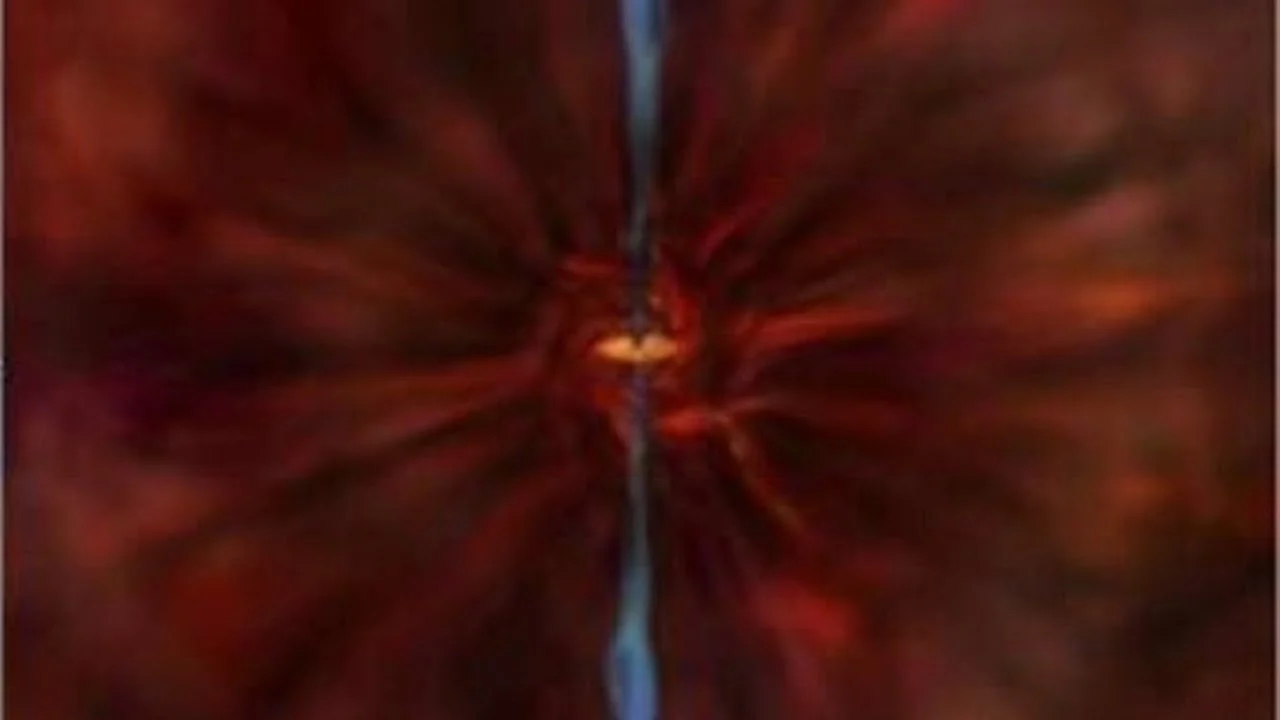
Illustration credit: CXC/M. Weiss and Figures taken from original IOP article.

Read more at: 

Researchers discover black hole in our galaxy spinning rapidly around itself

AstroSat and Chandra View of the High Soft State of 4U 1630–47 (4U 1630–472): Evidence of the Disk Wind and a Rapidly Spinning Black Hole

References

[1] Mayukh Pahari et al (2018), AstroSat and Chandra View of the High Soft State of 4U 1630–47 (4U 1630–472): Evidence of the Disk Wind and a Rapidly Spinning Black Hole, ApJ 867 86. DOI 10.3847/1538-4357/aae53b

[2] Haramein, N., and Rauscher, E. A. (2005). The orgin of spin: A consideration of torque and coriolis forces in Einstein’s field equations and grand unification theory. Beyond The Standard Model: Searching for Unity in Physics, 1, 153-168
Sign Up For Daily Newsletter

Be keep up! Get the latest breaking news delivered straight to your inbox.
loader

loader

loader

By signing up, you acknowledge the data practices in our Privacy Policy. You may unsubscribe at any time.
En vous inscrivant, vous reconnaissez les pratiques en matière de données dans notre politique de confidentialité. Vous pouvez vous désinscrire à n'importe quel moment.
Al registrarse, reconoce las prácticas de datos en nuestra política de privacidad. Puedes darte de baja en cualquier momento.
Share This Article
Facebook Twitter Copy Link Print
By Dr. Inés Urdaneta
Dr. Inés Urdaneta is a multi-published research physicist in the domain of light-matter interaction at the atomic, molecular, and nano/solid-state scales. In her more than 20 years of research she participated in national and international research projects throughout France, USA, México and Venezuela, on an extensive variety of topics. At present, as part of our research staff at the International Space Federation, Inés focuses on developing physical-chemical models in the frame of the generalized holographic model (GHM) and unification theory developed by Nassim Haramein, together with quantum information processes and their connection to black holes and to proto-consciousness.
Previous Article Quasars Shed New Light on the Hubble Constant
Next Article Is Spacetime A Quantum Code?

Stay Connected

981k Like
18.7k Follow
7.7k Follow
7.3k Subscribe

Categories

  • Astronomy106
  • Biology68
  • ISF News25
  • ISF Research14
  • Other22
  • Physics168
  • Technology36

You Might also Like

Physics

Gravitational Waves Leave Their Mark on Atomic Light: A New Window into Vacuum Field Physics

22. April 2026.
BiologyPhysics

Do Cells Use a Quantum Compass to Heal Wounds?

2. December 2025.
Physics

Space-Memory Experiments: Quantum Memory Matrix Results Explained

3. October 2025.
Physics

From Bit to Quanta: New Theory Links Entanglement to Particle Creation

17. September 2025.
The International Space Federation (ISF)The International Space Federation (ISF)

Harnessing quantum vacuum energy for sustainable solutions – a unified approach to science, technology and education.

Quick links

  • About
  • Research Papers
  • Events
  • Invest

Explore

  • ISF Research
  • Physics
  • Technology
  • Astronomy
  • Biology
  • ISF News

Sign Up for Our Newsletter

Subscribe to our newsletter to get our newest articles instantly!

loader

Follow US
© 2023 International Space Federation. All Rights Reserved. INTERNATIONAL SPACE FEDERATION is a trademark of ISFS SA. The mark is registered in the United States under Registration No. 7772313. The ®️ symbol is used exclusively in the U.S.
  • Press
  • Careers
  • Privacy policy
  • Carrieres
  • Presse
  • Prensa
Join Us!

Subscribe to our newsletter and never miss our latest news.

loader

Welcome Back!

Sign in to your account

Lost your password?