

Resonance is experienced, and even identified as responsible for the forms of what we perceive, observe, or infer based on it – an atom, a flower, planets, galaxies … -.

Resonance binds together the different elements that make up reality and allows interaction between them. It is the main factor for feedback to be possible, the conduit, shall we say, through which the exchange of information happens: the external can penetrate the internal, and vice versa; the internal can manifest itself outside. The condition for that channel to be opened, and made available, is the coincidence in energy; that the inner and outer energies are compatible. i. e., that they have the same frequency.
In general, we could say that everything around us is vibrating or is vibration. Light or electromagnetic fields is a free propagating vibration in empty space. It is usually depicted as a waveform in 2D, when in reality it moves in 3D following a helical motion, and it is a transverse wave because it vibrates perpendicular to the direction of propagation of the wave (green and red oscillating arrows):

The green and red oscillating vectors are the electric and magnetic component of the wave, respectively. For more on electromagnetic fields, please read the ISF article “The Origin of Quantum Mechanics I: Tle Electromagnetic field as a Wave”.
When the vibration is not happening in empty space, but through a material sample, then the wave is known as a sound wave, and its propagation speed will depend on the material nature of the sample. It will be a longitudinal wave, meaning that the vibration occurs in the direction of propagation of the wave.
Matter is also vibration, which is confined in a certain volume in space. All objects, even if static, have lots of internal vibrations, its atoms are basically, pure vibration. And the internal modes of vibrations – also known as vibration modes- are particular for each atom, and molecule. These are the fingerprint of the object, it being a quantum particle, such as an atom, or a tennis ball, or a planet, or a star.
Each object has its fingerprint, which are its own modes of vibration. These are defined by its form and atomic/molecular composition. For example, if we take a simple molecule of water, composed of one oxygen and two hydrogens, its normal modes of vibration are depicted in the video below:
When an external vibration (remember that energy has an oscillation or vibration associated with it, with frequency f) strikes the object, if that vibration (frequency) coincides with any of the object’s modes of vibration (which have their frequency as well), the object will absorb that energy and that normal mode of vibration will amplify its amplitude (it will vibrate more intensely, analogous to higher sea wave amplitude).
This principle is what makes, for example, that a glass vessel breaks when some acoustic vibration around it coincides with any of the normal or proper modes of vibration of the glass, so that if the volume (intensity of the sound) is high enough, the glass will absorb that more energy, its atoms will have more kinetic energy that is amplified by this is known as the resonant condition, until the glass breaks (loses its shape, unable to withstand so much internal energy amplified by the external).
Likewise, an object that is made to vibrate (it does so at its own frequencies or modes of vibration), can stimulate the vibration of any other object around it that has some mode of vibration of its own that matches its own.
Sound is, therefore, consequence of resonance.
Color, too, is another consequence of resonance.
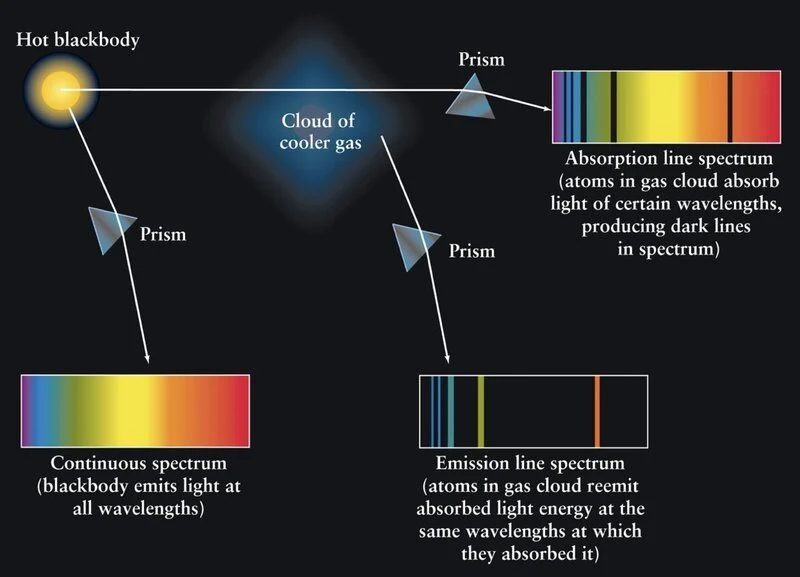
To explain the nature of color, we first would have to address some quantum mechanics concepts, which could be read in here “Origin of Quantum Mechanics II: The Black Body radiation and the Quantization of the Electromagnetic spectrum”, some of which is summarized in the Figure below.

The simplest known atom, the hydrogen, is mainly composed of a proton and an electron, where both are basically confined vibrations at different frequencies, also known as normal modes of vibrations. This means that they are allowed to vibrate only at certain frequencies, defined by quantum mechanics. Their vibrations are “quantized”. Meanwhile, white light propagating electromagnetic oscillations, contains all frequencies of the visible spectrum, therefore, when it reaches the hydrogen atom, only parts of the electromagnetic spectrum can be absorbed by the atom, and it becomes “excited”. This excitation lasts very short time, it decays almost immediately, and the energies emitted by the atom can also be detected. This is known as the emission spectra of the hydrogen atom.
There are two ways in which one can measure the spectra, or fingerprint of the interaction between light and the atom: from the perspective of the frequencies of light that are missing from the original after they have been absorbed by the atom (upper section in the figure below), the resulting spectra is known as absorption spectra of hydrogen atom, or, by measuring the emission spectra of the excited atom. Both spectra are almost the negative one of other one, except that there are very small energy loses as heat, during the de excitation of the atom, and hence the energy emitted is smaller than the absorbed, its frequency is a little smaller; it shifts the spectrum a little, almost unperceived bit, to the red side, i.e., to larger wavelengths.
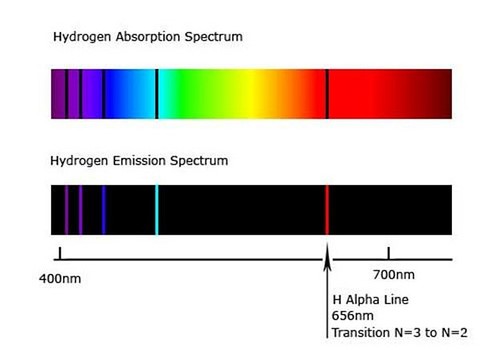
The spectrum is particular for each atom, it is the fingerprint of each atom. The scientific technique that measures the spectra of elements is known as spectroscopy, and it allows to determine the chemical composition -atomic and molecular- of everything around us. Molecules also have their own fingerprint (which is more complex than for the atom, because there are many more modes of vibrations involved), because it can be decomposed in the different vibrations coming from its bonded atoms.
One of the most beautiful ways of looking at the periodic table, is thought the emission spectra of the elements, as shown below, where we can confirm that effectively, each have their own spectra.

Spectroscopy is a technology based on quantum mechanics, and it is not only empolyed to determine the chemical composition in samples, but as well it is the main tool to know the chemical environment in astronomical objects, such as our Sun, and the atomic composition in the different layers of the Sun.

The black lines in Sun’s absorption spectrum are caused by gases helium, hydrogen, oxygen, on or above Sun’s surface that absorb some of the emitted light. Every gas has a very specific set of frequencies that it absorbs.
If a gas is heated to the point where it glows, the resulting spectrum has light at discrete wavelengths that turn out to match the wavelengths of missing light in stellar spectra. Therefore, by studying the spectra of various elements in a laboratory here on Earth, we can determine the composition of the distant stars and beyond!
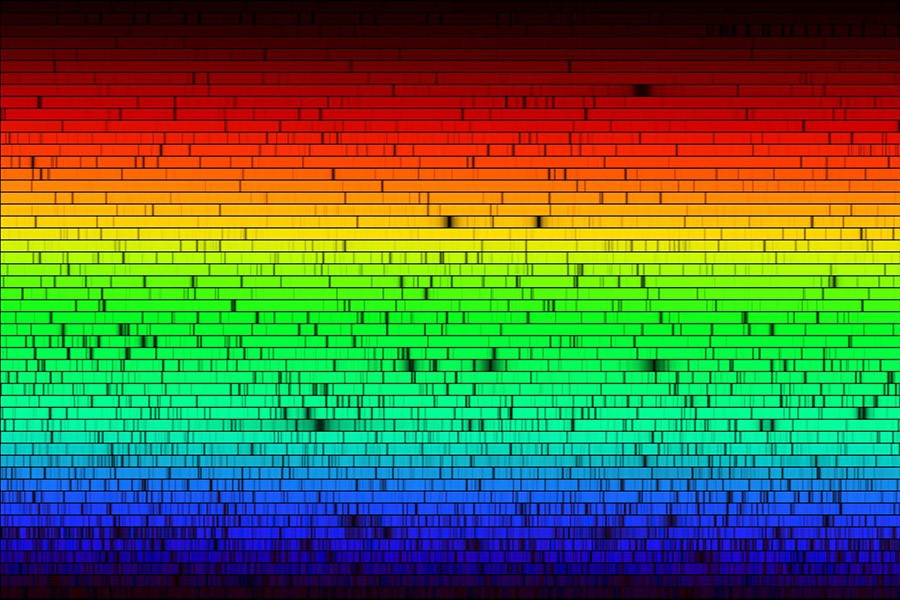
In the image above, the spectrum starts with red light at the top, with a wavelength of 700 nanometers (7,000 angstroms) and ends at the bottom with blue and violet colors with a wavelength of 400 nm (4,000 angstroms). The dark lines throughout the spectrum are caused by absorption of light by various elements in the Sun’s atmosphere. This dark-line absorption spectrum is sort of like a fingerprint of the Sun and it provides huge amounts of information about the chemical composition of the Sun and even about the temperature of different regions of the solar atmosphere [1].
When looked at it, doesn’t it resemble a barcode?
Unified Science in Perspective:
It is curious that the Sun emission spectra can be considered a black body radiation spectra, as the figure below shows:
“It should be noted that a black hole is a perfect black body, as is the sun. This fact is important in the context of Unified Physics Theory”. -Nassim Haramein
Nassim Haramein remarks that the Sun and a black hole, are both black body radiators, and that alone hints into the hidden nature of stars.
We have been following the topic very closely in our ISF science blog. The article Evidence of Black Holes Forming Stars is Mounting, explains very important studies have shed light on the now irrevocable fact that black holes in the center of galaxies are playing a predominant role in the galaxy formation, event that would explain why astronomers and astrophysicists have found a black hole in the center of galaxies.
In a former ISF article entitled Supermassive Black Holes Birthing Stars at Furious Rate we had addressed the case in which astronomers have observed supermassive black holes creating star-forming regions. Since 2017 a team of astrophysicists have been observing supermassive black holes, and the possibility that these entities could be birthing stars, finding evidence of new star birth from material being ejected from the black hole, called an outflow. An outflow of gas could be responsible for creating new stars by swirling around the center of the black hole, in something called an accretion disc. The possibility that the star formation happens in the accretion disk of the black hole was supported by observations.
Using the Hubble Space Telescope to observe and carry out spectroscopy on a dwarf galaxy Hen 2-10 (which is about 34 million light years away from Earth, in the constellation Pyxis), Schutte and his team conclude that the black-hole outflow in the center of the galaxy triggered the star formation of the galaxy, and their findings were published in Nature [1].
Stephen Adler, at Princeton University in New Jersey, has developed a new theory based on an interaction between black holes and the dark energy which provides a mechanism that could explain how a central black hole can catalyze star formation. This interaction with dark energy would cause black holes to leak matter creating a wind of particles that stream away.
“When this wind collides with infalling matter, the momentum cancels out leaving the products of the collision a certain distance from the black hole. It is this matter that then forms into stars.” The Physics arXiv Blog [2].
If black holes do emit a “wind” in the way that Adler proposes, astronomers could see evidence of it, using the James Webb Space Telescope. And just some days ago, a new study with observational data is supporting this view. The study finds that in fact, black hole growth and star formation are happening concurrently in the same galaxies and they do seem to be influencing each other. They also calculate the ratio that describes how the two phenomena are linked, and this is very important in the context of Unified physics because it proves that the connection between stars and black holes go es even deeper.
How deep can the relation go? Haramein’s coming paper, Scale Invariant Unification of Forces, Fields and Particles, in a Quantum Vacuum Plasma [3], is addressing this as well! As Haramein has affirmed for more than 25 years, stars are black holes with a thick ergosphere, which is why the spectra of a black body (a black hole) and a star, are so similar. The notion of Resonance is so important, elemental and Foundational, that our foundation establishes it as a Basic Principle. Resonance guides all our studies: the Generalized Holographic Principle, the Holofractographic Scaling Model, the Science of Consciousness, and much more … stay tuned!
References
[1] Schutte, Z., Reines, A.E. Black-hole-triggered star formation in the dwarf galaxy Henize 2-10. Nature 601, 329–333 (2022). https://doi.org/10.1038/s41586-021-04215-6
[2] Adler S., Mechanism By Which a “Leaky” Black Hole can Catalyze Galaxy Formation : arxiv.org/abs/2112.12491
[3] Haramein N, and Alirol O., Scale Invariant Unification of Forces, Fields and Particles, in a Quantum Vacuum Plasma, DOI 10.5281/zenodo.4050616.