

Have you ever wondered what’s really going on inside the materials around us? From the stainless steel on your refrigerator to the quartz in your kitchen countertop, many everyday materials harbor fascinating physics at the atomic level. These materials are crystals – highly ordered patterns of atoms arranged in repeating structures called atomic lattices. How electrons move through these lattices, hopping from atom to atom, determines many of a material’s properties, including its color, transparency, and ability to conduct heat and electricity.
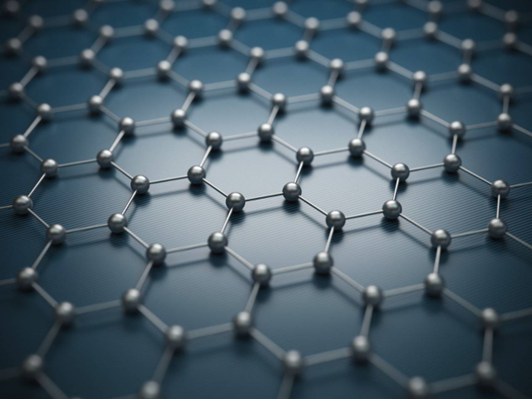
But some crystals exhibit even more exotic behaviors. Take graphene, for example – a single layer of carbon atoms arranged in a honeycomb pattern. The way electrons move in graphene produces extreme quantum effects, like particles tunneling through energy barriers that should block them according to classical physics. Graphene also shows a bizarre phenomenon called the quantum Hall effect, where its electrical conductivity increases in discrete steps related to fundamental constants of the universe.
The unique properties of graphene extend far beyond these quantum phenomena. Its two-dimensional structure gives rise to a host of remarkable characteristics that have captivated scientists and engineers alike. For instance, graphene is incredibly strong – about 200 times stronger than steel by weight. This extraordinary strength stems from the tight covalent bonds between its carbon atoms and its planar structure, which distributes forces effectively across its surface [1].
Graphene also boasts exceptional electrical and thermal properties, while remaining flexible and transparent [2], making it a promising material for next-generation electronics and thermal management systems [3].
Moreover, graphene exhibits unique optical properties. Despite being only one atom thick, it absorbs a significant amount of light – about 2.3% across the visible spectrum. This seemingly small percentage is remarkable for a material of its thickness. Graphene’s optical absorption can be tuned by applying an electric field, opening up possibilities for optoelectronic devices.
The flexibility and stretchability of graphene add another dimension to its potential applications. It can be stretched by up to 20% of its initial length without breaking, making it suitable for flexible electronics and wearable devices. Additionally, graphene is impermeable to most gases and liquids, despite its single-atom thickness, which could lead to applications in water purification and gas separation technologies.
These extraordinary properties of graphene have sparked a global research effort to harness its potential in various fields, from electronics and energy storage to biomedical applications and aerospace engineering. As scientists continue to explore and manipulate this wonder material, we may be on the cusp of a new technological revolution driven by the unique physics of this two-dimensional crystal [3].
While these properties make graphene incredibly interesting and potentially useful for applications ranging from better electronics to improved biomedical devices, it’s challenging for scientists to observe and understand exactly what’s happening at the atomic level. Electrons simply move too fast for us to capture the details.
Ingenious Solution: Making Matter Out of Light
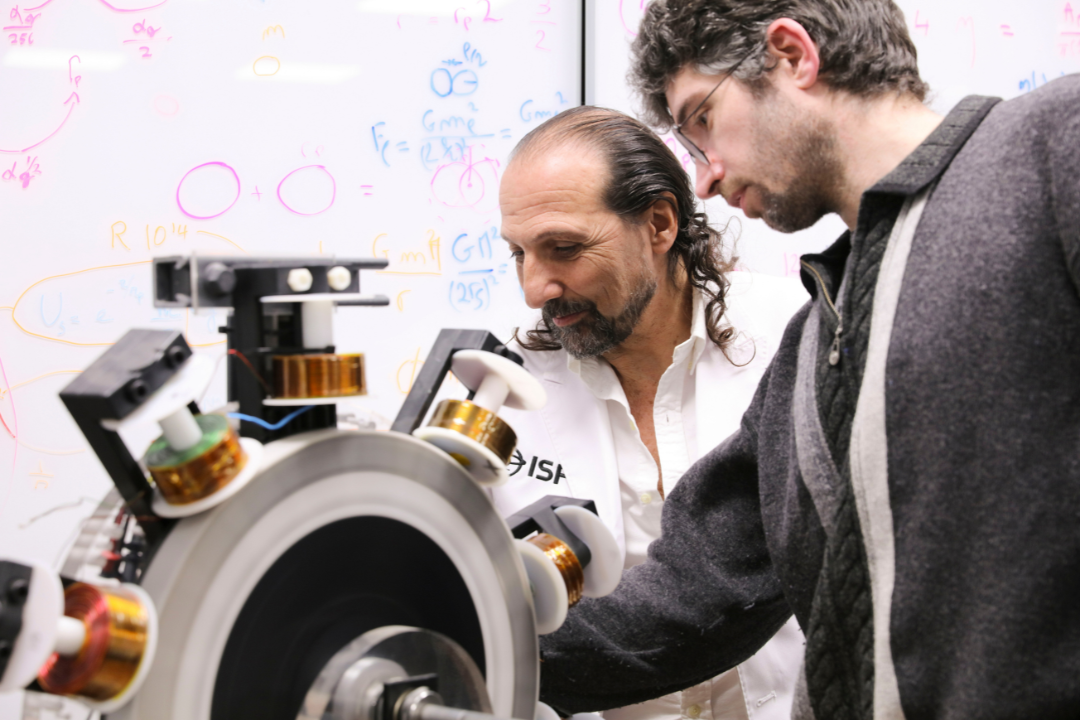
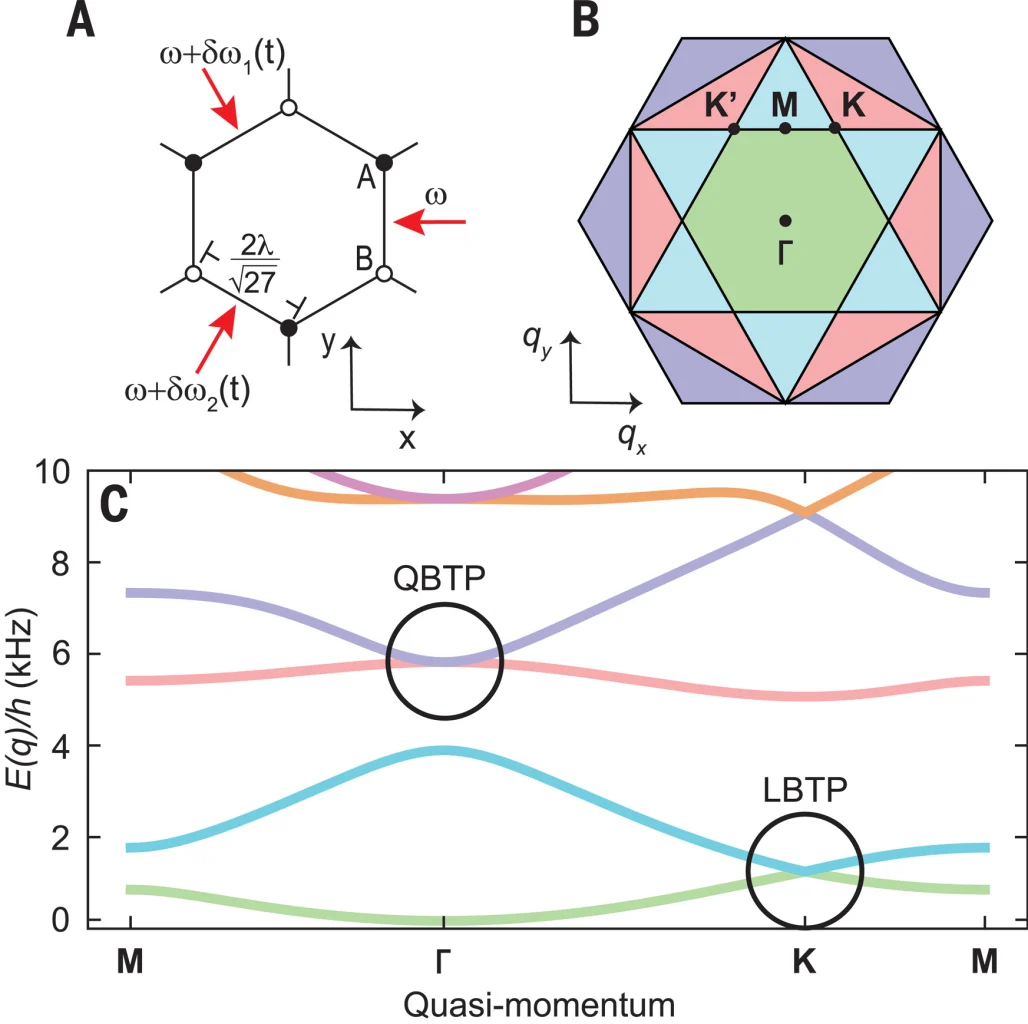
A team of physicists, led by Dr. Charles D. Brown II, has found a clever workaround to this limitation. Instead of studying actual graphene, they create an artificial version using light waves to form an “optical lattice” – a pattern of bright and dim spots that mimics the structure of graphene’s atomic lattice [4].
“In place of the atomic lattice, we use light waves to create what we call an optical lattice,” explains Dr. Brown. “Our optical lattice has the exact same geometry as the atomic lattice.”
In this system, ultra-cold rubidium atoms take the place of electrons, hopping around the lattice of light just as electrons would hop between carbon atoms in real graphene. By using atoms a million times colder than outer space and spacing the lattice points hundreds of nanometers apart (compared to fractions of a nanometer in real crystals), the researchers effectively create a magnified, slowed-down version of graphene that they can actually observe and measure directly.
While not a perfect replica, this “artificial crystal” allows scientists to study phenomena that would be impossible to see in solid-state materials. Dr. Brown’s team used this setup to investigate special features in graphene’s energy structure called Dirac points – locations where electrons can easily jump between energy levels, leading to graphene’s unusual properties.
The experiment revealed that Dirac points are true quantum singularities – places where the laws of physics become uncertain. As the team moved their artificial electrons (the cold atoms) through these points, they observed bizarre behaviors that can only be explained by quantum mechanics. For instance, the quantum state of the system would flip completely or enter a “superposition” – simultaneously excited and not excited – depending on how it approached the Dirac point.
What is a Dirac Point?
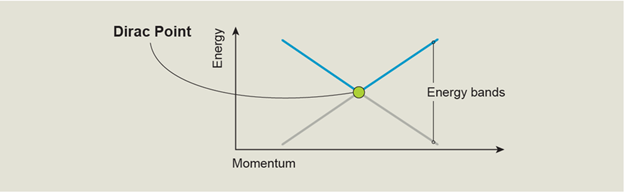
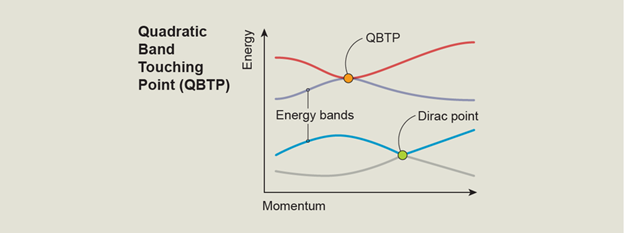
Dirac points, named after the physicist Paul Dirac, are special features in the electronic structure of certain materials, most famously observed in graphene. These points occur where the conduction and valence bands of a material’s electronic structure meet in a single point in momentum space, as seen in the image below. At these points, the energy-momentum relationship of electrons becomes linear, resembling that of massless relativistic particles described by the Dirac equation.
The unique properties of Dirac points extend beyond the observations in this experiment. In materials hosting Dirac points, electrons behave as if they have no mass, moving at extremely high velocities – up to about 1/300th the speed of light. This leads to extraordinary electrical conductivity and other unusual quantum phenomena.
One of the most intriguing aspects of Dirac points is their topological nature [5]. They are protected by symmetries in the crystal structure, making them robust against perturbations. This topological protection is of great interest in the field of quantum computing, as it could potentially be used to create stable qubits resistant to decoherence.
Furthermore, Dirac points are closely related to the emergence of exotic quantum states of matter. For example, when certain symmetries are broken, Dirac points can split into Weyl points, leading to the formation of Weyl semimetals. These materials exhibit even more unusual properties, including unique surface states called Fermi arcs.
The study of Dirac points has also led to the discovery of higher-order topological insulators, where Dirac-like physics occurs not just at points, but along lines or on surfaces within the material’s electronic structure. This expanding field of topological materials, rooted in the physics of Dirac points, promises new avenues for technological applications in electronics, spintronics, and quantum information processing.
Recent research has even explored the creation of artificial Dirac points in engineered quantum systems, such as photonic crystals and cold atom lattices [5]. These synthetic quantum materials allow for precise control and manipulation of Dirac physics, opening up new possibilities for studying fundamental quantum phenomena and developing novel quantum technologies.
“Quantum physics is a trip!” remarks Dr. Brown [6].
Another Singularity: The Quadratic Band Touching Point
The team’s most exciting discovery came when they used their technique to study another type of singularity called a quadratic band touching point (QBTP). These points, which are difficult to investigate in real materials, showed even stranger behavior. The researchers found that moving their system around a QBTP caused its quantum state to “wrap” twice before returning to its starting point – a unique topological property that could be related to exotic forms of superconductivity and other unusual phenomena in real materials.
QBTPs represent a fascinating class of band structure features distinct from the more widely studied Dirac points. While Dirac points exhibit a linear dispersion relation, QBTPs are characterized by a quadratic energy-momentum relationship. This seemingly subtle difference leads to profound consequences in the material’s electronic properties and quantum behavior.
One of the most intriguing aspects of QBTPs is their potential to host novel phases of matter [7]. Under certain conditions, materials with QBTPs can spontaneously develop exotic quantum states, such as nematic phases where electronic properties become directionally dependent, or time-reversal symmetry-breaking states that could lead to unusual magnetic properties. These states arise from the interplay between electron-electron interactions and the unique band structure near QBTPs.
The “double wrapping” behavior observed around QBTPs is a manifestation of their non-trivial topology. This property is quantified by a topological invariant called the Chern number, which in this case is 2, contrasting with the Chern number of 1 typically associated with Dirac points. The higher Chern number suggests the possibility of more robust and varied topological states, potentially leading to enhanced quantum Hall effects or novel types of topological superconductivity.
Real-world materials hosting QBTPs include certain pyrochlore iridates, HgTe quantum wells, and bilayer graphene under applied electric fields. These systems have attracted significant attention due to their potential for realizing exotic quantum phases. For instance, in bilayer graphene, the application of an electric field can induce a transition from a QBTP to a gapped state, effectively allowing electrical control over the material’s topological properties.
The study of QBTPs also intersects with the broader field of multiferroics – materials that exhibit multiple ferroic orders simultaneously. Some theoretical models suggest that the unique electronic structure near QBTPs could facilitate the coupling between different order parameters, potentially leading to materials with enhanced responses to external fields or novel functionalities for spintronics and quantum computing.
Moreover, the exploration of QBTPs has implications for our understanding of fundamental physics. The behavior of electrons near these points can be described by effective theories that bear similarities to certain models in high-energy physics, providing a unique platform to study exotic particle-like excitations and test fundamental symmetries of nature.
These findings, while seemingly abstract, have direct connections to the tangible properties that make materials like graphene so promising for future technologies. By providing a way to directly observe and measure quantum behaviors that are normally hidden from view, this “matter made of light” approach opens up new possibilities for understanding and potentially harnessing the exotic physics lurking inside the materials all around us.
The ability to engineer and control QBTPs in synthetic quantum systems, as demonstrated in this experiment, represents a significant advance in the field of quantum simulation. It allows researchers to probe regimes of physics that are challenging or impossible to access in naturally occurring materials. This approach could accelerate the discovery of new quantum phases and help bridge the gap between theoretical predictions and experimental realizations of exotic quantum matter.
Looking forward, the study of QBTPs and related quantum singularities could pave the way for a new generation of quantum devices. These might include topological quantum computers that are inherently protected against decoherence, novel sensors that exploit the unique responses of electrons near QBTPs, or advanced electronic and spintronic devices that harness the exotic properties of these quantum states. As our ability to manipulate and control these quantum features improves, we may be on the cusp of a new technological revolution driven by the principles of quantum topology and condensed matter physics.
References:
[1] Geim, A. K., & Novoselov, K. S. (2007). The rise of graphene. Nature Materials, 6(3), 183-191.
[2] Castro Neto, A. H., Guinea, F., Peres, N. M., Novoselov, K. S., & Geim, A. K. (2009). The electronic properties of graphene. Reviews of Modern Physics, 81(1), 109-162.
[3] Akanksha R. Urade, Indranil Lahiri, and K. S. Suresh, Graphene Properties, Synthesis and Applications: A Review, JOM (1989). 2023; 75(3): 614–630. doi: 10.1007/s11837-022-05505-8
[4] Brown C., et al. Direct geometric probe of singularities in band structure, Science, 377, 1319 (2022). DOI: 10.1126/science.abm644
[5] Castro Neto, A. H., Guinea, F., Peres, N. M., Novoselov, K. S., & Geim, A. K. (2009). The electronic properties of graphene. Reviews of Modern Physics, 81(1), 109-162. (This paper covers both graphene properties and Dirac points)
[6] Physicists Make Matter out of Light to Find Quantum Singularities, Scientific American 2023.
[7] Sun, K., Yao, H., Fradkin, E., & Kivelson, S. A. (2009). Topological insulators and nematic phases from spontaneous symmetry breaking in 2D Fermi systems with a quadratic band crossing. Physical Review Letters, 103(4), 046811.