

Einstein used thought experiments (Gedankenexperimente) to develop some of the central ideas of relativity. We can follow his example by asking a question in the spirit of his search for unification, a search that led him in 1935 to wonder whether particles themselves could be built from the geometry of spacetime. What happens to a quantum bound state when the curvature of spacetime becomes appreciable on the scale of the state itself? And could curvature itself be part of what holds such a state together?
Theoretical physicist Panos Betzios of Ghent University explores the first question in a simplified version of quantum chromodynamics (QCD), the theory of the strong interaction. In this model, a meson is represented by a quark and an antiquark bound by a narrow tube of color field. Now imagine that the space between them expands until even a light signal sent from one can never reach the other. Can the field still bind the pair into a single meson?
Betzios’s calculation gives a surprising answer. In the limit he studies, the tube of color field can stretch across the cosmological horizon and remain intact. Yet the meson itself has only a finite lifetime. Spacetime expansion can thus pull a bound state apart even when the field connecting its constituents cannot break. 1
In the Standard Model, quarks also form protons and neutrons, which together account for most of the mass of ordinary matter. In the conventional account, almost all of that mass comes not from the quarks’ own masses but from the energy of their motion and of the gluon fields that bind them. Lattice quantum chromodynamics, which calculates the strong interaction on a spacetime grid, already reproduces the measured masses of these particles in flat spacetime. General relativity says that the same energy also curves spacetime. A unified theory must describe both directions of influence. It must recover the measured hadron masses where curvature is negligible and the familiar gravitational field of matter at large distances. 2 The ISF model discussed below proposes a single source for both: curvature induced by fluctuations of the electromagnetic quantum vacuum. 5
One pair of quarks in two different universes
Betzios starts with a meson, a hadron made of a quark and an antiquark. He uses a model introduced by Gerard ’t Hooft in 1974, in which quarks move along just one spatial dimension and the number of quark colors is taken to infinity. Real quarks carry one of three colors. The simplification lets Betzios derive an exact equation for the pair on two prescribed spacetimes. The quarks respond to the geometry, while their energy cannot reshape it in this calculation. Nearly two decades after introducing that model, ’t Hooft proposed the holographic principle: the idea that the physics inside a region of space can be encoded on its boundary. The same principle underpins Haramein’s generalized holographic model. 9
The starting point in flat space is easy to picture. Separating the quark and antiquark stretches a tube of color field. Each extra unit of length costs the same amount of energy, much like pulling against a constant tension. Betzios keeps that color interaction and changes the geometry the quarks move through. In the coordinates he uses, curvature adds a term to the equation for the quarks’ motion. Its sign reverses between the two universes. 1
A spectrum in one universe and a lifetime in the other
A small patch of the Earth appears flat, even though the planet is curved. A similar principle helps explain Betzios’s first result. In the model universe called anti-de Sitter space, a tightly bound meson can be so small that the surrounding spacetime’s curvature has little effect on its internal behavior. Like a musical instrument with a particular set of notes, this quantum system has a particular set of allowed energies—its “spectrum.” When the meson is excited to higher energies, the tube of color field connecting its two constituents extends farther. Eventually, the system spans enough of the curved spacetime for the geometry to change the spacing between its allowed energies. In the musical analogy, spacetime curvature changes the instrument’s tuning. Betzios’s calculation describes how that tuning changes as the system grows.
In the expanding de Sitter universe, the kind of universe ours is gradually becoming as its expansion accelerates, separating the quarks initially costs energy, but the energy reaches a maximum. The pair can tunnel through that barrier and the expansion can then carry its ends beyond each other’s horizon. This is how the meson in our opening example acquires a finite lifetime even though ordinary string breaking by creation of another quark pair is suppressed in the infinite-color limit. Picture a ball sitting in a valley with a hill on either side. At first, pulling the pair apart costs energy, like pushing the ball uphill. In quantum mechanics, the pair has a chance of reaching the far side of that energy hill even when it has too little energy to climb over it. This is what physicists call tunneling. Once the pair reaches the far side, expansion can carry its two ends so far apart that even a light signal sent from one can never reach the other. That boundary is the cosmological horizon.
Like the horizon of a black hole, the horizon of an expanding universe has a temperature, as Gary Gibbons and Stephen Hawking showed in 1977. 10 For a deeply bound state, the rate carries a thermal factor set by that temperature. As curvature weakens, escape becomes exponentially unlikely. The same temperature reshapes the vacuum itself. In Betzios’s solution, the quark condensate, an ordering of the vacuum that in the conventional account helps generate hadron masses, shrinks as the expansion rate grows and vanishes when the horizon temperature reaches a critical value. Whether this lifetime has a counterpart in three spatial dimensions remains open. 1
The geometry inside a proton
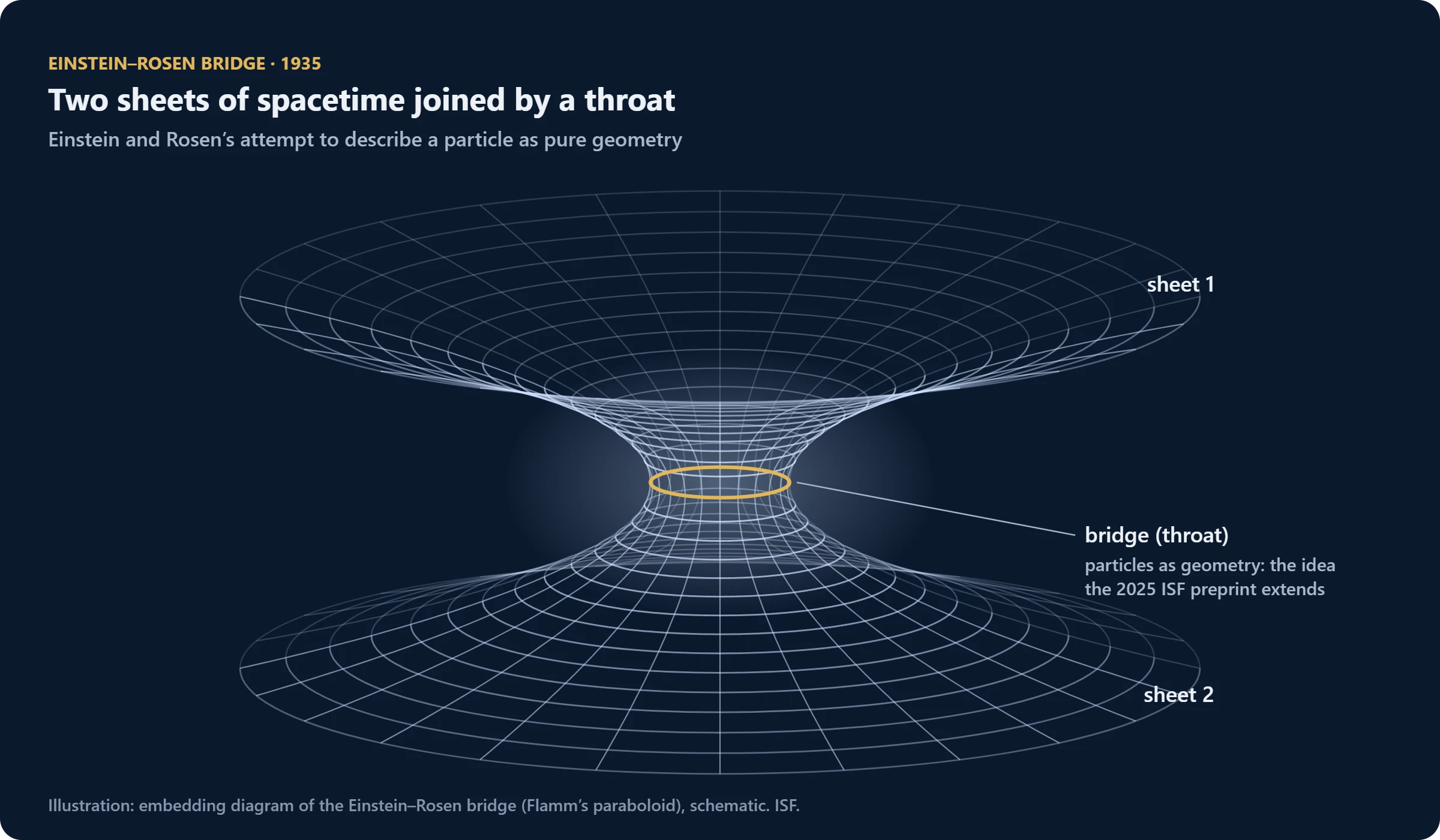
In 1935, Albert Einstein and Nathan Rosen asked whether a particle could be represented by a regular configuration of gravitational and electromagnetic fields. Their construction joined two sheets of spacetime with a bridge. Its simplest charged solution had zero mass, leaving an obvious question for anyone hoping to describe a proton. What physical ingredient could set the mass of a charged particle? 4
In their 2025 preprint, ISF researchers Nassim Haramein, Olivier Alirol and Cyprien Guermonprez propose that the electromagnetic quantum vacuum supplies that ingredient. Their title states the ambition: a single mechanism, curvature induced by vacuum fluctuations, as the source of mass, gravity and nuclear confinement, three phenomena that the Standard Model and general relativity treat separately. They model the proton as a resonant cavity and evaluate correlations of its fluctuating electric field over the time light takes to travel one proton charge radius, about 3 × 10⁻²⁴ seconds. They then put the energy and stresses of the vacuum field into Einstein’s equations as a source of curvature. In their model, screening at successive surfaces permits strong curvature in the interior to coexist with the weak gravitational field seen from outside. 5
The authors associate an inner surface at the proton’s reduced Compton wavelength (about 0.21 femtometres from the centre) with the horizon of a rotating, charged (Kerr–Newman) spacetime. One femtometre is 10⁻¹⁵ metres. By comparison, the Schwarzschild radius corresponding to the proton’s measured mass is only about 2.5 × 10⁻⁵⁴ metres. A horizon at the proposed scale depends on the much larger interior vacuum source in the ISF model. 5,6 The authors calculate that the Hawking radiation of this horizon is equivalent to the proton’s rest energy, with an evaporation time that far exceeds the age of the universe, and propose that vacuum fluctuations inside the proton act as a stabilising source that balances it. In this picture, the proton is a stable, black-hole-like structure in equilibrium with the vacuum. 5
What the proton numbers can tell us
The ISF model gives a simple relation between two independently measurable properties. The charge radius should equal four times the proton’s reduced Compton wavelength, a length fixed by its mass. The inner horizon described above therefore sits at exactly one quarter of the charge radius. Using the measured mass gives a radius of 0.84124 femtometres. In 2026, Lothar Maisenbacher and colleagues inferred 0.8406 ± 0.0015 femtometres from laser spectroscopy of hydrogen. The predicted radius falls within that uncertainty. Spectroscopy measures how the proton’s spread of charge shifts atomic energy levels. It leaves open which mechanism produced that distribution. 5,7
The relation predates this preprint. Haramein first published it in 2013, in a holographic calculation that compared the number of Planck-scale units tiling the proton’s surface with the number filling its volume. There it appears as four Planck lengths multiplied by the ratio of the Planck mass to the proton mass, an expression identical to four reduced Compton wavelengths. 11 At the time, the internationally recommended radius was 0.8775 femtometres, while measurements with muonic hydrogen pointed to a smaller proton, a discrepancy that became known as the proton radius puzzle. The recommended value has since moved to 0.84075 ± 0.00064 femtometres. 12,6 The most precise single determination, from muonic hydrogen, gives 0.84060 ± 0.00039 femtometres, about 1.6 standard deviations below the relation. Because the relation has no adjustable parameters, each gain in precision sharpens the test, and new electron- and muon-scattering experiments (PRad-II and MUSE) are expected to add independent checks. 13,14
The comparison with Betzios turns on what each author takes as given. In his model, the color interaction already confines quarks in flat space. Curvature changes which mesons can survive and what energies they can have. Haramein and colleagues give geometry a different role. They propose that vacuum-induced distortions of the metric produce the binding force itself. Geometric descriptions of confinement are not foreign to mainstream theory. In gauge/gravity duality, a confining gauge theory is described by a curved geometry with an extra dimension, and the hot phase in which quarks are freed corresponds to a black-hole horizon in that geometry. There the geometry belongs to a dual mathematical description; in the ISF model it is the proton’s own spacetime. 16
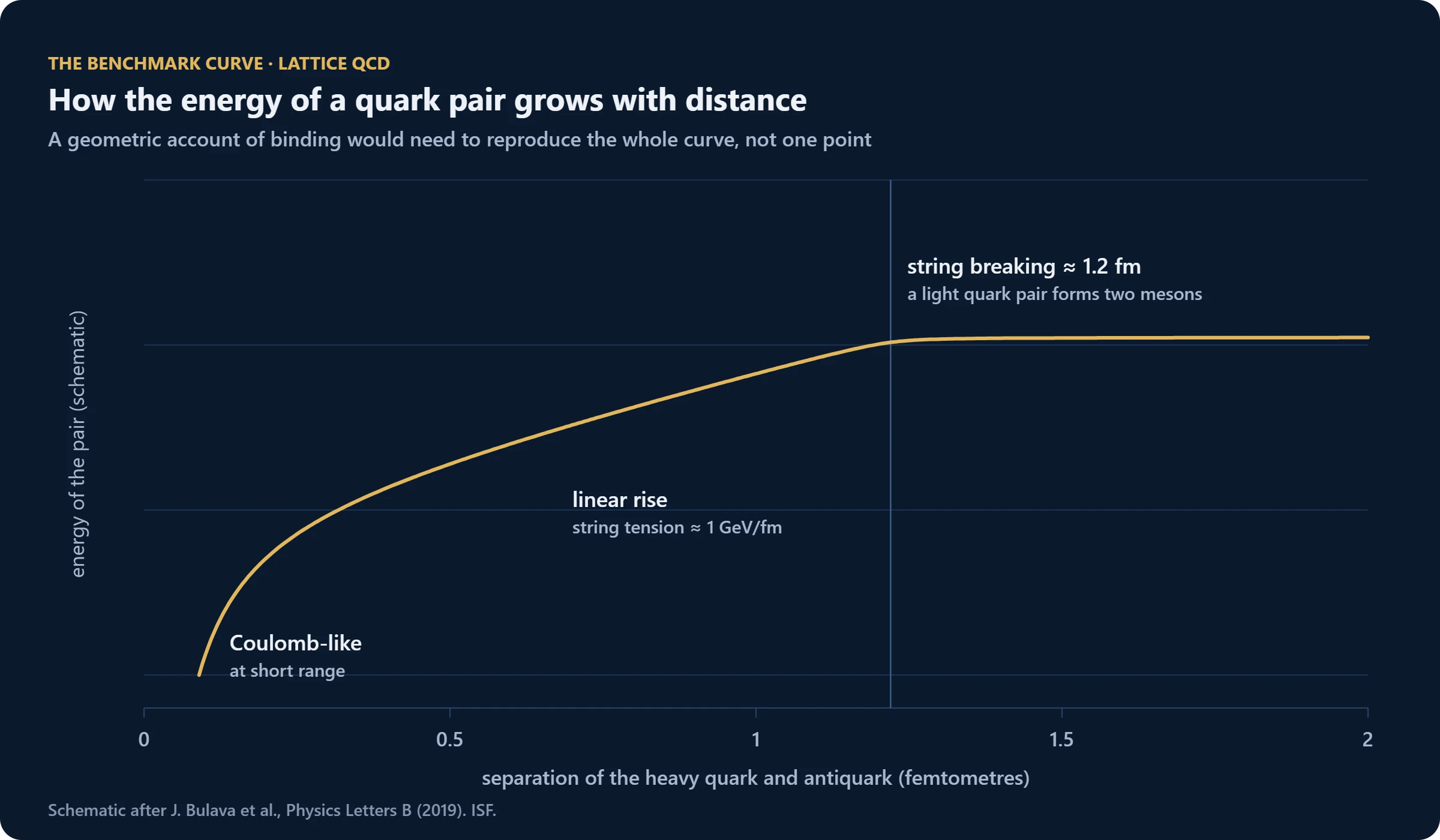
Around the charge radius, the ISF effective field equation gives a Yukawa-like radial profile, in which the field dies away exponentially with distance. Hideki Yukawa introduced that form in 1935, the year of the Einstein–Rosen paper, to describe the force between protons and neutrons. 15 On this basis, the authors argue that one geometric mechanism links the confinement of quarks, the residual nuclear force and gravity. Evaluated at the charge radius, their model gives a force of about 160,000 newtons, close to the characteristic tension of a QCD flux tube of about one gigaelectronvolt per femtometre, roughly the weight of a 16-tonne truck. So far, the comparison is between force magnitudes at a single scale. 1,5
There is a way to push that comparison further. Hold a heavy quark and antiquark a fixed distance apart and calculate the energy. Then repeat at other separations. Lattice QCD gives a whole curve, including the region in which it becomes energetically favourable for light quarks to screen the heavy sources and form two mesons. Deriving that same curve from a vacuum-sourced metric would test whether the agreement in force extends over distance. Betzios offers a second benchmark. In his simpler universe, weak curvature shifts the meson levels by different, calculable amounts. A geometric account that could reproduce those shifts under the same assumptions would connect the proposed origin of binding to the fate of individual bound states. 1,8
ISF Perspective
For more than a decade, Nassim Haramein’s unified physics has pursued a single proposition: that mass, gravity and the forces that bind matter are expressions of the geometry of the quantum vacuum. The two papers discussed here approach the strong force from opposite directions. Read together, they make a case for taking geometry seriously in hadron physics.
Betzios holds the strong interaction fixed and changes only the geometry around it. Curvature alone, with no change to the force law, reorganises the meson spectrum, reduces the vacuum condensate and, through the temperature of a horizon, sets how long a meson can survive. Geometry is not a passive stage for the strong force. It helps decide which bound states can exist.
The ISF preprint turns the question around and asks whether geometry, sourced by the electromagnetic vacuum, supplies the binding itself. It continues a line of work that began with Haramein’s 2013 holographic mass solution, in which the proton’s rest mass emerged from the ratio of Planck-scale units on its surface to those within its volume, giving a charge radius of 0.8412 femtometres when the recommended value was still 0.8775. The 2025 preprint reaches the same relation by a different route, through vacuum field correlations in a resonant cavity. It also adds a mechanism for why an enormous interior vacuum source appears from outside as the familiar 938 megaelectronvolts: screening at nested surfaces, with a Kerr–Newman horizon at the reduced Compton wavelength and the charge radius at four times that length. 5,11
In this picture, horizons are a recurring architecture of the vacuum rather than rare astrophysical curiosities. In Betzios’s calculation, the temperature of a cosmological horizon sets the lifetime of a meson. In the ISF model, a horizon inside the proton, whose Hawking radiation matches the proton’s rest energy and is balanced by vacuum fluctuations, sets its mass. Haramein’s scaling law places organised matter, from protons to stellar black holes, galactic nuclei and the universe as a whole, along a single relation, and these two papers probe opposite ends of that range.
The preprint presents its model as a completion of Einstein and Rosen’s 1935 programme, read alongside Wheeler’s quantum foam and the ER = EPR conjecture, which links wormhole geometry to quantum entanglement. In Haramein’s broader framework, Planck-scale bridges of this kind connect protons to one another in what ISF calls the spacememory network. 17,18
The proposal makes commitments that can be checked. The radius relation has no adjustable parameters, so every new measurement of the proton’s size is a sharper test. Deriving the full lattice-QCD energy curve from a vacuum-sourced metric, string breaking included, and reproducing Betzios’s calculable curvature shifts would show whether agreement in force at one scale extends to the full structure of the strong interaction. Those are natural next steps for the programme.
Primary sources
- P. Betzios, The ’t Hooft model on (A)dS₂. arXiv, 2026, v2. §§5.4 and 9.4–9.6.
- S. Dürr et al., Ab Initio Determination of Light Hadron Masses. Science, 2008.
- G. ’t Hooft, A Two-Dimensional Model for Mesons. Nuclear Physics B, 1974.
- A. Einstein and N. Rosen, The Particle Problem in the General Theory of Relativity. Physical Review, 1935.
- N. Haramein, O. Alirol and C. Guermonprez, Extending Einstein-Rosen’s Geometric Vision: Vacuum Fluctuations-Induced Curvature as the Source of Mass, Gravity and Nuclear Confinement. Preprints.org, 2025, v2. §§4–5 and 8.
- P. J. Mohr et al., CODATA recommended values of the fundamental physical constants: 2022. Reviews of Modern Physics, 2025.
- L. Maisenbacher et al., Sub-part-per-trillion test of the Standard Model with atomic hydrogen. Nature, 2026.
- J. Bulava et al., String breaking by light and strange quarks in QCD. Physics Letters B, 2019.
- G. ’t Hooft, Dimensional Reduction in Quantum Gravity. arXiv, 1993.
- G. W. Gibbons and S. W. Hawking, Cosmological Event Horizons, Thermodynamics, and Particle Creation. Physical Review D, 1977.
- N. Haramein, Quantum Gravity and the Holographic Mass. Physical Review & Research International, 2012.
- P. J. Mohr, B. N. Taylor and D. B. Newell, CODATA recommended values of the fundamental physical constants: 2010. Reviews of Modern Physics, 2012.
- K. Pachucki et al., Comprehensive theory of the Lamb shift in light muonic atoms. Reviews of Modern Physics, 2024.
- G. A. Miller, The Proton Radius Puzzle. arXiv, 2026.
- H. Yukawa, On the Interaction of Elementary Particles. I. Proceedings of the Physico-Mathematical Society of Japan, 1935.
- E. Witten, Anti-de Sitter Space, Thermal Phase Transition, and Confinement in Gauge Theories. Advances in Theoretical and Mathematical Physics, 1998.
- J. Maldacena and L. Susskind, Cool Horizons for Entangled Black Holes. Fortschritte der Physik, 2013.
- N. Haramein, W. D. Brown and A. Val Baker, The Unified Spacememory Network: from Cosmogenesis to Consciousness. NeuroQuantology, 2016.