

New studies reveal the moving geometry of neural activity, opening specific questions about its relationship to ISF’s proposed spacememory framework.
Remember a familiar place. A doorway, a voice, the position of sunlight across a room: elements separated in the original experience can return together in recollection. Understanding this process requires explaining how activity across many neural populations becomes organized into a meaningful event.
Three studies bring the geometry of that organization into focus. They examine how brain activity travels, changes direction, and forms rotating patterns. For research exploring a relationship between biological memory and spacetime, these findings offer a particularly interesting point of contact: the measurable patterns through which a recalled experience might become expressed across the brain.
Memory in motion
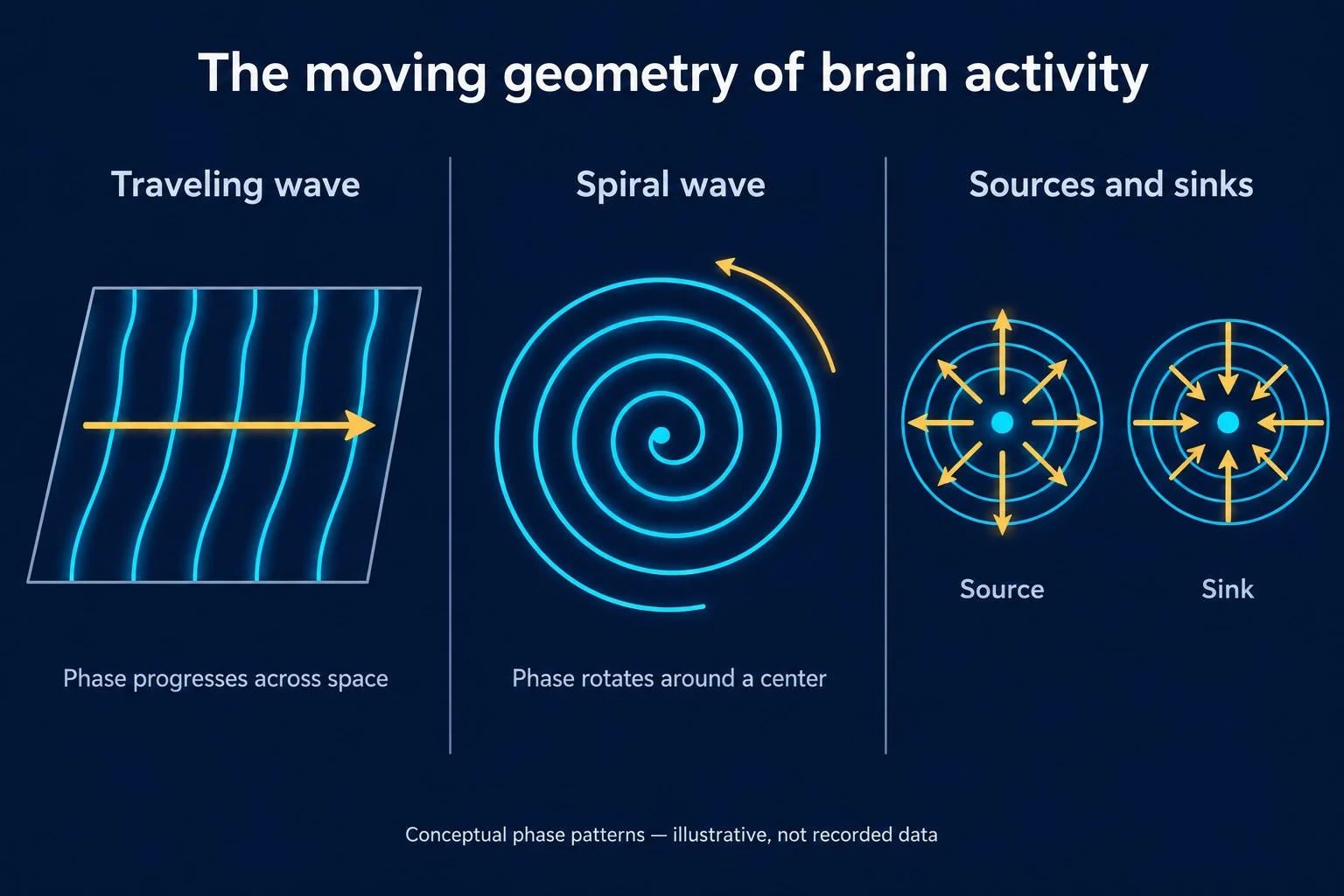
A traveling brain wave involves a progression of neural activity across locations. Much as a stadium wave moves through spectators who remain in their seats, a collective neural pattern can propagate across populations of cells. Its frequency describes the rhythm’s rate, while its phase describes the position within each cycle. Spatial relationships among those phases give the wave its direction and shape.
In a 2024 Nature Human Behaviour study, Uma Mohan and colleagues examined direct brain recordings from 93 people undergoing epilepsy monitoring. During successful memory encoding, theta and alpha waves tended to travel from posterior toward anterior regions. During recall, the preferred direction tended to reverse. These patterns varied across recordings, but the overall relationship suggested that wave direction carries information about the operation a neural network is performing. Whether changing that direction would alter memory remains an experimental question. Mohan et al., 2024
An April 2026 Nature Communications study by Anup Das and colleagues expanded the investigation beyond direction. Recordings from 24 patients performing spatial and verbal memory tasks revealed planar waves, rotating spirals, outward-spreading sources, inward-converging sinks, and more complex configurations. Their direction and strength changed with task stage. Wave features also distinguished some letters during presentation, allowing classifiers to extract information about stimulus identity. Separating the perceptual and mnemonic contributions to those letter-specific patterns remains important. Das et al., 2026
A third study, published in Science in June 2026, examined the anatomical foundations of rotating waves. Zhiwen Ye and colleagues combined imaging and electrical recordings in awake mice. They found waves sweeping across somatosensory maps, with a circular organization that matched features of local axonal architecture. Related rotations appeared across hemispheres and sensory–motor regions, coordinated with activity in deeper structures.
Small bilateral cuts in somatosensory circuitry reduced rotating-wave occurrence in motor cortex. This intervention supports a causal role for the circuitry in sustaining the waves. Separate behavioral observations linked changes in wave organization to correct visual–motor performance. Establishing whether selectively manipulating those waves changes behavior requires further work. Ye et al., 2026
The Barcelona proposal
These results make spatially organized neural dynamics a concrete subject for investigating memory. They also provide a way to sharpen a proposal developed within ISF: that molecular configurations inside neurons could participate in accessing information associated with earlier spacetime events.
The broader background is the Unified Spacememory Network, proposed by Nassim Haramein, William Brown, and Amira Val Baker in 2016. That framework treats spacetime as possessing a persistent information structure and proposes that organized biological systems can interact with it. Its application to memory depends on identifying how an experience could leave an accessible record and how a biological system could subsequently select that record. Haramein, Brown, and Val Baker, 2016
In my presentation at the 2025 Science of Consciousness Conference in Barcelona, I illustrated a possible biological pathway using changes in tubulin configurations within microtubules. The schematic follows an assembly through a sequence labeled A–B–A.
At an initial spacetime coordinate, α, configuration A accompanies an experience and, within the proposed model, contributes to an imprint in spacetime. As the biological system continues along its worldline, its molecular configuration changes to B. At a later coordinate, β, an incoming signal restores configuration A. The hypothesis assigns that restoration a specific role: it re-establishes access to information associated with the earlier coordinate.
The return to A therefore represents a proposed selection mechanism. The molecular configuration would determine which previously established information relationship becomes accessible. This resonant-access interpretation also appears in ISF’s earlier discussion of the memory field. The Memory Field
The diagram then follows the proposed process into neuronal physiology. Information accessed through the hypothesized quantum-geometric connection would influence photon signaling within the molecular assembly. That signaling would affect electrical activity in dendrites and axons, helping reinstate a distributed electromagnetic pattern associated with the recalled experience.
This final step is where the new brain-wave studies become especially relevant. The Barcelona model proposes that recall culminates in organized spatiotemporal activity across the brain. The studies supply ways of characterizing such activity through wave direction, rotational structure, convergence, and divergence. They make the proposed large-scale expression of recall more precisely measurable.
The connection remains a hypothesis about how the levels fit together. None of these studies measures a tubulin-mediated spacetime retrieval process. Demonstrating that process would require tracing the proposed sequence from molecular state selection through neuronal signaling to a content-specific cortical pattern.
Gravitational memory
The Barcelona formulation also gives gravitational memory a literal role in the proposed storage mechanism. In this account, biological activity would leave persistent gravitational imprints associated with particular experiences. Appropriately configured molecular systems would later couple to those imprints and recover information.
There is an existing physical meaning of gravitational-wave memory that must remain clear. General relativity predicts that a gravitational-wave event can produce a lasting change, manifested as a persistent relative displacement of freely moving test masses after the wave has passed. This is the effect analyzed by Christodoulou and explained by Kip Thorne. Thorne, 1992
The biological proposal extends that concept substantially. It requires an experience-specific encoding process, persistence of the relevant information, and a mechanism by which molecular systems can read it. The established gravitational-memory effect supplies a physical example of lasting change associated with an earlier event. Identifying it with autobiographical memory additionally requires explaining the magnitude, selectivity, and biological accessibility of the proposed imprint.
Spirals and paired tori
The rotating patterns also invite comparison with Haramein’s longstanding interest in rotational organization. His work with Elizabeth Rauscher explored spin and dual-torus geometry more than two decades ago. Their 2005 paper, The Origin of Spin, proposed incorporating torque and Coriolis terms into a gravitational framework and described a dual-torus construction. This places rotational organization within a sustained theoretical program concerned with how physical structure and motion relate across scales. Haramein and Rauscher, 2005
For that program, mirrored cortical rotations and recurring spiral patterns are worth investigating as possible examples of organized circulation. A rotating wave repeatedly brings different locations into a patterned temporal relationship. This offers a concrete way to ask whether circulation helps coordinate distributed processes.
The geometric comparison needs an explicit test. A spiral phase pattern across cortex establishes rotation around a center. A double-toroidal configuration requires a more specific three-dimensional organization. Demonstrating paired toroidal structures would therefore require reconstructing activity through depth and testing whether the relevant circulation closes in the proposed way. Even that finding would leave the gravitational coupling question to be examined separately.
Testing the connection
A useful research program can now connect these ideas through increasingly demanding experiments. One step would be to characterize molecular states alongside neuronal and cortical dynamics during encoding and recall. Another would be to perturb a defined molecular state and test whether it produces a predicted change in the timing, geometry, or content specificity of the larger pattern, while accounting for ordinary cytoskeletal and synaptic effects.
Testing the spacememory component would require an additional quantitative prediction: what physical state stores the information, how strongly it couples to the biological system, how long it persists, and what observation would distinguish its retrieval from established neural mechanisms.
The Barcelona schematic gives that investigation a proposed sequence. The new wave studies provide measurements against which part of the sequence can be examined. A successful connection will have to explain how a particular molecular configuration selects a particular remembered experience—and why that selection produces the moving geometry observed across the brain.