


New research suggests the Sun may have a “dark compact core,” possibly formed from a tiny primordial black hole—or perhaps from one it captured long ago. Helioseismology and neutrino data offer tantalizing hints of a compact object at the heart of our star, raising profound questions for the future of astrophysics. In our 2024 article, we explored the provocative question: “Is the Sun a Black Hole?” Now, a recent study by astronomers Earl Bellinger and Matt Caplan, published in The Astrophysical Journal, adds compelling new evidence [1], suggesting it is surprisingly plausible that the Sun might indeed conceal such a mysterious, dense core.

Using precise solar observations like neutrino fluxes and the Sun’s “sound waves” (helioseismology), Bellinger and Caplan examined how introducing a small, extremely dense object at the Sun’s center would affect these measurements. Remarkably, their analysis showed that including a dark core improved the match between the Sun’s observed characteristics and theoretical models, especially when considering solar vibrations.
Primordial black holes (PBHs)—ancient, microscopic black holes formed just after the Big Bang [2]—are intriguing candidates for the Sun’s hidden core. These PBHs could actually contribute energy, gently influencing solar structure. Far from being destructive, these tiny black holes could quietly reside at the heart of stars, subtly shaping their evolution.
What makes this idea so captivating is that it challenges our conventional views: black holes might not only exist within stars but could actively help power them. The findings imply it’s not only plausible but potentially beneficial for stars, including our Sun, to harbor these hidden cores.
Understanding the Physics: How Could This Work?
At first glance, the notion of a black hole inside the Sun might seem bizarre. However, recent studies show that when astronomers insert a theoretical black hole into models of the Sun, predictions suddenly align more closely with what we observe. Specifically, the presence of a compact object at the Sun’s core would affect how energy moves and how sound waves propagate through its layers. By analyzing these acoustic waves—like ringing a bell and listening for echoes—scientists can infer details about the Sun’s hidden interior.
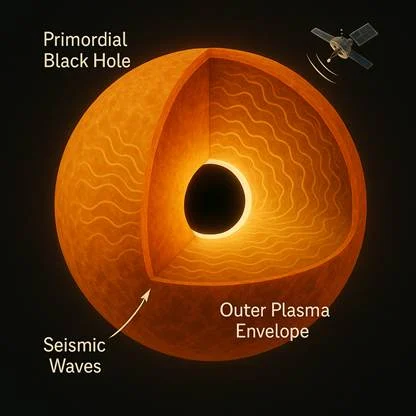
This illustration shows how helioseismology—the study of seismic (sound) waves traveling through the Sun—helps scientists probe its interior. By measuring how these waves ripple through the Sun’s plasma and bounce back to the surface, researchers can detect subtle differences in density and composition deep within. Recent studies suggest that adding a compact object like a primordial black hole at the Sun’s center improves how well these seismic models match observations, pointing to the possibility of a hidden dark core.
The compact object would not consume the Sun in a destructive manner. Instead, it would accrete mass very slowly, radiating small amounts of energy. Over billions of years, this gentle process would influence the star’s evolution and characteristics subtly. Although the research team remained agnostic about what the “dark compact object” could be at the core, suggesting that it could be anything from ‘dark quark nuggets’ to PBHs. As we discussed in the previous article “Is the Sun a Black hole?”, a PBH could function as a nucleating center that initiates star formation when transiting through an interstellar nebula. Interestingly, PBHs at the Sun’s center could even help explain certain mysterious solar observations, such as discrepancies in neutrino emissions or unexpected solar vibrations that standard solar models struggle to account for.
Insights from Ultrafaint Dwarf Galaxies
A related study by the same team including astronomer Andrew Santarelli published in December 2024 [3], strengthens the case for the existence of these stars with PBHs at their cores. Called “Hawking stars”, so named because Stephen Hawking was one of the first to publish a study on the likelihood and effects of PBH capture by stars like our Sun. Their research found that stars in small, early-formed galaxies—known as ultrafaint dwarf galaxies—could naturally capture primordial black holes. Over time, these PBHs would gently accrete the host stars, potentially converting them into “red stragglers,” stars that appear anomalously bright and old, and eventually into sub-Chandrasekhar-mass black holes.

Santarelli and colleagues’ simulations showed that such Hawking stars could form relatively easily in these dwarf galaxies due to their high dark matter density and lower metallicity, conditions ideal for PBH capture. Their results also indicated that the slow, steady accretion of these black holes could significantly affect the star’s evolution, making this scenario plausible for our Sun and stars throughout the universe.
Concluding Thoughts: A Universe Powered by Tiny Black Holes?
Taken together, these studies suggest a compelling scenario where primordial black holes are not just theoretical curiosities but integral parts of stellar evolution. If stars, including our Sun, harbor tiny black holes at their cores, this could fundamentally change our understanding of stellar dynamics and evolution.
Future research, especially more detailed observations and advanced modeling, will be crucial in confirming these ideas. As astronomers continue to peer deeper into the cosmos and refine our understanding of solar phenomena, the once radical idea that stars might contain black holes becomes increasingly plausible, opening a thrilling new chapter in astrophysics.
References
1. E. P. Bellinger and M. E. Caplan, “The Sun’s Dark Core: Helioseismic and Neutrino Flux Constraints on a Compact Solar Center,” ApJ, vol. 988, no. 2, p. 212, Jul. 2025, doi: 10.3847/1538-4357/ade70f.
2. B. Carr, S. Clesse, J. Garcia-Bellido, M. Hawkins, and F. Kuhnel, “Observational Evidence for Primordial Black Holes: A Positivist Perspective,” Physics Reports, vol. 1054, pp. 1–68, Feb. 2024, doi: 10.1016/j.physrep.2023.11.005.
3. A. D. Santarelli, M. E. Caplan, and E. P. Bellinger, “Formation of Sub-Chandrasekhar-mass Black Holes and Red Stragglers via Hawking Stars in Ultrafaint Dwarf Galaxies,” ApJ, vol. 977, no. 2, p. 145, Dec. 2024, doi: 10.3847/1538-4357/ad8ec0.