
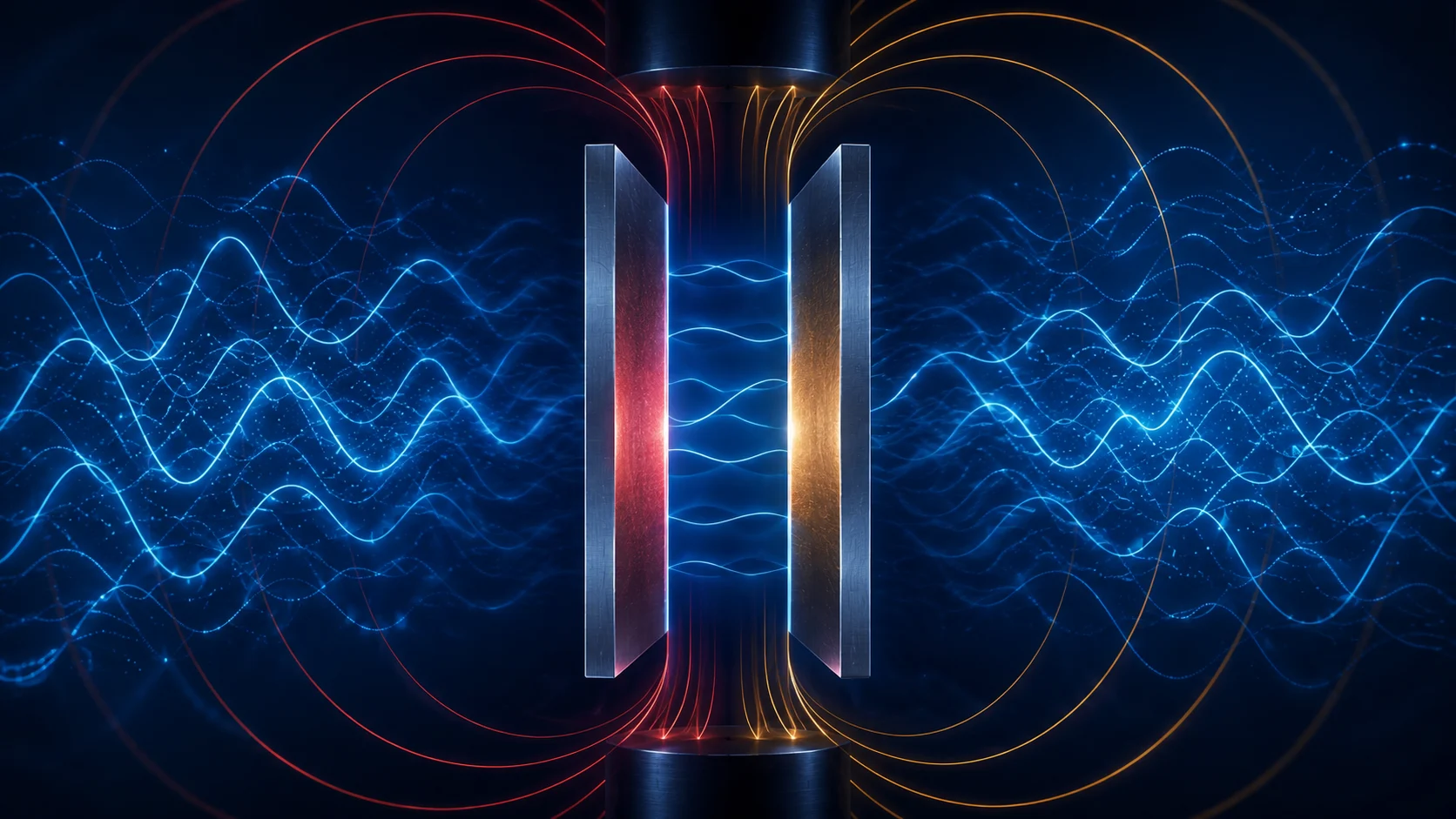

There is a quiet force at work in the gap between any two closely spaced surfaces. You will never feel it pushing on your hand, but at the scale of micromachines and microchips it is decisive — strong enough to make tiny moving parts stick together and seize up. It arises not from electric charge, magnetism, or gravity in any familiar sense, but from the restless quantum fluctuations of the electromagnetic field in the vacuum itself. We call it the Casimir force, and for most of its history it has been regarded as something to be measured and endured rather than controlled.
That assumption is now being overturned. Writing in Nature Physics, a group led by Changgan Zeng at the University of Science and Technology of China has demonstrated a method for reversibly tuning the Casimir force — and, remarkably, for switching it between attractive and repulsive — by applying an external magnetic field [1]. The work is a vivid reminder of a theme central to research at the International Space Federation: the vacuum is structured, dynamic, and increasingly something we can manipulate.
What the Casimir force actually is
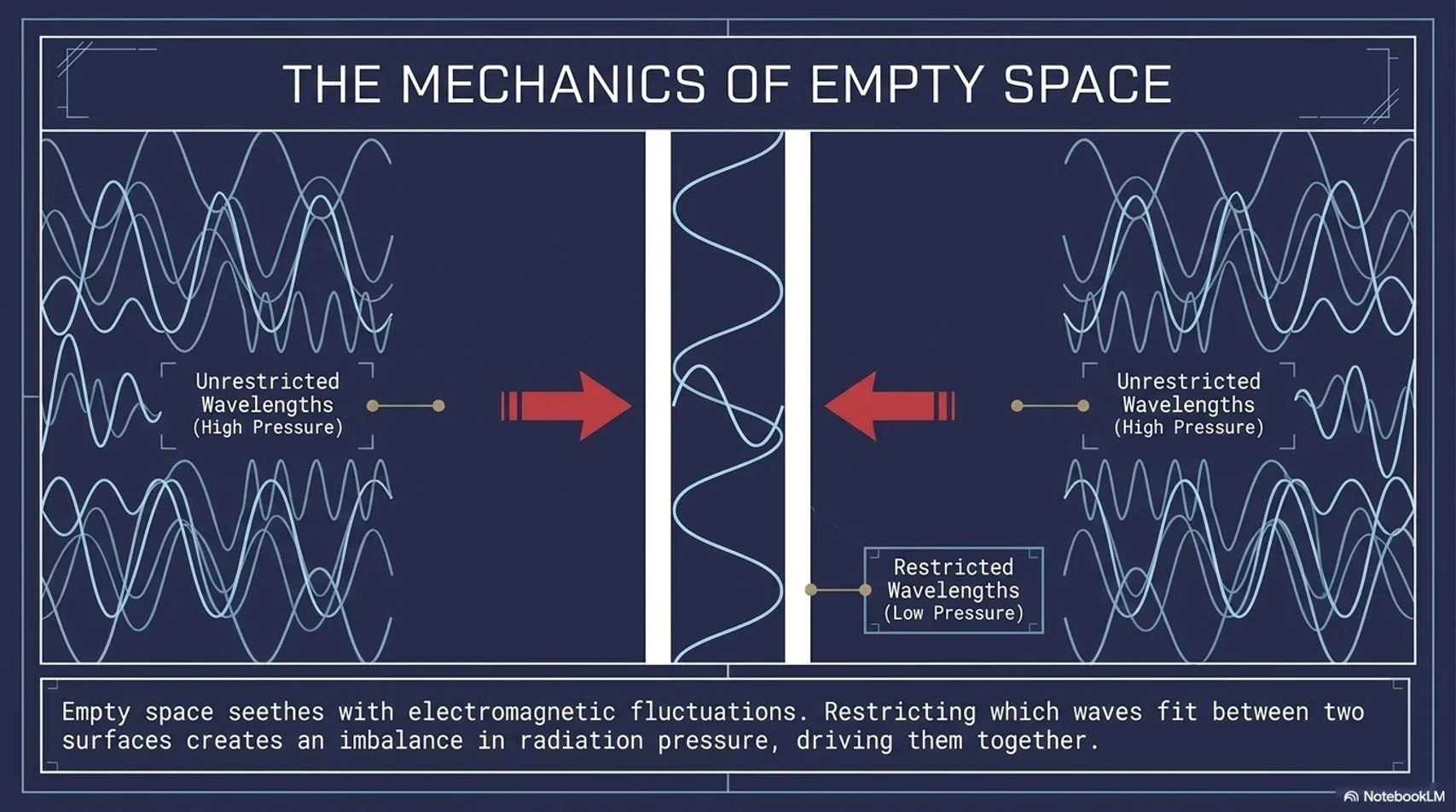
In 1948 the Dutch physicist Hendrik Casimir predicted that two uncharged, perfectly conducting plates placed very close together in a vacuum would feel a mutual attraction. The reasoning is subtle but elegant. Empty space is not truly empty; it seethes with electromagnetic field fluctuations due to the intrinsic energy density of the materiality of the vacuum. In studies like Extending Einstein-Rosen’s Geometric Vision : Vacuum Fluctuations-Induced Curvature as the Source of Mass, Gravity and Nuclear Confinement, by Haramein et al. [2], it is shown how this intrinsic energy of the vacuum is responsible for nuclear confinement forces. That the vacuum can generate force is exactly what Casimir had predicted, and is known as the Casimir force.
When you place two plates close together, you restrict which wavelengths can exist in the gap between them — only those that ‘fit’ are allowed. Outside the gap, no such restriction applies. The result is a slight imbalance in the radiation pressure of the vacuum on either side of each plate, and that imbalance manifests as a force pushing the plates together.
For decades the Casimir force was a theorist’s curiosity, too delicate to measure cleanly. That changed in the late 1990s, when improvements in microscopy allowed the force to be measured directly and with precision. It is now one of the most concrete experimental windows we have onto the reality of vacuum fluctuations.
Attractive, repulsive, and the role of materials
Crucially, the Casimir force is not always attractive. Whether two surfaces pull together or push apart depends on the electromagnetic properties — the dielectric permittivities and magnetic permeabilities — of the materials involved and of the medium between them. A landmark 2009 experiment by Munday and colleagues, also published in Nature [3], showed that by carefully choosing materials immersed in a fluid, the force could be made repulsive rather than attractive. It was this result that first inspired Zeng to pursue controllable Casimir forces, as he recounted in describing the project’s origins.
But selecting fixed materials gives you a force that is repulsive or attractive — and then leaves it there. What had eluded researchers was a way to switch between the two states on demand, in a single fixed apparatus, reversibly. That is the gap this new work fills.
Tuning the void with a magnet
The team’s insight came from theory that is decades old but rarely exploited. The strength and even the sign of the Casimir force depend, through what is known as Lifshitz theory, not only on the dielectric properties of the materials but also on their magnetic permeability. Dielectric permittivity is stubborn — it does not respond much to external fields. Magnetic permeability, in the right material, is a different story.
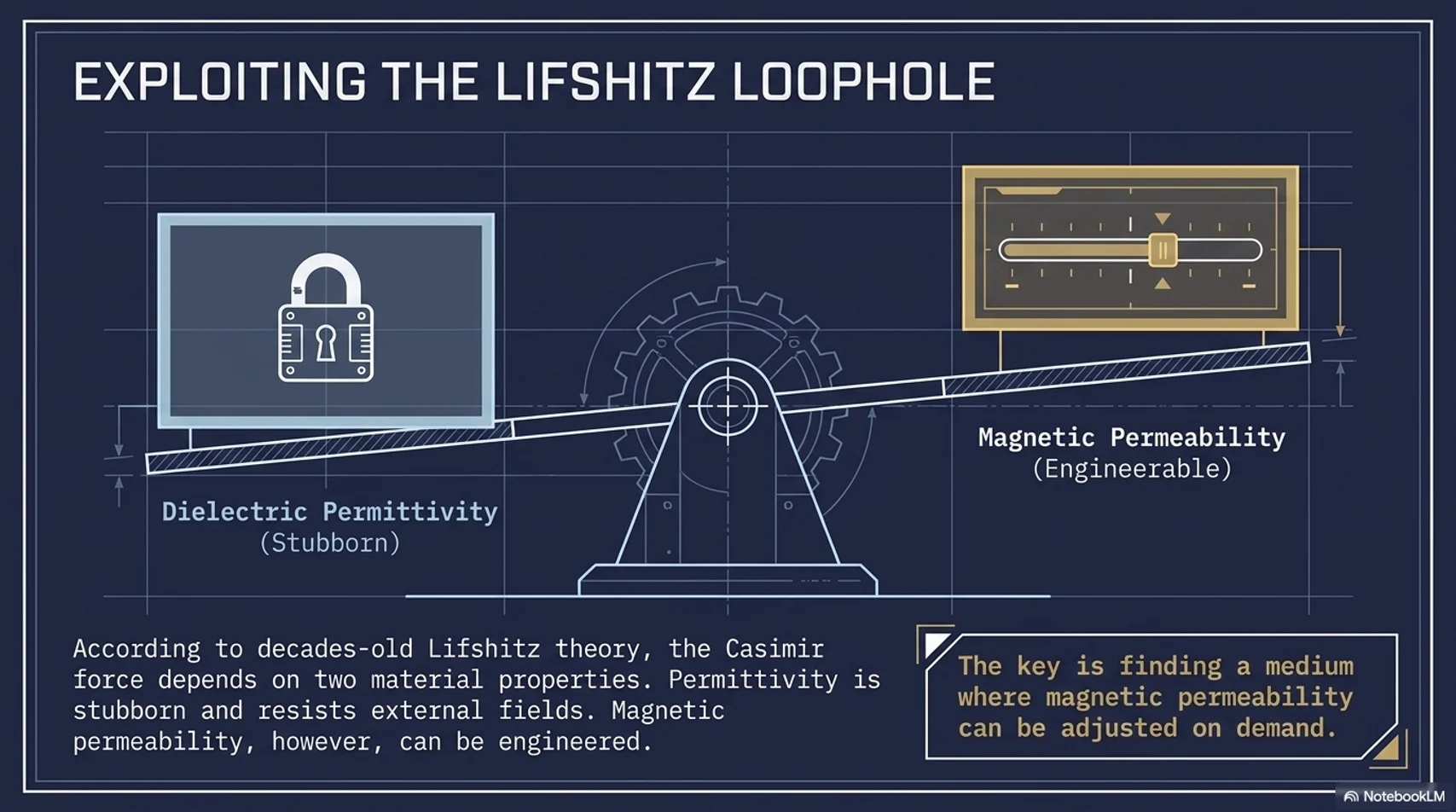
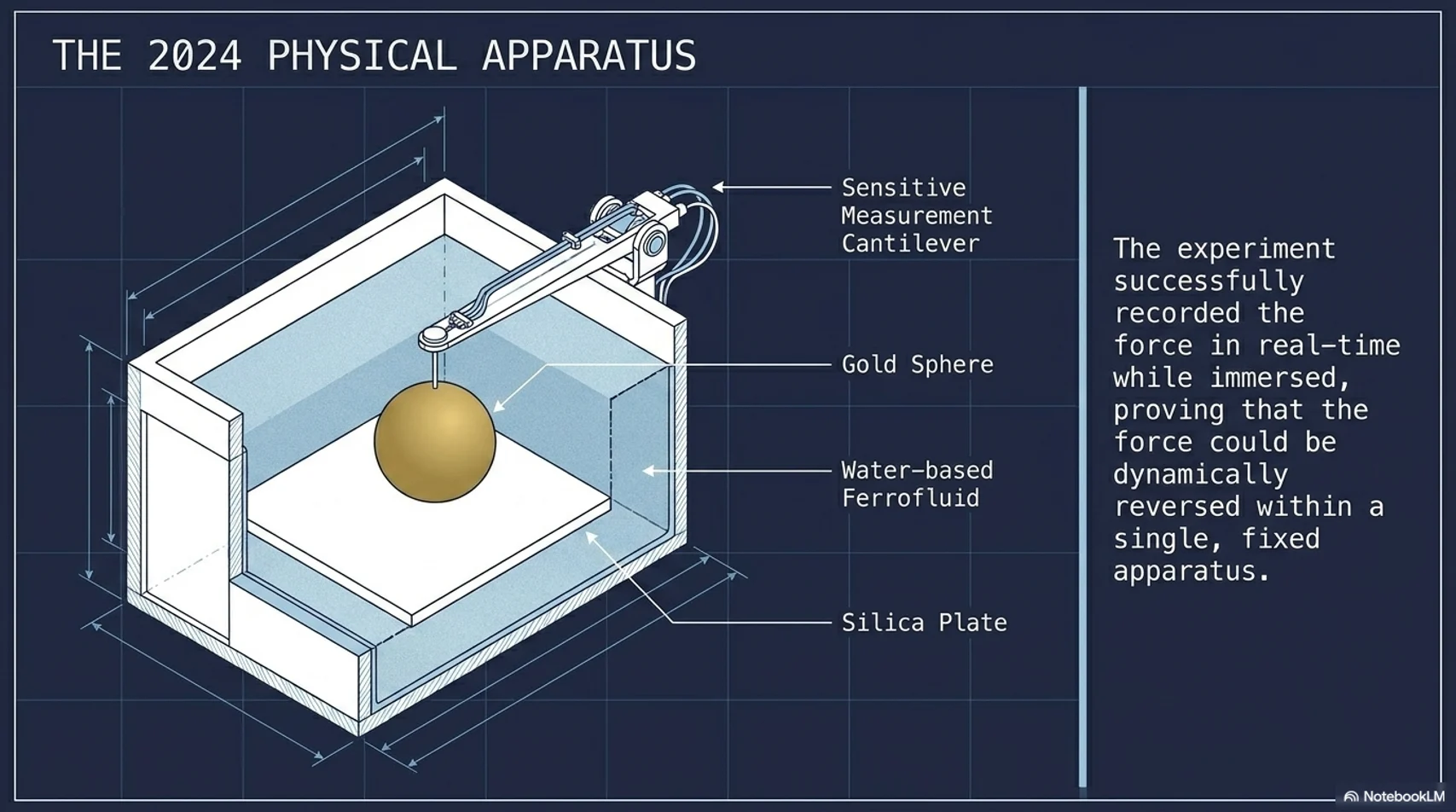
The right material, in this case, is a ferrofluid: a stable liquid suspension of nanoscale magnetic particles. The magnetic permeability of a water-based ferrofluid can be dialed up and down simply by applying an external magnetic field, which aligns the suspended particles. That gives experimenters a knob — an external, adjustable, fully reversible knob — on one of the very quantities that determines the Casimir force.
Zeng’s group placed a gold sphere and a silica plate in a water-based ferrofluid and measured the force between them using a sensitive cantilever capable of taking readings while immersed in the fluid. Their theoretical calculations had predicted that by adjusting three parameters — the strength of the applied magnetic field, the separation between the sphere and the plate, and the volume of ferrofluid — the Casimir force could be driven from attractive to repulsive and back again. The experiment bore this out: applying the field reversibly switched the sign of the force.
Notably, the project was carried out largely by undergraduate students. Zeng has described proposing the work to his graduate students first, none of whom were willing to take on a problem this speculative; it was a group of talented undergraduates who ultimately saw it through. There is a lesson in that worth dwelling on, about where genuine novelty in physics often comes from.

Why this matters
The most immediate application is technological. At the micro- and nanoscale, the ever-present, always-attractive Casimir force is a genuine engineering nuisance. In microelectromechanical systems — the tiny accelerometers, gyroscopes, and switches that populate modern devices — Casimir attraction can cause moving components to stick irreversibly to nearby surfaces, a failure mode known as stiction. A Casimir force that can be switched off, or actively reversed into a repulsion that holds components apart, opens the door to a new class of switchable micromechanical devices and frictionless nanoscale machinery.

Zeng has indicated that the next step for his group is to attempt control of the Casimir force using light rather than magnetism — for instance by exciting plasmons in metal plates with optical fields, which should likewise alter the force. The broader research program is clear: the Casimir effect is moving from a fixed phenomenon to a tunable resource.
The deeper picture
From the vantage point of the ISF’s research interests, the significance runs deeper than micromachines. The Casimir force is one of the clearest experimental signatures we have that the vacuum is a physical system with real, measurable energy content — that ’empty’ space carries structure and exerts influence on matter embedded within it. Demonstrating that this influence can be tuned, and its direction reversed, by an external field is a meaningful proof of principle. It shows that the boundary conditions we impose on the vacuum, and the electromagnetic environment we build around it, materially shape how zero-point fluctuations couple to physical systems.
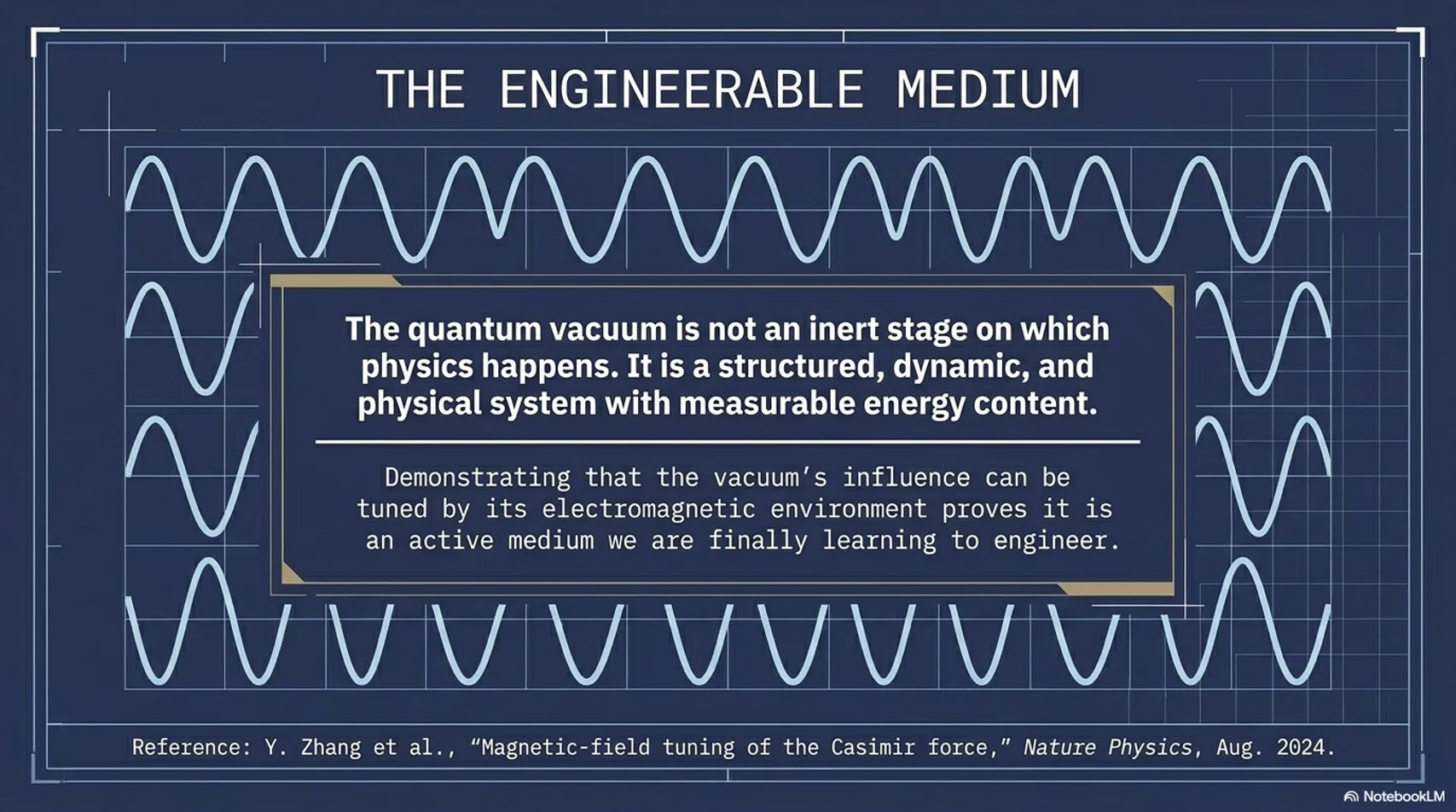
That is precisely the kind of coupling — between the geometry and electromagnetic environment of a system and the vacuum field it is immersed in — that sits at the heart of the ISF’s work on vacuum energy across scales. A magnet that can flip the Casimir force is, in miniature, a demonstration that the quantum vacuum is not an inert stage on which physics happens, but an active medium we are beginning to learn to engineer.
References
[1] Y. Zhang et al., “Magnetic-field tuning of the Casimir force,” Nature Physics, vol. 20, no. 8, pp. 1282–1287, Aug. 2024. DOI: 10.1038/s41567-024-02521-0.
[2] N. Haramein, O. Alirol, and C. Guermonprez, “Extending Einstein-Rosen’s Geometric Vision : Vacuum Fluctuations-Induced Curvature as the Source of Mass, Gravity and Nuclear Confinement,” Sep. 23, 2025, Preprints: 2025091835. doi: 10.20944/preprints202509.1835.v1.
[3] J. N. Munday, F. Capasso, and V. A. Parsegian, “Measured long-range repulsive Casimir–Lifshitz forces,” Nature, vol. 457, no. 7226, pp. 170–173, Jan. 2009, doi: 10.1038/nature07610.