

A terahertz resonator changes a superconducting material and brings vacuum engineering closer to practical control of quantum matter
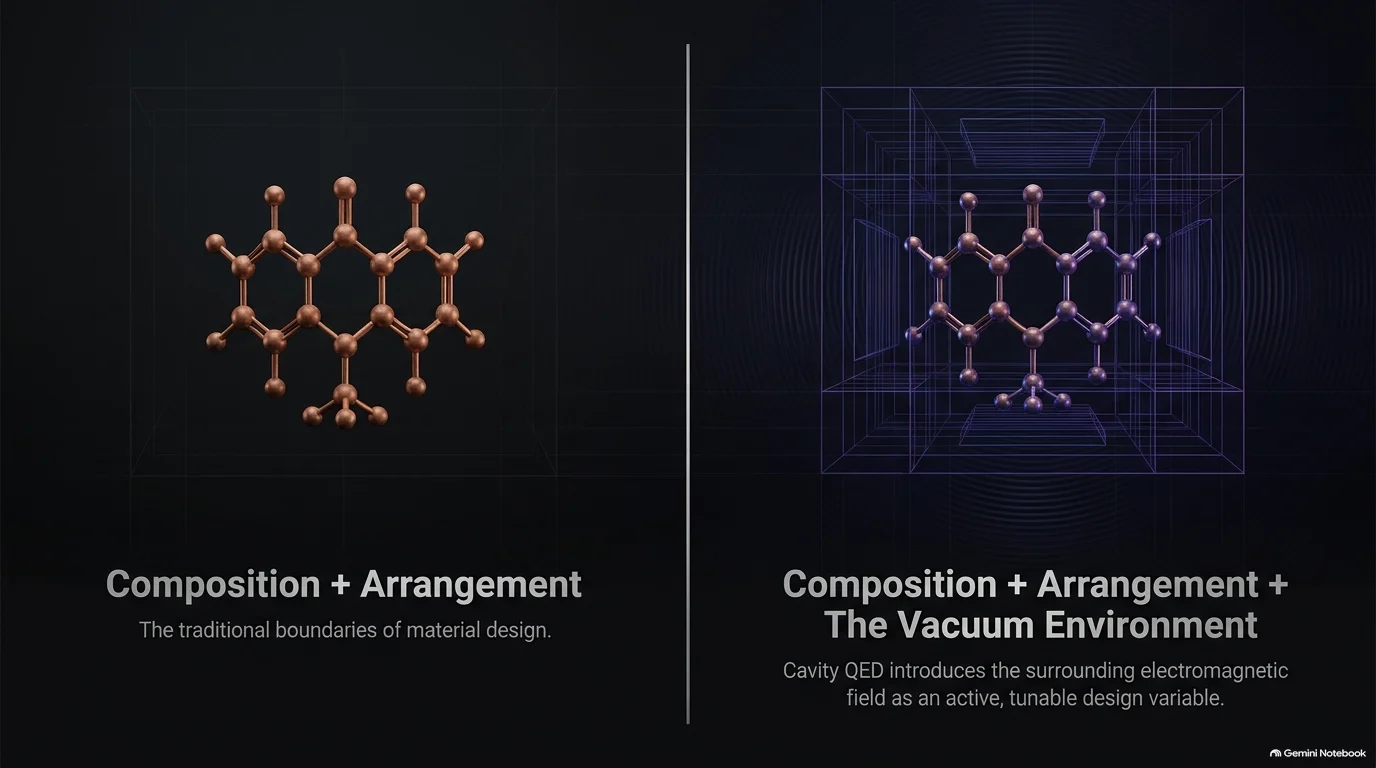
A material’s properties depend on the atoms it contains and the way those atoms are arranged. Cavity quantum electrodynamics adds another design variable: the electromagnetic environment in which the material exists. By changing the modes of the surrounding field, can we change the conditions under which a collective state of matter forms?
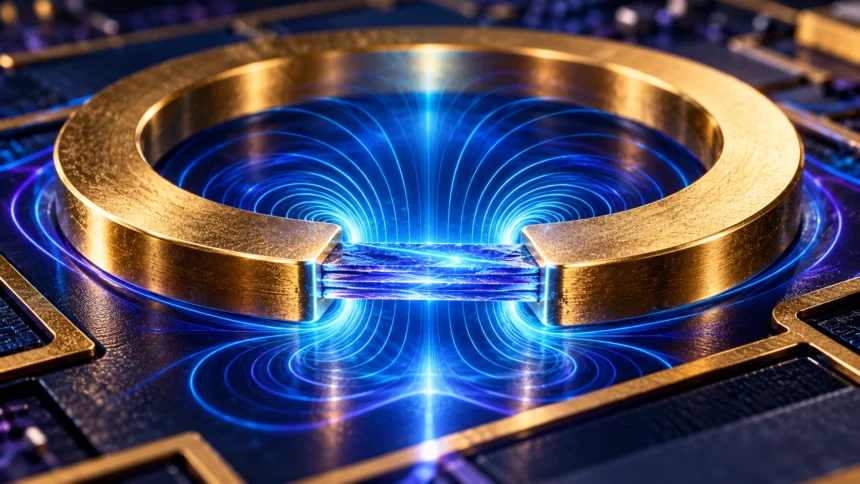
A study published in Nature on 19 August 2026 reports evidence that this approach can strengthen superconductivity. Zheyan Wang and colleagues placed thin niobium diselenide, NbSe₂, within a split-ring resonator and observed a higher superconducting transition temperature. Near the transition, the material also sustained greater critical currents and magnetic fields. The authors interpret the findings in terms of coupling between electronic degrees of freedom and fluctuating cavity modes. [1]
For the International Space Federation, the result connects directly with our investigation of material properties through controlled coupling to electromagnetic environments. It also extends a theme running through our recent articles and talks on vibrational strong coupling and cavity QED: the field surrounding a material can participate in the physics that determines its behavior.
What the experiment measured
Superconductivity emerges when electrons form a collective quantum state that carries electrical current without resistance. Its critical temperature marks the transition into that state; critical current and critical magnetic field describe additional limits on its survival. Changing these quantities therefore changes the conditions under which superconductivity can operate.
The collaboration included Changgan Zeng and Guanghui Cheng at the University of Science and Technology of China, Qing-Dong Jiang at Shanghai Jiao Tong University, and Frank Wilczek at MIT. Their terahertz “dark cavity” produced an enhancement without an external optical drive. In a six-layer NbSe₂ device, the reported increase in critical temperature reached 5.4%. [2]
The effect varied with the resonator’s characteristic frequency, reaching a peak near resonance. The team also compared cavity geometries, sample thicknesses, dielectric materials, and metallic structures to test explanations involving strain, degradation, inhomogeneity, or screening. These controls strengthen the case for an electromagnetic contribution. [2]
The frequency dependence is particularly useful for research. A resonance supplies a measurable relation between the environment and the material response. It gives experimenters something to tune, a response to predict, and a way to test whether the same physical explanation survives a change of device.
How a cavity changes the electromagnetic environment
In quantum electrodynamics, a field mode retains zero-point fluctuations even when it contains no photons. Its average electric field can be zero while its fluctuations remain finite. A cavity changes the frequencies, spatial patterns, and polarizations available to that field, together with the strength of its interaction with matter.
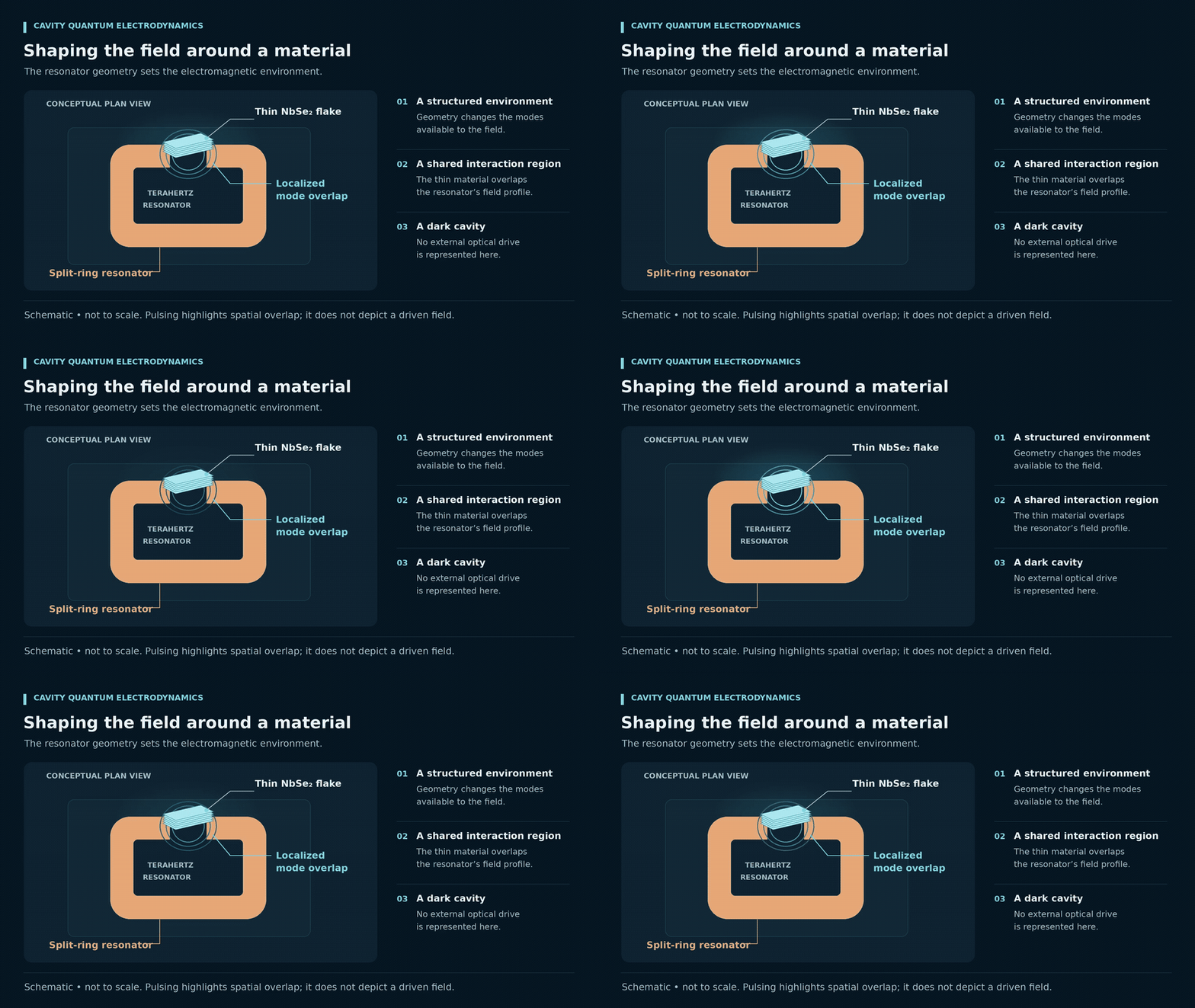
This is the physical basis of cavity engineering. The geometry and electromagnetic response of the surrounding structure determine where a mode is concentrated and how it overlaps the material. A mirror cavity, a metallic resonator, and a nanoscale interface produce different environments. Their dimensions matter, but so do absorption, leakage, and the material response itself.
The interaction is reciprocal. Matter polarizes in response to the field, and that polarization contributes to the field acting back on the material. A complete description must therefore treat the coupled system self-consistently. The relevant question is whether this interaction changes the energies or stability of the material states being studied.
In the superconductivity paper, the proposed description uses Ginzburg–Landau theory, which expresses the stability of a superconducting state through its free energy. The authors associate the enhancement with virtual-photon exchange and a lowering of the superconducting state’s energy. This is a proposed microscopic interpretation of the measured changes, with its detailed mechanism still being developed. [1],[2]
The connection to vibrational strong coupling
Vibrational strong coupling, or VSC, provides a particularly clear example of matter and a cavity acquiring shared modes. When an infrared cavity resonance interacts sufficiently strongly with a molecular vibration, the spectrum develops upper and lower vibrational polaritons. These excitations contain both molecular and electromagnetic character. The coupling must compete successfully with the losses and dephasing that would otherwise erase the interaction. [3]
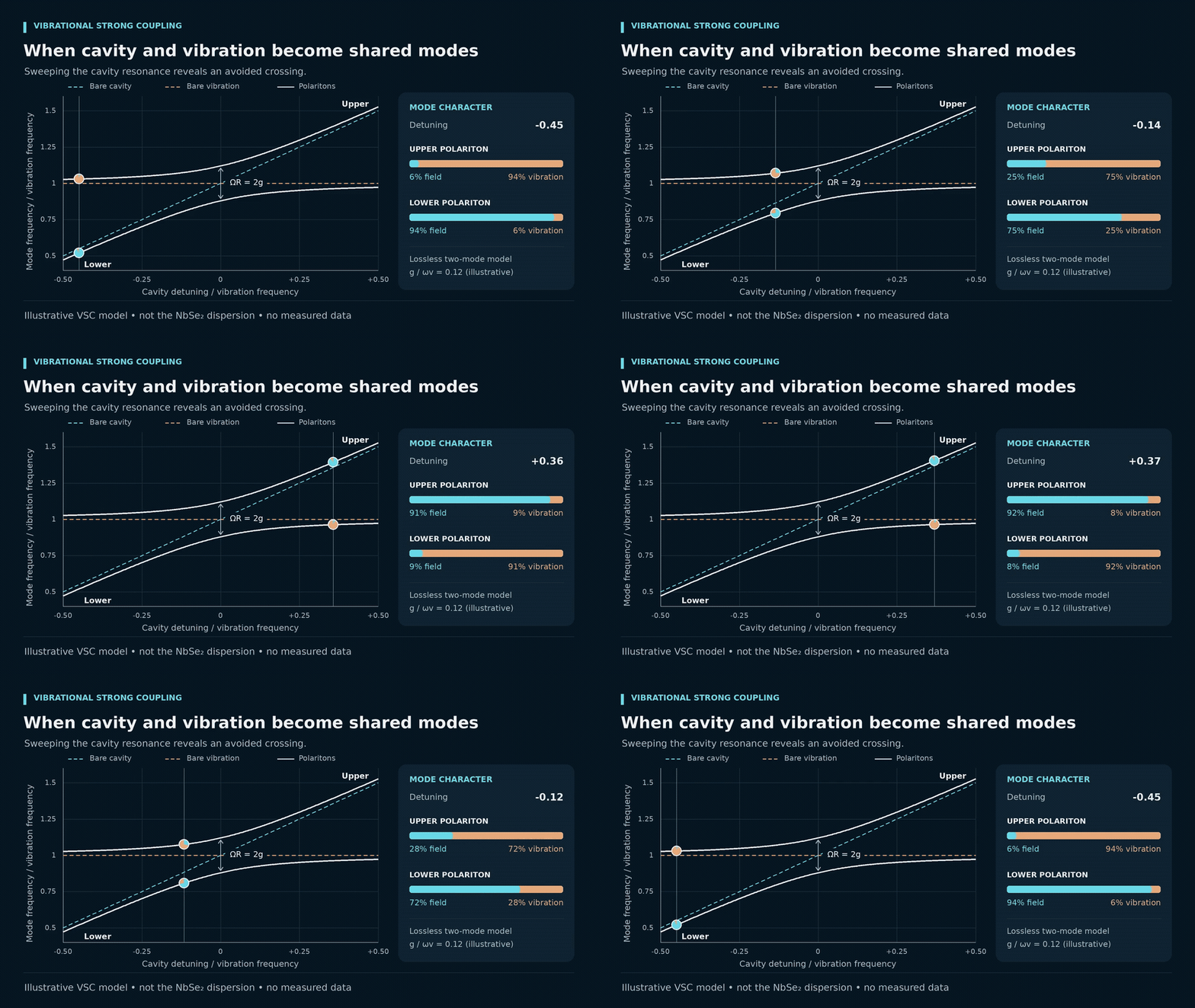
Shalabney and colleagues demonstrated collective vibrational coupling in a polymer microcavity in 2015. Many molecular oscillators interacting with the same field mode can achieve a much larger collective coupling than one oscillator alone. As the cavity is tuned through the molecular resonance, the hybrid branches avoid crossing. This measurable splitting is a central diagnostic of the coupled regime. [3]
Water supplies a closer connection to ISF’s research. In a 2022 study, Tomohiro Fukushima, Soushi Yoshimitsu, and Kei Murakoshi coupled the O–H stretching vibration of water to a Fabry–Pérot cavity mode. They reported enhanced proton conductivity and an increased dielectric response at resonance. The study provides a published example linking water–cavity hybridization to measured material properties. [4]
The comparison suggests a common research strategy: identify the material motion that couples to a mode, characterize that coupling, and measure how the material changes. The superconducting system involves electronic collective behavior; water VSC involves molecular vibrations. Their mechanisms must be established separately, but both can be investigated through the structure of the coupled electromagnetic and material response.
Coherence has a precise role in this comparison. Coherent exchange and correlated collective dynamics can occur without a populated, phase-locked classical field. The existence of hybrid spectral modes also leaves a further question to answer: how strongly do those modes affect a bulk property or a chemical process? Measuring that connection is essential to turning cavity spectroscopy into material control.
Which material mode produces the enhancement
A related theoretical preprint by Qing-Dong Jiang, revised on 22 August 2026, helps sharpen the mechanism question. Within a minimally coupled Ginzburg–Landau model of a passive cavity, Jiang finds that the contribution favoring superconductivity cannot overcome the opposing diamagnetic contribution. Enhancement therefore requires additional physics beyond that model. [5]
The preprint identifies two possible routes. An additional collective material excitation could reinforce the favorable interaction, or the cavity could weaken an order that competes with superconductivity. Both mechanisms can yield an enhancement, but they imply different experimental signatures. Tracking the material excitation, or measuring the competing order as the transition temperature rises, would help distinguish them. This analysis remains a preprint. [5]
For material engineering, the implication is useful: a stronger field or smaller cavity is insufficient as a design rule. We need to know which degree of freedom couples to the environment, how it affects the state of interest, and whether the interaction survives the losses of a real device.
From Casimir forces to the ISF research program
Our recent article on tunable Casimir forces examined how changing a system’s electromagnetic response can change a fluctuation-induced force. [6] The superconductivity study asks a complementary question about the stability of a collective state inside a material. Together, these subjects broaden the experimental scope of vacuum engineering from forces between bodies to properties within them.
In our recent aquaphotomics presentation, Nassim Haramein and I explored how a structured electromagnetic environment could modify the collective response of water. The framework treats water polarization and the surrounding field as a coupled system, with possible consequences for hydration and biological organization. Our illustrative resonator model includes an external source, and the biological extension remains a research hypothesis. [7]
The superconductivity result gives this broader program a useful experimental reference. It motivates asking whether a measured change follows the predicted resonance, spatial overlap, and loss dependence. For water, isotopic substitution offers another discriminating test: replacing hydrogen with deuterium shifts vibrational frequencies, allowing a proposed vibrational mechanism to make a specific prediction. These are ways to move from an observed response toward identifying its physical cause.
An extension to biological interfaces will require its own measurements of the relevant modes and their lifetimes. The NbSe₂ experiment strengthens the motivation for that investigation while leaving its outcome open. Its value to our research lies in making the relationship between electromagnetic structure and material behavior increasingly concrete.
Designing materials together with their surroundings
For future devices, the next step is to determine whether an enhancement can be reproduced across samples, enlarged through resonator design, and maintained under useful operating conditions. A device designer would need the full response: the gain in superconducting performance, the associated losses, and the sensitivity to fabrication and temperature.
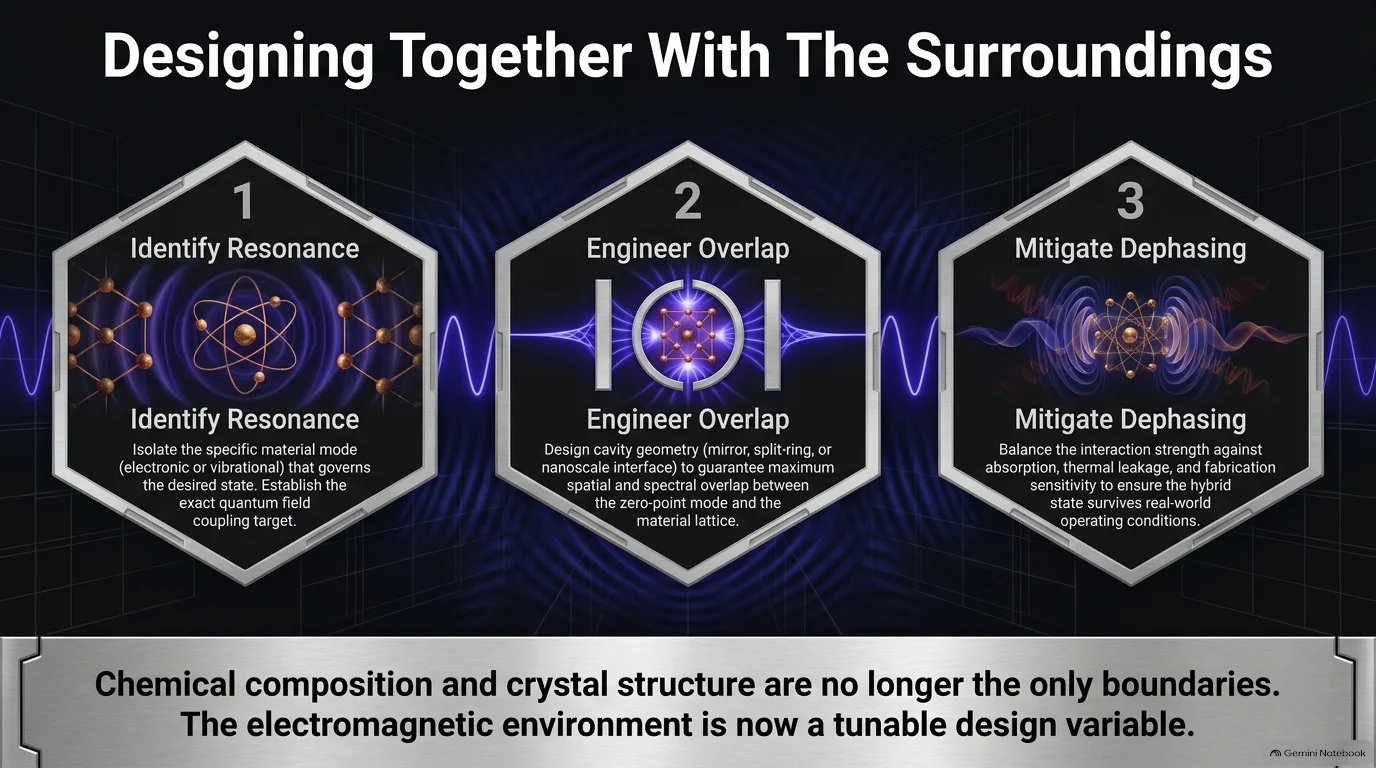
This perspective expands what it means to design a material. Chemical composition and crystal structure remain central, while the electromagnetic environment becomes another variable to characterize and engineer. For ISF, the most productive question is now specific: which material states can we change predictably by shaping their coupling to the quantum field, and what experimental signature will establish that control?
References
[1] Wang, Z. et al. Evidence for vacuum-enhanced superconductivity in NbSe₂. Nature 657, 912–917 (2026). Published online 19 August 2026. doi.org/10.1038/s41586-026-11037-x
[2] Chinese Academy of Sciences. Researchers Achieve First Experimental Demonstration of Vacuum-Fluctuation-Enhanced Superconductivity. Institutional research announcement, 21 August 2026. Read the research announcement
[3] Shalabney, A. et al. Coherent coupling of molecular resonators with a microcavity mode. Nature Communications 6, 5981 (2015). doi.org/10.1038/ncomms6981
[4] Fukushima, T., Yoshimitsu, S. and Murakoshi, K. Inherent Promotion of Ionic Conductivity via Collective Vibrational Strong Coupling of Water with the Vacuum Electromagnetic Field. Journal of the American Chemical Society 144, 12177–12183 (2022). doi.org/10.1021/jacs.2c02991
[5] Jiang, Q.-D. No-Go Theorem and Routes towards Cavity-Enhanced Superconductivity. arXiv:2608.14784v2, revised 22 August 2026. Preprint. arxiv.org/abs/2608.14784v2
[6] Brown, W. Quantum Vacuum Engineering | Study Finds Tunable Casimir Force. International Space Federation (June 2026). Read the ISF article on tunable Casimir forces
[7] International Space Federation. Water, Light, and Life: ISF to Present New Research at the European Aquaphotomics Conference. 11 September 2026. Related presentation by N. Haramein and W. Brown, Water Hybridized with Light, September 2026. Read the ISF aquaphotomics research overview