


In previous original ISF articles we have discussed experiments that tested qubit teleportation via a traversable micro-wormhole, and teleportation of energy utilizing the intrinsic spatial correlation (quantum entanglement) of vacuum energy density. In each case, and indeed in all quantum teleportation experiments, the “sender” and “receiver” systems must exchange information first, and this exchange of information must, necessarily, occur via a classical channel (id est, at or below the speed of light). This means that while quantum teleportation is a clever method to leverage the kind of strong spatial correlation that only occurs in quantum systems to transfer an informational state or energy from one system to another with 100% fidelity, it is not the kind of teleportation we generally think of in which something is instantaneously transferred from one location to another or reconstituted from one location to another with no intervening transit. The requirement that the receiver requires information that can only be sent via a classical communication channel means that the transference will never occur faster than the speed of light (and hence, will not violate causality or the relativity of simultaneity).
Despite the issues associated with faster-than light travel and disturbing the structural integrity and the very nature of causality, there are allowable mechanisms for effective superluminal transit, such as a traversable wormhole geometry of spacetime (an Einstein-Rosen bridge), which is an effective kind of teleportation, as entering one side of an Einstein-Rosen bridge and exiting the other would constitute a quasi-instantaneous translocation. Since this multiply-connected geometry of spacetime is allowed within the framework of general relativity, it is possible—and veritably required within unified physics / quantum gravity (see quantum foam)—that wormholes exist, and hence teleportation is possible. But why in quantum teleportation is there a requirement for a classical signal— a physical exchange of information at or below the speed of light— if the teleportation is occurring via a traversable micro-wormhole as reported in the Google Sycamore quantum computer experiment? As it turns out, upon further analysis there are some significant considerations that suggests the experiment did not actually demonstrate gravitational teleportation through a micro-wormhole. The reasons for this are detailed, but in brief: it has been suggested that the function specifying the evolution of state of the qubit system, which was highly “refined” via a machine-learning procedure, did not exhibit key features expected of gravitational teleportation via a traversable wormhole. The full critique is detailed in the report Comment on “Traversable wormhole dynamics on a quantum processor” [1].
The Role of Wormholes in Quantum Teleportation
So even when there are strong indications of gravitational interaction in a qubit teleportation experiment, such as in the Google Sycamore quantum computer experiment, there are still significant challenges to showing conclusively that quantum gravitational physics were involved. Indeed, quantum gravitational experiments in the lab [2] are no easy task, but despite the challenges, physicists are moving ahead with plans for the next gravitational teleportation experiments. The next big test of quantum gravity: a full-on teleportation where a system will be reconstituted from one location to another with no intermediary exchange of information. This is teleportation in the truest sense of the term, and in addition to elucidating via direct experimentation the nature of real-world wormholes and quantum gravity, it may lead to technological breakthroughs like ‘unhackable’ communication and exchange-free quantum computers, where output information is instantaneously accessed without necessarily going through computational processing or transmission [3].
A counterportation experiment demonstrating the traversability of space, by means of what is essentially a 2-qubit exchange-free quantum computer, can point to the existence in the lab of traversable wormholes.”
-Hatim Salih, From Counterportation to Local Wormholes
Protocol for Direct Counterfactual Quantum Communication
The proposed experiment has the goal of full teleportation without the exchange of any physical intermediaries between “sender” and “receiver”, and, if successful, will be the strongest demonstration of traversable wormhole physics yet achieved. The experiment is detailed in the journal Quantum Science and Technology [4] and based on a protocol conceived and authored by physicist Hatim Salih [5], who is an Honorary Research Fellow at the University of Bristol’s Quantum Engineering Technology (QET) Labs, and co-founder of the start-up DotQuantum. The procedure utilizes what is called counterfactual quantum communication, or what Hatim Salih terms “counterportation” (compound term of ‘counterfactual quantum teleportation’) because although it achieves the end goal of teleportation—quasi-instantaneous disembodied translocation—unlike quantum teleportation that requires the spatial exchange of a physical signal, counterportation does so without any detectable information carriers (in that sense it is counterfactual communication).
Counterportation Through a Quantum Wormhole
Counterfactual communication long predates quantum mechanics, and in fact we use it all the time in the process of drawing inferences. For example, following the tautology: were A to happen, B would happen; B did not happen; therefore A did not happen—we have a clear classical counterfactual inference. Counterfactual quantum communication, however, utilizes the wave-particle duality of a signal (an information-carrying qubit) and is based on the often-counterintuitive behavior of quantum systems—like electrons, photons, atoms, or ions. One such peculiar state of a quantum system is the superposition or wavefunction, based on the wave-particle duality that can make a particle, like a qubit, appear to behave as if it is delocalized like a cloud in the field, being everywhere at once and no where specific at the same time. Interrogation (i.e., measurement) of the position of such a wavefunction can make it appear as though it has “collapsed” into a definite position, and it is often described as reduction of the wavefunction—in this example position was used but the superposition could be of any state, e.g., spin, and collapse of the wavefunction is reduction of the superposition of possible states to one definite state (e.g., spin up).
However, with quantum information processing, the goal is to maintain the superposition state of the information-carrying particles, or qubits, so that the wavefunction can be maximally leveraged. This can present quite a challenge when it comes to computational information processing, because conventional computation processing is based on interrogation (reading) the state of the informational bits. If this is done with a quantum state, however, the wavefunction is reduced and can no longer be utilized for quantum information processing. This is one major hurtle with quantum computations, because the action of computation requires interrogation of the state of the qubit, but such interrogation reduces the qubit to a classical bit. So, how is the parallelism of the quantum superposition effectively leveraged if the output is always a classical bit?
There is a method to maintain the superposition of states while still accessing the quantum information the non-classical bit contains—and that is via “soft measurements”, or interaction-free measurements. These are methodologies by which a qubit is “read” without being perturbed: it is in “exchange-free” interaction. Counterfactual computation is one example of an interaction-free measurement, and the protocol has been experimentally verified [6,7,8].
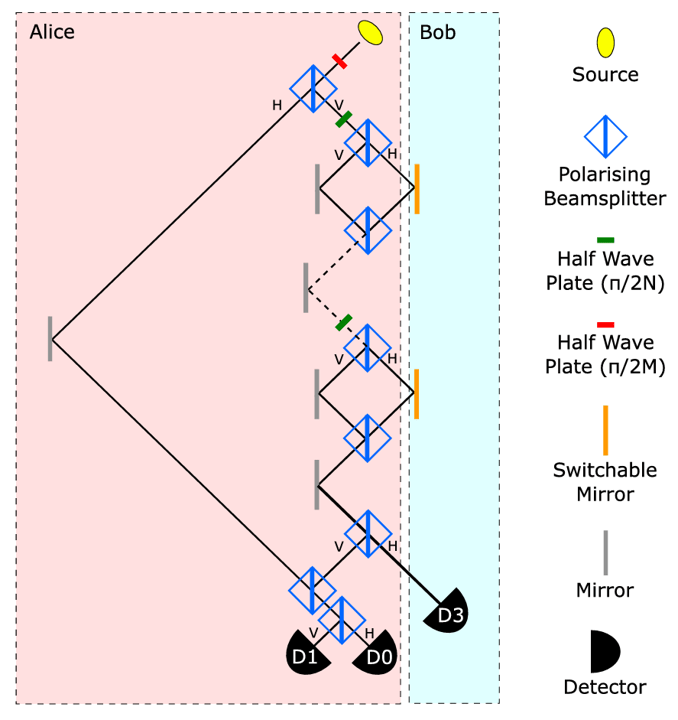
Figure 1. A schematic diagram of Salih et al.’s protocol for counterfactual communication, where, for every bit communicated, provably no photons have been sent to Bob. Beam splitters split a photon’s probability amplitude between the two eigenstates that correspond to the photon going in each direction; in the classical case, they split the beam intensity (and field). As interference still occurs, when Bob does not block, waves on both sides still destructively interfere, so the light never returns to Alice. However, Bob’s D3 and Alice’s D0 both detect light simultaneously. Similarly, when he blocks, light goes to his blockers and Alice’s D1 simultaneously. Therefore, in both cases, as light goes between Alice and Bob, it is not counterfactual. The only way to avoid this is to force the light to end at only one point – to postselect, with information only travelling when nothing goes between Alice and Bob. Only single photons can do this. Therefore, the only way to make the protocol counterfactual is to use these, and so make the protocol quantum. Image and image description reproduced from [12]: Hance, J.R., Ladyman, J. & Rarity, J. How Quantum is Quantum Counterfactual Communication?. Found Phys 51, 12 (2021). https://doi.org/10.1007/s10701-021-00412-5.
Chained Quantum Zeno Effect
The fact that qubits in a quantum state like the wavefunction will be irreversibly altered upon interrogation (or measurement), makes for an interesting possibility to utilize the wavefunction for quantum cryptography—since any attempt at snooping by an eavesdropper in a quantum channel will cause the qubit wavefunctions to reduce and will be immediately detectable [9]. Based on interaction-free measurements, or quantum interrogation, several quantum key distribution (QKD) protocols have been developed and successfully implemented, opening the door for a counterfactual quantum communication protocol in which no information carrying qubits are needed to physically transmit cryptographic keys between sender and receiver. The basic idea of interaction-free measurement, central to both counterfactual cryptography and counterfactual computation, makes use of experimental observation that the presence of an obstructing object (acting as a measuring device) inside an interferometer setting (which produces and guides quantum waves) destroys interference even if no particle is absorbed by the object.
This has the surprising consequence that sometimes the presence of such an object can be inferred without the object directly interacting with any (interrogating) particles. The counterfactual QKD protocol utilizes the quantum Zeno effect— which refers to the fact that repeated measurement of an evolving quantum system can inhibit its evolution, leaving it in its initial state, an effect often paraphrased as “a watched kettle never boils”. By implementing a chained version of the quantum Zeno effect, information can be directly exchanged between sender and receiver with no physical particles traveling between them, realizing direct counterfactual communication.
Counterportation Through a Quantum Wormhole
Similar to the quantum energy teleportation protocol, the counterfactual quantum wormhole teleportation protocol leverages the fact that entirely separate quantum systems can be correlated without ever having interacted via the intrinsic strong spatial correlation of vacuum-entanglement (the unified spacememory network [10,11]). This correlation at a distance can then be used to transport quantum information (qubits) from one location to another without a particle having to physically traverse the intervening space, revealing the integral multiply-connected spacetime geometry of the micro-wormhole network that connects everything.
The experiment to test the counterfactual quantum wormhole teleportation (counterportation) protocol will utilize cavity quantum electrodynamics in an optical set-up, where it can be demonstrated that communication has been achieved without detectable photons traversing the channel between two communicating parties (often referred to as Alice and Bob), no measurements are carried out between an initial quantum state and a final quantum state, and hence an underlying physical state—a traversable wormhole—is what has carried the quantum information across space. Such exchange-free communication is only explainable via the Maldacena-Susskind ERb = EPR holographic correspondence, in which quantum states like entanglement of qubits are equivalent to or a manifestation of a quantum wormhole connection through space between the two systems. The experiment proposed by Hatim will implement the construction of a universal exchange-free 2-qubit computational circuit, or gate (a CNOT gate, combined with single-qubit operations), to counterfactually transport an unknown quantum state from one or more senders to one or more receivers across space, via a local wormhole—an experiment that if successful will be a demonstration of Hatim’s counterportation protocol and primary holographic correspondence conjectures of quantum gravity.
Unified Science in Perspective
The concept of exchange-free quantum computation / communication has significant implications for the unified physics model expounded by Haramein & Brown [10, 11], which describes an entropic force engendered from the temporal entanglement and information exchange across the multiply-connected geometry and networks of spacetime, or more aptly termed the unified spacememory network. Our work explains the ordering mechanism underlying dynamical processes such as the evolution and development of general physical systems in the universe— towards ever-increasing levels of order and organizational synergetics—leading to the emergence of living forms of matter, i.e., the living system. The same info-entropic dynamic underlying generalized evolution of organized matter and living systems is unified with the propensity of some forms of organized matter in the universe to exhibit intelligence, often and arguably arising from or correlated with the attribute called consciousness, the dynamics of which we further explain are linked via a trans-temporal information exchange generating morphic resonance, via the intrinsic wormhole connectivity circuits of the quantum vacuum, and which are integral to intelligent systems and processes via the spacememory network.
For example, regarding theories for the emergence of sentient systems, it is popular within conventional scientific theory to equate consciousness with computational processes, or more specifically with neurocomputation within the brain. However, this paradigm suffers from a fundamental misunderstanding about the nature of the biological system and a significant lack of imagination in which theorists are taking our most efficient contemporaneous means of information processing, the digital computer, and attempting to equate the biologically equivalent information processor as a kind of digital organic computer. To see how this conceptual framework may be myopic consider that our level of technological sophistication comes from about two to three thousand years of development (depending on which metric you want to use, let’s say starting around the era that saw the development of the Antikythera analog computer), whereas the natural technology of the biological system has had hundreds of millions of years of refinement, so it may be a little more advanced than we are even able to recognize at our current level of understanding.
The problem with the neurocomputational paradigm (and why our current computers are not an apex information processing technology) is two-fold, (1) there is no indication that the brain is storing information digitally via binary states, hence it is not a digital computer, and (2) digital computers (our most advanced present means of information processing) will seem technologically rudimentary to future quasi-instantaneous information processing systems, like the exchange-free quantum computer (utilizing traversable wormhole teleportation). Hence, the mind and the physiological correlates of mental processing are not performing sequential digital computations to, for instance, remember past states (memory) where a network of neurons represent “on” / “off” binary values— but instead, there is an instantaneous direct accession of past states (and even potential “future” states) via the temporal entanglement of the intrinsic multiply-connected wormhole network of space. A computer based on the same principles will not so much process information, but instantaneously access the output (this can also be thought of in terms of the multiverse: in which there is access to parallel universes where “answers” have already been computed and are therefore available in universes where the actual sequential information processing has not yet physically occurred).
Another salient implication is the necessity of developing a communication technology that is not limited by the speed of light. In order for human civilization to survive far into the future it must master interstellar travel. At interstellar distances, communicating via light signals (like radio transmission) is not feasible—without even regarding the power requirements of sending a strong enough signal over light-years of distance, it is completely impractical to have a multi-year transmission time (over 8 years to send and receive a message between Earth and its closest solar system, Alpha Centauri). This is why SETI has not detected any radio transmissions—technologically advanced civilizations are not communicating via electromagnetic signals. Instead, leveraging the intrinsic spatial-entanglement of the quantum vacuum, and the multiply-connected wormhole network of spacetime, it is more likely that advanced civilizations are utilizing a form of exchange-free quantum communication, and this may be our best bet for interstellar parsec-spanning communication technology. So, the protocol and experiment proposed by Hatim Salih could not be more important! And perhaps it will lead to a path of research that one day realizes quasi-instantaneous communication and computational technology.
References
[1] B. Kobrin, T. Schuster, and N. Y. Yao, “Comment on ‘Traversable wormhole dynamics on a quantum processor’”. 15 Feb 2023, https://arxiv.org/abs/2302.07897
[2] D. Carney, P. C. E. Stamp, and J. M. Taylor, “Tabletop experiments for quantum gravity: a user’s manual,” Class. Quantum Grav., vol. 36, no. 3, p. 034001, Jan. 2019, doi: 10.1088/1361-6382/aaf9ca
[3] O. Hosten, M. T. Rakher, J. T. Barreiro, N. A. Peters, and P. G. Kwiat, “Counterfactual quantum computation through quantum interrogation,” Nature, vol. 439, no. 7079, pp. 949–952, Feb. 2006, doi: 10.1038/nature04523
[4] H. Salih, “From counterportation to local wormholes,” Quantum Sci. Technol., vol. 8, no. 2, p. 025016, Mar. 2023, doi: 10.1088/2058-9565/ac8ecd
[5] H. Salih, Z.-H. Li, M. Al-Amri, and M. S. Zubairy, “Protocol for Direct Counterfactual Quantum Communication,” Phys. Rev. Lett., vol. 110, no. 17, p. 170502, Apr. 2013, doi: 10.1103/PhysRevLett.110.170502
[6] M. Ren, G. Wu, E. Wu, and H. Zeng, “Experimental demonstration of counterfactual quantum key distribution,” Laser Phys., vol. 21, no. 4, pp. 755–760, Apr. 2011, doi: 10.1134/S1054660X11070267
[7] G. Brida, A. Cavanna, I. P. Degiovanni, M. Genovese, and P. Traina, “Experimental realization of Counterfactual Quantum Cryptography.” arXiv, Jul. 27, 2011. Accessed: Apr. 03, 2023. [Online]. Available: https://arxiv.org/abs/1107.5467
[8] Y. Liu et al., “Experimental demonstration of counterfactual quantum communication,” Phys. Rev. Lett., vol. 109, no. 3, p. 030501, Jul. 2012, doi: 10.1103/PhysRevLett.109.030501
[9] C. H. Bennett, “Quantum cryptography using any two nonorthogonal states,” Phys. Rev. Lett., vol. 68, no. 21, pp. 3121–3124, May 1992, doi: 10.1103/PhysRevLett.68.3121
[10] N. Haramein, W. D. Brown, and A. Val Baker, “The Unified Spacememory Network: from Cosmogenesis to Consciousness,” Neuroquantology, vol. 14, no. 4, Jun. 2016, doi: 10.14704/nq.2016.14.4.961
[11] W. Brown, “Unified Physics and the Entanglement Nexus of Awareness,” NeuroQuantology, vol. 17, no. 7, pp. 40–52, Jul. 2019, doi: 10.14704/nq.2019.17.7.2519
[12] Hance, J.R., Ladyman, J. & Rarity, J. How Quantum is Quantum Counterfactual Communication?. Found Phys 51, 12 (2021). https://doi.org/10.1007/s10701-021-00412-5