


Cosmic inflation is a theory governing the dynamics of the early universe, moments after the grand cosmic event called the Big Bang. MIT physicist Alan Guth was the first one to propose the inflationary theory in the early 1980s however, it was later advanced by other influential physicists like Andrei Linde and Paul Steinhardt [1-3]. The theory mainly deals with the exponential expansion of space and subsequently the large-scale structure formation in the universe during its evolutionary stages. It is also suggested by the theory that the epoch of inflation lasted from 10−36 seconds to sometime between 10−33 and 10−32 seconds after the Big Bang. But in order to articulate the events following the Big Bang admirably, one needs to have a full-fledged quantum theory of gravity, which is yet a substantial challenge for physicists.
So far, inflationary theory has been employed to undertake multiple challenges in modern cosmology. Some of these are the horizon problem, flatness problem, uniformity of the cosmic microwave background radiation, the existence of magnetic monopoles, etc. Incidentally, it was while exploring the problem of magnetic monopoles that led Alan Guth to the theory of cosmic inflation. Now, it is quite customary in physics that physical particles and their dynamics take place in a field so it makes sense to propose a field and its associated quanta in relation to inflation as well. This has been termed as the inflaton, though we are yet to have any observational evidence associated with it. Nevertheless, inflation has become one of the important tenets of theoretical cosmology today.
Challenges and Criticisms of Cosmic Inflation
Conversely, there are also areas where this theory fails to deliver satisfactory results. One of the prime reasons the paradigm is criticized is due to the lack of empirical backing. Notable critics of cosmic inflation include Paul Steinhardt and Nobel prize-winning physicist Roger Penrose. For instance, Penrose delivered a very critical remark about inflation at a conference in 2015 which goes: “inflation isn’t falsifiable, it’s falsified. … BICEP did a wonderful service by bringing all the Inflation-ists out of their shell, and giving them a black eye”. Besides opinions by experts, alternative to inflation theories also exist in the scientific literature which is under development phase. Some of these are big bounce models, Ekpyrotic and cyclic models, string gas cosmology to name but a few.
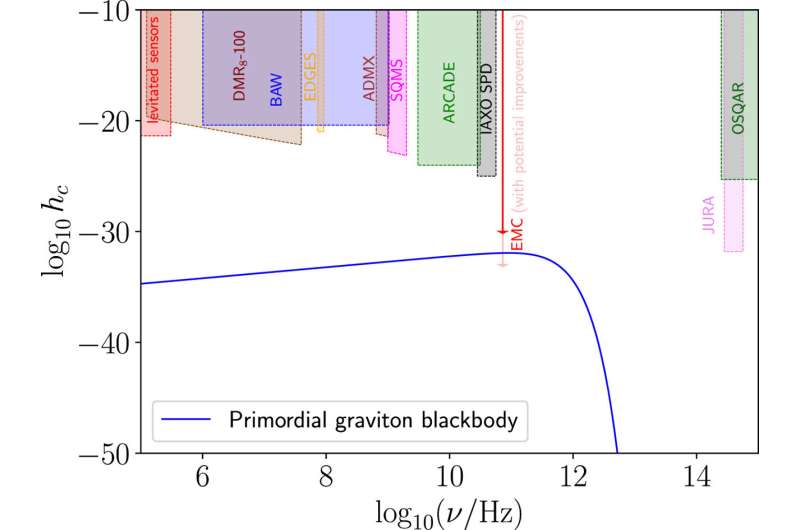
Strain of the CGB stochastic background of high-frequency GWs, alongside the sensitivities of various detector concepts discussed in the main text. The red line (“EMC”) refers to enhanced magnetic conversion, with the more transparent extension referring to potential future technological improvements discussed in the main text. Figure and Description: Vagnozzi and Loeb
Recent Developments: The Cosmic Graviton Background (CGB)
In view of the critical side of inflationary theory, two physicists have recently proposed an effect that according to them could lead to abolishing the inflationary paradigm altogether if confirmed observationally. Sunny Vagnozzi from Cambridge University and Avi Loeb, a senior astrophysicist at Harvard theorized the cosmic graviton background (CGB), described as a relic background of thermal gravitational radiation with a temperature of slightly less than one degree above absolute zero [4]. For an analogy, one could compare it with the cosmic microwave background (CMB). The primary aim of Vagnozzi and Loeb’s exploration was to test inflation in a “model-independent” way which would ultimately signify whether inflation is actually correct or it just works in specific cosmological scenarios.
However, the conventional Big Bang model has something else in store for the new work as it suggests that even if the CGB signal existed, it would have faded away much earlier due to the exponential expansion drived by the inflationary epoch. Furthermore, only a miniscule amount of CGB signal could be present in the universe, which sadly is perhaps undetectable.
Conclusively, at this moment we could only hope for better empirical probes to reveal crucial and relevant data regarding the CGB but this could frankly take us decades from the scientific and technological standpoint. However, Vagnozzi and Loeb have high hopes and they certainly believe that the CGB could be detected with the help of futuristic probes. Up until then, physicists could have a good time researching the stimulating properties associated with this newly theorized physical phenomenon.
References:
[1] Alan H. Guth, “Inflationary universe: A possible solution to the horizon and flatness problems”, Phys. Rev. D (1981). DOI:10.1103/PhysRevD.23.347
[2] Andrei Linde, “A new inflationary universe scenario: a possible solution of the horizon, flatness, homogeneity, isotropy and primordial monopole problems”, Physics Letters B (1982). DOI: 10.1016/0370-2693(82)91219-9
[3] Daile La, Paul J. Steinhardt, “Extended Inflationary Cosmology”, Physical Review Letters (1989). DOI: 10.1103/PhysRevLett.62.376
[4] Sunny Vagnozzi and Abraham Loeb, “The Challenge of Ruling Out Inflation via the Primordial Graviton Background”, The Astrophysical Journal Letters (2022). DOI: 10.3847/2041-8213/ac9b0e