

In a previous article ISF physicist Dr. Ines Urdaneta discussed a proposed study for probing the Unruh effect with quantum optics [1]. Because of the importance of experiments that will probe quantum effects in gravitational fields and to further elucidate the nature of the quantum vacuum, we will take another look at this proposed experiment and expound on some of the key insights of the study.
As Dr. Urdaneta explained in the previous article, the importance of probing the Unruh effect has to do with its relationship to quantum gravitational effects via the equivalence principle first described by Albert Einstein. Einstein is well known for his seminal work on the theory of relativity, which regards the behavior of clocks and rulers under accelerating and non-accelerating frames of reference, and the relativity of simultaneity that results from the invariance of the speed of light relative to any frame of reference. However, the field in which he was most prestigiously honored by the scientific community was in the study of light-matter interaction, of which he was awarded the Nobel Prize in Physics in 1921 for his discovery of the law of the photoelectric effect. He would now perhaps be pleased to see that a union of his two most important contributions to physics is being proposed to empirically study light-matter interactions of systems at relativistic speeds and, by equivalence, quantum effects (like the photoelectric effect) within gravitational fields.
The photoelectric effect is a resonant process in which the electromagnetic field is resonant with the atomic transition of an atom, resulting in three paradigmatic behaviors: spontaneous emission, stimulated emission, and absorption (see Dr. Urdaneta’s article ‘What is Resonance and Why is it so Important‘ to learn more about resonance and its role in light-matter interactions). The study of light-matter interactions, like the photoelectric effect, has enabled more than a few significant technological advancements, like light amplification via stimulated emission of radiation, or LASERs.
Under most light-matter interactions that have been studied so far, like lasers, the resonant interaction of the radiation field with atoms dominates the system’s behavior and most engineering projects have been focused on strengthening the individual interaction of photons with individual atom-like systems. However, there is a theoretical consideration: what would happen to the light-matter interaction in such systems under acceleration, i.e., non-inertial motion? One surprising theoretical prediction for such a condition is that accelerating atoms will experience a thermal field even when the field is perceived to be in the vacuum state (and hence not emitting photons) by observers in non-accelerating frames of reference.
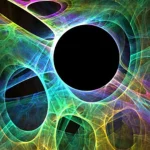
This is called the Unruh effect, in which the quantum field of the vacuum reveals a non-zero energy value by the spontaneous emission of photons for accelerating observers, and by the equivalence principle it is one and the same effect as Hawking radiation, in which the quantum vacuum around strongly gravitating objects—like black holes—will thermalize. The two effects are really one-and-the same and are the result of the generation of an event horizon (see image below):

In both cases the Unruh-Hawking effect is predicted to be subtle— for very large black holes and for accelerations approaching the speed of light the increased thermalization of the quantum field is around 1 Kelvin, just enough to see a glow of the vacuum. As such, the effect remains theoretical as experimental conditions necessary for testing the effect were thought to be well-outside the technological capabilities of Earth-bound labs— gravitational control technologies are non-existent, so generating a singularity is not feasible, and particle accelerators are not constructed so as to study single particles under relativistic accelerations (they are built to accelerate many hadrons and smash them together). So experimental investigation of the quantum gravitational postulate remains elusive.
Some analog black hole systems have observed analog Hawking radiation; see for instance Tunable Quantum Entanglement in Stimulated Hawking Radiation in an Analog White-Black Hole Pair [2]. However, a new study has proposed a way to directly view the theoretical effects via placing atoms in certain accelerating trajectories that result in stimulated Unruh radiation emission without the need for ultra-strong coupling—which is to say the state may be inducible under normal laboratory conditions. The details of this remarkable conclusion that it may be possible to stimulate the Unruh effect are described in a recent publication in Physical Review Letters by a joint effort of researchers from the Perimeter Institute for Theoretical Physics and MIT [3].
In the publication the research team describes how particular accelerating trajectories of atoms results in the conventional resonant light-matter interactions being reduced or even completely suppressed and non-resonant effects coming to dominate, leading, for example, to “acceleration-induced transparency”, in which an atomic system will no longer absorb or reflect light (which requires resonant interactions) and may become wholly transparent. There are thus two discoveries of accelerating matter that the research team postulates.
Acceleration-induced transparency means that a single atom can serve as an ‘Unruh effect detector’, such that under certain accelerations the atom will become ‘transparent’ to the normal resonant atomic transitions that are observed in non-accelerating (inertial) light-matter interactions, so that when stimulated by a laser the Unruh emission can be isolated and identified since all other emissions will be muted. The likelihood of observing the Unruh effect increases with the number of photons interacting with the accelerating atom, so by using a sufficiently powerful laser the effect should be measurable.
Einstein also taught us about the Equivalence principle, in which the effects of acceleration are exactly equivalent to those of gravitation, so by extension there should also be a “gravity-induced transparency”. The two quantum field properties described by the study could then also potentially be used to stimulate Hawking radiation, which, like Unruh radiation, has not been empirically observed (and therefore supported by direct experimentation). The accelerated atom will go from being an ‘Unruh effect detector’ to a ‘Hawking effect detector’. The accelerated atom will thus become equivalent to a microscopic black hole— which, if you study the work of physicist Nassim Haramein you know is an apt equivalency as protons are microscopic black holes— with the thermalization or glow around the atom being the stimulated Hawking emission.
Certainly, if the experiment is performed and the data are released we will be sharing the results here at the Resonance Science Foundation, and its implications to unified physics, so stay tuned!
Reference
[1] Ines Urdaneta, Probing The Unruh Effect with Quantum Optics, Resonance Science Foundation, May 2022.
[2] William Brown, Tunable Quantum Entanglement in Stimulated Hawking Radiation in an Analog White-Black Hole Pair, Resonance Science Foundation, May 2022.
[3] Barbara Šoda, Vivishek Sudhir, and Achim Kempf, Acceleration-Induced Effects in Stimulated Light-Matter Interactions. Phys. Rev. Lett. 128, 163603 – Published 21 April 2022. DOI: https://doi.org/10.1103/PhysRevLett.128.163603