


The Magnetic Compass System
It has long been recognized that birds possess a magnetic compass, but its true nature proved surprisingly complex. What’s more, this compass operates in a fundamentally different way than our technological compasses, detecting the angle of magnetic field lines rather than their polarity. This remarkable system, called an inclination compass, allows birds to distinguish “poleward” where magnetic field lines point downward from “equatorward” where they point upward.
The theoretical foundations for understanding this biological compass were laid in the 1970s when researchers first demonstrated that European robins use magnetic fields for orientation. However, it wasn’t until the early 2000s that scientists began understanding the quantum mechanical basis of this sense.
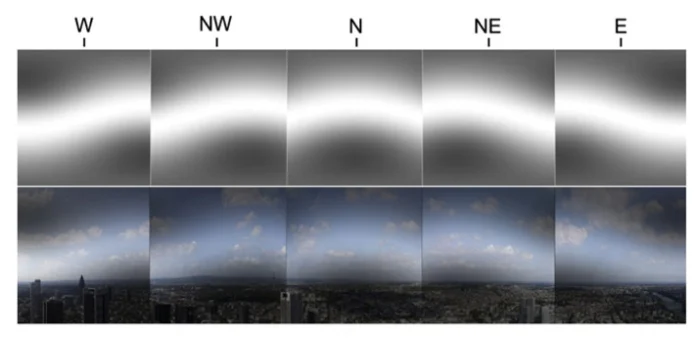
The compass requires light to function, specifically wavelengths from ultraviolet to green (about 565 nm). Under yellow or red light, birds become disoriented. This crucial discovery pointed researchers toward a light-dependent quantum mechanism called the radical pair model. When specific proteins called cryptochromes absorb photons of light, they form pairs of molecules with unpaired electrons (radicals). The ratio between different spin states of these radical pairs depends on their orientation in the magnetic field, creating a pattern of activation across the retina that birds can use to detect magnetic directions.
Early theoretical work focused on understanding the fundamental aspects of this quantum biological compass. Researchers identified several types of cryptochrome proteins in bird eyes, with one variant called Cry1a emerging as the most likely primary magnetic sensor. Located in specialized UV/violet-sensitive cone cells distributed across the retina, these proteins are perfectly positioned to create the theoretical activation pattern that could indicate magnetic directions.
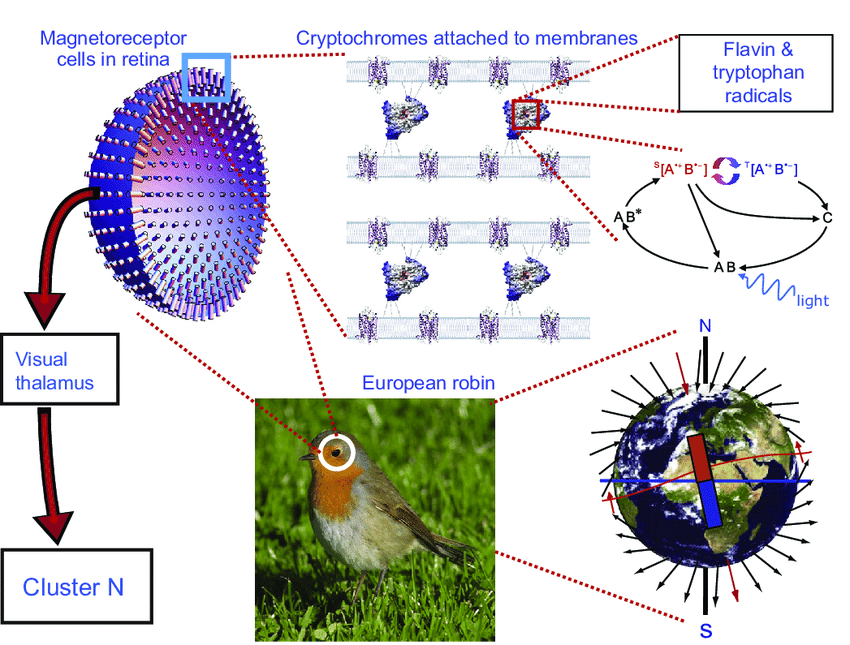
A significant development came with the discovery that this magnetic compass is primarily processed through the right eye and left brain hemisphere in adult birds. Young birds initially use both eyes for magnetic orientation, but develop this right-eye preference between their first autumn and spring migrations. This lateralization appears somewhat flexible at first but becomes firmly established with experience.
Recent work has continued to expand our understanding of the magnetic compass. Studies using radio frequency fields that specifically disrupt radical pair processes have provided strong evidence for the quantum mechanism. When exposed to the proper frequencies, birds become disoriented even though the magnetic field itself remains unchanged.
The radical pair compass offers several remarkable features:
- It detects the angle but not polarity of magnetic field lines
- It requires short-wavelength light to function
- It is calibrated to the local magnetic field intensity
- It achieves surprising precision of about 3-5 degrees
Implementation of the Magnetic Map System
In previous articles we have explored how animals generate neuronal maps for successful navigation (New Study Describes Invariance of the Correlation Structure of Grid Cell Modules in a Manifold with Toroidal Topology), but birds present a particularly sophisticated case by combining their magnetic compass with a magnetic “map” sense. This map sense appears to detect subtle variations in magnetic field intensity that could help birds determine their position.
This magnetic map sense manifests through a completely different mechanism than the compass – one based on magnetic particles called magnetite. Of particular relevance to recent experimental breakthroughs is the discovery that this information travels through the trigeminal nerve, specifically its ophthalmic branch that innervates the beak region.

The magnetic map sense shows several key differences from the compass:
- It does not require light
- It can be disrupted by strong magnetic pulses
- It appears to measure absolute intensity rather than field direction
- It achieves remarkable sensitivity of about 20 nanotesla
Location of Magnetite-Based Receptors
While the existence of this magnetic map sense is well established through behavioral and neurological studies, the exact location of the receptors remains controversial. Early studies identified promising magnetite-containing structures in the upper beak, but later work questioned these findings. Current evidence still points to receptors in the beak region, but their precise nature and structure remain unclear.
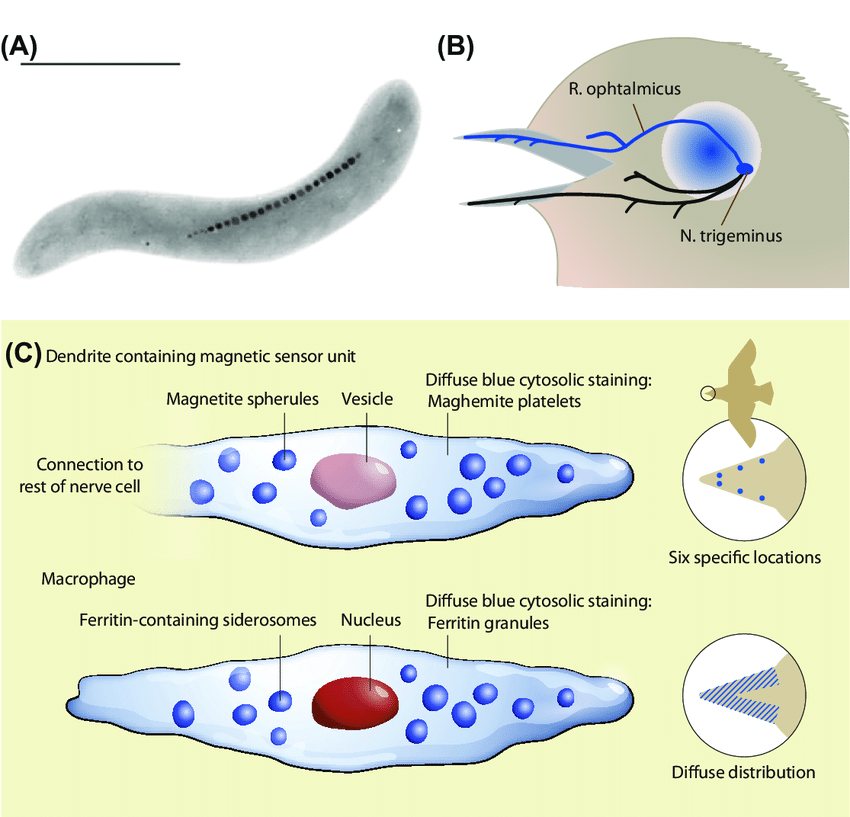
The search for these receptors has revealed several important clues:
- They appear to use superparamagnetic magnetite particles
- They are innervated by the ophthalmic branch of the trigeminal nerve
- They can be temporarily disrupted by strong magnetic pulses
- They recover from disruption within about 10 days
Neural Processing of Magnetic Information
A final breakthrough we will examine is how birds process and integrate magnetic information in their brains. This research has revealed that magnetic compass information from the eyes travels through the visual system, while magnetic intensity information from the putative beak receptors travels through the trigeminal system.
The compass information appears to be processed in several visual areas, including a region called “cluster N” that shows high activity during magnetic orientation in night-migrating birds. However, the exact way that magnetic information is extracted from the quantum compass mechanism and converted into neural signals remains unclear.
Magnetic intensity information travels through the trigeminal nerve to processing centers in the brainstem. About 15-20% of neurons in this pathway respond to changes in magnetic field intensity, providing a potential mechanism for magnetic map navigation.
This dual-pathway system allows birds to:
- Detect both magnetic direction and intensity
- Process compass and map information separately
- Integrate magnetic cues with other navigational information
- Achieve remarkable navigational precision
Highlights
The successful demonstration of two distinct magnetic sensing systems in birds represents a significant milestone in our understanding of animal navigation. While previous studies had shown that birds could use magnetic fields, we now understand the quantum mechanical and biophysical mechanisms underlying this remarkable ability.
The magnetic compass system demonstrates that nature has evolved to detect and utilize quantum effects, opening new possibilities for understanding quantum biology. Meanwhile, the magnetic map sense shows how evolution has also engineered sophisticated magnetic field detectors using specialized biominerals.
These magnetic senses are likely only part of a redundant navigational system that also includes visual, olfactory, and other cues. However, they provide crucial information that allows birds to achieve their remarkable navigational feats.

The discoveries about bird magnetoreception raise intriguing questions about the evolution of sensory systems and the possible existence of similar mechanisms in other species. While birds appear unique in their specific implementation, the principles revealed by studying their magnetic senses may help us understand magnetic sensitivity across the animal kingdom.