

As reported in phys.org by Gemini Observatory, March 2018
Galaxies and dark matter go hand in hand; you typically don’t find one without the other. So when researchers uncovered a galaxy, known as NGC1052-DF2, that is almost completely devoid of the stuff, they were shocked.
“Finding a galaxy without dark matter is unexpected because this invisible, mysterious substance is the most dominant aspect of any galaxy,” said lead author Pieter van Dokkum of Yale University. “For decades, we thought that galaxies start their lives as blobs of dark matter. After that everything else happens: gas falls into the dark matter halos, the gas turns into stars, they slowly build up, then you end up with galaxies like the Milky Way. NGC1052-DF2 challenges the standard ideas of how we think galaxies form.”
The research, published in the March 29th issue of the journal Nature, amassed data from the Gemini North and W. M. Keck Observatories, both on Maunakea, Hawai’i, the Hubble Space Telescope, and other telescopes around the world.
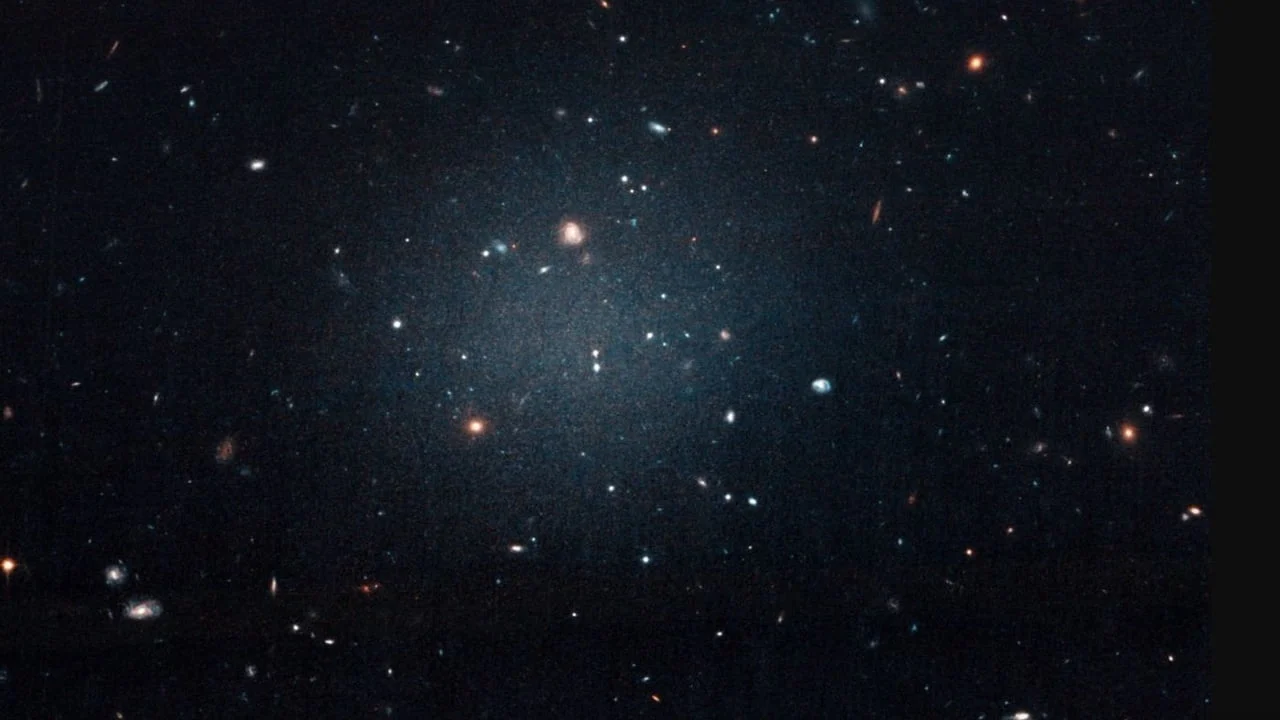
Given its large size and faint appearance, astronomers classify NGC1052-DF2 as an ultra-diffuse galaxy, a relatively new type of galaxy that was first discovered in 2015. Ultra-diffuse galaxies are surprisingly common. However, no other galaxy of this type yet-discovered is so lacking in dark matter.
“NGC1052-DF2 is an oddity, even among this unusual class of galaxy,” said Shany Danieli, a Yale University graduate student on the team.
To peer even deeper into this unique galaxy, the team used the Gemini Multi Object Spectrograph (GMOS) to capture detailed images of NGC1052-DF2, assess its structure, and confirm that the galaxy had no signs of interactions with other galaxies.
“Without the Gemini images dissecting the galaxy’s morphology we would have lacked context for the rest of the data,” said Danieli. “Also, Gemini’s confirmation that NGC1052-DF2 is not currently interacting with another galaxy will help us answer questions about the conditions surrounding its birth.”
Van Dokkum and his team first spotted NGC1052-DF2 with the Dragonfly Telephoto Array, a custom-built telescope in New Mexico that they designed to find these ghostly galaxies. NGC1052-DF2 stood out in stark contrast when comparisons were made between images from the Dragonfly Telephoto Array and the Sloan Digital Sky Survey (SDSS). The Dragonfly images show a faint “blob-like” object, while SDSS data reveal a collection of relatively bright point-like sources.
In addition to the Gemini observations, to further assess this inconsistency the team dissected the light from several of the bright sources within NGC1052-DF2 using Keck’s Deep Imaging Multi-Object Spectrograph (DEIMOS) and Low-Resolution Imaging Spectrometer (LRIS), identifying 10 globular clusters. These clusters are large compact groups of stars that orbit the galactic core.
The spectral data obtained on the Keck telescopes revealed that the globular clusters were moving much slower than expected. The slower the objects in a system move, the less mass there is in that system. The team’s calculations show that all of the mass in the galaxy could be attributed to the mass of the stars, which means there is almost no dark matter in NGC1052-DF2.

“If there is any dark matter at all, it’s very little,” van Dokkum explained. “The stars in the galaxy can account for all of the mass, and there doesn’t seem to be any room for dark matter.”
“Keck is in a very small group of telescopes that could even attempt these observations, because you need a large telescope to measure these accurate velocities,” van Dokkum added. “Keck also has some of the best spectrographs in the world for measuring the velocities of faint objects. We had the opportunity to check and make sure we got the same result within the uncertainties, and that gave us confidence that we were doing things right.”
The team’s results demonstrate that dark matter is separable from galaxies. “This discovery shows that dark matter is real – it has its own separate existence apart from other components of galaxies,” said van Dokkum.
NGC1052-DF2’s globular clusters and atypical structure has perplexed astronomers aiming to determine the conditions this galaxy formed under.
“It’s like you take a galaxy and you only have the stellar halo and globular clusters, and it somehow forgot to make everything else,” van Dokkum said. “There is no theory that predicted these types of galaxies. The galaxy is a complete mystery, as everything about it is strange. How you actually go about forming one of these things is completely unknown.”
However, researchers do have some ideas. NGC1052-DF2 resides about 65 million light years away in a collection of galaxies that is dominated by the giant elliptical galaxy NGC 1052. Galaxy formation is turbulent and violent, and van Dokkum suggests that the growth of the fledgling massive galaxy billions of years ago perhaps played a role in NGC1052-DF2’s dark-matter deficiency.
Another idea is that a cataclysmic event within the oddball galaxy, such as the birth of myriad massive stars, swept out all the gas and dark matter, halting star formation.
These possibilities are speculative, however, and don’t explain all of the characteristics of the observed galaxy, the researchers add.
The team continues the hunt for more dark-matter-deficient galaxies. They are analyzing Hubble images of 23 other diffuse galaxies. Three of them appear to share similarities with NGC1052-DF2, which van Dokkum plans to follow up on in the coming months at Keck Observatory.
“Every galaxy we knew about before has dark matter, and they all fall in familiar categories like spiral or elliptical galaxies,” van Dokkum said. “But what would you get if there were no dark matter at all? Maybe this is what you would get.”
Article: Dark Matter “missing” in a Galaxy Far, Far Away