

A twenty-hour stare through a gravitational lens
When the James Webb Space Telescope opened its infrared eye on the universe, it immediately found something nobody had ordered: a population of tiny, intensely red, intensely compact points of light. They were invisible to Hubble. They are ubiquitous in JWST data. And for three years they have refused to fit into any established category of cosmic object.
These are the little red dots (LRDs) — and a new paper published in The Astrophysical Journal has just delivered the most detailed anatomical study of one ever performed [1].
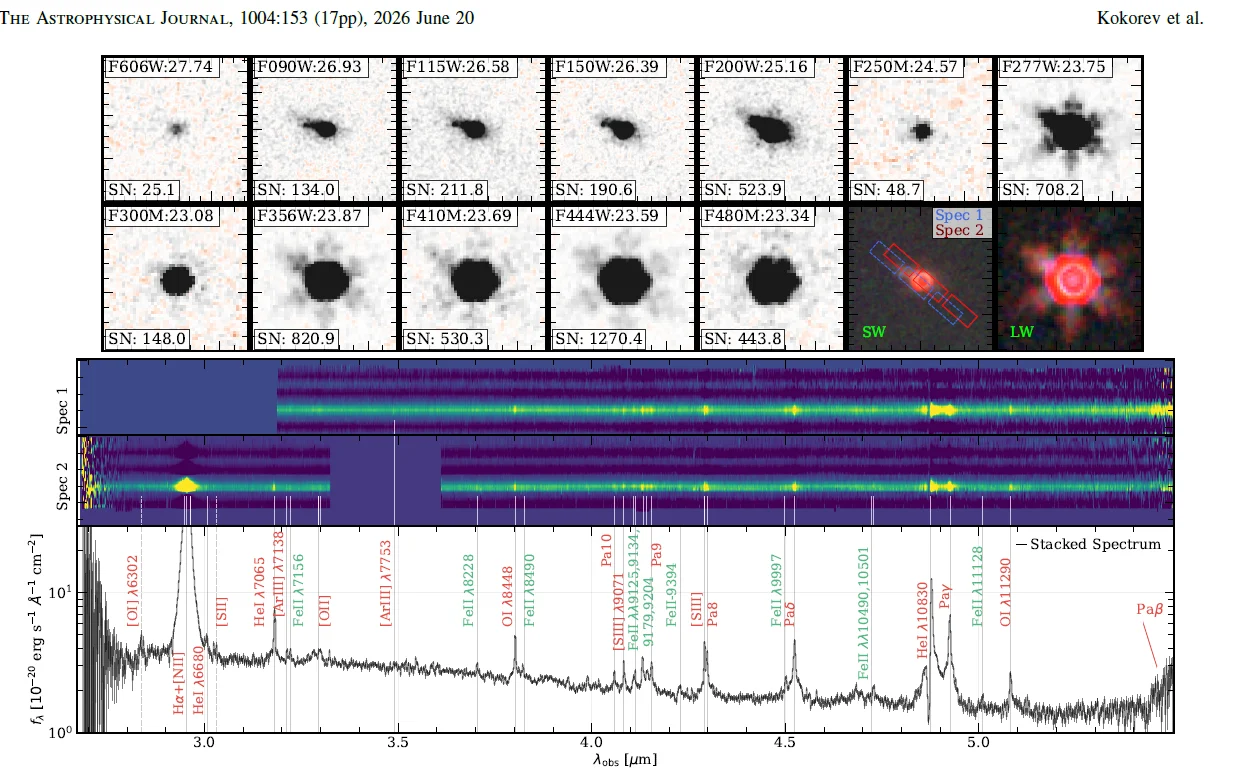
The object has a special alignment, it sits behind a massive galaxy cluster called Abell S1063, whose gravitational field acts as a natural telescope and magnifies it by a factor of roughly two. Vasily Kokorev and an international team combined ultradeep NIRCam imaging with a NIRSpec G395M spectrum accumulated over 20.55 hours of exposure — which, corrected for the lensing boost, is equivalent to an 80-hour stare at an unlensed source. Nothing this deep has ever been obtained for an object of this class.
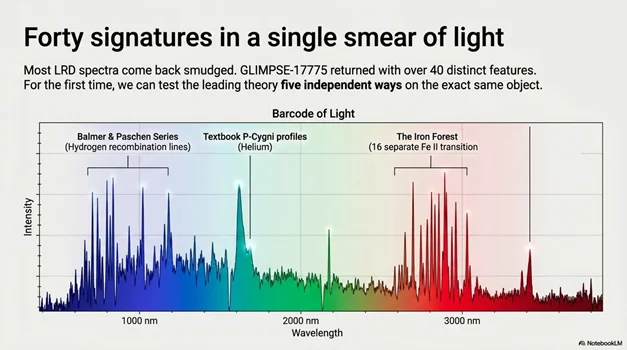
The result is a spectrum of almost absurd richness. More than forty distinct emission and absorption features. Numerous broad hydrogen recombination lines across both the Balmer and Paschen series — light emitted when free electrons rejoin protons and the atom settles down, at the fixed wavelengths hydrogen always produces when it lands on its second (Balmer) or third (Paschen) energy level. Helium lines with textbook P-Cygni profiles: a lopsided line shape, absorption on the blue side and emission on the red, which is the imprint left by a shell of gas expanding toward the observer. And a dense thicket of sixteen separate iron (Fe II) transitions — plus one Fe III — so crowded together that the authors describe it as an “iron forest.” A transition is a jump between two of the allowed energy levels available to an atom’s electrons: absorb a photon of the right energy and the electron steps up; emit one and it drops back down, often cascading through intermediate levels on the way. Iron is unusually rich in such transitions — the atomic models used to predict its spectrum track thousands of energy levels and tens of thousands of lines.
That depth is the whole story. Because for the first time, there is enough signal to test the leading explanation for what LRDs actually are — not with one diagnostic, but with five, independently, on the same object.
The speck that wouldn’t behave
So: scattered across JWST images are hundreds of tiny, intensely red points of light, which Hubble had never seen — they were simply too faint, and glowing in colors Hubble wasn’t built to catch—but Webb found them everywhere.
Astronomers gave them a nickname that stuck: little red dots.
And then spent three years arguing about what they are.
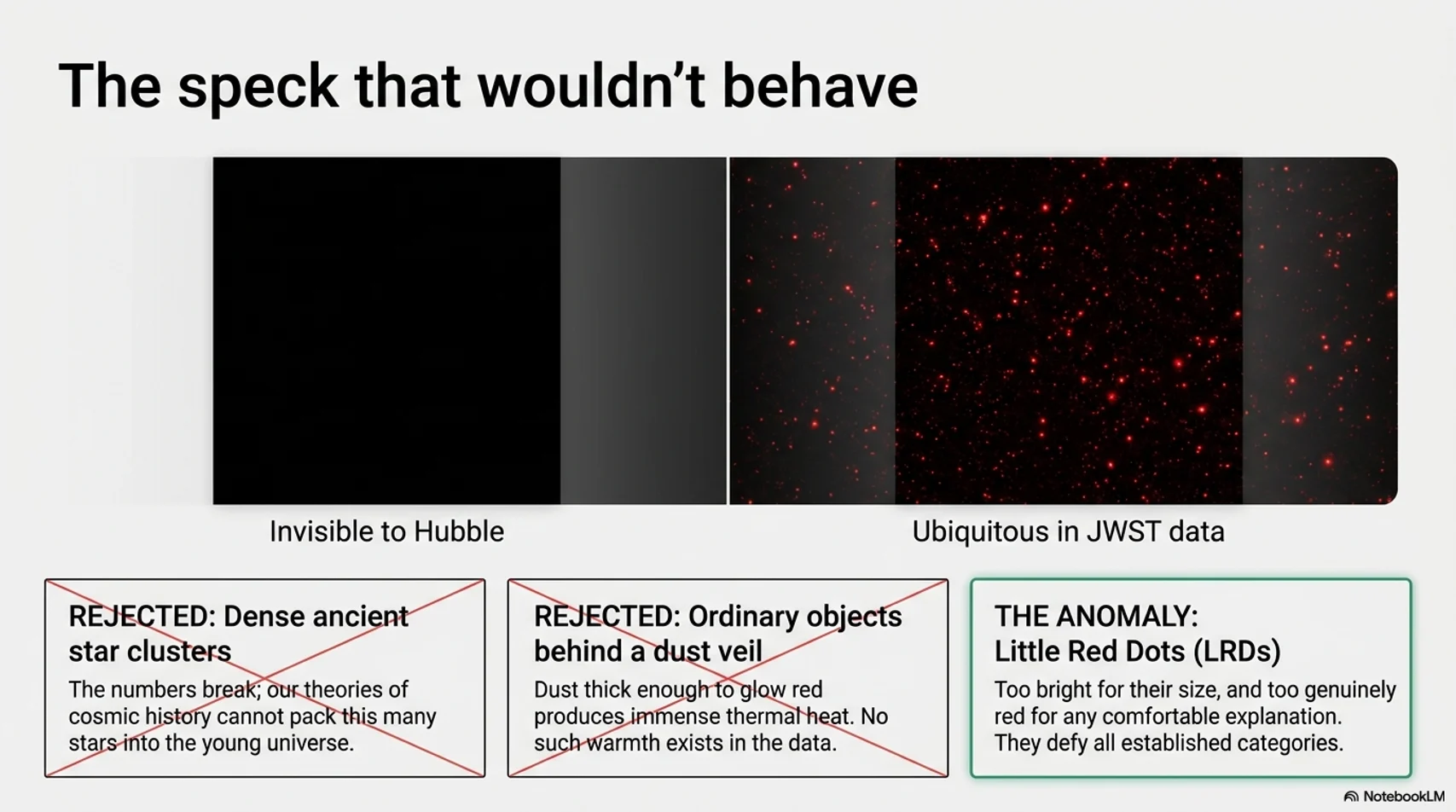
The problem is that these dots are far too bright for how small they are, and far too red for any comfortable explanation. Every attempt to file them under something familiar has failed. Maybe they were enormous crowds of ancient stars? That would require more stars packed into the young universe than our best theories of cosmic history can produce — the numbers simply break. Maybe they were ordinary bright objects seen through a veil of dust, the way a sunset turns red? But dust that thick glows with its own warm heat, and no such warmth is there.
Something else is going on. And now, thanks to the work of Kokorev and team, for the first time, we have a good enough look at one of them to say what.
Twenty hours, magnified into eighty
The object is called GLIMPSE-17775, and astronomers got lucky with it twice.
The first piece of luck is that it happens to sit directly behind an enormous cluster of galaxies. A cluster that massive bends the light passing through it, acting as a natural magnifying glass — a real one, made of gravity. This particular lens roughly doubles the brightness of anything behind it.
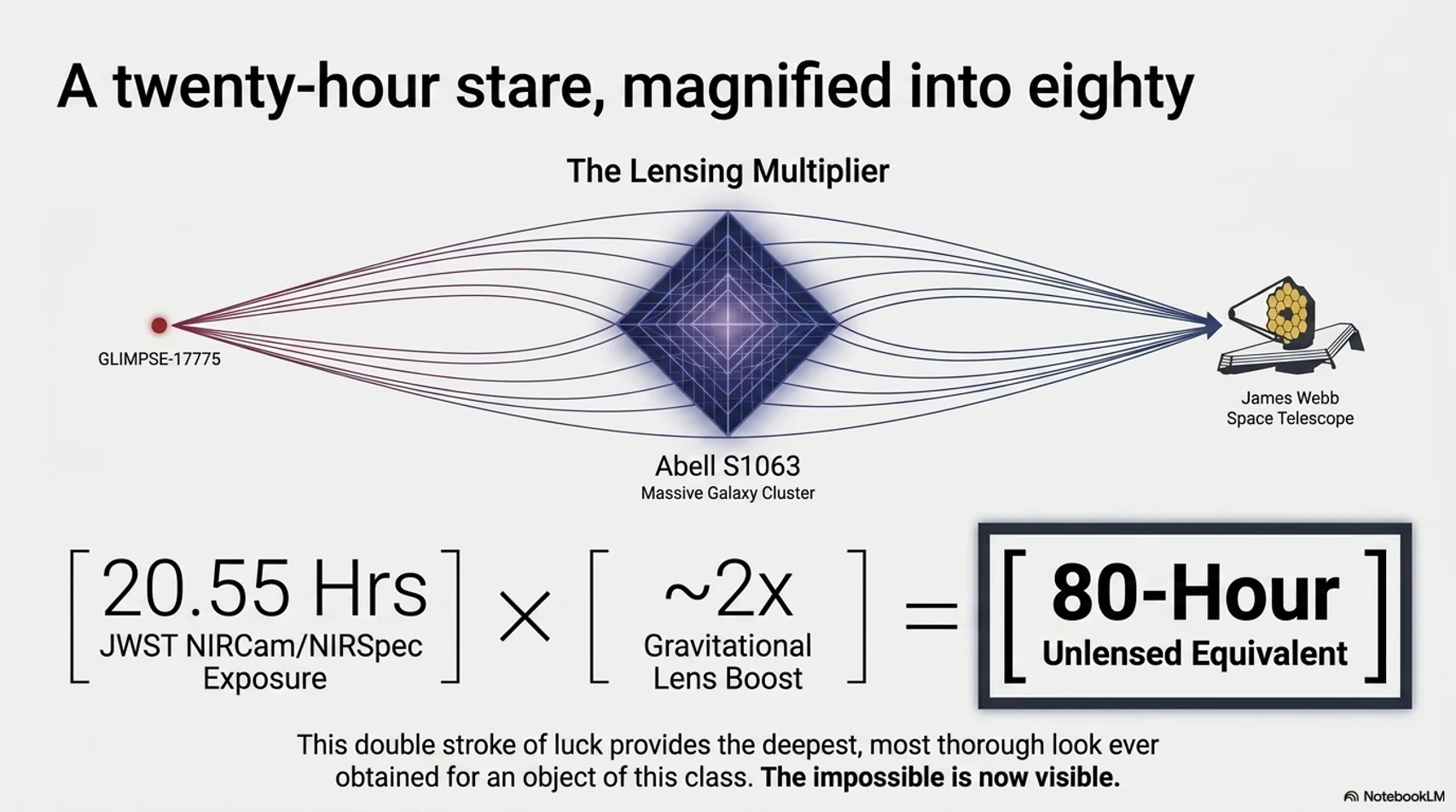
The second piece of luck is that Kokorev’s team got permission to point Webb at it and hold still for more than twenty hours. With the gravitational magnifying glass helping, that adds up to what would otherwise have taken eighty hours — halve an object’s brightness and you need four times the exposure to see it equally well, because the graininess in an image fades only as the square root of the time spent collecting light. Nothing this thorough has ever been done for an object of this kind.
Here is what that buys you.
When you pass light through a prism, it spreads into a rainbow. Look closely at that rainbow and you find it isn’t smooth — it’s ruled with bright and dark lines, like a barcode. Every chemical element prints its own unique pattern of lines. Read the barcode and you can tell what a distant object is made of, how hot it is, how fast it’s moving, and what its light has passed through on the way to you. This is how essentially everything we know about the distant universe was learned.
Most little red dots are so faint that their barcode comes back smudged. GLIMPSE-17775’s barcode came back with more than forty readable features.
That is an embarrassment of riches. And it let them do something nobody had managed before: check the leading theory five different ways, independently, on the same object.
The theory: a black hole star
The idea that survived, when the others fell over, is this.
Picture a black hole. Not a lonely one in empty space, but one buried inside a vast, dense cocoon of gas — gas so thick and so agitated that light cannot travel straight out of it. Every particle of light produced near the center has to fight its way out, bouncing and scattering, absorbed and re-emitted, over and over, before it finally escapes.
By the time that light reaches us, it has been thoroughly worked over. It no longer looks like light from a black hole. It looks, uncannily, like light from a star.
Astronomers have started calling these objects black hole stars.
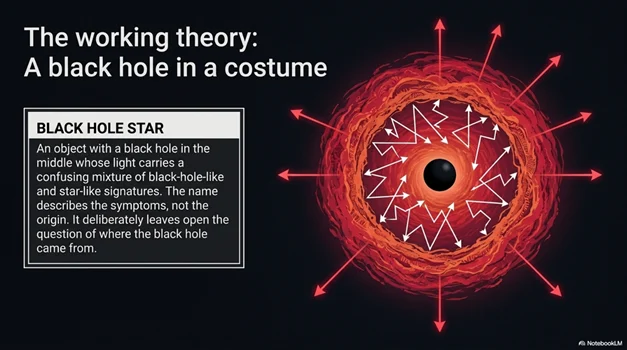
The name is a description, not an explanation — and it’s worth being clear about that, because it invites misreading. It means: an object with a black hole in the middle whose light carries a confusing mixture of black-hole-like and star-like signatures. It deliberately doesn’t commit to what the cocoon looks like, and it deliberately doesn’t say a word about where the black hole came from. Keep that second point in mind. We’ll come back to it.
Until now, the case for this picture leaned on one or two suggestive clues at a time — a sharp step in the light here, a hint of a shadow there. Suggestive, but circumstantial. Nobody had assembled the whole case in one place.
Five witnesses who never met
The most useful way to think about what Kokorev’s team did is to imagine a detective with five witnesses. None of them knows the others. None of them has any reason to agree. And every single one describes the same room.
Witness one: the fog
Look at car headlights on a clear night and you see two sharp points. Look at the same headlights in thick fog and you see two soft glows, spreading far out into the murk.
The lamps haven’t changed. The fog has.
For decades, astronomers have measured the width of the bright lines in an object’s barcode and read it as speed — how fast gas is whirling around the central black hole. Faster whirling means stronger gravity, which means a bigger black hole. Straightforward.
But there’s another way to make a line look wide. If the light has to scramble out through a dense enough crowd of loose electrical particles, each bounce nudges it slightly, and the line smears into broad soft edges. Fog, not speed.
Nearly every bright line in GLIMPSE-17775’s barcode has exactly those soft, spreading edges. Not slightly — unmistakably. When the team tried to force the old, speed-only explanation onto the data, it failed badly and visibly. The fog explanation fits.
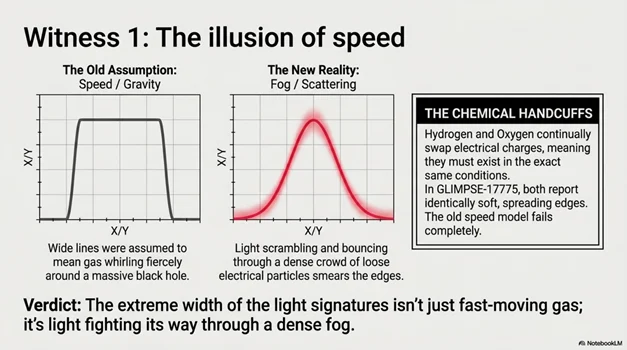
And there’s a lovely check built in. Two of the gases producing these lines, hydrogen and oxygen, happen to be chemically handcuffed to one another — they constantly swap electrical charge back and forth, so fast that they cannot help but sit in the same place under the same conditions. If both are really reporting from the same fog bank, their lines should have matching widths.
They do.
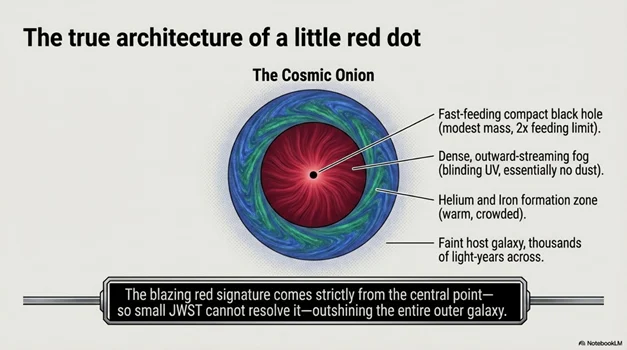
Meanwhile helium’s lines are noticeably narrower, and iron’s are narrower still. Those gases are reporting from farther out, where the fog thins. The cocoon isn’t a uniform blob. It has layers, like an onion.
Witness two: the cliff and the shadow
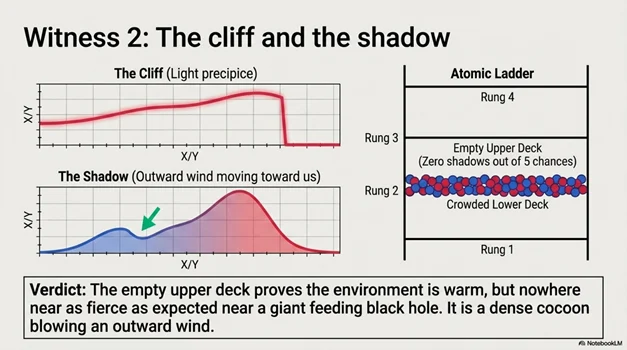
The second clue is a sudden cliff in the light.
Across most of the rainbow, this object’s brightness rises and falls gently. But at one very specific color, it drops off a precipice — as though somebody flipped a switch. Ordinary stars and ordinary galaxies don’t do that. It’s like a song that fades out smoothly, except this one cuts off dead in the middle of a note.
Alongside the cliff there’s a shadow. One of the brightest lines in the barcode is lopsided, with a bite taken out of one side — the signature of cool gas sitting in front of the bright source and swallowing some of its light on the way past. And the bite sits slightly off-center in a telling direction, the way an ambulance siren rises in pitch as it races toward you. The gas doing the swallowing is moving toward us. The cocoon is blowing outward. There’s a wind.
Then comes the detail that really tightens the case.
Atoms hold their electrons on a kind of ladder of fixed rungs. Which rungs are occupied depends on conditions. Different rungs cast shadows in different colors, so by looking for shadows you can effectively count who’s standing where.
In GLIMPSE-17775, the second rung is crowded. The third rung is very nearly empty — five separate chances to spot a shadow from it, and not one shows up. This isn’t a limitation of the equipment, because a helium shadow is picked up cleanly right next door in the barcode.
A packed lower deck and an empty upper deck tells you the temperature of the stadium. Do that arithmetic and you get gas that is warm — but nowhere near as fierce as you’d expect near a feeding black hole. Warm, crowded, and only partly torn apart. Precisely the cocoon the theory calls for.
Witness three: helium in a crowded room
Three different helium signatures show up, and they’re produced by different processes.
One of them appears in gas of almost any density. The other two are the sort of thing that only happens in a crowded room — they need atoms packed tightly enough to be constantly jostling each other. In thin gas they barely register.
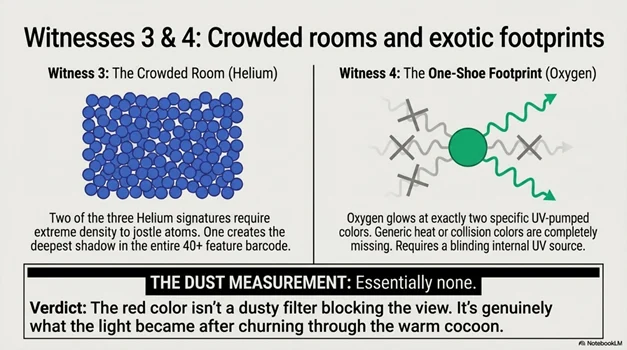
In this object, the two crowded-room signatures are the loud ones. The density-indifferent one is faint.
Better still: one of them shows the deepest shadow in the entire barcode. Not a subtle bite — the most pronounced absorption feature anywhere in a spectrum with over forty features. That kind of shadow requires an enormous quantity of helium sitting in the line of sight, and helium shadows like this remain genuinely rare in distant objects. Only a handful have ever been published.
Witness four: the footprint that only one shoe makes
The fourth clue is not a measurement. It’s a mechanism — and it’s identified by what’s missing.
Oxygen atoms in this object are glowing at two very particular colors. There’s a known process that produces exactly that pair: ultraviolet light of one precise color strikes an oxygen atom, kicks it up the ladder, and the atom tumbles back down in a specific sequence, glowing at those two colors on the way.
Now, oxygen can be made to glow by ordinary means too — heat, collisions, the usual. But if that were happening here, several other oxygen colors would be glowing right alongside. The team looked for all of them.
Not one is there.
So the ordinary routes are ruled out, and the one exotic route is left standing — a route that only works if there is a blindingly bright ultraviolet source at the center and a thick blanket of gas wrapped around it. It’s a footprint that only one shoe could have made.
As a bonus, that same pair of oxygen colors turns out to be a clean way to measure dust, because their true relative brightness is fixed by physics. The answer: essentially no dust at all.
Hold that thought too.
Witness five: an object playing sheet music written in 2003
Finally, the iron forest — sixteen separate iron signatures crowding one stretch of the barcode.
Iron has embarrassed astronomers for a long time. It glows more brightly around feeding black holes than any straightforward calculation says it should. By the mid-1980s a suspect had emerged: ultraviolet light of one particular color, pumping the iron atoms and lifting them to states from which they tumble down glowing in the near-infrared. A promising idea, but for years it stayed an idea — nobody could say what pattern of colors it would actually produce.
That is what two theorists, T. A. A. Sigut and Anil Pradhan, finally pinned down. Using freshly calculated data on how iron atoms behave, they ran the enormous computation the problem demanded and turned a hunch into a specific prediction: not just that the iron should glow, but exactly which colors, and exactly how brightly each one relative to the others. They published the full pattern in 2003.
It didn’t stay untested for long. Within a couple of years those near-infrared iron colors were spotted in several nearby galaxies with feeding black holes at their centers, and in the glowing wreckage of an exploded star. The prediction worked. For objects in our own cosmic neighborhood, of kinds astronomers already knew well.
Then GLIMPSE-17775 turned up — a member of a class of object that did not exist, as far as anyone knew, when that calculation was run.
It plays the same tune. Line by line, across roughly fourteen of the sixteen signatures, this distant stranger matches the twenty-three-year-old pattern almost note for note. The one mismatch is a place where two signatures overlap and can’t be cleanly separated.
There’s a charming footnote here. Among the crowd of iron features the team spotted one line that the standard reference catalogs actually flag as “hazy” — a note from the catalog compilers meaning, roughly, nobody knows what shape this line takes, because in gas crowded enough to distort it we’ve never had anything to look at.
We do now.
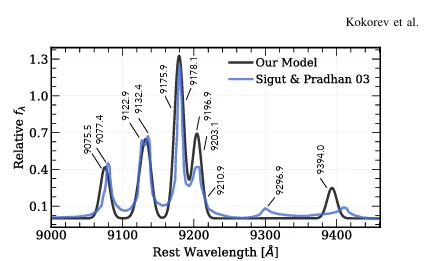
Iron is the problem child of this field. An international effort ran for years simply to work out how its atoms behave well enough to make predictions like this one. That such a prediction now lands, line by line, on an object nobody had discovered yet is the sort of thing that makes astronomers sit up.
It was never dust
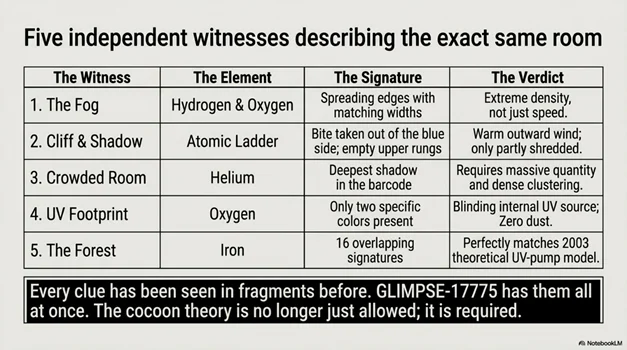
Remember the dust measurement from witness four. There is essentially none.
This matters more than it sounds, because it demolishes the intuitive explanation for why these things are red. We assumed a veil — dust in the way, reddening the light the way it reddens a sunset.
There is no veil.
These objects are genuinely red. The color isn’t a filter laid over the light. It’s what the light became after being churned through a thick, warm cocoon of gas. The gas isn’t obscuring the object. The gas is doing the writing.
And the shape confirms it. The faint outer fuzz is a galaxy, thousands of light-years across. The blazing part, the part that dominates once you look in the redder colors, is so small that even Webb cannot resolve it — it’s a point. A whole galaxy, and inside it, something tiny that outshines the lot.
What actually makes this one special
It’s worth being precise, because it would be easy to oversell.
This is not the first black hole star anyone has proposed. It is not the earliest one found — its light left when the universe was young, but others have been spotted from far closer to the beginning. Its light-cliff isn’t even the sharpest on record; several other objects have steeper ones.
Every single one of the five clues had been seen before, on its own, in some other little red dot.
What makes GLIMPSE-17775 matter is that all five turned up together, in one object, clearly enough to be trusted at once. None of the previous little red dots had all the pieces of evidence in the same place. That’s the difference between five arguments about five different objects and five independent witnesses describing the same room.
Five witnesses. One room. A dense, warm, half-shredded cocoon of gas, wrapped around a black hole feeding faster than it should be able to.
If cocoons like this turn out to be common rather than freakish, then this violent, wrapped-up, faster-than-the-limit feeding may be how black holes grew up in the early universe — not a curiosity, but the standard route.
Where our research comes in: black holes came first
Readers who have followed this thread will recognize the shape of the finding.
For more than thirty years, ISF founder and principal investigator Nassim Haramein has argued for a picture of the cosmos that runs opposite to the conventional one, and the argument has two parts.
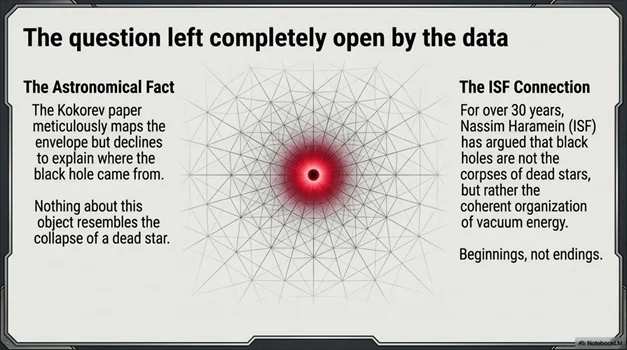
First: black holes are not the corpses of dead stars. The standard story has a big star running out of fuel, collapsing under its own weight, and leaving a black hole behind — black holes as endings. In Haramein’s framework they are beginnings. They arise directly out of the structure of space itself, from the restless energy that fills what we mistakenly call empty vacuum, when that energy organizes itself into coherent order.
Second: once one exists, everything else assembles around it. Gas and matter gather, organize, and settle into structure around a core that was already there. The core comes first. What we then name and classify — a particle, a star, a galaxy — is the envelope that grew around it.
And crucially, Haramein has never restricted this to one size of object. The prediction runs the entire span of nature: quantum-scale black holes at the hearts of subatomic particles, on up through stars, on up through galaxies, and finally to the universe itself, which on this reading satisfies the conditions of a black hole. Plot mass against size for organized matter at every scale and the same relationship keeps reappearing — a universal scaling law. Same architecture, over and over, from the proton to the cosmos.
That is what makes this new result a direct hit rather than a loose parallel.
The heart of a galaxy is one of the rungs on that ladder — one of the scales the model has always explicitly named. And what Kokorev’s team has now characterized in extraordinary detail is exactly the predicted architecture: a compact core, wrapped in an envelope of matter organized around it, with the envelope’s glow governed by the core at its center. Right down to the detail that gives these objects their name — the envelope’s light reads as star-like, because that is what happens when matter organizes itself around a compact core.
The mainstream is moving
For most of the past thirty years, Haramein’s was a lonely position. The textbook account was settled: black holes are what massive stars leave behind. Anything else was a curiosity in the back pages.
That is changing quickly.
The idea that some black holes were never stars has been in the literature since the early 1970s, when Stephen Hawking and Bernard Carr worked out that the chaotic first moments after the Big Bang could have squeezed black holes directly into existence [14] (see our article Is The Sun a Black Hole for more on the Carr-Hawking primordial black hole and Carr’s recent work on Observational Evidence for Primordial Black Holes). For fifty years it stayed a footnote — mathematically respectable, observationally untested, professionally unfashionable.
Then the gravitational wave detectors found something that shouldn’t be there.
LIGO listens for the faint tremor in space produced when two black holes collide. After a decade and hundreds of detections, it has now picked up a signal from a black hole that appears to be too small — below the minimum size a collapsing star is capable of producing. Whatever it is, it is not the corpse of a star.
The reaction has been telling. This is no longer a fringe conversation. PBS Space Time — mainstream, careful, aimed squarely at the general public — has run an episode on it under the title We Thought All Black Holes Came From Stars. We May Have Been Wrong [15]. When the popular science establishment starts making explainers, an idea has arrived.
The explanation now on the table is the Hawking and Carr one: patches of the infant universe that happened to be denser than their surroundings, collapsing under their own weight in the first fraction of a second. Fifty years old, mathematically solid, and now with something real to point at.
ISF’s position is not an alternative to this. It sits underneath it.
Notice what the standard account quietly takes for granted. It begins with a universe that is already lumpy — already carrying faint variations in density, some patches slightly fuller than others. Every one of those early black holes has to start from one of those lumps. But where did the lumps come from? Conventional cosmology hands that question off to the opening instants and to the theory of inflation, and there it largely rests.
Haramein’s answer is that the structure was inherited.
In his account the Big Bang was not a beginning from nothing. It issued from a black hole that already existed — and a black hole is not featureless. It has organization, orientation, a definite architecture. A universe emerging from one does not start out as a smooth blank. It starts out already carrying the imprint of that structure, and that imprint is what sets up regions of exceptionally high coherence in the fabric of space.
Those regions are the lumps. They are where the earliest black holes formed.
The nearest everyday comparison is a seed crystal. Drop one into the right solution and structure spreads outward from it, following the pattern of the original. Nothing gets added — the material was there all along, waiting for something to organize around. What the seed supplies is not substance but form.
So the two accounts describe different links in a single chain. Carr and Hawking worked out what happens once a dense patch exists. Haramein is addressing the step before: why there was anything for gravity to work with in the first place.
And this is not the only place the evidence points the same way.
Webb has spent three years finding things at cosmic dawn that ought not to be there yet — not only the little red dots, but galaxies that look substantially assembled at an age when, on the conventional timetable, they should barely have started. Black holes appear to have been present early, and present in force, at a moment when there had scarcely been time for generations of stars to live and die and leave remnants behind.
Two independent lines of evidence, arriving from opposite directions. One object too small to be a dead star. A whole population too developed, too early, to have been built out of dead stars. Neither on its own tells you the mechanism. Together they close off the same answer: not stellar collapse.
That much the observations now carry on their own. Where the structure itself came from — whether the universe inherited its architecture from a black hole that preceded it — is a larger question, and one no telescope has yet been pointed at. It is the question ISF’s work has been aimed at for thirty years, and the thing worth noticing is that the field has arrived at its doorstep from an entirely different direction.
For fifty years, black holes before stars was a footnote. It is now on the whiteboard.
What happens next
The team is candid about what they couldn’t do.
Look more finely. There are hints that the inner cocoon is streaming outward while the outer gas sits still — a wind blowing off the engine. Confirming that needs a sharper setting on Webb’s instruments than this observation used.
Do this again, further back. GLIMPSE-17775 came with a rare combination of advantages: a bright object, a gravitational magnifying glass, and a very generous slice of telescope time. Pulling off the same five-witness case on something from much closer to the beginning of time is the real test.
Count them. One object is one object. Working out how these five signatures shift with brightness and distance is what will settle whether this was the standard way black holes grew in the young universe, or just one way among several.
The team has released their data publicly, which deserves a mention. Anyone can check their work.
One speck, five clues
For three years the little red dots have been a running argument about what the young universe was busy doing. Ancient stars, or dust, or black holes — and if black holes, then black holes too big to be believed.
This one object doesn’t settle the argument for all of them. It does something narrower and more valuable. It shows, with a thoroughness nobody has managed before, that the cocoon picture isn’t merely allowed by the evidence. Five independent lines of evidence require it.
A compact core. An envelope so dense that light has to fight its way out. And a glow that reads as star-like, because the gas — not the star — is doing the writing.
The architecture is there, plainly, at the heart of a distant galaxy.
The question left over is the one the paper never asks. Where did that core come from?
References
[1] V. Kokorev, J. Chisholm, R. P. Naidu, S. Fujimoto, H. Atek, G. Brammer, et al., “The Deepest GLIMPSE of a Dense Gas Cocoon Enshrouding a Little Red Dot,” The Astrophysical Journal, vol. 1004, no. 2, p. 153, Jun. 2026. doi: 10.3847/1538-4357/ae4ed7
[2] M. Boylan-Kolchin, “Stress testing ΛCDM with high-redshift galaxy candidates,” Nature Astronomy, vol. 7, p. 731, 2023. doi: 10.1038/s41550-023-01937-7
[3] I. Labbé, P. van Dokkum, E. Nelson, et al., “A population of red candidate massive galaxies ~600 Myr after the Big Bang,” Nature, vol. 616, p. 266, 2023. doi: 10.1038/s41586-023-05786-2
[4] T. A. A. Sigut and A. K. Pradhan, “Predicted Fe II Emission-Line Strengths from Active Galactic Nuclei,” The Astrophysical Journal Supplement Series, vol. 145, p. 15, 2003. doi: 10.1086/345498
[5] A. de Graaff, H.-W. Rix, R. P. Naidu, I. Labbé, B. Wang, J. Leja, J. Matthee, et al., “A remarkable ruby: Absorption in dense gas, rather than evolved stars, drives the extreme Balmer break of a little red dot at z = 3.5,” Astronomy & Astrophysics, vol. 701, p. A168, 2025. doi: 10.1051/0004-6361/202554681
[6] R. P. Naidu, J. Matthee, H. Katz, et al., “A Black Hole Star Unveils the Remarkable Nature of Little Red Dots,” arXiv:2503.16596, 2025. doi: 10.48550/arXiv.2503.16596
[7] K. Inayoshi and R. Maiolino, “Extremely Dense Gas around Little Red Dots and High-redshift Active Galactic Nuclei,” The Astrophysical Journal Letters, vol. 980, p. L27, 2025. doi: 10.3847/2041-8213/adaebd
[8] N. Haramein, O. Alirol, and C. Guermonprez, “Extending Einstein-Rosen’s Geometric Vision: Vacuum Fluctuations-Induced Curvature as the Source of Mass, Gravity and Nuclear Confinement,” Preprints, 2025091835, Sep. 2025. doi: 10.20944/preprints202509.1835.v1
[9] N. Haramein, E. A. Rauscher, and M. Hyson, “Scale Unification: A Universal Scaling Law for Organized Matter,” Proceedings of the Unified Theories Conference, 2008. ISBN 9780967868776.
[10] N. Haramein, “The Schwarzschild Proton,” AIP Conference Proceedings, CP 1303, pp. 95–100, 2010.
[11] N. Haramein and E. A. Rauscher, “Collective Coherent Oscillation Plasma Modes in Surrounding Media of Black Holes and Vacuum Structure — Quantum Processes with Considerations of Spacetime Torque and Coriolis Forces,” in Beyond the Standard Model: Searching for Unity in Physics, Orinda, 2005, pp. 279–331.
[12] E. P. Bellinger and M. E. Caplan, “The Sun’s Dark Core: Helioseismic and Neutrino Flux Constraints on a Compact Solar Center,” The Astrophysical Journal, vol. 988, no. 2, p. 212, Jul. 2025. doi: 10.3847/1538-4357/ade70f
[13] V. Rusakov, D. Watson, G. P. Nikopoulos, et al., Nature, vol. 649, p. 574, 2026.
[14] B. J. Carr and S. W. Hawking, “Black Holes in the Early Universe,” Monthly Notices of the Royal Astronomical Society, vol. 168, no. 2, pp. 399–415, Aug. 1974, doi: 10.1093/mnras/168.2.399.
[15] M. O’Dowd, “We Thought All Black Holes Came From Stars. We May Have Been Wrong,” PBS Space Time, Season 11, Episode 33, 2026. Available: https://www.youtube.com/watch?v=I07RBedXRYA