


By using this site, you agree to the Privacy Policy.
Accept
The International Space Federation (ISF)The International Space Federation (ISF)The International Space Federation (ISF)
  • Science News
    • All Articles
    • Physics
    • Astronomy
    • Biology
    • Technology
    • Other
  • Research
    • Research Papers
    • Physicists Testimonials
  • Technology
  • About
    • About us
  • ISF News
  • Events
    • Events
  • Get Involved
    • Invest
    • Donate – Zero Point Foundation
  • Careers
  • Contact Us
Reading: Quantum Coherence Underlying Magnetoreception in Avian Species
Share
The International Space Federation (ISF)The International Space Federation (ISF)
Search
  • Science News
    • Physics
    • Astronomy
    • Biology
    • Technology
  • Research Papers
    • Physicists Testimonials
  • About
    • ISF News
  • Events
  • Get involved
    • Invest
  • Translations
    online pharmacy https://worldneurologyonline.com/ no prescription pharmacy
Follow US
© 2022 International Space Federation. All Rights Reserved.
The International Space Federation (ISF) / Explore / Biology / Quantum Coherence Underlying Magnetoreception in Avian Species
Biology

Quantum Coherence Underlying Magnetoreception in Avian Species

Birds possess one of nature's most remarkable navigation systems - an ability to detect and use Earth's magnetic field for orientation and navigation. Recent breakthrough studies have demonstrated not only that birds can sense magnetic fields through two distinct mechanisms, but more remarkably, that they integrate this information into a sophisticated neural network for precise navigation. Through careful experimental design and advanced molecular techniques, researchers have shown that birds use light-sensitive proteins in their eyes to detect magnetic field direction, while a separate system likely based in their beaks detects magnetic field intensity. This achievement has profound implications for our understanding of animal navigation, sensory biology, and quantum biology. The ability to sense quantum-level effects in biological systems opens new possibilities for understanding how nature has evolved to detect and utilize fundamental physical forces.

Dr. William Brown
Last updated: 2024/12/04 at 12:00 PM
Dr. William Brown
Share
10 Min Read
SHARE

The Magnetic Compass System

It has long been recognized that birds possess a magnetic compass, but its true nature proved surprisingly complex. What’s more, this compass operates in a fundamentally different way than our technological compasses, detecting the angle of magnetic field lines rather than their polarity. This remarkable system, called an inclination compass, allows birds to distinguish “poleward” where magnetic field lines point downward from “equatorward” where they point upward.

The theoretical foundations for understanding this biological compass were laid in the 1970s when researchers first demonstrated that European robins use magnetic fields for orientation. However, it wasn’t until the early 2000s that scientists began understanding the quantum mechanical basis of this sense.
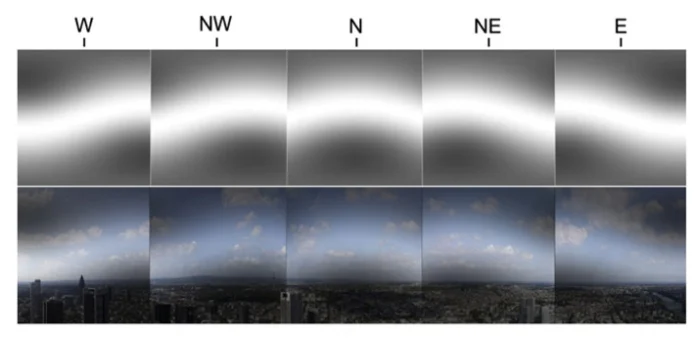
The compass requires light to function, specifically wavelengths from ultraviolet to green (about 565 nm). Under yellow or red light, birds become disoriented. This crucial discovery pointed researchers toward a light-dependent quantum mechanism called the radical pair model. When specific proteins called cryptochromes absorb photons of light, they form pairs of molecules with unpaired electrons (radicals). The ratio between different spin states of these radical pairs depends on their orientation in the magnetic field, creating a pattern of activation across the retina that birds can use to detect magnetic directions.

Early theoretical work focused on understanding the fundamental aspects of this quantum biological compass. Researchers identified several types of cryptochrome proteins in bird eyes, with one variant called Cry1a emerging as the most likely primary magnetic sensor. Located in specialized UV/violet-sensitive cone cells distributed across the retina, these proteins are perfectly positioned to create the theoretical activation pattern that could indicate magnetic directions.
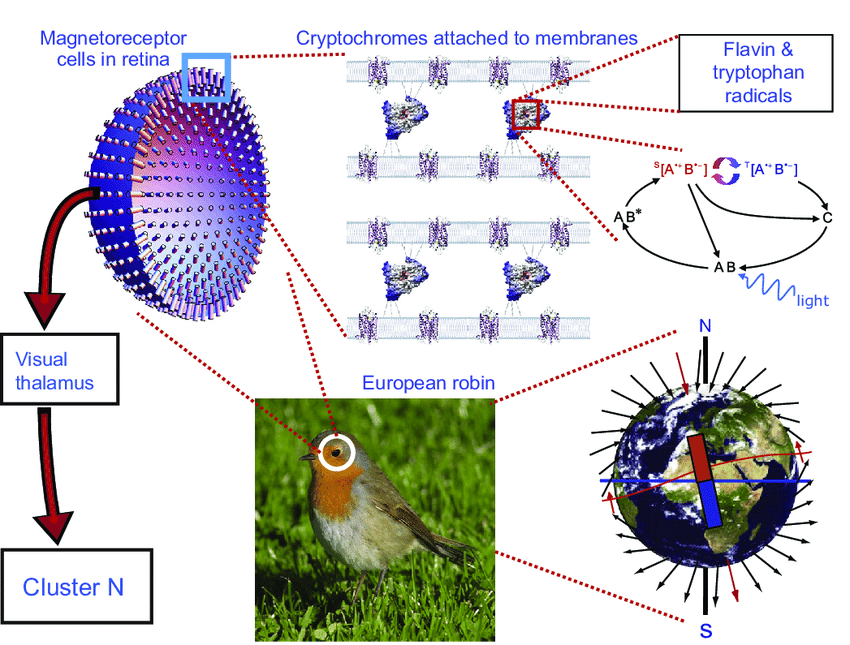
Summary of the proposed light-dependent magnetic compass sensing hypothesis in birds (Photo © Henrik Mouritsen). The reference direction provided by the Earth’s magnetic field is detected in the birds’ eyes, where cryptochrome proteins are the most likely light-dependent magnetic sensory molecules. Light absorption is thought to generate long-lived flavin-tryptophan radical pairs within cryptochromes in the retina, the reaction yields of which are determined by the orientation of the molecule with respect to the geomagnetic field vector. If the cryptochromes were associated e.g. with the membrane disks of the outer segments of the photoreceptors, then an ordered structure could result, and different reaction yields in different parts of the retina could be compared to provide a visual impression of the compass bearing. Light-dependent magnetic compass information is transmitted from the retina through the optic nerve to the visual thalamus and from there to Cluster N in the forebrain via the thalamofugal visual pathway. If Cluster N is destroyed, European robins can no longer use their magnetic compass. Image and image description from- https://www.researchgate.net/publication/279446083_Magnetoreception_in_Birds_and_Its_Use_for_Long-Distance_Migration

A significant development came with the discovery that this magnetic compass is primarily processed through the right eye and left brain hemisphere in adult birds. Young birds initially use both eyes for magnetic orientation, but develop this right-eye preference between their first autumn and spring migrations. This lateralization appears somewhat flexible at first but becomes firmly established with experience.

Recent work has continued to expand our understanding of the magnetic compass. Studies using radio frequency fields that specifically disrupt radical pair processes have provided strong evidence for the quantum mechanism. When exposed to the proper frequencies, birds become disoriented even though the magnetic field itself remains unchanged.

The radical pair compass offers several remarkable features:

  • It detects the angle but not polarity of magnetic field lines
  • It requires short-wavelength light to function
  • It is calibrated to the local magnetic field intensity
  • It achieves surprising precision of about 3-5 degrees

Implementation of the Magnetic Map System

In previous articles we have explored how animals generate neuronal maps for successful navigation (New Study Describes Invariance of the Correlation Structure of Grid Cell Modules in a Manifold with Toroidal Topology), but birds present a particularly sophisticated case by combining their magnetic compass with a magnetic “map” sense. This map sense appears to detect subtle variations in magnetic field intensity that could help birds determine their position.

This magnetic map sense manifests through a completely different mechanism than the compass – one based on magnetic particles called magnetite. Of particular relevance to recent experimental breakthroughs is the discovery that this information travels through the trigeminal nerve, specifically its ophthalmic branch that innervates the beak region.

A newly identified trigeminal brain pathway in a night-migratory bird could be dedicated to transmitting magnetic map information

The magnetic map sense shows several key differences from the compass:

  • It does not require light
  • It can be disrupted by strong magnetic pulses
  • It appears to measure absolute intensity rather than field direction
  • It achieves remarkable sensitivity of about 20 nanotesla

Location of Magnetite-Based Receptors

While the existence of this magnetic map sense is well established through behavioral and neurological studies, the exact location of the receptors remains controversial. Early studies identified promising magnetite-containing structures in the upper beak, but later work questioned these findings. Current evidence still points to receptors in the beak region, but their precise nature and structure remain unclear.
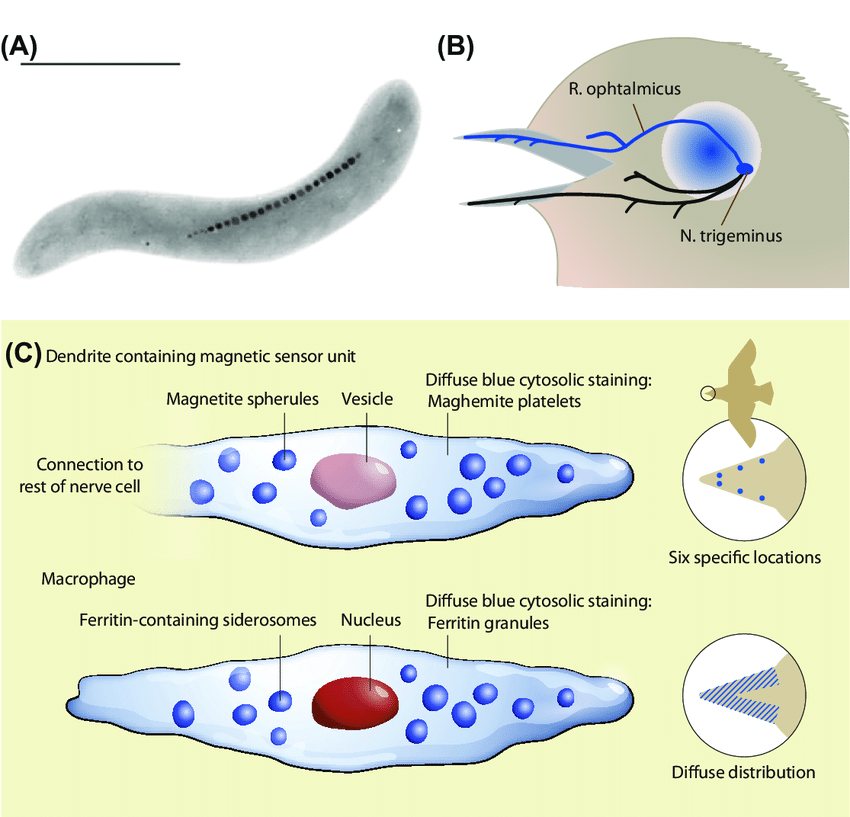
Iron-mineral structures in birds. (A) Transmission electron micrograph of the magnetotactic bacteria, Magnetospirillum magnetotacticum, showing the magnetosome chain inside of the cell. Scale bar: 1 μm (Photograph © Richard B. Frankel). Magnetosomes would be the most straightforward solution for a magnetic field sensor in the nervous system of a bird, but, so far, magnetosomes have not been proven to occur in any bird. (B) Bird head schematically illustrating the anatomical location of the three branches of the trigeminal nerve. (C) Schematic drawing of iron mineral-containing structures in birds’ upper beak illustrating the opposing interpretations of potential locations. Image and image description from- https://www.researchgate.net/publication/279446083_Magnetoreception_in_Birds_and_Its_Use_for_Long-Distance_Migration

The search for these receptors has revealed several important clues:

  • They appear to use superparamagnetic magnetite particles
  • They are innervated by the ophthalmic branch of the trigeminal nerve
  • They can be temporarily disrupted by strong magnetic pulses
  • They recover from disruption within about 10 days

Neural Processing of Magnetic Information

A final breakthrough we will examine is how birds process and integrate magnetic information in their brains. This research has revealed that magnetic compass information from the eyes travels through the visual system, while magnetic intensity information from the putative beak receptors travels through the trigeminal system.

The compass information appears to be processed in several visual areas, including a region called “cluster N” that shows high activity during magnetic orientation in night-migrating birds. However, the exact way that magnetic information is extracted from the quantum compass mechanism and converted into neural signals remains unclear.

Magnetic intensity information travels through the trigeminal nerve to processing centers in the brainstem. About 15-20% of neurons in this pathway respond to changes in magnetic field intensity, providing a potential mechanism for magnetic map navigation.

This dual-pathway system allows birds to:

  • Detect both magnetic direction and intensity
  • Process compass and map information separately
  • Integrate magnetic cues with other navigational information
  • Achieve remarkable navigational precision

Highlights

The successful demonstration of two distinct magnetic sensing systems in birds represents a significant milestone in our understanding of animal navigation. While previous studies had shown that birds could use magnetic fields, we now understand the quantum mechanical and biophysical mechanisms underlying this remarkable ability.

The magnetic compass system demonstrates that nature has evolved to detect and utilize quantum effects, opening new possibilities for understanding quantum biology. Meanwhile, the magnetic map sense shows how evolution has also engineered sophisticated magnetic field detectors using specialized biominerals.

These magnetic senses are likely only part of a redundant navigational system that also includes visual, olfactory, and other cues. However, they provide crucial information that allows birds to achieve their remarkable navigational feats.

The discoveries about bird magnetoreception raise intriguing questions about the evolution of sensory systems and the possible existence of similar mechanisms in other species. While birds appear unique in their specific implementation, the principles revealed by studying their magnetic senses may help us understand magnetic sensitivity across the animal kingdom.
References

[1] R. Wiltschko and W. Wiltschko, “Magnetoreception in birds,” Journal of The Royal Society Interface, vol. 16, no. 158, p. 20190295, Sep. 2019, doi: 10.1098/rsif.2019.0295.

Sign Up For Daily Newsletter

Be keep up! Get the latest breaking news delivered straight to your inbox.
loader

loader

loader

By signing up, you acknowledge the data practices in our Privacy Policy. You may unsubscribe at any time.
En vous inscrivant, vous reconnaissez les pratiques en matière de données dans notre politique de confidentialité. Vous pouvez vous désinscrire à n'importe quel moment.
Al registrarse, reconoce las prácticas de datos en nuestra política de privacidad. Puedes darte de baja en cualquier momento.
Share This Article
Facebook Twitter Copy Link Print
By Dr. William Brown
William Brown is a biophysicist, investigating the physics operational at the cellular and molecular level of the biological system. He presents lectures (Unified Science Review), talks, and Q&A forums to teach the syncretic theories of unified science. He is a part of the research team at The International Space Federation where he applies his extensive knowledge of cellular and molecular biology to an exploration of the biological system from a unified physics perspective; developing an understanding of life from the most fundamental level.
Previous Article Dark Matter ‘Missing’ in a Galaxy Far, Far Away
Next Article Prediction of Giant Vortex in Liquid Light!

Stay Connected

981k Like
18.7k Follow
7.7k Follow
7.3k Subscribe

Categories

  • Astronomy106
  • Biology69
  • ISF News25
  • ISF Research14
  • Other22
  • Physics168
  • Technology36

You Might also Like

Biology

Quantum Spin Controls Microtubule Assembly, Study Finds

20. May 2026.
Biology

Cognition Without Brains: How Memory Emerges in Polymers, Cells, and Spacetime.

23. March 2026.
Biology

Where Biology Meets Resonance: Light, Vibration, and Living Order

19. February 2026.
BiologyPhysics

Do Cells Use a Quantum Compass to Heal Wounds?

2. December 2025.
The International Space Federation (ISF)The International Space Federation (ISF)

Harnessing quantum vacuum energy for sustainable solutions – a unified approach to science, technology and education.

Quick links

  • About
  • Research Papers
  • Events
  • Invest

Explore

  • ISF Research
  • Physics
  • Technology
  • Astronomy
  • Biology
  • ISF News

Sign Up for Our Newsletter

Subscribe to our newsletter to get our newest articles instantly!

loader

Follow US
© 2023 International Space Federation. All Rights Reserved. INTERNATIONAL SPACE FEDERATION is a trademark of ISFS SA. The mark is registered in the United States under Registration No. 7772313. The ®️ symbol is used exclusively in the U.S.
  • Press
  • Careers
  • Privacy policy
  • Carrieres
  • Presse
  • Prensa
Join Us!

Subscribe to our newsletter and never miss our latest news.

loader

Welcome Back!

Sign in to your account

Lost your password?