

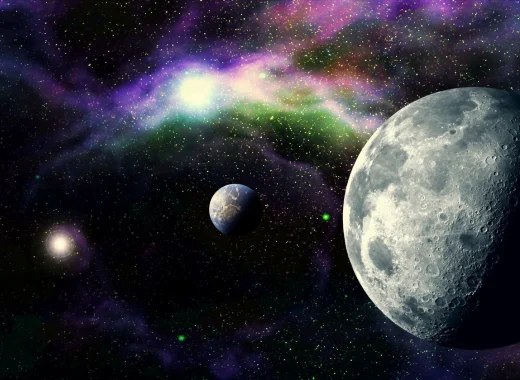
featured image credit: Jack O’Malley-James/Cornell University: The intense radiation environments around nearby M stars could favor habitable worlds resembling younger versions of Earth.
A primary prediction of the USN model as presented in the Unified Spacememory Network publication by physicist Nassim Haramein, astrophysicist Amira Val Baker, and biologist William Brown is that the prebiotic chemistry that generates organic compounds and even complex biomolecules is occurring in nebulae throughout galaxies—a postulation that is termed universal biogenesis. Under this model, the precursors to cellular biology are abundant throughout the galactic medium, and therefore there is a very high likelihood that wherever conditions are hospitable to organisms, life will take hold there.
Proxima Centauri b: A Prime Candidate for Habitability
Considering the implications of universal biogenesis, it was very exciting when an Earth-like planet was discovered within the habitable zone of our closest stellar neighbor, the red dwarf star (M type star) α Centauri C (Proxima Centuari) in the triple star system Alpha Centauri. Although this system is 4.37 light years away from our solar system (Proxima Centauri is the closest of the trio and the nearest star to our own, at about 4.2 light years), it is close enough that we currently have the technological capability to feasibly send a probe to the planet Proxima Centauri b.

Proxima Centauri b is not the only Earth-like exoplanet to have been found, indeed there are a wealth of such systems: there are currently about fifty known exoplanets whose diameters range from Mars-sized to several times the Earth’s and which also reside within their stars’ habitable zone –these exoplanets are currently our best candidates for hosting life. Many of these exoplanets are found around red dwarf stars (because it is easier to detect planets around this class of stars), and for some astrobiologists this is problematic for the potential habitability of such planets.
Habitability Challenges of M-Class Stars
M class stars are stable for hundreds of billions of years—plenty of time for life to develop and evolve—however, there are several factors that throw into question whether these worlds will be suitable for the long-term habitation of organisms. To be within the habitable zone, the planets must be much closer to the red dwarf star as compared to higher-temperature stars like our sun. This means there is a high likelihood that the planets are orbitally-locked, so that only one face of the planet is perpetually oriented towards the star—just like our moon. Such tidal locking occurs when the orbital period matches the rotational period of a body. A tidally-locked planet will have one side that is baking hot, and another side that is freezing cold. However, there may be a perpetual habitable zone along the circumference of the planet in-between these two extremes.
What’s more, low mass red dwarf stars emit solar flares much more often than stars like our sun. Solar flares carry high loads of radiation to nearby planets, and red dwarf exoplanets in the habitable zone are very nearby. This has led some to speculate that the protective atmospheres of these planets will have long-ago been obliterated and the surface will have frequent exposure to high solar radiation levels—a situation that is considered largely inhospitable to most life-forms.
Does this mean that such exoplanets are poor candidates for the investigation of biosignatures and extra-solar life? Astrophysicists Lisa Kaltenegger and Jack O’Malley-James have conducted a study that suggests otherwise. In their publication: Lessons from early Earth: UV surface radiation should not limit the habitability of active M star systems; they calculate that exoplanets such as Proxima Centauri b actually experience lower radiation levels than those that were present on the early Earth, an epoch that saw the rise of life and the formation of a biosphere on Earth. Obviously then, there are some forms of life, like unicellular extremophiles, that can not only survive such conditions, but can thrive in them. These early colonists will veritably terraform a planet, increasing the hospitability of the planet for life-forms that we are more familiar with, which require a strong ozone layer and atmosphere to block high radiation levels and regulate surface temperatures.
O’Malley-James and Kaltenegger ran a similar analysis for three other Earth-like exoplanets that are closest to our solar system: TRAPPIST-1e, Ross-128b, and LHS-114ob:
At 3.4 parsec from the Sun, the planet Ross 128b, with a minimum mass of about 1.4 Earth masses, orbits in the HZ of its cool, inactive M4V dwarf star. The TRAPPIST-1 planetary system of seven transiting Earth-sized planets around a cool, moderately active M8V dwarf star, which has several (three to four) Earth-sized planets in its HZ, is only about 12 parsec from the Sun. The planet LHS 1140b orbits in the HZ of its cool, likely inactive M4.5V dwarf star, with a measured rocky composition based on its radius of 1.4 Earth radii and mass of 6.7 Earth masses. These four planetary systems already provide an intriguing set of close-by potentially habitable worlds for the search for life beyond our own Solar system.
While the compositions of the atmospheres of our nearest habitable exoplanets are currently unknown; the study shows that if the atmospheres of these worlds resemble the composition of Earth’s atmosphere through geological time, UV surface radiation would not be a limiting factor to the ability of these planets to host life. Even for planets with eroded or anoxic atmospheres orbiting active, flaring M stars the surface UV radiation in the researcher’s models remains below that of the early Earth for all cases modelled. Therefore, rather than ruling these worlds out in the search for life, they provide an intriguing environment for the search for life and even for searching for alternative biosignatures that could exist under high-UV surface conditions.
Article: https://news.cornell.edu/stories/2019/04/study-nearest-exoplanets-could-host-life