


What is a Fractal?
It is common to find naturally occurring macroscopic biological structures such as the branches of a tree, a Romanesco broccoli, or blood vessels, that can be described through fractal geometry.
Fractals are defined mainly by three characteristics [1]:
- Self-similarity: identical or very similar shapes and forms at all scales.
- Iteration: a recursive relationship limited only by computer capacity. With sufficiently high performance, the iterations could be infinite. This allows for very detailed shapes at every scale, that modify with respect to the first iteration, manifesting the original shape at some levels of iteration. Because of this, fractals may have emergent properties, which make them a suitable tool for complex systems.
- Fractal dimension, or fractional dimensions: describes the counter-intuitive notion that a measured length changes with the length of the measuring stick used; it quantifies how the number of scaled measuring sticks required to measure, for example, a coastline, changes with the scale applied to the stick.

Fractals at microscopic scale
Despite the extraordinary diversity of biomolecular assemblies known to science, naturally occurring fractals are not easy to find at the quantum scale. One of the first discoveries of fractal behavior at quantum scale was reported in our article Fractal Pattern in a Quantum Material Confirmed for the First Time where physicists at MIT had discovered fractal-like patterns in the magnetic domains of the quantum material neodymium nickel oxide or NdNiO3, a rare earth nickelate that conduces electricity or acts as an insulator, depending on its temperature.
Now, an international team of researchers led by groups from the Max Planck Institute in Marburg and Phillips University in Marburg report the discovery of a natural metabolic enzyme -a microbial enzyme citrate synthase (CS) from a cyanobacterium— capable of forming Sierpiński triangles in dilute aqueous solution at room temperature [2]. They determined the structure, the assembly mechanism, and its regulation of enzymatic activity in vitro to finally understand how the citrate synthase fractal assembles from a hexameric building block, i.e., how it evolved from non-fractal precursors. This is the first regular molecular arrangement found in nature that spontaneously assembles into a regular fractal pattern. The pattern is known as the Sierpiński triangle; an infinitely repeating series of triangles made up of smaller triangles.
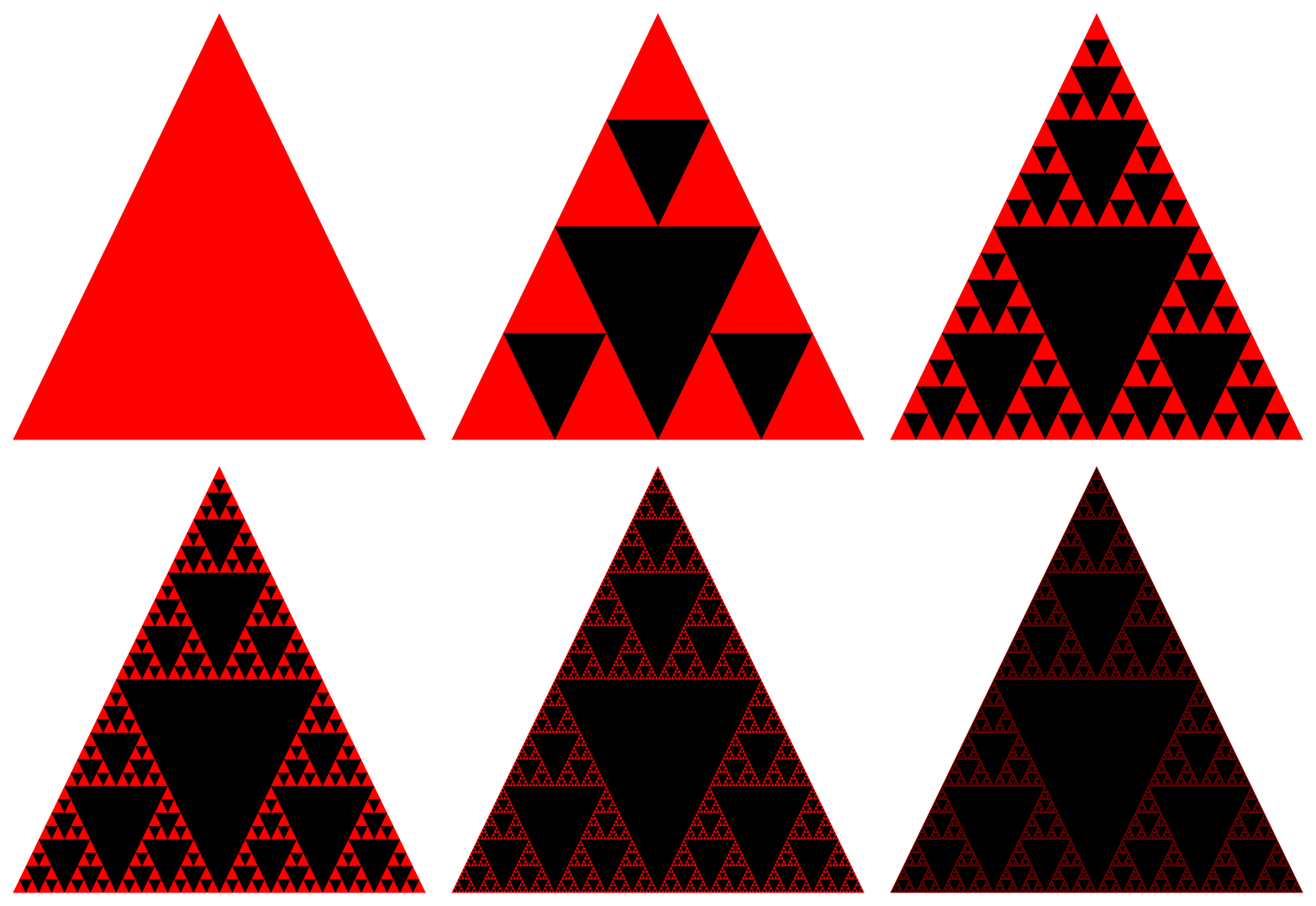
Mathematically, the Sierpiński triangle can be created by triangular subdivision. In the example below the iterations appear as black opposite triangles. The first iteration is the first inverted black triangle in the center, that divides the main red triangle into three smaller red triangles, then the second iteration performs the same on each red triangle, which will become three smaller red triangles in the third iteration, and so on:
How does fractal geometry appear naturally in a biological quantum system?
Fractal algorithms are difficult to translate into molecular self-assembly. For instance, the Sierpiński triangle can be created by triangular subdivision, in a rather “top-to-bottom” approach. Meanwhile, self-assembly of biomolecules occurs through the sequential addition of subunits rather than by subdivision, in a sort of “bottom to top” approach, and therefore relies on local interactions between protomers to coordinate assembly.
As explained by the authors of the study, CS enzymatic proteins can assemble into dimers and hexamers. Mass photometry (MP) analyses of the purified enzyme at nanomolar concentrations showed that CS from the cyanobacterium S. elongatus PCC 7942 (SeCS) forms an unusual assembly that reveals a complex comprising 18 CS subunits. The cartoons in the image below represent the assembly of known CS proteins.

Figure 1: Extract of Figure 1 CS of S. elongatus PCC 7942 assembles into Sierpiński triangles [from Emergence of fractal geometries in the evolution of a metabolic enzyme]
The experiment was conducted by starting at the highest concentration and then serially diluting the protein, therefore larger assemblies are reversible. One sample for each concentration step was measured over ten frames.
As seen in Fig 1, the 18mer contains 9 discernible densities, each corresponding to a dimer. Three dimers are first arranged in a hexameric ring (dashed square) and three hexamers then connect into a triangle. This 18mer represented the main oligomeric species (composed of more than one subunit) under MP conditions. The 54mer consisted of three 18mers arranged into an even larger triangle with a large void at its center. The 6mer, 18mer and 54mer represent the zeroth, first and second order of the Sierpiński triangle. Although the 36mer is not a fractal structure, it represents another kind of triangle that shares the 6mer building block and preserves the triangular shape overall.
To validate that the 18mer and the 54mer assemblies are fractal geometries, the authors of this study estimated their Hausdorff dimension D through a linear regression (in log scale), which for non-fractal shapes, takes an integer value (D = 2 for a square, D = 3 for a cube, and so on), whereas for fractals, it is non-integer. Different fractals have their specific characteristic D values. The box-counting method used produced non-integer values that closely corresponded to the calculated fractal dimension of the Sierpiński triangle, obtaining the following values: D18mer = 1.53 ± 0.02, D54mer = 1.67 ± 0.02, DSierpiński = 1.59, as seen in Figure 2 below.

Figure 2: Hausdorff dimension D. Extract from Fig 2 in [2] Layers of fractal assembly.
To explore whether their protein fractal could increase in size beyond 54 subunits, the authors used small-angle X-ray scattering (SAXS) measurements to assess the radius of gyration (Rg) in solution at a range of concentrations and compared their measured values to theoretical Rg values calculated for structural models of the 6mer, 18mer, and 54mer. They found that at concentrations above 100 µM (approximately 2,000 times higher than for MP measurements), the measured Rg values exceeded the size of 54mers and rapidly reached the limit of detection. These experiments indicated that the protein is capable of extended growth, as predicted for fractal assembly, although they cannot prove that the larger assemblies are Sierpiński triangles rather than some other type of assembly.

Figure 3: a, Schematic representation of the requisites needed to produce a Sierpiński fractal from hexameric blocks and the symmetry-based constraints on oligomeric assembly. Green and blue dots represent active or open interfaces, respectively. b, Cryo-EM density maps of Sierpiński triangles of the zeroth, first and second fractal level. The 6mer (3.1 Å) was derived from the hexameric Δ2–6 SeCS variant. The 18mer (3.9 Å) was derived from the wild-type (WT) SeCS. The 54mer (5.9 Å) was derived from the pH-stabilized variant H369R SeCS. Figure and caption taken from [2].
Understanding the fractal molecular assembly
To understand how the fractal forms assemble, the authors in this study used a technique known as cryo-Electron Microscopy to solve the structures for the zeroth order (6mer, 3.1 Å), first order (18mer, 3.9 Å) and second order (54mer, 5.9 Å) of the protein Sierpiński triangle, and their analysis revealed that the two dimers forming the fractal connections undergo a small clockwise rotation relative to their conformation within a free hexamer, subtly breaking the D3 symmetry of the hexameric building block within the fractal. These slight movements are known as conformational changes.
Altogether, the large number of observations performed by this study revealed a fundamental principle from which Sierpiński triangles seem to emerge: all observed assemblies seemed to minimize the number of unsatisfied fractal interfaces. As stated in the paper [2]:
- At stoichiometries for which Sierpiński triangles can be built (18, 54, 162, and so on), they are always the most efficient way to achieve this, leaving only 3 dimers at the corners of the triangle unsatisfied.
- At intermediate stoichiometries, the protein apparently populates non-fractal but still triangular assemblies, which leave more dimers partially unsatisfied in the interior of the triangle (although six 36mers could be arranged into a different type of fractal that is based on Pascal’s triangle).
The authors of this study remark that it is notable that the SeCS achieves these assemblies without the help of metal coordination or symmetrical surfaces to assemble on, which synthetic biological Sierpiński triangles usually require. Instead, the rupture of local symmetries as they assemble into higher-order structures – a feature known as conformational flexibility, present in many proteins- seems to give rise to this ability. One wonders why the hexameric building blocks of SeCS are particularly suited to constructing Sierpiński triangles when compared with other dihedral homomeric protein complexes, as there is no evident reason for it.
The study concludes that this assemblage exceptional behavior may be an evolutionary accident, as in the case of the cyanobacterium that this enzyme is found in, the authors find that whether its citrate synthase can assemble into a fractal or not, does not seem to make any difference to the bacteria.
Although it may be too soon to claim that there is no difference between both scenarios.
References
[1] David Harte, Multifractals, Chapman & Hall. pp. 3–4. ISBN 978-1-58488-154-4.
[2] Sendker, F.L., Lo, Y.K., Heimerl, T. et al. Emergence of fractal geometries in the evolution of a metabolic enzyme. Nature (2024). https://doi.org/10.1038/s41586-024-07287-2